Most of my recent generative GI experiments have centered on Google Gemini…which has its limitations:
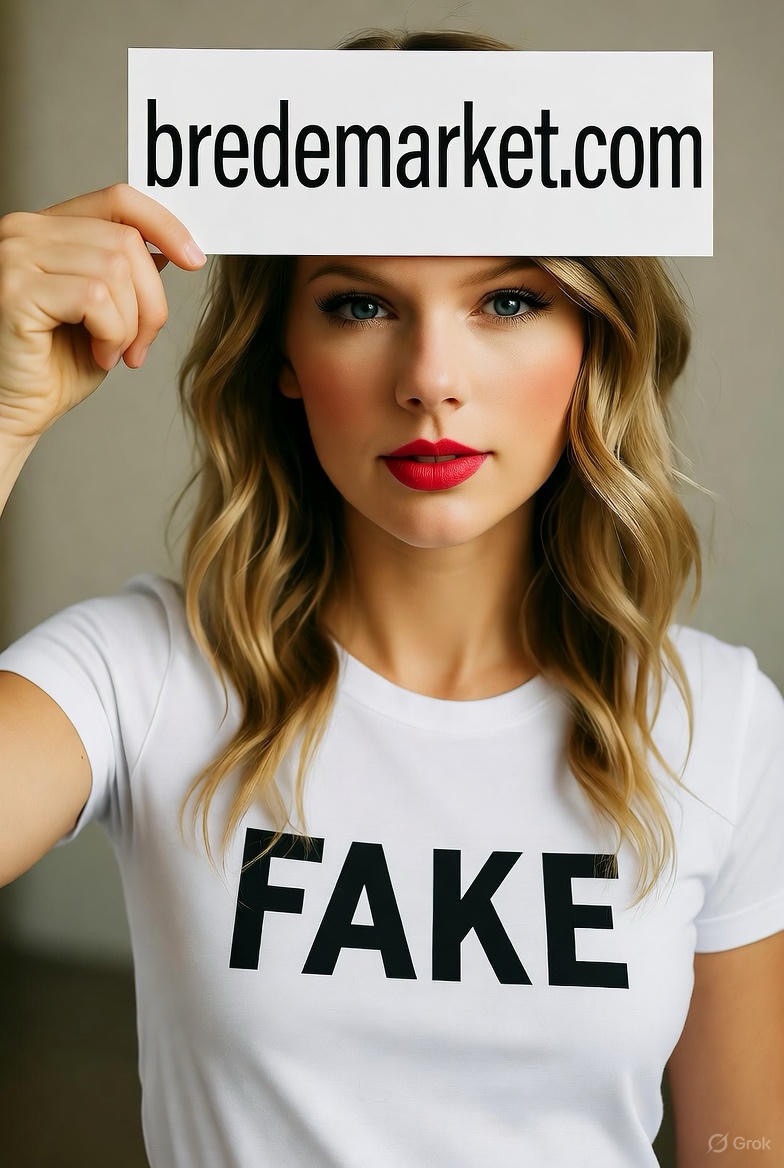
“Google Gemini imposes severe restrictions against creating pictures of famous figures. You can’t create a picture of President Taylor Swift, for example.”
Why does Google impose such limits? Because it is very sensitive to misleading the public, fearful that the average person would see such a picture and mistakenly assume that Taylor Swift IS the President. In our litigious society, perhaps this is valid.
“One common accusation about Grok is that it lacks the guardrails that other AI services have.”
During a few spare moments this morning, I signed up for a Bredemarket Grok account. I have a personal X (Twitter) account, but haven’t used it in a long time, so this was a fresh sign up.,
And you know the first thing that I tried to do.
Grok.
Grok created it with no problem. Actually, there is a problem, because Grok apparently is not a large multimodal model and cannot precisely generate text in its image generator. But hey, no one will notice “TWIRSHIITE BOUSE,” will they?
But wait, there’s more! After I generated the image, I saw a button to generate a video. I thought that this required the paid service, but apparently the free service allows limited video generation.
Grok.
I may be conducting some video experiments some time soon. But will I maintain my ethics…and my sanity?
I just posted the latest edition of my LinkedIn newsletter, “The Wildebeest Speaks.” It examines the history of deepfakes / likenesses, including the Émile Cohl animated cartoon Fantasmagorie, my own deepfake / likeness creations, and the deepfake / likeness of Sam Altman committing a burglary, authorized by Altman himself. Unfortunately, some deepfakes are NOT authorized, and that’s a problem.
Biometric marketing leaders, do your firm’s product marketing publications require the words of authority?
John E. Bredehoft of Bredemarket, the biometric product marketing expert.
Can John E. Bredehoft of Bredemarket—the biometric product marketing expert—contribute words of authority to your content, proposal, and analysis materials?
I offer:
30 years of biometric experience, 10 years of product marketing expertise, and complementary proposal and product management talents.
Success with numerous biometric firms, including Incode, IDEMIA, MorphoTrak, Motorola, Printrak, and over a dozen biometric consulting clients.
What is a drug? Here’s what the U.S. Food and Drug Administration said to Ancestral Supplements in April 2025.
“This letter is to advise you that the U.S. Food and Drug Administration (FDA) reviewed your website at http://ancestralsupplements.com in March 2025 and has found that you take orders there for Ancestral Grassfed Beef Thyroid. Various claims and statements made on your website and/or in other labeling establish that this product is a drug as defined in 21 U.S.C. § 321(g)(1)(B) because it is intended for the treatment, cure, mitigation, or prevention of disease. For example, your website recommends or suggests the use of Ancestral Grassfed Beef Thyroid to treat or prevent hypothyroidism and Grave’s disease. As explained further below, the introduction of this product into interstate commerce for such uses violates the Federal Food, Drug, and Cosmetic Act.”
A client recently asked me to perform some research. After initially performing one aspect of the research manually, I performed the second part of the research automatically using Google Gemini. I informed the client of my use of AI for the second part of the research.
This particular use case is separate from using AI for CONTENT, something I’ve been discussing for years. However, since part of Bredemarket’s services include ANALYSIS, I felt it best to disclose when someone other than me performed the analysis.
This post describes the two parts of my research (manual and automated), what I disclosed to my client, and why I disclosed it.
Part One (Manual)
My client required assistance in identifying people with a particular skill set (which I cannot disclose). To fulfill this request, I went into LinkedIn, performed some searches, read some profiles, and selected people who may possess the skills my client required.
After spending some time collecting the research, I forwarded it to the client.
Google Gemini.
Part Two (Automated)
Several hours after sending the initial research to my client, I thought about taking a separate approach to my client’s need. Rather than identifying people with this skill set, I wanted to identify COMPANIES with this skill set.
But this time, I didn’t manually perform the research. I simply created a Google Gemini prompt asking for the companies with this skill set, their website URLs, their email addresses, and their phone numbers.
“Deloitte’s member firm in Australia will pay the government a partial refund for a $290,000 report that contained alleged AI-generated errors, including references to non-existent academic research papers and a fabricated quote from a federal court judgment.”
Now in this case the refund was due to hallucinations in the AI-generated document.
But what of the fact that at least one of Deloitte’s report writers was the Deloitte equivalent of Bredebot?
Personally, I think that disclosure in this instance is required also.





 Bredemarket