Canada’s IRCC ITQ B7059-180321/B and the biometric proposals chess match

In a competitive bid process, one unshakable truth is that everything you do will be seen by your competitors. This affects what you as a bidder do…and don’t do.

My trip to Hartford for a 30 minute meeting

I saw this in action many years ago when I was the product manager for Motorola’s Omnitrak product (subsequently Printrak BIS, subsequently part of MorphoBIS, subsequently part of MBIS). Connecticut and Rhode Island went out to bid for an two-state automated fingerprint identification system (AFIS). As part of the request for proposal process, the state of Connecticut scheduled a bidders’ conference. This was well before online videoconferencing became popular, so if you wanted to attend this bidders’ conference, you had to physically go to Hartford, Connecticut.

The Mark Twain House in Hartford. For reasons explained in this post, I spent more time here than I did at the bidders’ conference itself. By Makemake, CC BY-SA 3.0, https://commons.wikimedia.org/w/index.php?curid=751488

So I flew from California to Connecticut to attend the conference, and other people from other companies made the trip. That morning I drove from my hotel to the site of the conference (encountering a traffic jam much worse than the usual traffic jams back home), and I and the competitors assembled and waited for the bidders’ conference to begin.

The state representative opened the floor up to questions from bidders.

Silence.

No one asked a question.

We were all eyeing each other, seeing what the other people were going to ask, and none of us were willing to tip our hands by asking a question ourselves.

Eventually one or two minor questions were asked, but the bidders’ conference ended relatively quickly.

There are a number of chess-like tactics related to what bidders do and don’t do during proposals. Perhaps some day I’ll write a Bredemarket Premium post on the topic and spill my secrets.

But for now, let’s just say that all of the bidders successfully kept their thoughts to themselves during that conference. And I got to visit a historical site, so the trip wasn’t a total waste.

And today, it’s refreshing to know that things don’t change.

When the list of interested suppliers appears to be null

Back on September 24, the Government of Canada issued an Invitation to Qualify (B7059-180321/B) for a future facial recognition system for immigration purposes. This was issued some time ago, but I didn’t hear about it until Biometric Update mentioned it this morning.

Now Bredemarket isn’t going to submit a response (even though section 2.3a says that I can), but Bredemarket can obviously help those companies that ARE submitting a response. I have a good idea who the possible players are, but to check things I went to the page of the List of Interested Suppliers to see if there were any interested suppliers that I missed. The facial recognition market is changing rapidly, so I wondered if some new names were popping up.

So what did I see when I visited the List of Interested Suppliers?

An invitation for me to become the FIRST listed interested supplier.

That’s right, NO ONE has publicly expressed interest in this bid.

A screen shot of https://buyandsell.gc.ca/procurement-data/tender-notice/PW-XS-002-39912/list-of-interested-suppliers as of the late morning (Pacific time) on Monday, October 11.

And yes, I also checked the French list; no names there either.

There could be one of three reasons for this:

  1. Potential bidders don’t know about the Invitation to Qualify. This is theoretically possible; after all, Biometric Update didn’t learn about the invitation until two weeks after it was issued.
  2. No one is interested in bidding on a major facial recognition program. Yeah, right.
  3. Multiple companies ARE interested in this bid, but none wants to tip its hand and let competitors know of its interest.

My money is on reason three.

Hey, bidders. I can keep your secret.

As you may have gathered, as of Monday October 11 I am not part of any team responding to this Invitation to Qualify.

If you are a biometric vendor who needs help in composing your response to IRCC ITQ B7059-180321/B before the November 3 due date, or in framing questions (yes, there are chess moves on that also), let me know.

I won’t tell anybody.

Bredemarket and September 2021 on the proposal side

I was looking over the Bredemarket blog posts for September, and I found some posts that addressed the proposal side of Bredemarket’s services. (There are also blog posts that address the content side; see here for a summary of those posts.)

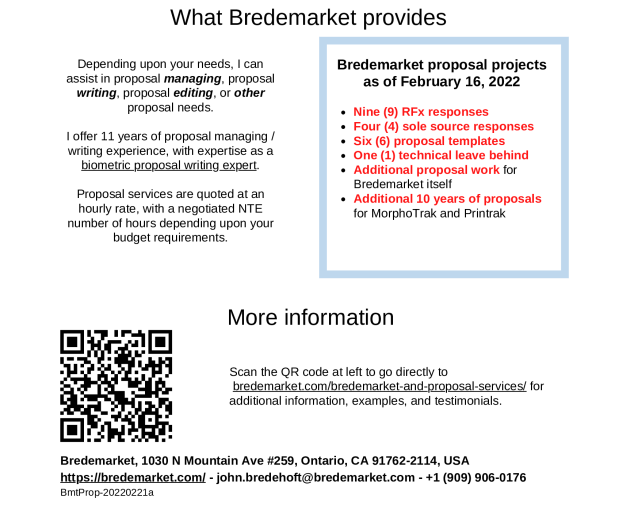
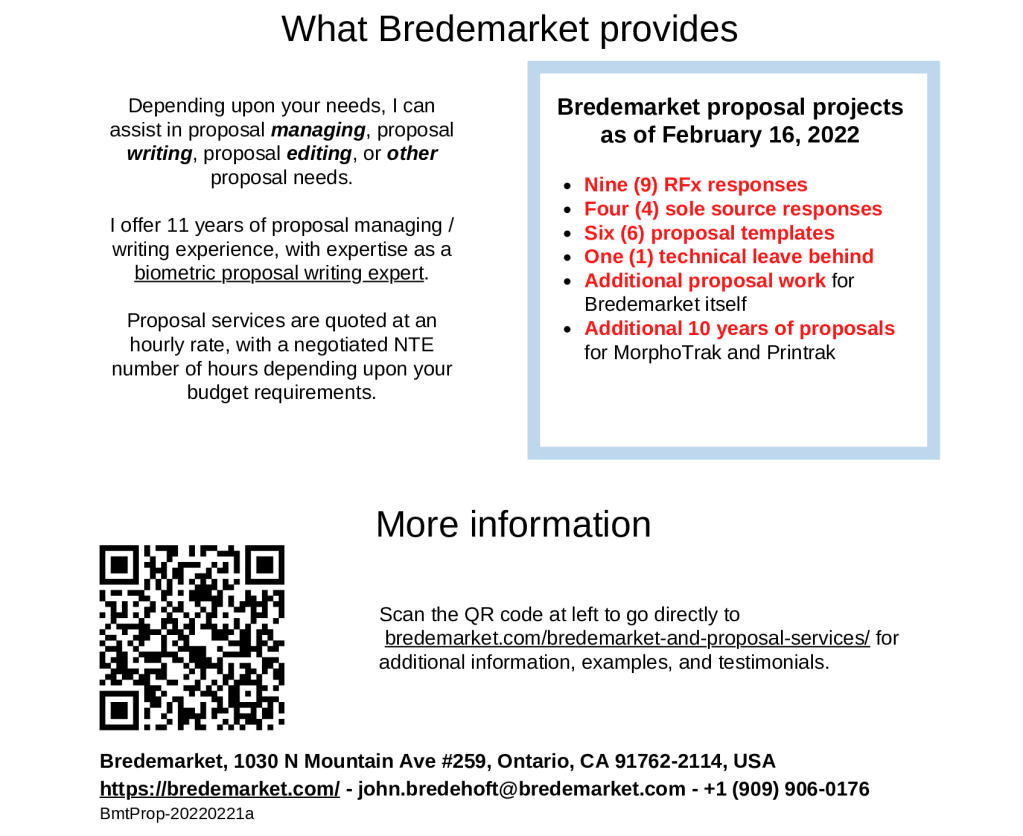
As a starting point, what proposal services has Bredemarket provided for its clients? I quantified these around the middle of the month and came up with this list.

And I’ve been working on additional proposal projects for clients that I haven’t added to the list yet.

Now if you’ve already read my September 2021 content post, it seems like I’ve been repeating myself. Well the repetition ends here, because my other big proposal-related accomplishment for the month was my Association of Proposal Management Professionals Foundation certification.

This will not only allow me to provide better proposal services to biometric firms (yes, yes, I am a biometric proposal writing expert), but also to other firms.

What other firms?

I’ll let you know.

If I can provide proposal services for you:

When I will style myself John E. Bredehoft, CF APMP…and when I won’t

TL;DR: Yesterday I achieved APMP® Bid and Proposal Management Foundation 2021 certification.

This post explains what APMP Foundation certification is, why I pursued the certification, the difference between APMP and APMG, and when I will (and will not) use my shiny new “CF APMP” designation.

What is APMP Foundation certification?

First, for those not familiar with the acronym, “APMP” stands for the Association of Proposal Management Professionals, an organization that I re-rejoined back in July. APMP membership provides many benefits, including improved service to Bredemarket clients because of my access to the APMP Body of Knowledge.

It also provides a mechanism for proposal professionals to certify their mastery of the proposal field. And, as APMP itself notes, certification conveys the following:

Demonstrates a personal commitment to a career and profession.

Improves business development capabilities.

Creates a focus on best team practices.

Gains the respect and credibility of peers, clients and organizational leaders and, in some cases, additional compensation.

Reinforces bid/proposal management as an important role within an organization and not as an ad hoc function that anyone can perform. 

Frankly, most of these won’t matter to YOU, but the process required to achieve certification does improve business development capabilities for Bredemarket’s clients. You can ignore the rest, unless you’re suddenly eager to shower additional compensation on me. I won’t argue.

There are multiple levels of APMP certification, and the very first level is “Foundation” certification. There is an eligibility requirement to pursue this certification, however:

Candidates should have at least one year of experience in a bid and proposals environment; this experience does not have to be continuous. Time spent working or supporting sales and marketing also counts.

So I was eligible to pursue Foundation certification years ago…but I never did.

Why did I pursue APMP Foundation certification?

I already wrote about this on LinkedIn a week ago, but if you missed that explanation here’s an abbreviated version.

Over the years I kept on joining APMP while in a proposals position, then letting my APMP membership lapse when I transferred to a non-proposals position. So by the time I ever thought about seriously pursuing APMP Foundation certification, I was already out of proposals.

This time, I said to myself when I re-rejoined in July, it will be different.

I finally made the move after attending SMA’s weekly town hall and hearing Heather Kirkpatrick present on the various APMP certification levels.

But I acknowledged that certification is not universally desirable:

Yes, I know the debates about whether certifications (or, for that matter, formal education in general) are truly worthwhile, but there are times when checking off that box on that checklist truly matters.

And therefore I began reading the two documents that I had just purchased, including a study guide and a glossary of terms.

Why is the APMG involved in APMP stuff?

However, to actually achieve the certification, I didn’t go to the APMP itself, but to an organization called the APMG.

And no, the APMG was NOT established to confuse proposal practitioners by using a similar acronym. (Seriously; when I saw others’ announcements of proposal certification, I couldn’t figure out why they kept getting the APMP acronym wrong.)

The APM Group is actually a completely separate organization that provides certifications and other services for a number of disciplines. It serves aerospace, business, information technology, cybersecurity, and other disciplines.

In my case, once I had studied and taken a practice exam, I proceeded to sit for the real exam itself…after paying another fee.

(This is why some people oppose certifications; they think they’re a racket just to charge fees all over the place. But I had already determined that in this case, the return on investment would be positive.)

Well…I passed, and therefore can direct interested parties to my shiny new badge.

By the way, I was never asked to provide a reference to verify my experience, but I could have provided dozens of references if asked.

What about the shiny new designation that comes with the shiny new badge?

Oh, and there’s one more thing.

Certified people (as opposed to people who are certifiable) have the option of appending their certification to their name. In the business world, you often see this used by people who have achieved Project Management Professional (PMP) certification. In some countries, MBAs and even BAs append the appropriate designation to their names.

In the same manner, those who have achieved one of the APMP certifications can append the appropriate certification. In the case of APMP Foundation certification, that means that I can style myself as “John E. Bredehoft, CF APMP.” (Or “John E. Bredehoft, MBA, CF APMP, RSBC” if I want to be thorough. But I probably won’t, since “RSBC” stands for “Radio Shack Battery Club.”)

However, the “CF APMP” designation only makes sense if the person reading the designation knows what it means. And it’s a fairly safe bet that if I were to walk into a coffee shop, or even into the main office of a marketing firm, the people there would have no idea what “CF APMP” meant. In fact, it might strike some of them as pretentious.

But it DOES make a difference in some (not all) proposal circles.

Including the attendees at the APMP Western Chapter Training Day next month.

Which I really should attend if possible. After all, I need to maintain my Continuing Education Units (CEUs) to keep my certification up to date.

This one won’t count for my Foundation certification renewal, but it’s nice.

Excuse me, but I have a lot of questions…

I’ve previously shared how I’ve revised my content creation process.

Like any good process, the not-so-new-anymore Bredemarket content creation process asks a lot of questions up front. These questions ensure that I perform the project in accordance with the wishes of my client.

Because, as we all know, it costs more to rework a project at the end than it does at the beginning. (Or maybe you didn’t know that; it’s something I included in some work I did for a client. But the client knows.)

Specifically, early in the engagement I reach agreement with my client on all or most of the following questions on the content:

  • The topic.
  • The goal.
  • The benefits.
  • The target audience.
  • If necessary:
    • The outline.
    • The section sub-goals.
    • Relevant examples.
    • Relevant key words/hashtags.
    • Interim and final due dates.

When you break it out, that’s a lot of stuff.

And there’s more stuff that I need to know from the client that I’m not sharing publicly. But I’ll give you a hint: some of the questions are driven by a recent experience with Google Docs, and the fact that two different people weren’t using the same fonts, sizes, and styles. Well, if Google Docs can’t take care of it automatically, I can ask about fonts/sizes/styles (when applicable) so that the issue can be resolved manually.

So I’ve created a form that I can use for either the content or proposals sides of the Bredemarket business, and the form contains all of the questions that I need to ask a client at the beginning of an engagement.

My in-house form, first iteration.

Or at least I think it contains all of the questions.

I’m going to try it out with a future client.

And perhaps I’ll iterate it afterwards.

Using Toggl Track to quantify proposal services for marketing purposes

Bredemarket’s slogan should be “better late than never.” It took me a year to print business cards, and it has taken me almost a year to quantify my proposal services work for clients. But Toggl helped me quantify my work.

Incidentally, this post is NOT sponsored by Toggl. If I were smart I would have pitched this post to Toggl and gotten something substantive in return. But I’m not that smart; I’m just a happy Toggl Track user. Sure the service has had a couple of hiccups in April and August, but Toggl responded to these hiccups quickly. In general, Toggl Track has been very useful in tracking time, gathering data to bill clients, and (as I just discovered this week) very useful in quantifying Bredemarket’s work and accomplishments.

Quantifying hours per proposal

The whole Toggl Track quantification exercise started over the last couple of weeks, when I had two separate discussions with firms regarding the number of hours that a contractor usually spends responding to a request for something (proposal, information, comment, etc.). Acronym lovers can use RFx, RFP, RFI, RFC, etc. as needed.

After the second client raised the issue, I realized that my Toggl Track data contained time data on all of my billable proposals work. (Helpful hint: even with the free version of Toggl Track, you can set up project names to keep track of billable hours, although you have to manually calculate the billing yourself.)

So I logged into Toggl Track, selected the billable projects that I knew had Rfx hours, downloaded a comma-separated values (csv) version of all of the data from January 1, 2021 to present, opened the csv file in Excel, filtered out the columns that I didn’t need, filtered out the rows that didn’t pertain to RFx work, sorted the data by description (for example, “AFIS proposal for Noname County”), then subtotaled the hours at each change of description.

And then I realized that I did something wrong.

When the Toggl Track data was loaded into Excel, it used a standard hours-minutes-seconds format. What that meant was that the subtotals also displayed in a standard hours-minutes-seconds format. So if I had three time entries—one for 10:00:00, one for 9:00:00, and one for 8:00:00—the resulting subtotal would be 3:00:00, or only three hours.

Whoops.

I played around a bit with the number formats in the Duration column, and found a format (displayed in Excel as “37:30:55”) that correctly rendered my subtotals—in the example above, yielding the correct value of 27:00:00, or 27 hours.

So once I got the subtotals to work correctly, what did I find, based on my own RFx proposal work data?

  • One of my projects required approximately 20 billable hours of work.
  • Three of the projects required less than 20 billable hours per project.
  • The remaining three required more than 35 billable hours per project.

Obviously my results do not apply to other independent contractors, and certainly do not apply to employees who are involved much more intimately in a company’s proposal process. So don’t try to extrapolate my numbers and make the declaration “Studies show that nearly half of all RFx responses require over 35 hours of work per person.”

But this data gave me the information that I needed in my discussions with the second firm.

But this exercise raised another question that I should have answered long ago.

Quantifying total proposal work

As Bredemarket, I have not only worked on RFx responses, but have also worked on sole source responses, and on proposal templates.

But I’ve never compiled a definitive overview of all of my proposal work.

Now I’ve certainly discussed bits of my proposal work here and there. You’ve probably already seen the testimonial that I received from a client regarding my proposal template work:

“I just wanted to truly say thank you for putting these templates together. I worked on this…last week and it was extremely simple to use and I thought really provided a professional advantage and tool to give the customer….TRULY THANK YOU!”

But after the proposal hours exercise above, I decided that it was time to quantify this work.

  • How many competitive proposals have I worked on for clients?
  • How many sole source responses have I worked on for clients?
  • How many of these “extremely simple to use” (my client’s words, not mine) templates have I assembled?

Obviously I had all the data; I just had to pull it together.

So I went to Toggl Track (and to other sources) to quantify my total proposal work, searching for billable (and in the cases of Bredemarket’s own proposals, nonbillable) work and identifying all the projects.

Sharing the quantification

Once that was done, I was able to create a neat handy dandy summary.

Which I put into a brochure.

Which I then added to various pages on the Bredemarket website.

September 10, 2021 iterative revision to https://bredemarket.com/bredemarket-and-proposal-services/.

And, of course, I’ll share the information in this blog post when I publish it and distribute it via my social media outlets-not forgetting Instagram, of course. (Did you notice that my statistical graphic is square? Now you know why.)

And I need to share this information in one more place, but that’s a topic for another time.

Can my proposal services help you?

If my experience (now with better quantification!) can help you with your proposal work, then please contact me.

Why is Kaye Putnam happy that I’m IGNORING her marketing advice?

This is the cover art for the album Parsley, Sage, Rosemary and Thyme by the artist Simon & Garfunkel. The cover art can be obtained from Columbia. Fair use, https://en.wikipedia.org/w/index.php?curid=2184092

A few hours after finishing my revision of Bredemarket’s work process, I attended this month’s Orange County (California) Freelancers Union SPARK webinar. I’ve shared some things from SPARK meetings in the past (July’s happy hour, May’s AB2257 discussion), and I’m going to share some things from the August meeting also.

Jung and the restless

This meeting (which also happened to be the national Freelancers Union meeting for the month; our chapter rules!) was led by Cara Raffele, who spoke about “The Power of Storytelling.”

From https://www.freelancersunion.org/community/spark-events/#spark–monthly-theme, although it might have changed by the time you read this.

I’m not going to talk about the ENTIRE meeting, but will focus on the last part of the meeting, during which Raffele discussed “understanding your brand for maximum impact,” or brand archetypes.

The idea of archetypes started with Carl Jung, who defined them as images and themes that derive from the collective unconscious.

Jung claimed to identify a large number of archetypes but paid special attention to four. Jung labeled these archetypes the Self, the Persona, the Shadow and the Anima/Animus.

In modern-day marketing, this “large number of archetypes” has been boiled down to twelve, and it was these twelve that Raffele referenced in her presentation.

Twelve archetypes. From https://www.kayeputnam.com/brandality-archetypes/. More about Kaye Putnam later.

Raffele encouraged all of us freelancers to listen to all twelve, and then to select multiple archetypes (not just one) that seemed to reflect our freelance brands. So I iterated a first cut at the archetypes that I believed applied to Bredemarket; my preliminary list included Sage, Creator, and Explorer.

Why Sage? That particular one resonated with me because of my experiences with my clients (educating on benefits vs. features, expanding the understanding of law enforcement agency stakeholders), and because of the way I’ve been marketing myself anyway. After all, when I self-reference as the biometric content marketing expert and the biometric proposal writing expert, then it’s obvious that I can add the sage to my clients’ parsley, rosemary, and thyme. (Sorry, couldn’t resist, even though I know it’s bad.)

But after guessing that Bredemarket is Sage with a pinch of Creator and Explorer, I realized that I might not know myself as well as I thought, so I asked if there were some type of online “archetypes test,” similar to the online Meyers-Briggs personality tests, that could help you semi-independently discern your archetypes.

Raffele responded by pointing us to Kaye Putnam and her online Brand Personality Quiz.

(One aside before moving on to Putnam’s test. A few of you realize that I did not come up with the section title “Jung and the restless” on my own. Yes, I stole it from a Steve Taylor song title (and he stole it from a soap opera). I used the title even though Taylor is frankly not that positive about secular psychology. But he did say “some of my best friends are shrinks.” Oh, and that’s obviously Gym Nicholson of Undercover fame on guitar.)

From https://www.youtube.com/watch?v=5JNOMb_IG8I.

My “Brand Personality Quiz” results, and Kaye Putnam’s recommendations

If you’ve taken an online Meyers-Briggs personality test, or any other similar online test, the process of the Brand Personality Quiz will seem familiar to you. Putnam’s quiz asks you a series of independent questions, some of which have as many as twelve options. It then tabulates your answers against attributes of the twelve brand archetypes, and produces a final result listing a primary brand archetype and some secondary archetypes.

Here are my results.

So if you take Putnam’s quiz as gospel, I was somewhat accurate in my initial self-assessment.

  • Note that “Sage” came first and “Explorer” came second in the quiz results, and those were two of the archetypes I initially tweeted about before taking the quiz.
  • Considering the personal writing style I use in my blog, tweets, and elsewhere, “Entertainer” wasn’t much of a surprise either.
  • Upon further personal reflection, “Royalty” makes sense also. (So bow before me, serfs.)

And after reading Putnam’s description of “Creator” and its emphasis on visual presentation (rather than textual presentation), I can see why this was NOT on the list.

I did not draw this myself. Originally created by Jleedev using Inkscape and GIMP. Redrawn as SVG by Ben Liblit using Inkscape. – Own work, Public Domain, https://commons.wikimedia.org/w/index.php?curid=1692938

Along with my results, Putnam provided a link that allowed me to download a brief description of my primary archetype, Sage. Now this brief description doesn’t include all of the detail found in Putnam’s 12 Brandfluency courses (one for each archetype), but it does include many actionable items.

The “Sage Inspiration Kit” provides useful tips for Sage businesspeople to include in their brand marketing. The kit asserts that if the tips are followed, the results will produce emotional responses in potential clients that will increase brand attractiveness, thus allowing businesspeople to win more business (and win better business).

Tips are provided on the following:

  • Color.
  • Typography.
  • Words.

Obviously that’s a lot of stuff to absorb, even in this brief kit. (The paid course offers tips in additional areas.) And even if I wanted to, I couldn’t change all the colors and fonts in my marketing overnight.

But I could look at Putnam’s word suggestions.

Ignoring the expert

Now Kaye Putnam’s word suggestions are freely available to anyone, but I’m not going to just copy all of them and reproduce them here. Request them yourself. (The link is for the Sage archetype)

But I’ll offer comments on a few of the 18 words and phrases in the kit.

From https://xkcd.com/386/. Attribution-NonCommercial 2.5 Generic (CC BY-NC 2.5).

First off, I’m NOT going to use “think tank” in Bredemarket’s marketing. Perhaps this phrase may resonate for a larger firm, or even for a smaller firm with a team of people addressing their clients’ needs. But it would take a lot of stretching to describer a solopreneur think tank.

Another term that DOESN’T make sense for Bredemarket is “engineering.” Now obviously engineering is a good thing, although I’ve seen cases where engineering is overemphasized. But it doesn’t really make sense for my business, in which I make a point of emphasizing my ability to communicate engineering concepts to non-engineers. The same issues apply with the phrase “the code.”

I won’t go into all of my concerns, but there are several “Sage words” in the list that I would never use for Bredemarket, or would use very sparingly.

And that’s…OK

Remember, of course, that Stuart Smalley is not a licensed practitioner. By http://www.tvacres.com/words_stuart.htm, Fair use, https://en.wikipedia.org/w/index.php?curid=31855280

When someone gives you advice, whether it’s Kaye Putnam or John Bredehoft, you have to judge whether the advice is good for YOU.

Even if you narrow a brand down to one archetype, there are innumerable differences between individuals who align with this archetype. One size does not fit all, and I personally may love the term “experiment” but hate the terms listed above.

Now perhaps I may be wrong in rejecting Putnam’s advice. Perhaps there’s a really, really good reason why I should sprinkle the phrase “think tank” through all of my marketing materials.

But in the end it’s up to the recipient to decide whether or not to follow the advice of the expert. That applies to people giving advice to me, and that also applies to the advice that I give to my clients. (If a client insists on using the phrase “best of breed,” I can’t stop the client from doing so.)

But several of those words and phrases DO seem like good ideas, and I’ll probably make a concerted effort to sprinkle the GOOD words and phrases throughout Bredemarket’s website, social media channels, proposals, and other marketing.

Even though this might require me to re-revise the content creation process that I just revised.

Oh well. It’s good to…experiment with things. After all, Bredemarket is in effect a laboratory in which I like to try solutions out myself before I try to make a case for them with my clients. It’s easier to speak to research-based proven solutions than ones with which I have no experience at all.

By Rembrandt – The Yorck Project (2002) 10.000 Meisterwerke der Malerei (DVD-ROM), distributed by DIRECTMEDIA Publishing GmbH. ISBN: 3936122202., Public Domain, https://commons.wikimedia.org/w/index.php?curid=157824

Did that paragraph sound sage-like? I got six of the words/phrases into that paragraph!

Oh, and if you’re looking for a Royally Entertaining and Exploring Sage…

Bredemarket offers clients deep experience in content marketing, proposals, and strategy. I can offer expert advice to biometrics firms, since (as noted above) I am a biometric content marketing expert and a biometric proposal writing expert. However, this expert advice can also be provided to other technology firms, and to general business.

You can read here about how my content creation process ensures that the final written content (a) advances your GOAL, (b) communicates your BENEFITS, and (c) speaks to your TARGET AUDIENCE.

If Bredemarket can fill a gap in your company’s needs (NOTE TO SELF: DO NOT MENTION PARSLEY. DO NOT MENTION PARSLEY. DO NOT MENTION PARSLEY.), then feel free to contact me and we can discuss your needs and possible solutions.

The end of the APMP-AWBP brouhaha

Back on July 20, I shared my thoughts on the brouhaha over the proposed renaming of the Association of Proposal Management Professionals to become the Association of Winning Business Professionals, and how that might impact the APMP conference in Denver later this year. (This was posted before I re-rejoined the APMP.)

By Billy Hathorn – Own work, CC BY-SA 3.0, https://commons.wikimedia.org/w/index.php?curid=11357434

Well, there’s an update.

On August 2, the APMP posted a video on its YouTube channel. But the video is marked as “unlisted,” which means that the APMP probably doesn’t want everyone to see it. So I’m not going to link to it.

And the APMP has posted information on its website, but it’s behind the login firewall. So I’m not going to link to it.

I will, however, summarize it.

The Association of Winning Business Professionals is no more. It has ceased to be, bereft of life, it rests in peace, it has kicked the bucket, hopped the twig, bit the dust, snuffed it, breathed its last, and gone to meet the Chief Renaming Officer in the sky. (Adapted from Cleese and Chapman’s Dead Parrot Sketch.)

Actually, there is a public discussion of this, posted by Robin Davis.

It’s official, your efforts to #SaveAPMP paid off! The name stays—and everything it stands for. Thanks for your passion—that’s the kind of energy that can change the world! 

Perhaps I should revisit this topic five years from now. Not seven years from now.

By Published by Corpus Christi Caller-Times-photo from Associated Press – Corpus Christi Caller-Times page 20 via en:Newspapers.com, Public Domain, https://commons.wikimedia.org/w/index.php?curid=37860629

Yes, I’ll repurpose that old joke for a while.

How the APMP Body of Knowledge (BOK) benefits Bredemarket’s NON-proposal clients

(Updated 4/16/2022 with additional benefits information.)

Presumably you saw my earlier post, “I just re-rejoined the Association of Proposal Management Professionals. So what?” This post is a follow-up to the “So what?” part, specifically addressing clients of my consulting firm Bredemarket (marketing and writing services for biometric, technology, and general business firms) who DON’T use me for proposal services.

I said the following in that prior post:

But there are benefits for my Bredemarket clients who DON’T depend upon me for proposal support, but instead depend upon me for content marketing or other marketing and writing services. The same strategies and tactics that contribute to a more effective proposal can be extrapolated to apply to other areas, thus contributing to better white papers, better case studies, better blog posts, better social media posts, better marketing plans, etc., etc., etc. Again, this can help my clients win business.

(Yes, I intentionally used the words “win business.”)

Of course, now I’m in the initial process of making use of my new/old APMP membership by soaking in APMP things (while ALSO hopefully contributing things) that will benefit me and my clients.

I’ll talk about live webinars, the APMP Body of Knowledge, and the benefits for Bredemarket’s non-proposal clients.

Live webinars! Well, sometimes

My first opportunity to obtain value from my APMP membership came on Wednesday July 28, when the Western Chapter (a merger of the California Chapter and other chapters) scheduled a webinar entitled “Persuasion Through Page Architecture.” The presenter, Nancy Webb, offers over 30 years of design expertise. I recall the name, so I’ve probably attended a previous presentation of hers during my second (or perhaps even my first) stint in APMP.

Sadly, I was unable to learn from Nancy Webb on July 28. A major requirement for a webinar is the ability to access the web, and when we all logged into the webinar on Wednesday, we learned that Webb’s Internet connection was out and that the meeting would have to be rescheduled.

By Monoklon – Own work, CC BY-SA 4.0, https://commons.wikimedia.org/w/index.php?curid=75697420

Ah, technology.

The APMP Body of Knowledge

But MY Internet connection is working, so on Thursday afternoon I was able to visit the APMP website and poke around some more.

Which led me to the page describing the APMP Body of Knowledge (BOK).

Not a body OF KNOWLEDGE, but this illustration was created by Leonardo da Vinci, so the SMA folks will like it. By Leonardo da Vinci – https://www.metmuseum.org/special/Leonardo_Master_Draftsman/tour_gallery4.htm, Public Domain, https://commons.wikimedia.org/w/index.php?curid=1744423

And yes, I’m going to call the Body of Knowledge the BOK from now on. Bok bok bok.

By Andrei Niemimäki from Turku, Finland – Friends, CC BY-SA 2.0, https://commons.wikimedia.org/w/index.php?curid=3769100

It’s no surprise that the proposals world has a slew of acronyms (more on that later).

One important thing you need to know about the APMP BOK; it’s only for APMP members.

The APMP Body of Knowledge (BOK) is available to all APMP members in good standing.

Well, I haven’t done anything to lose my good standing yet, although if I were to log in to the BOK, copy all of the content, and post it here in the Bredemarket blog, I would obviously get in a heap of trouble. For one thing, Wordman would come after me.

Wordman. From https://wordmanspeaks.com/about-wordman/. Fair use. NOT created by Leonardo da Vinci; Wordman avatar created by Sean Jones (www.knitestudios.com)

As it turns out, Wordman could come after me in multiple ways. In addition to his superhero status, Wordman (Richard “Dick” Eassom) chairs the APMP Western Chapter, and is also an executive with SMA, Inc. (which I previously joined). I could get kicked out of the APMP AND SMA in one fell swoop!

(I could go off on a tangent and say why Moses was the most evil man in the Bible, but I really shouldn’t.)

(Moses broke all Ten Commandments at once.)

Um, John, let’s get back to the BOK

So I’m NOT going to go behind the firewall and redistribute the internal content of the APMP BOK.

But I CAN note what the APMP publicly says about the BOK.

TL;DR: as I’ve noted when talking about the brouhaha, the BOK and the APMP itself talk about topics that have applicability far beyond the creation of a proposal.

The topics are grouped into seven categories, which represent key practice areas for improving an organization’s business development focus:

Understand business development

Focus on the customer

Create deliverables

Lead a team

Manage processes

Train staff

Use tools and systems

Obviously, all seven of these categories apply to the creation of a proposal.

Benefits for my NON-proposal clients

And all seven of those categories just as easily apply to the creation of a blog post, case study, white paper, corporate strategy, or ANY deliverable for a customer-facing firm.

(4/16/2022: For additional information on benefits, click here.)

Again, I can’t speak about BOK specifics, but I spent part of Thursday afternoon reading about a topic which would have benefited me greatly in one of my NON-proposal positions with IDEMIA/MorphoTrak/Motorola/Printrak. Well, better late than never.

There are a number of helpful pieces of content in the APMP BOK, including…a list of common proposal acronyms. (CPAs??? No.)

For those who don’t know this, the major purpose of acronyms is to allow people of a small group to exchange secret communications in the presence of the non-initiated. “When you complete the response to the RFP for DoD, ensure that the collected KPIs align with the BD-CMM.” (In truth, many of these acronyms are used outside of the proposal profession, but the acronym list collects some of the important ones in one place.)

So I anticipate that I’ll be spending some significant time in the future reviewing the APMP BOK. And if all goes well, I’ll actually RETAIN something from these BOK content reviews that will result in better written content for ALL Bredemarket clients.

(And yes, Dick, I know that there’s also an SMA body of knowledge to which I have access…)

Another acronym is CTA

Incidentally, if you are a biometric (identity) or technology firm that needs a proposal (or content) consultant, feel free to contact Bredemarket.