When the Games Stopped: March 11, 2020

In late 2019 and early 2020 I was working on a project promoting biometric entry at sports facilities and concert venues…until a teeny little worldwide pandemic shut down all the sport and concert venues.

Some of you may remember that a pivotal day during that period was March 11, 2020. Among many many other things, this was the day on which basketball fans awaited the start of a game.

“8 p.m. [ET; 7 p.m. local time]: In Oklahoma City, it was just another game day for Nerlens Noel and his Thunder teammates, who were warming up to play the visiting Utah Jazz.”

The day soon became abnormal after a meeting between NBA officials and the two coaches. Unbeknownst to the crowd, the officials and coaches were discussing a medical diagnosis of Rudy Gobert. (That’s another story.)

“8:31 p.m. [ET]: Teams were sent back to their locker rooms but the crowd at Chesapeake Energy Arena weren’t informed of the cancellation immediately. Instead, recording artist Frankie J, the intended halftime entertainment, put on his show, while officials decided how to break the news.”

Eight minutes later, the crowd was instructed to leave the arena.

Twenty minutes after that, the NBA suspended all games.

Imagen 4.

A little over a month later, on April 19, millions of people were huddled in their homes, glued to the opening episode of a TV series called The Last Dance…the only basketball any of us were going to get for a while. And of course, these games were on decades-long tape delay, and we already knew the outcome. (The Chicago Bulls won.)

And that was our basketball…until the suspended season resumed on July 30 under very bizarre circumstances.

Anyway, all of that was a very long time ago.

Imagen 4.

Games and concerts have been back in business since 2021, and identity verification and authentication of venue visitors with biometrics and other factors is becoming more popular every year.

Mistaken Identity

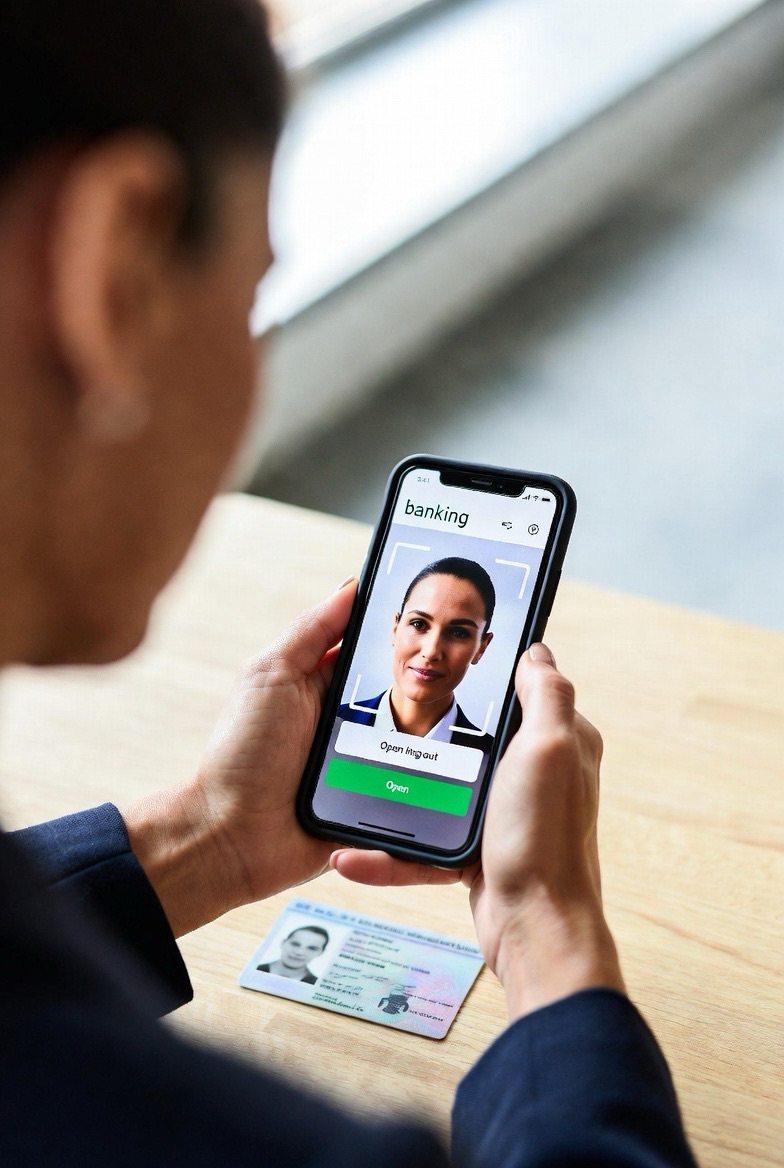
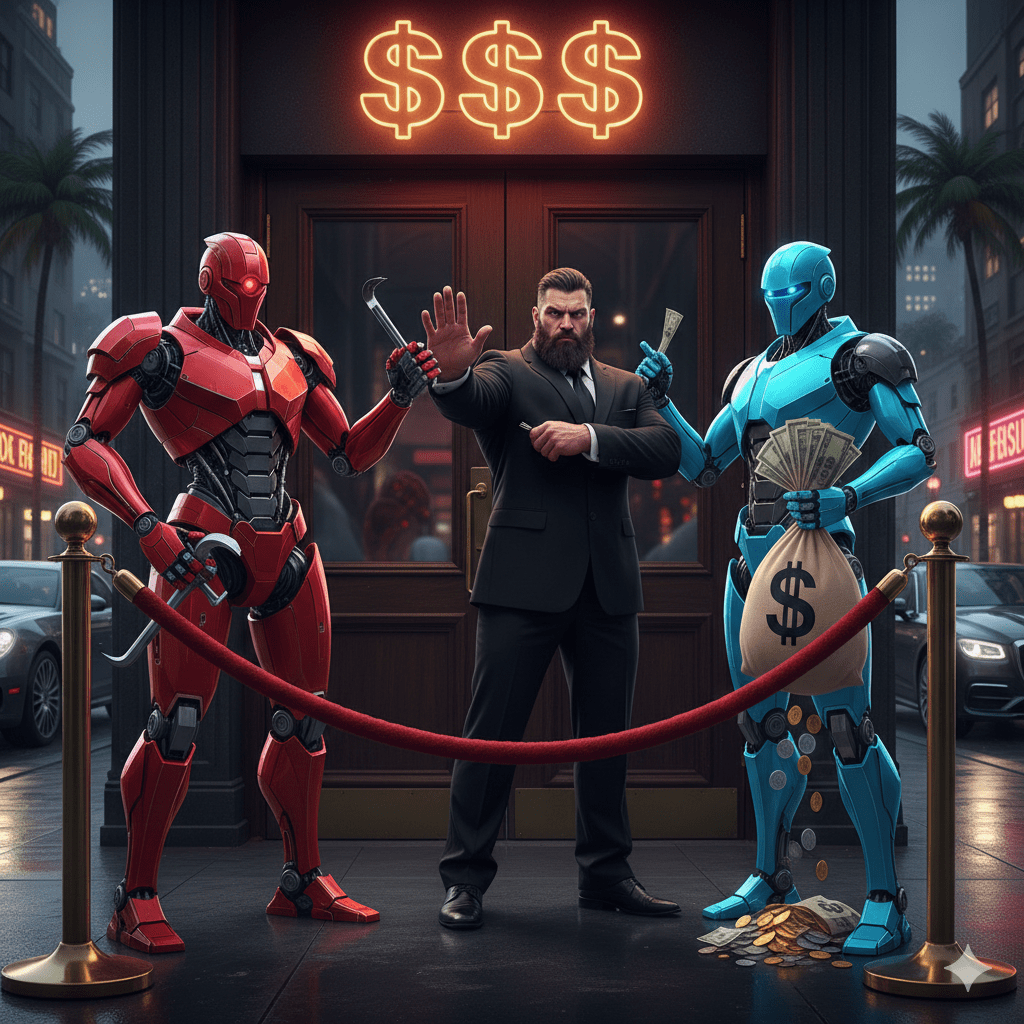
I generated this picture in Imagen 4 after reading an AI art prompt suggestion from Danie Wylie. (I have mentioned her before in the Bredemarket blog…twice.)

The AI exercise raises a question.

What if you are in the middle of an identity verification or authentication process, and only THEN discover that a fraudster is impersonating you at that very moment?

Oh, Joel (Texas Porn and Georgia Social Media)

The definitive summary on U.S. age assurance for adult content and social media as of today (June 27, 2025) has already been written at Biometric Update.

And I confess that if I were Joel R. McConvey, I would have unable to resist the overpowering temptation to dip my pen in the inkwell and write the following sentence:

“But as age checks become law in more and more places, the industry will have to weigh how far it can push – or pull out.”

But McConvey’s article does not just cover the Supreme Court’s decision on Texas HB 1181’s age verification requirement for porn websites—and Justice Clarence Thomas’ statement in the majority opinion that the act “triggers, and survives, review under intermediate scrutiny because it only incidentally burdens the protected speech of adults.”

What about social media?

The Biometric Update article also notes that a separate case regarding age assurance for social media use is still winding its way through the courts. The article quotes U.S. District Judge Amy Totenberg’s ruling on Georgia SB 351:

“[T]he act curbs the speech rights of Georgia’s youth while imposing an immense, potentially intrusive burden on all Georgians who wish to engage in the most central computerized public fora of the twenty-first century. This cannot comport with the free flow of information the First Amendment protects.”

One important distinction: while opposition to pornography is primarily (albeit not exclusively) from the right of the U.S. political spectrum, opposition to social media is more broad-based. So social media restrictions are less of a party issue.

But returning to law rather than politics, one can objectively (or most likely subjectively) debate the Constitutional merits of naked people having sex vs. AI fakes of reunions of the living members of Led Zeppelin, the latter of which seem to be the trend on Facebook these days.

Minority Report

But streaking back to Texas, what of the minority opinion of the three Supreme Court Justices who dissented in the 6-3 opinion? According to The Texas Tribune, Justice Elena Kagan spoke for Justices Sonia Sotomayor and Kentanji Brown Jackson:

“But what if Texas could do better — what if Texas could achieve its interest without so interfering with adults’ constitutionally protected rights in viewing the speech HB 1181 covers? The State should be foreclosed from restricting adults’ access to protected speech if that is not in fact necessary.”

If you assume age verification (which uses a government backed ID) rather than age estimation (which does not), the question of whether identity verification (even without document retention) is “restricting” is a muddy one.

Of course all these issues have little to do with the technology itself, reminding us that technology is only a small part of any solution.

IDV Differentiation as Measured in the Prism Project’s Deepfake and Synthetic Identity Report

Because I have talked about differentiation ad nauseum, I’m always looking for ways to see how identity/biometric and technology vendors have differentiated themselves. Yes, almost all of them overuse the word “trust,” but there is still some differentiation out there.

And I found a source that measured differentiation (or “unique positioning”) in various market segments. Using this source, I chose to concentrate on vendors who concentrate on identity verification (or “identity proofing & verification,” but close enough).

My source? The recently released “Biometric Digital Identity Deepfake and Synthetic Identity Prism Report” from The Prism Project, which you can download here by providing your business address.

Before you read this, I want to caution you that this is NOT a thorough evaluation of The Prism Project deepfake and synthetic identity report. After some preliminaries, it focuses on one small portion of the report, concentrating on ONLY one “beam” (IDV) and ONLY one evaluation factor (differentiation).

Four facts about the report

First, the report is comprehensive. It’s not merely a list of ranked vendors, but also provides a, um, deep dive into deepfakes and synthetic identity. Even if you don’t care about the industry players, I encourage you to (a) download the report, and (b) read the 8 page section entitled “Crash Course: The Identity Arms Race.”

  • The crash course starts by describing digital identity and the role that biometrics plays in digital identity. It explains how banks, government agencies, and others perform identity verification; we’ll return to this later.
  • Then it moves on to the bad people who try to use “counterfeit identity elements” in place of “authentic identity elements.” The report discusses spoofs, presentation attacks, countermeasures such as multi-factor authentication, and…
  • Well, just download the report and read it yourself. If you want to understand deepfakes and synthetic identities, the “Crash Course” section will educate you quickly and thoroughly, as will the remainder of the report.
Synthetic Identity Fraud Attacks. Copyright 2025 The Prism Project.

Second, the report is comprehensive. Yeah, I just said that, but it’s also comprehensive in the number of organizations that it covers.

  • In a previous life I led a team that conducted competitive analysis on over 80 identity organizations.
  • I then subsequently encountered others who estimated that there are over 100 organizations.
  • This report evaluates over 200 organizations. In part this is because it includes evaluations of “relying parties” that are part of the ecosystem. (Examples include Mastercard, PayPal, and the Royal Bank of Canada who obviously don’t want to do business with deepfakes or synthetic identities.) Still, the report is amazing in its organizational coverage.

Third, the report is comprehensive. In a non-lunatic way, the report categorizes each organization into one or more “beams”:

  • The aforementioned relying parties
  • Core identity technology
  • Identity platforms
  • Integrators & solution providers
  • Passwordless authentication
  • Environmental risk signals
  • Infrastructure, community, culture
  • And last but first (for purposes of this post), identity proofing and verification.

Fourth, the report is comprehensive. Yes I’m repetitive, but each of the 200+ organizations are evaluated on a 0-6 scale based upon seven factors. In listed order, they are:

  • Growth & Resources
  • Market Presence
  • Proof Points
  • Unique Positioning, defined as “Unique Value Proposition (UVP) along with diferentiable technology and market innovation generally and within market sector.”
  • Business Model & Strategy
  • Biometrics and Document Authentication
  • Deepfakes & Synthetic Identity Leadership

In essence, the wealth of data makes this report look like a NIST report: there are so many individual “slices” of the prism that every one of the 200+ organizations can make a claim about how it was recognized by The Prism Project. And you’ve probably already seen some organizations make such claims, just like they do whenever a new NIST report comes out.

So let’s look at the tiny slice of the prism that is my, um, focus for this post.

Unique positioning in the IDV slice of the Prism

So, here’s the moment all of you have been waiting for. Which organizations are in the Biometric Digital Identity Deepfake and Synthetic Identity Prism?

Deepfake and Synthetic Identity Prism. Copyright 2025 The Prism Project.

Yeah, the text is small. Told you there were a lot of organizations.

For my purposes I’m going to concentrate on the “identity proofing and verification” beam in the lower left corner. But I’m going to dig deeper.

In the illustration above, organizations are nearer or farther from the center based upon their AVERAGE score for all 7 factors I listed previously. But because I want to concentrate on differentiation, I’m only going to look at the identity proofing and verification organizations with high scores (between 5 and the maximum of 6) for the “unique positioning” factor.

I’ll admit my methodology is somewhat arbitrary.

  • There’s probably no great, um, difference between an organization with a score of 4.9 and one with a score of 5. But you can safely state that an organization with a “unique positioning” score of 2 isn’t as differentiated from one with a score of 5.
  • And this may not matter. For example, iBeta (in the infrastructure – culture – community beam) has a unique positioning score of 2, because a lot of organizations do what iBeta does. But at the same time iBeta has a biometric commitment of 4.5. They don’t evaluate refrigerators.

So, here’s my list of identity proofing and verification organizations who scored between 5 and 6 for the unique positioning factor:

  • ID.me
  • iiDENTIFii
  • Socure

Using the report as my source, these three identity verification companies have offerings that differentiate themselves from others in the pack.

Although I’m sure the other identity verification vendors can be, um, trusted.

Oh, by the way…did I remember to suggest that you download the report?

Identity Verification for Nevada Sex Workers

(Part of the biometric product marketing expert series)

There is a lot of discussion about identity verification for people working in certain jobs: police officers, teachers, financial professionals, and the like.

With one exception.

One job that isn’t frequently discussed in the identity verification world is that of a sex worker. Primarily because sex workers usually don’t undergo identity verification for employment, but identity checks for criminal proceedings.

With a few exceptions. 

In portions of Nevada sex work is legal. But it is heavily regulated. So there are laws in places like Carlin, Nevada that govern prostitute registration and work cards. Among other things:

  • Applicants are fingerprinted and are also required to submit a recent photo.
  • Applicants must provide their birth name and all subsequent “names or aliases used.”
  • Three years of residence addresses and employment information.
  • The applicant criminal record “except minor traffic violations.”
  • “A waiver of release of medical information,” since the nature of the work involves the possibility of transmission of communicable diseases. And you thought being a nuclear power plant worker was dangerous!

Presumably the fingerprints are searched against law enforcement databases, just like the fingerprints of school teachers and the other newer professions.

Why?

“The chief of police shall investigate, through all available means, the accuracy of all information supplied by the prostitute on the registration form.”

Included in the investigation:

  • Controlled substance criminal convictions.
  • Felony convictions.
  • Embezzlement, theft, or shoplifting convictions.
  • Age verification; you have to be 21.

As you can see, the identity verification requirements for sex workers are adapted to meet the needs of that particular position.

But…it takes two to tango.

Brothel clients need to be at least 18 years old.

But I don’t know if Nevada requires client age verification, or if age estimation is acceptable.

From https://www.instagram.com/share/_mMj2BVRh.

Jobseekers and Know Your (Fill in the Blank)

I’ve noticed that my LinkedIn posts on jobseeking perform much better than my LinkedIn posts on the technical intricacies of multifactor identity verification.

But maybe I can achieve both mass appeal and niche engagement.

Private Equity Talent Hunt and Emma Emily

A year ago I reposted something on LinkedIn about a firm called Private Equity Talent Hunt (among other names). As Shelly Jones originally explained, their business model is to approach a jobseeker about an opportunity, ask for a copy of the jobseeker’s resume, and then spring the bad news that the resume is not “ATS friendly” but can be fixed…for a fee.

The repost has garnered over 20,000 impressions and over 200 comments—high numbers for me. 

It looks like a lot of people are encountering Jennifer Cona, Elizabeth Vardaman, Sarah Williams, Jessica Raymond, Emily Newman, Emma Emily (really), and who knows how many other recruiters…

…who say they work at Private Equity Talent Hunt, Private Equity Recruiting Firm, Private Equity Talent Seek, and who knows how many other firms.

If only there were a way to know if you’re communicating with a real person, at a real business.

Actually, there is.

Know Your Customer and Business

As financial institutions and other businesses have known for years, there are services such as “Know Your Customer” and “Know Your Business” that organizations can use. 

KYC and KYB let companies make sure they’re dealing with real people, and that the business is legitimate and not a front for another company—or for a drug cartel or terrorist organization.

So if a company is approached by Emma Emily at Private Equity Talent Hunt, what do they need to do?

The first step is to determine whether Emma Emily is a real person and not a synthetic identity. You can use a captured facial image, analyzed by liveness detection, coupled with a valid government ID, and possibly supported by home ownership information, utility bills, and other documentation.

If there is no Emma Emily, you can stop there.

But if Emma Emily is a real person, you can check her credentials. Where is she employed today? Where was she employed before? What are her post secondary degrees? What does her LinkedIn profile say? If her previous job was as a jewelry designer and her Oxford degree was in nuclear engineering, Emma Emily sounds risky.

And you can also check the business itself, such as Private Equity Talent Hunt. Check their website, business license, LinkedIn profile, and everything else about the firm.

But I’m not a business!

OK, I admit there’s an issue here.

There are over 100 businesses that provide identity verification services, and many of them provide KYC and KYB.

To other businesses.

Very few people purchase KYC and KYB per se for personal use.

So you have to improvise.

Ask Emma Emily some tough questions.

Ask her about the track record of her employer.

And if Emma Emily claims to be a recruiter for a well-known company like Amazon, ask for her corporate email address.

(Image from Microsoft Copilot)

What is B2B Writing?

Business-to-business (B2B) writing isn’t as complex as some people say it is. It may be hard, but it’s not complex.

Why do I care about what B2B writing is?

Neil Patel (or, more accurately, his Ubersuggest service) um, suggested that I say something about B2B writing.

And then he (or it) suggested that I use generative artificial intelligence (AI) to write the piece.

I had a feeling the result was going to suck, but I clicked the “Write For Me” button anyway.

Um, thanks but no thanks. When the first sentence doesn’t even bother to define the acronym “B2B,” you know the content isn’t useful to explain the topic “what is B2B writing.”

And this, my friends, is why I never let generative AI write the first draft of a piece.

So, what IS B2B writing?

Before I explain what B2B writing is, maybe I’d better explain what “B2B” is. And two related acronyms.

  • B2B stands for business to business. Bredemarket, for example, is a business that sells to other businesses. In my case, marketing and writing services.
  • B2G stands for business to government. Kinda sorta like B2B, but government folks are a little different. For example, these folks mourned the death of Mike Causey. (I lived outside of Washington DC early in Causey’s career. He was a big deal.) A B2G company, for example, could sell driver’s license products and services to state motor vehicle agencies.
  • B2C stands for business to consumer. Many businesses create products and services that are intended for consumers and marketed directly to them, not to intermediate businesses. Promotion of a fast food sandwich is an example of a B2C marketing effort.

I included the “B2G” acronym because most of my years in identity and biometrics were devoted to local, state, federal, and international government sales. My B2G experience is much deeper than my B2B experience, and way deeper than my B2C expertise.

Let’s NOT make this complicated

I’m sure that Ubersuggest could spin out a whole bunch of long-winded paragraphs that explain the critical differences between the three marketing efforts above. But let’s keep it simple and limit ourselves to two truths and no lies.

TRUTH ONE: When you market B2B or B2G products or services, you have FEWER customers than when you market B2C products or services.

That’s pretty much it in terms of differences. I’ll give you an example.

  • If Bredemarket promoted its marketing and writing services to all of the identity verification companies, I would target less than 200 customers.
  • If IDEMIA or Thales or GET Group or CBN promoted their driver’s license products and services to all of the state, provincial, and territorial motor vehicle agencies in the United States and Canada, they would target less than 100 customers.
  • If McDonald’s resurrects and promotes its McRib sandwich, it would target hundreds of millions of customers in the United States alone.

The sheer scale of B2C marketing vs. B2B/B2G marketing is tremendous and affects how the company markets its products and services.

But one thing is similar among all three types of writing.

TRUTH TWO: B2B writing, B2G writing, and B2C writing are all addressed to PEOPLE.

Well, until we program the bots to read stuff for us.

This is something we often forget. We think that we are addressing a blog post or a proposal to an impersonal “company.” Um, who works in companies? People.

(Again, until we program the bots.)

Whether you’re marketing a business blog post writing service, a government software system, or a pseudo rib sandwich, you’re pitching it to a person. A person with problems and needs that you can potentially solve.

So solve their needs.

Don’t make it complex.

But what IS B2B writing?

Let’s return to the original question. Sorry, I got off on a bit of a tangent. (But at least I didn’t trail off into musings about “the dynamic and competitive world.”)

When I write something for a business:

  • I must focus on that business and not myself (customer focus). The business doesn’t want to hear my talk about myself. The business wants to hear what I can do for it.
  • I must acknowledge the business’ needs and explain the benefits of my solution to meet the business needs. A feature list without any benefits is just a list of cool things; you still have to explain how the cool things will benefit the business by solving its problem.
  • My writing must address one, or more, different types of people who are hungry for my solution to their problem. (This is what Ubersuggest and others call a “target audience,” because I guess Ubersuggest aims lasers at the assembled anonymous crowd.)

Again, this is hard, but not complex.

It’s possible to make this MUCH MORE complex and create a 96 step plan to author B2B content.

But why?

So now I’ve answered the question “What is B2B writing?”

Can Bredemarket write for your business? If so, contact me.