In many instances of fingerprint capture, whether obtaining prints through ink or through livescan, the tenprint person captures 14 images. Not 10, not 20, but 14.
Why?
Quality control.
Because the 14 images contain two impressions of every print, you can compare the top set of prints (the rolled prints) against the bottom set (the slap prints).
Locations of finger 2 (green) and finger 3 (blue) for rolled and slap prints.
In the example above, if the green rolled print is NOT the same as the green slap print, or if the blue rolled print is NOT the same as the blue slap print, then you captured the fingerprints in the wrong order.
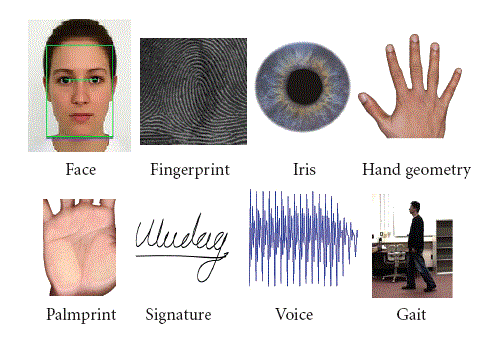
There are various types of dedicated fingerprint reader devices, including multispectral readers that can examine the subdermal layers of your fingers. Even if your surface fingerprints are worn away by bricklaying, time, or other factors, multispectral fingerprint readers can identify you anyway.
Identity/biometrics firms don’t just create social media channels for the firms themselves. Sometimes they create social media channels dedicated to specific products and services.
That’s the good news.
Here’s the bad news.
[REDACTED]
As I write this, it’s March 3. A firm hasn’t updated one of its product-oriented social media channels since February 20.
That’s February 20, 2020…back when most of us were still working in offices.
It’s not like the product no longer exists…but to the casual viewer it seems like it. As I noted in a previous post, a 2020 survey showed that 76% of B2B buyers make buying decisions primarily based on the winning vendor’s online content.
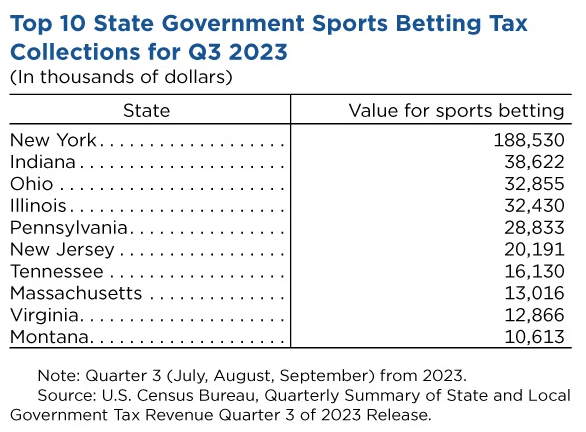
New York was the state with the largest share of the nation’s tax revenue in the (third) quarter of 2023: $188.53 million or more than 37% of total tax revenue and gross receipts from sports betting in the United States. Indiana ($38.6 million) and Ohio ($32.9 million) followed.
Are you wondering why populous states such as California and Texas don’t appear on the list? That’s because sports betting is only legal in 38 states and the District of Columbia.
Sports betting in any form is currently illegal in California, Texas, Idaho, Utah, Minnesota, Missouri, Alabama, Georgia, South Carolina, Oklahoma, Alaska and Hawaii.
But the remaining states that allow sports betting need to ensure that the gamblers meet age verification requirements. (Even though they have a powerful incentive to let underage people gamble so that they receive more tax revenue.)
Some firms make claims and don’t support them, while others support their claims with quantified benefits. But does quantifying help or harm the firms that do it? This pudding post answers this question…and then twists toward the identity/biometrics market at the end.
The “me too” players in the GCP market
Whoops.
In that heading above, I made a huge mistake by introducing an acronym without explaining it. So I’d better correct my error.
GCP stands for Glowing Carbonated Pudding.
I can’t assume that you already knew this acronym, because I just made it up. But I can assure you that the GCP market is a huge market…at least in my brain. All the non-existent kids love the scientifically advanced and maximally cool pudding that glows in the dark and has tiny bubbles in it.
Glowing Carbonated Pudding. Designed by Google Bard. Yeah, Google Bard creates images now.
Now if you had studied this non-existent market like I have, you’ll realize from the outset that most of the players don’t really differentiate their offerings. Here are a few examples of firms with poor product marketing:
Jane Spain GCP: “Trust us to provide good GCP.”
Betty Brazil GCP: “Trust us to provide really good GCP.”
Clara Canada GCP: “Trust us to provide great GCP.”
You can probably figure out what happened here.
The CEO at Betty Brazil told the company’s product marketers, “Do what Jane Spain did but do it better.”
After that Clara Canada’s CEO commanded, “Do what Betty Brazil did but do it better.” (I’ll let you in on a little secret. Clara Canada’s original slogan refereneced “the best GCP,” but Legal shot that down.)
But another company, Wendy Wyoming, decided to differentiate itself, and cited independent research as its differentiator.
Wendy Wyoming Out of This World GCP satisfies you, and we have independent evidence to prove it!
The U.S. National Institute of Standards and Technology, as part of its Pudding User Made (PUM, not FRTE) Test, confirmed that 80% of all Wendy Wyoming Out of This World GCP mixes result in pudding that both glows and is carbonated. (Mix WW3, submitted November 30, 2023; not omnigarde-003)
Treat your child to science-backed cuisine with Wendy Wyoming Out of This World GCP!Wendy Wyoming is a top tier (excluding Chinese mixes) GCP provider.
But there are other competitors…
The indirect competitor who questions the quantified benefits
There are direct competitors that provide the same product as Wendy Wyoming, Jane Spain, and everyone else.
And then there are indirect competitors who provide non-GCP alternatives that can substitute for GCPs.
For example, Polly Pennsylvania is NOT a GCP provider. It makes what the industry calls a POPS, or a Plain Old Pudding Sustenance. Polly Pennsylvania questions everything about GCP…and uses Wendy Wyoming’s own statistics against it.
Designed by Google Bard.
Fancy technologies have failed us.
If you think that one of these GCP puddings will make your family happy, think again. A leading GCP provider has publicly admitted that 1 out of every 5 children who buy a GCP won’t get a GCP. Either it won’t glow, or it’s not carbonated. Do you want to make your kid cry?
Treat your child to the same pudding that has satisfied many generations. Treat your child to Polly Pennsylvania Perfect POPS.
Pennsylvania Perfect remembers.
So who wins?
It looks like Polly Pennsylvania and Wendy Wyoming have a nasty fight on their hands. One that neck-deep marketers like to call a “war.” Except that nobody dies. (Sadly, that’s not true.)
Some people think that Wendy Wyoming wins because 4 out of 5 of their customers receive true GCP.
Others think that Polly Pennsylvaia wins because 5 out of 5 of their customers get POPS pudding.
But it’s clear who lost.
All the Jane Spains and Betty Brazils who didn’t bother to create a distinctive message.
Don’t be Jane Spain. Explain why your product is the best and all the other products aren’t.
Copying the competition doesn’t differentiate you. Trust me.
The “hungry people” (target audience) for THIS post
Oh, and if you didn’t figure it out already, this post was NOT intended for scientific pudding manufacturers. It was intended for identity/biometric firms who can use some marketing and writing help. Hence the references to NIST and the overused word “trust.”
If you’re hungry to kickstart your identity/biometric firm’s written content, click on the image below to learn about Bredemarket’s services.
Let’s say that your identity/biometric firm has decided that silence ISN’T golden, and that perhaps your firm needs to talk about its products and services.
So you turn to your favorite generative AI tool to write something that will represent your company in front of everyone. What could go wrong?
Battling synthetic identities requires a multi-pronged approach. Layering advanced technology is key: robust identity verification using government-issued IDs and biometrics to confirm a person’s existence, data enrichment and validation from diverse sources to check for inconsistencies, and machine learning algorithms to identify suspicious patterns and red flags. Collaboration is crucial too, from financial institutions sharing watchlists to governments strengthening regulations and consumers practicing good cyber hygiene. Ultimately, vigilance and a layered defense are the best weapons against these ever-evolving digital phantoms.
From Google Bard.
Great. You’re done, and you saved a lot of money by NOT hiring an identity blog writing expert. The text makes a lot of important points, so I’m sure that your prospects will be inspired by it.
Bot-speak is not an optimal communication strategy either. Generated at craiyon.com.
Well…
…until your prospects ask what YOU do and how you are better than every other identity firm out there. If you’re the same as all the other “me too” solutions, then your prospects will just go with the lowest price provider.
So how do you go about intelligently writing about biometrics?
Intelligently writing about biometrics doesn’t only require some critical words such as “validation.”
Intelligently writing about biometrics doesn’t only require that you KNOW what those words mean, and that you’re conversant in basic biometric topics. (If you want to know five topics a biometric content marketing expert needs to understand, read my post on that subject.)
Intelligently writing about biometrics requires that you put all of this information together AND effectively communicate your message…
…including why your identity/biometrics firm is great and why all the other identity/biometric firms are NOT great.
If you’re doing this on your own, be sure to ask yourself a lot of questions so that you get started on the right track.
If you’re asking Bredemarket to help you create your identity/biometric content by intelligently writing about biometrics, I’ll take care of the questions.
Oh, and one more thing: if you noted my use of the word “no siree” earlier in this post, it was taken from the Talking Heads song “The Big Country.” Here’s an independent video of that song, especially recommended for people outside of North America who may not realize that the United States and Canada are…well, big countries.
On behalf of a recruiter I am re-examining my consulting experience in the identity/biometric industry, and came to this realization:
If Bredemarket hasn’t consulted for you, it’s a guarantee that Bredemarket has applied its 29 years of identity/biometric experience consulting for your competitors.
Do you want your competitors to realize all the benefits?
As we close out 2023, I’ve been thinking about a lot of things.
Will 2024 be like 2021, in which the new year (2024) offers mimimal improvement over the preceding year (2023)? Reply hazy, try again later. (“And while tech layoffs slowed down in the summer and fall, it appears that cuts are ramping up yet again.”)
What new ways will we develop to better ghost people? Or will the old ways of ghosting continue to dominate the (lack of) conversation? (And if the person who ghosts is the ghoster, and the person who is ghosted is the ghostee…who is the ghost?)
Most importantly for this post, I’ve been thinking about the following: why are target audiences TARGETS, and why are they AUDIENCES? And is the term “target audience” the best description? (TL;DR: No.) If not, what’s a better description? (TL;DR: I don’t know.)
So let’s look at target audiences. And if you don’t mind, I’ve asked William Tell, Cheap Trick, Steve Dahl, Google Bard, Andrew Loog Oldham, and others to help me examine the topic, which will probably be Bredemarket’s last blog post of 2023.
But first I’ll explain where I’m coming from. Rather than diving into great detail, I’ll take a more, um, targeted approach and just quote a bit from the relevant information page.
There are roughly 8 billion people in the world. Most businesses don’t care about 7.99999 billion of these people; the businesses only care about 0.00001 billion (or fewer) people who will buy or recommend the business’ product or service.
Your content (or proposal) needs to resonate with these people. The others don’t matter.
Daily Copywriting’s use of the word “target” as a pejorative got me thinking about my fave phrase “target audience.”
Let’s start with the first word. At its worst, “target” implies something that you shoot, in a William Tell sort of way. If your weapon hits the target, you and your son don’t die. If your weapon misses low, you kill your son. Is that what we marketers do? Hopefully not.
Even at its best, “target” is just something that you get right. You’ve narrowed the 8 billion people to the few that really matter. So what?
Then we move to the second word of the fave phrase “target audience.” An audience is a group of people that sit in chairs while you perform your song and dance in front of them. (“These are the seven questions your content creator should ask you. Thank you for coming to my BRED talk.”)
Sometimes the audience just sits. Not good.
Sometimes the audience claps. A little better.
If you’re the Beatles or Cheap Trick, the audience screams. But still not enough.
Clapping or screaming is nice, but this doesn’t count as true engagement. I mean, in a way it would be nice if you scream with joy at this post, but it counts for nothing if you don’t actually buy Bredemarket’s marketing and writing services.
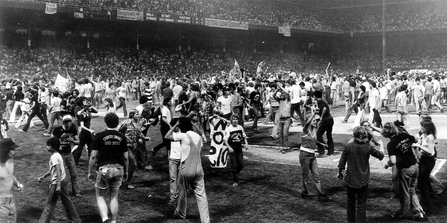
I’m forced to admit that there was one time where someone truly engaged his target audience—and that was during Steve Dahl’s “Disco Demolition Night.”
Dahl was not a disco fan, since he lost his WDAI radio job when his then-employer switched to a disco format. As a counter-reaction to disco, Dahl entertained baseball fans on Disco Demolition Night by destroying disco records between two games of a doubleheader. 7,000 fans stormed the field in delirious joy, wrecking the field, and the second game of the doubleheader was never played. This was NOT a good thing. But the White Sox survived, and even celebrated the 40th anniversary of the promotion. Dahl threw out the first pitch. Nothing exploded. But nothing was accomplished.
So if “target audience” isn’t the right term to use, what is?
I’ll grant that “needy people” has a negative connotation, like the person who is sad when people forget their birthday. (Not “ghosting” per se, but perhaps a little “boo.”) But “needy people” is certainly better than “target audience.”
“Needy” is stronger than “target.” Rather than just representing a demographic, it actually represents people who truly NEED things. Just because a company needs content for its website doesn’t necessarily mean that it needs Bredemarket. Many companies have their own people to create content.
And for the reasons stated by Daily Copyrighting, “people” is stronger than “audience.” You are not a faceless audience that claps (or screams) when Bredemarket does its song and dance. You are people who work in a certain way, which I why I talk to people before creating content for them.
This “needy people” phrase sounded good a few days ago, but now that I’ve thought about it some more I see some problems with this formulation also. In addition to the negative connotations of the phrase, the mere fact that someone is “needy” doesn’t necessary mean that they will buy Bredemarket’s services. Take my identification of “needy people” from a few days ago:
My mini-survey shows that of the 40+ identity firms with blogs, about one-third of them HAVEN’T SAID A SINGLE THING to their prospects and customers in the last two months.
Yes, these companies are damaging their future prospects and need Bredemarket. But none of these companies has approached Bredemarket, or any other marketing and writing consultant, or their in-house people.
Perhaps they don’t see the problem at all.
Perhaps they see the problem, but don’t want to spend money (even a few hundred dollars) to fix it.
Perhaps they see the problem but don’t consider it as critically important as the other problems they face. Rather than spending a few hundred dollars, some companies are saving millions of dollars by “rightsizing” by 10-20% and cutting marketing budgets. They’re just fine with spiderweb-covered blog pages.
Because “needy people” doesn’t capture my meaning, I’ll do the recommended thing and use this blog post to throw up another idea.
The problem with the term “hungry people”
My latest iteration of “target audience” is “hungry people.” I figure that unlike “needy people,” “hungry people” are more inspired to act on their needs. They don’t just clap or scream; they are motivated to search for something to eat.
Using my example of the non-blogging identity firms, perhaps some of those quiet firms are troubled by their lack of communication with their prospects and clients. Rather than doing nothing, these firms are ready to plug their communications gap. But will they plug it with healthy food, or with junk food?
Even without writers, companies can unleash a content creation boom with generative AI. By feeding the AI brand guidelines, target audience data, and product specifics, they can churn out blog posts, ad copy, product descriptions, and even social media snippets. This AI assistant generates captivating headlines, outlines engaging narratives, and drafts basic texts, all while maintaining brand voice and SEO optimization. AI handles the heavy lifting, freeing up resources for strategic planning and audience engagement, boosting content output from silence to symphony.
I know this may surprise you, but I didn’t write the paragraph above. Google Bard did. And perhaps some hungry companies will opt for the free route and let generative AI write their content rather than contracting or employing a content marketer. Silence to symphony for a $0 budget! I consider this bittersweet.
I let the melody shine, let it cleanse my mind, I feel free now. Even though the melody was from Andrew Loog Oldham, uncredited, resulting in a decades-long copyright dispute between the Verve and the Rolling Stones. From https://www.youtube.com/watch?v=1lyu1KKwC74.
So “hungry” doesn’t quite cut it, since I seek the people who are not only hungry, but who will pay for quality fare such as Bredemarket’s marketing and writing services.
To be continued
In this case, the blog post IS a temporary expression of thought. I’ve determined that “target audience” is an imperfect phrase and that I need to replace it with SOMETHING, but I haven’t figured out what that “something” is yet.
Until I get a better idea, I’ll use “hungry people” in my internal work, but I won’t change my customer-facing work (such as the e-book) until I come up with an effective alternative to “target audience.”
And one more thing
And unless I get a sudden brainstorm, this will probably be the last Bredemarket blog post for 2023, and I’m currently ruminating about the first question I asked in this post regarding prospects for 2024. While there were some positive things that happened this year, the negatives during the last seven months tended to outweigh the positives. A lot of other people are also experiencing this, so I’m sharing this song for those who are glad that 2023 is almost over, and who hope that 2024 isn’t more of the same.
Gartner has released a new report, “Emerging Tech: Security — How to Stay Relevant as an Identity Verification Vendor.” Because it’s better to be relevant than to be irrelevant.
Identity verification (which Gartner defines as the ID-plus-selfie process) is arguably the topic that I get the most inquiry calls about, but I also cover >70 vendors in this space. My end-user clients struggle to differentiate between them, and as the market evolves, it will become tougher to stand out in the crowd.
There are many different ways to tell the sellers from the non-sellers, but one key way (at least as far as I’m concerned) is that sellers are saying things.
If you’re not saying things, then you’re not a seller.
And you’re not selling.
If you want to sell, maybe you should say stuff.
Whether you are an identity/biometric firm, a technology firm, or a firm located in California’s Inland Empire, Bredemarket can help you create the blog posts, case studies, white papers, and other content your firm needs.
Click on one of the images below to start to create content that converts prospects for your product/service and drives content results.
















 Bredemarket