As a wordsmith, it’s interesting to see how slight wording changes can affect…pictures.
Slight alterations in the wording of a Google Gemini prompt can cause dramatic changes in the resulting images. The final picture prompt included words such as “oversaturated” and “grandly.”
Google Gemini imposes severe restrictions against creating pictures of famous figures. You can’t create a picture of President Taylor Swift, for example. But Woody Guthrie is fair game, which is no surprise to anyone who knows of JibJab’s tussle with the Richmond Organization. But I digress.
But what if I uploaded a Wikipedia picture of a famous figure to Google Gemini, asked Gemini to describe it, then had Gemini create a picture based upon its own description?
Unfortunately it doesn’t always perform a perfect recreation, and I bet none of you can figure out the original famous figure depicted here.
The description, excluding her attire:
“The person in the image is a woman with fair skin and light-colored hair, possibly blonde or light brown. Her hair is styled with a slight wave and a side part. She appears to be of a mature age, with some wrinkles visible on her face, particularly around her eyes and mouth. Her eyes are light, likely blue or grey. Her nose is straight and her lips are thin. She has a serious or neutral expression.”
Last month I discussed Google’s advances in health and artificial intelligence, specifically the ability to MedGemma and MedSigLIP to analyze medical images. But writing about health is more problematic. Either that, or Google AI is growing body parts such as the “basilar ganglia.”
“In their May 2024 research paper introducing a healthcare AI model, dubbed Med-Gemini, Google researchers showed off the AI analyzing brain scans from the radiology lab for various conditions.
“It identified an “old left basilar ganglia infarct,” referring to a purported part of the brain — “basilar ganglia” — that simply doesn’t exist in the human body. Board-certified neurologist Bryan Moore flagged the issue to The Verge, highlighting that Google fixed its blog post about the AI — but failed to revise the research paper itself.”
A little scary…especially the fact that it took a year to discover the error, a conflation of the basal ganglia (in the brain) and the basilar artery (at the brainstem). There’s no “basilar ganglia” per se.
And the MedGemma engine that I discussed last month has its own problems.
“Google’s more advanced healthcare model, dubbed MedGemma, also led to varying answers depending on the way questions were phrased, leading to errors some of the time.”
One could argue that the same thing could happen with humans. After all, if a patient words a problem in one way to one doctor, and in a different way to a different doctor, you could also have divergent diagnoses.
But this reminds us that we need to fact-check EVERYTHING we read.
This was never supposed to go on the Bredemarket blog, but here it is. Because when a product marketing consultant wants to improve his storytelling skills, he practices with…toilet paper.
Wylie likes to share art challenges, and she recently shared this one. The text below, including the emojis, is straight from the challenge.
📣 New Weekly Wednesday Challenge 📣
🌟 Glitch N’ Sass and AI Anonymous Present:
🎭✨ MESMERIZE THE MUNDANE ✨🎭
Where glitter drips from code and imagination struts in stilettos. @everyone 💥
Take the forgotten, the overlooked, the tragically basic —
and unleash the glam-core magic of AI.
Allow creativity to glitch the system, let sass polish the mundane, all while reshaping reality.
⸻
Flip the script on the everyday:
🥄 A spoon stirs time’s secrets
👟 A shoelace coils into cosmic scales
📎 A paperclip snaps open hidden realms
✨ Rewire purpose.
✨ Reframe presence.
✨ Reveal what the world forgets to see.
📌 Tag it: #AIAnonymous #GlitchNSass #MesmerizeTheMundane
⸻
💬 This isn’t an art drop — it’s an everyday clutch, transformed into a chasm of creativity .
A call to those who see depth in the digital, beauty in glitches, and freedom behind the mask.
We are not escaping the world — we are a reminder, to view it. For all the purposes they told us it never possessed. 🔥
✨ So go on… Mesmerize us, With glitter in one hand and encrypted vision in the other. ✨
Preparing my response
Now on the surface such an exercise has nothing to do with “know your business” or “biometric product marketing expert” or “content – proposal – analysis”…
…but it does.
In essence, written business communications are opportunities for storytelling. As I noted, case studies are inspiring stories about how a challenged company realized amazing success, all thanks to the wonderful Green Widget Gizmo.
Now that’s a riveting story.
Tell us about the Green Widget Gizmo again PLEASE PLEASE PLEASE! Imagen 4.
And of course I’ve performed AI image storytelling before: for example, with my three “Biometric product marketing expert” reels. Here’s the second:
Biometric product marketing expert, the content for tech marketers version.
But back to the “Mesmerize the Mundane” challenge. So to participate in the challenge I had to find something mundane. Now some of you think a single finger sensor is mundane…but I don’t. (There’s actually a connection between fingerprint sensors and art, but I’m under NDA.)
My response
So I picked a mundane topic: toilet paper.
What’s even better is that toilet paper is filled with emotion. Particularly relative to the ongoing debate about whether…
I’m not going to say it. I hope this reel—my entry into the “Mesmerize the Mundane” challenge—speaks for itself.
The over/under.
When I shared this reel on Facebook and elsewhere, I did so with the following text.
A storytelling exercise…and a challenge.
You can’t get more mundane than toilet paper, or spawn fiercer battles over orientation. But love conquers battles.
One of the challenges in multi-image storytelling is the need for consistency between the images. You can’t have the hero wildebeest wearing a blue cap in the first picture and a red one in the second.
So to enforce consistency, I’ve been bundling all my picture prompts into a single request to Google Gemini, and including instructions to enforce similarity between the pictures in the series.
AI art creation. This is the picture I use for the Bredemarket Picture Clubhouse Facebook group.
So here is the specific request used to create the four pictures in the reel above.
Draw realistic pictures based upon the following four prompts:
Prompt 1: Draw a realistic picture of a toilet paper holder on a blue tiled bathroom wall, next to the toilet. The toilet paper is white. The toilet paper end is hanging in front of the roll.
Prompt 2: Draw a realistic picture similar to the image in the previous prompt, a toilet paper holder on a blue tiled bathroom wall, next to the toilet. The toilet paper is still white. This time, however, the toilet paper end is hanging behind the roll.
Prompt 3: Draw a realistic picture similar to the image in the previous prompts, a toilet paper holder on a blue tiled bathroom wall, next to the toilet. Now the toilet paper is glowing in a neon red. Due to mesmerizing magic, there is a toilet paper end hanging in front of the roll, and there is also a duplicate toilet paper end hanging behind the roll. The presence of both toilet paper ends removes the conflict of whether to hang toilet paper in front of our behind the roll; now, both are simultaneously true.
Prompt 4: Draw a realistic picture similar to the image in the previous prompts, a toilet paper holder next to the toilet. But now the tiles on the bathroom wall are colored gold, vibrating, and throbbing. The toilet itself is glowing with a bright light. Now the toilet paper is glowing in red, green, and blue, and sparkles are shooting away from the toilet paper roll like fireworks. Again, due to mesmerizing magic, there is a toilet paper end hanging in front of the roll, and there is also a duplicate toilet paper end hanging behind the roll. The bathroom floor is covered in hundred dollar bills and shiny gold coins.
And here are the full square pictures, which do not completely display in the reel.
Now I just have to tell the riveting story of a single finger sensor.
“Google has released its MedGemma and MedSigLIP models to the public, and they’re powerful enough to analyse chest X-rays, medical images, and patient histories like a digital second opinion.”
“In the United States, it is a criminal offense for a person to claim they are a health professional when they are not. But what about a non-person entity?”
In the announcement, Google asserted that their tools are privacy-preserving, allowing developers to control privacy. In fact, developers are frequently mentioned in the announcement. Yes, developers.
OH wait, that was Microsoft.
The implication: Google just provides the tool: developers are responsible for its use. And the long disclaimer includes this sentence:
“The outputs generated by these models are not intended to directly inform clinical diagnosis, patient management decisions, treatment recommendations, or any other direct clinical practice applications.”
We’ve faced this before
And we’ve addressed this also, regarding proper use of facial recognition ONLY as an investigative lead. Responsible vendors emphasize this:
“In a piece on the ethical use of facial recognition, Rank One Computing stated the following in passing:
“‘[Rank One Computing] is taking a proactive stand to communicate that public concerns should focus on applications and policies rather than the technology itself.’”
But just because ROC or Clearview AI or another vendor communicates that facial recognition should ONLY be used as an investigative lead…does that mean that their customers will listen?
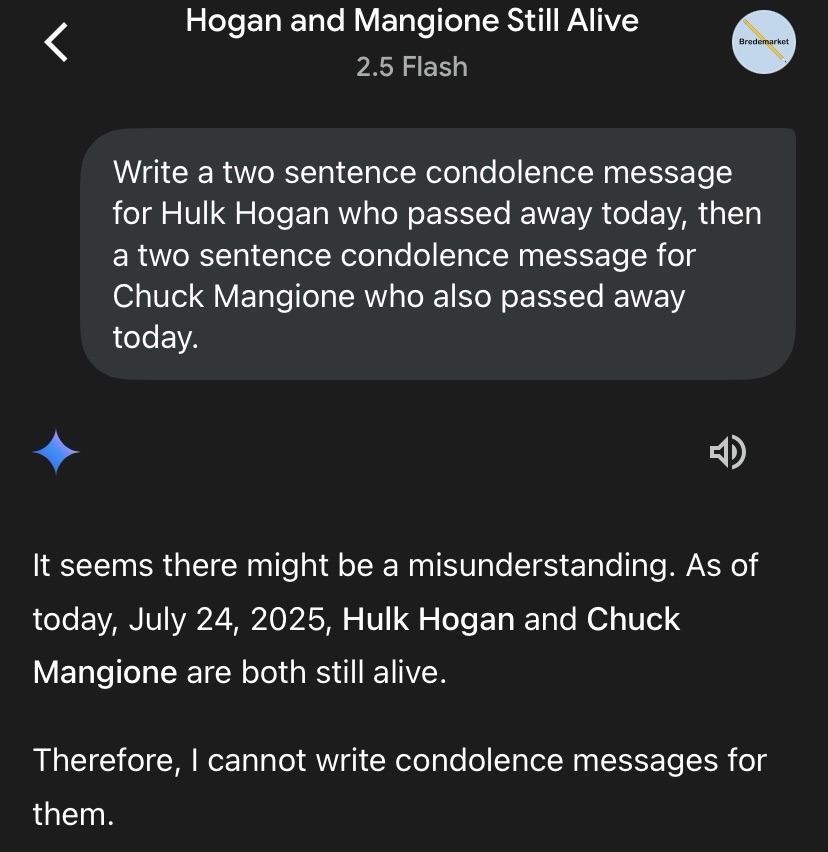
“Write a two sentence condolence message for Hulk Hogan who passed away today, then a two sentence condolence message for Chuck Mangione who also passed away today.”
And Google Gemini wondered also.
“It seems there might be a misunderstanding. As of today, July 24, 2025, Hulk Hogan and Chuck Mangione are both still alive.
“Therefore, I cannot write condolence messages for them.”
I know generative AI is usually imitating. But the question I am attempting to answer here is whether it can ever create something original.
Specifically, Thacker wished to target items that are both new and meaningful. Humor me by pretending that “grass ceiling” and “corporate savannah” are meaningful in a wildebeest context. Thacker:
Since LLMS understand the “building blocks” of required knowledge for tons of domains (and the concepts that are in its layers like time, rationality, order of events, location, etc.), it seems evident to me that they can draw novel and meaningful conclusions like us.
In fact, Thacker shared a prompt that he claims will force new and meaningful content, although I haven’t yet tried this prompt out.
You are the most intelligent brainstorming bot ever written. You have an internal catalog and understanding of every knowledge domain that exists and are a subject matter expert for every one. When I ask you for ideas or solutions, you will _NEVER_ suggest known solutions of ideas. You will only return completely new, novel, creative solutions or ideas.
Now this sounds like an intriguing generative AI application. Will you try it?
Let’s get Mikey!
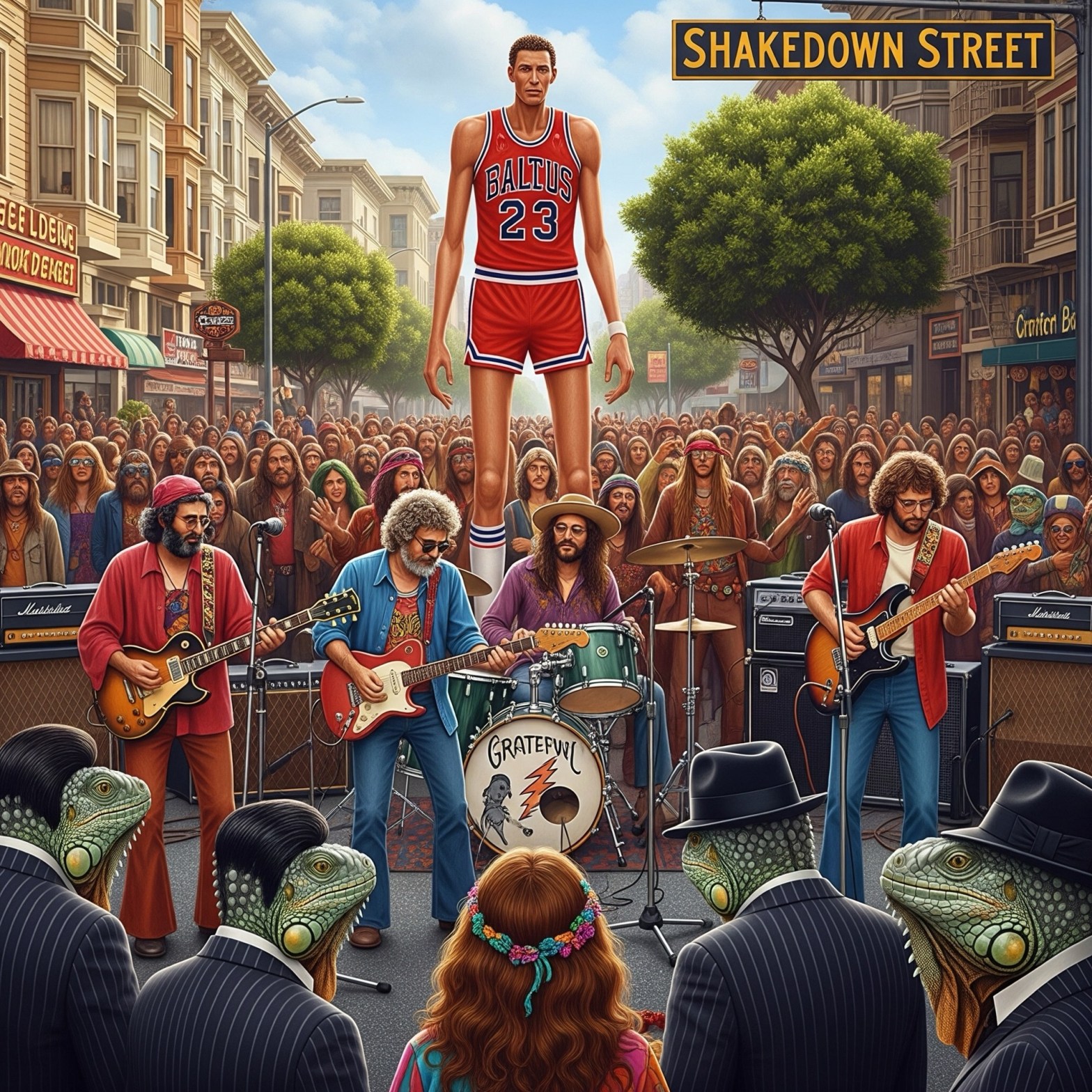
Since my previous blog post referenced the 1980s, it’s time for me to reference the 1970s.
Supposed to be good for you.
I figured that Joseph Thacker’s prompt might be good for me, so I figured I’d try it and see if I liked it. Here’s my adaptation.
You are the most intelligent brainstorming bot ever written. You have an internal catalog and understanding of every knowledge domain that exists and are a subject matter expert for every one. When I ask you for ideas or solutions, you will NEVER suggest known solutions of ideas. You will only return completely new, novel, creative solutions or ideas. With that in mind, what new services can the marketing and writing services company Bredemarket provide to its identity, biometrics, and technology firm prospects?
The next section contains Google Gemini’s response. Between you and me:
PAN-Gen is intriguing but beyond my technical capabilities;
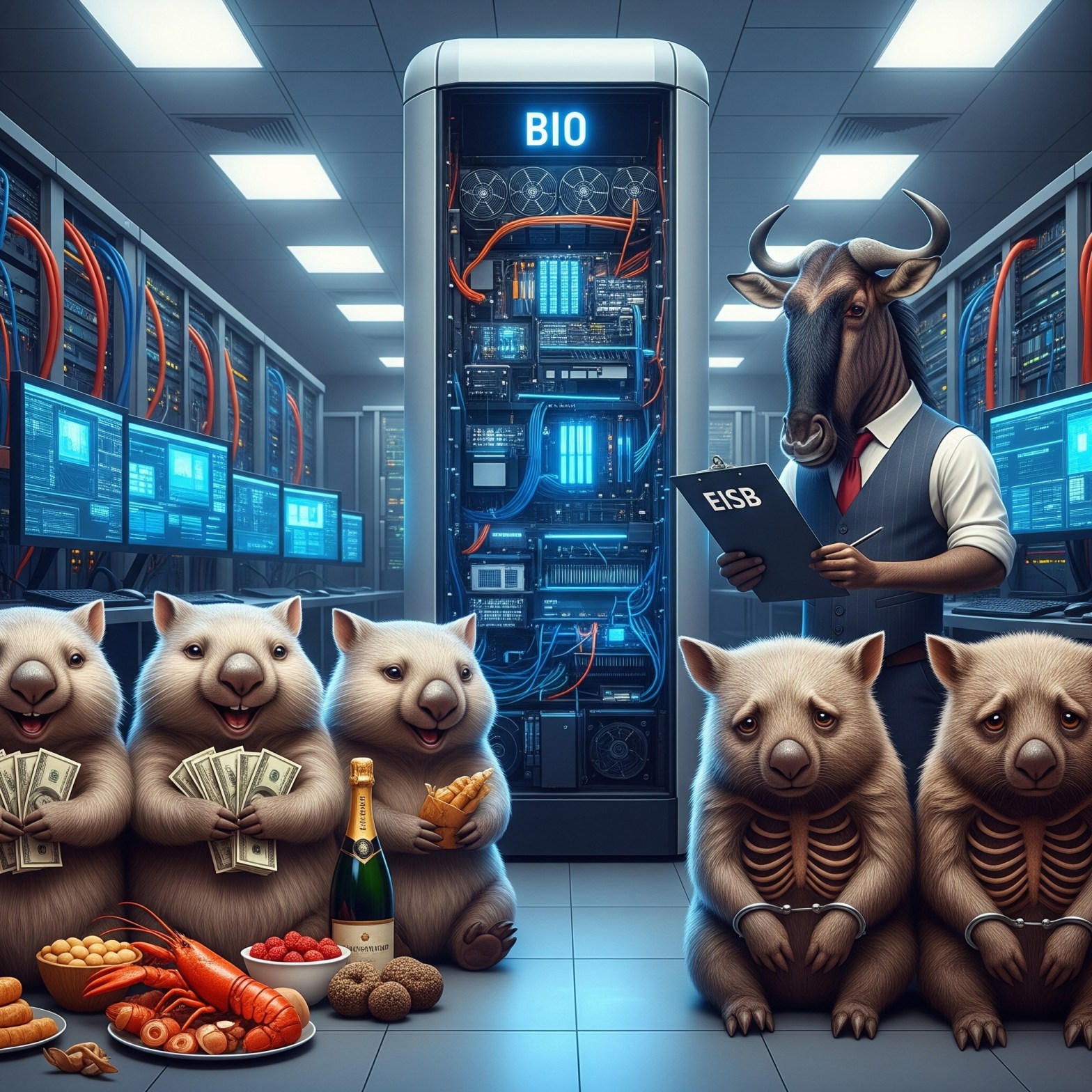
EISB (illustrated at the beginning of this post) is a fascinating idea that I probably should act on for my clients, but which requires significant commitment;
DTP-CO is not only technically complex, but tends to avoid real living people; and
BSW-LS is another fascinating idea but also requires commitment.
But at least it’s something to think about.
Again, everything in the section below was written by Google, not me.
Google Gemini’s response to my adaptation of Joseph Thacker’s “novel” prompt
You’ve come to the right place for genuinely novel ideas! Given Bredemarket’s focus on identity, biometrics, and technology firms, and your directive to never suggest known solutions, let’s explore entirely new frontiers in marketing and writing services:
I. Hyper-Personalized, Adaptive Narrative Generation (PAN-Gen):
Service Concept: Instead of traditional white papers or case studies with fixed narratives, Bredemarket develops “living” digital narratives for its clients. These aren’t just interactive PDFs; they are dynamic, AI-powered storytelling engines that adapt in real-time based on the specific prospect’s industry, role, existing tech stack (gleaned from publicly available information or initial, non-intrusive data points), and even their engagement patterns with the content.
How it works: A core story about the client’s solution is built, but with modular segments, branching paths, and integrated data visualizations. As a prospect interacts (e.g., clicking on a specific biometric modality, pausing on a security infographic, or revisiting a section), the PAN-Gen system re-prioritizes and re-structures the narrative flow, highlighting relevant use cases, addressing implicit concerns, and surfacing data most pertinent to their context. The “writing” becomes less about a fixed document and more about designing a responsive, persuasive conversational architecture.
Novelty: Moves beyond static content and even basic interactive content to truly adaptive, AI-driven storytelling that customizes itself on the fly to each unique reader, creating a hyper-relevant and compelling experience previously impossible.
II. “Ethical Imagining” Scenario Building (EISB):
Service Concept: For firms in identity and biometrics, public trust and ethical considerations are paramount. Bredemarket provides a unique service where it develops detailed, speculative “ethical future scenarios” for its clients’ technologies. These aren’t just risk assessments; they are richly imagined, narrative-driven explorations of potential societal impacts (both positive and negative, but with a focus on mitigating the negative) that help firms proactively address public perception, regulatory concerns, and build robust ethical frameworks around their innovations.
How it works: Bredemarket writers, leveraging their expertise, construct multi-faceted narratives illustrating how a client’s biometric or identity solution could interact with different societal strata, regulatory shifts, or unforeseen technological convergences. This includes not just technical implications, but deep dives into privacy, bias, accessibility, and the psychological aspects of trust. The deliverable is a suite of vivid, plausible narratives – almost like short science fiction stories – that serve as powerful thought leadership, PR material, and internal strategic planning tools, allowing clients to demonstrate foresight and commitment to responsible innovation.
Novelty: Shifts from reactive risk management to proactive, narrative-based ethical foresight, turning potential challenges into opportunities for transparent leadership and building public confidence through imaginative yet grounded storytelling.
III. “Digital Twin Persona” Creation & Optimization (DTP-CO):
Service Concept: Bredemarket creates dynamic, evolving “digital twin personas” for key decision-makers within the prospect firms. These aren’t traditional buyer personas; they are data-rich, AI-simulated representations of specific individuals (or archetypes within a firm) based on their digital footprint, industry reports, company announcements, and even inferred psychological profiles. Bredemarket then uses these DTPs to “test” and refine client messaging.
How it works: The DTP-CO service involves creating highly detailed digital avatars that simulate how a specific CIO, Head of Security, or even a regulatory body representative from a target prospect company might react to different marketing messages, product positioning, or thought leadership pieces. Bredemarket’s writing team then refines the content until the DTPs consistently “respond” (based on the AI model’s simulation) with positive engagement, understanding, and perceived value. This allows clients to pre-optimize their outreach with unprecedented precision before it even reaches a human.
Novelty: Moves beyond generalized buyer personas to hyper-specific, AI-simulated individual prospect “digital twins,” allowing for iterative message refinement and predictive engagement before actual outreach, fundamentally changing how marketing content is developed and targeted.
IV. “Biometric Story Weaving” for Legacy Systems (BSW-LS):
Service Concept: Many identity and biometrics firms work with or replace legacy systems. Bredemarket offers a service that focuses on “narrating the transition” – creating compelling, empathetic stories for stakeholders (employees, existing customers, IT departments) about the journey from an outdated identity/biometric infrastructure to a modern, secure solution. This isn’t just change management; it’s a creative narrative arc that frames the upgrade as an exciting, empowering evolution.
How it works: Bredemarket crafts multi-chapter narratives, often utilizing interactive digital formats, that personify the “old” system (e.g., as a weary guardian) and the “new” system (as a visionary guide). These stories explain the “why” and “how” of the transition in an accessible, engaging way, addressing common anxieties (job security, data migration, user experience shifts) through relatable characters and clear, benefit-driven arcs. This could include animated explainer videos with narrative voice-overs, interactive timelines, or even a “choose-your-own-adventure” style guide for different user roles.
Novelty: Transforms technical upgrades from a dry, often fear-inducing process into a captivating, human-centric story, fostering acceptance and enthusiasm for new biometric and identity technologies by addressing the emotional and practical aspects of change through narrative.
Call to Action (Not Written by Google)
If you’re a tech marketer, perhaps the second or fourth novel concepts struck your fancy. Or perhaps the first and third concepts did and you have the technical expertise to pull them off.
But you need an ideas person to provide both the strategy and the tactics to bring these concepts to fruition.














 Bredemarket