The Pros and Cons of California Senate Bill 988, the Freelance Worker Protection Act

The Freelancers Union wants me to write my state senator and voice my support for California Senate Bill 988, called either the “Freelance Isn’t Free Act” or the “Freelance Worker Protection Act” depending upon who you ask.

I’m not sure if that’s a good thing.

This post talks about:

What is a freelancer?

Semantics are semantics.

I do not choose to refer to myself as a “freelancer”—my preferred term is “sole proprietor.” But for practical purposes there is no real difference between a non-incorporated freelancer, sole proprietor, independent contractor, or whatever word you want to use to describe people who conduct business on their own without creating a partnership, a limited liability company, or some type of corporation. (If I incorporated, I’d have to pay the state of California $800 a year, as we will see later.)

But in certain circles, the term “freelancer” is in vogue, and I really don’t have a problem with it.

Look for the union label

There’s even a union. Sort of.
The Freelancers Union, based in Brooklyn, New York, advocates for freelancers. My major point of contact with the Freelancers Union has been the SPARK groups that host meetings on a monthly basis. Between 2020 and 2022 I was regularly attending the virtual (COVID-imposed) meetings of the Orange County, California SPARK group. The meetings have definitely been helpful; that’s where I learned about brand archetypes, and it’s where I learned about the business-to-business exemptions for classifying workers as employees or non-employees in California. For example, I learned that California Assembly Bill 5 (AB 5) was superseded by Assembly Bill 2257 (AB 2257).

While Orange County is changing, it still has a reputation as a not-so-leftist place, so our local SPARK chapter didn’t march around and create rhymes and call people scabs.

To my knowledge there are no Freelancers Union chapters in France. This is probably a good thing. By Siciliathisma – Own work, CC BY-SA 4.0, https://commons.wikimedia.org/w/index.php?curid=129832260

Actually, the Freelancers Union isn’t really a union. We don’t pay dues (although the Freelancers Union accepts donations), and we don’t picket against clients who don’t support the union. For obvious reasons, since a single picketing freelancer can’t shut down a company in the same way that a mass of picketing employees can shut down, say, a Starbucks. (Or try to.)

But while the Freelancers Union can’t strike, it can impact legislation.

The first “Freelance Isn’t Free” law

The Freelancers Union’s initial target jurisdiction was its home city of New York, where the first “Freelance Isn’t Free” law was passed in 2017.

Several of the new rights granted under the law include a right to a written contract and timely payment for work performed and freedom from retaliation and discrimination when they exercise their rights. In addition, the law provides for an award of double damages and attorneys’ fees to freelancers who prevail on their claims in court.

From https://blog.freelancersunion.org/2018/05/15/how-to-file-a-nonpayment-claim-with-the-nyc-department-of-consumer-affairs/

The Freelancers Union and the city of New York define “timely payment” as net 30 terms.

Which reminds me of a bandleader I used to know.

California knows how to party

As some of you know, my 25-year history with IDEMIA stretches back a long way. I started with a company called Printrak International, at the time an independent company first privately owned, then traded on NASDAQ. Despite its lofty position as a publicly traded company, it was a pretty small, informal outfit.

Until Printrak was acquired by Motorola, a huge multinational firm with almost 150,000 employees and a presence in police radios, cellular telephones, and many other industries. While the company shrunk during the years I was an employee, it was still a pretty big outfit.

One thing that didn’t change was the annual Users Conference held for the law enforcement agencies that used our software. By the time Motorola acquired Printrak, that software was called Omnitrak, and would later be renamed Printrak BIS.

The Users Conferences (which IDEMIA continues to this day) have always been a mixture of education and entertainment. Education in the form of training in the use of Omnitrak/Printrak BIS and in forensic techniques, and entertainment in the form of a midweek party and an end-of-week banquet.

That’s where my coworker comes in. I’m not going to refer to him by name; for purposes of this blog post I’ll refer to him as “Cliff.”

By Paramount Pictures – Netflix, Fair use, https://en.wikipedia.org/w/index.php?curid=50708166

Now Cliff, who had been with the company longer than I had, thought he’d do a favor for his employer Motorola. He’d assemble a band to play at the midweek party and bill Motorola for the band’s services.

That’s when Cliff learned just how big Motorola is.
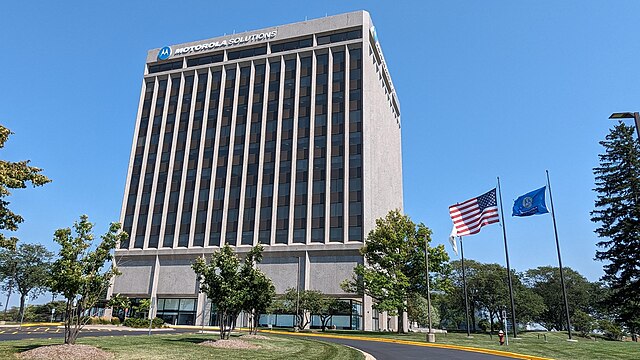
Motorola Solutions (formerly Motorola) previous headquarters on the Schaumburg, Illinois campus. Motorola Solutions subsequently moved to the city of Chicago. By CacioPepeLePu – Own work, CC BY-SA 4.0, https://commons.wikimedia.org/w/index.php?curid=137584046

You see, if you want to do business with a big company like Motorola, you have to play by Motorola’s rules. And in the case of Motorola, that meant net 45 terms.

So Cliff wouldn’t get paid for 45 days, but he’d have to pay his band members long before that.

Ouch.

California knows how to legislate

Now if the Freelance Isn’t Free Act provisions had applied at the time, Motorola would have been required to pay Cliff within 30 days. However, this incident occurred long before the Freelance Isn’t Free act was passed, and the incident occurred outside of the jurisdiction of New York City.

While versions of the Freelance Isn’t Free Act have been passed in a few other jurisdictions, including the city of Los Angeles, the state of California was not governed by such a law.

That may change.

We have some exciting news! Just last week California State Senator Scott Wiener introduced Senate Bill 988 (SB 988) or as we like to call it, the Freelance isn’t Free Act. As in other parts of the country, where we have been successful in implementing similar laws, it aims to ensure fundamental protections for freelance workers, enforced by the State Labor Commissioner and the Attorney General. These protections include the right to a contract, prompt payment within 30 days of completing work, and the right to double damages for non-payment.

From https://blog.freelancersunion.org/2024/02/08/new-legislation-introduced-to-expand-freelance-protections-to-california-state/.
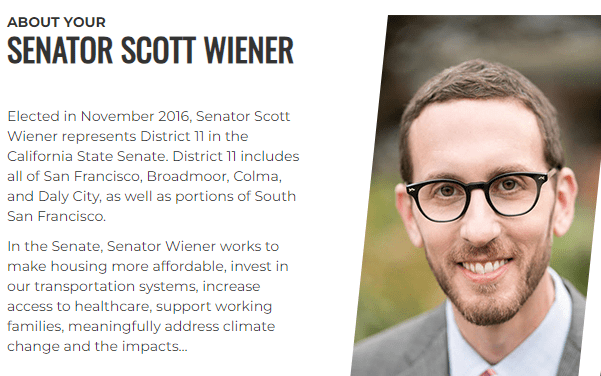
It turns out that Senator Wiener didn’t adopt the Freelancers Union’s preferred branding, and instead called his bill the “Freelance Worker Protection Act.” I don’t know if this means that I’m supposed to picket the Senator, but the bill title is what it is.

Why do we need a bill covering all of California when there’s already a bill in Los Angeles? The Freelancers Union addresses this:

Similar legislation was passed in the City of Los Angeles in February 2023, but it has limitations, notably covering only work performed within county limits. Given the rise of remote freelancing, especially due to the pandemic, this loophole disincentivizes hiring freelance workers residing and working in Los Angeles.

From https://blog.freelancersunion.org/2024/02/08/new-legislation-introduced-to-expand-freelance-protections-to-california-state/.

We’ll come back to this in a minute.

The pros of CA SB988

As a freelancer, CA SB988 obviously benefits me, primarily because it helps me get paid. If a client stiffs me, I can sic lawyers on them and then the client will REALLY have to pay.

Enough said.

The cons of CA SB988

However, not all is rosy for freelancers if SB988 passes, and it potentially impacts me personally.

A couple of years ago, I signed a contract with another multinational company. And this contract has net 90 terms. I’m not all that happy about it, but if this is what it took for me to do business with that company, then this is what it took.

If SB988 passes, then I will need to go to this multinational and inform them that since I am a California resident, those 90 day terms are now illegal, and you will have to amend these to net 30 terms if you wish to enjoy the marketing and writing services of Bredemarket.

And of course I’m sure that the multinational will readily agree…

…that because of the requirements imposed by the state of California, perhaps the multinational doesn’t need to do business with Bredemarket any more. There are certainly talented writers in South Dakota or India who can write things that are “good enough” for this particular multinational.

At this point it is impossible to predict the number of freelancers who will lose some income because their clients insist on terms greater than net 30. Because the similar Illinois law won’t go into effect until July 1, and appears to only affect contracts executed after that date, it’s too early to tell whether large companies will refrain from doing business with freelancers in Illinois due to the state’s “onerous” conditions. The same could hold true in California.

Could freelancers in certain states be shut out of contracts? It’s already happening with employees. And one person who employed someone from California found out the hard way that California labor requirements can be onerous:
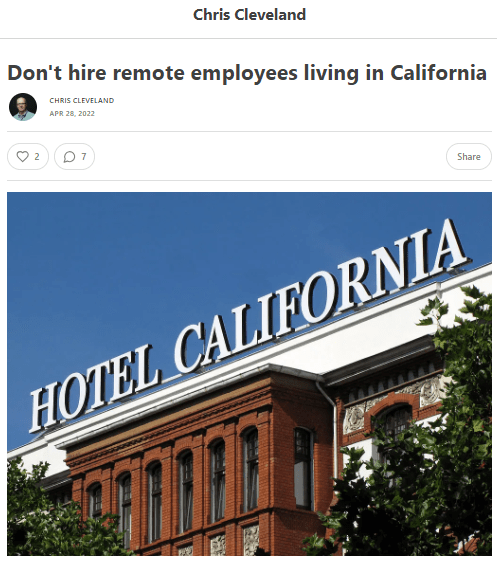
You’d think that I could simply tell them (the California Employment Development Department) that I’m not doing business in California and be done with it. No — California defines “doing business” in a number of ways, one of which is to have more than 25% of your payroll in California. Which I had, because I had only one employee.

So now, because I employed one of their residents, I’m fully subject to California regulation. I have to file all of the employment-related forms, including those pertaining to withholding and unemployment insurance (which I expected). I also have to register my company with the California Secretary of State and renew my information every year or face penalties, and apparently I have to file a corporate income tax return

You’d think I’d be able to file a simple return, file zeroes on it, and be done with it. But no — I had to pay my accountant to do it, and the form is literally 42 pages long. That cost a few hundred dollars. And in the end, I still owed them $800. For 2019 alone; I’ll also owe them for 2020 and 2021.

I owe $800 for the “minimum franchise tax”. California charges this fee to everyone for the “privilege” of “doing business” in California, whether they have revenue or not. Only a few states have a business franchise tax, and California’s is wildly higher than anywhere else. This is in addition to California’s generally out of control taxes.

From https://ccleve.com/p/dont-hire-remote-employees-living.

So if California ends up being marked with a big red X by employers, will California also end up being marked with a big red X by companies hiring independent contractors?

Time will tell.

Why is Kaye Putnam happy that I’m IGNORING her marketing advice?

This is the cover art for the album Parsley, Sage, Rosemary and Thyme by the artist Simon & Garfunkel. The cover art can be obtained from Columbia. Fair use, https://en.wikipedia.org/w/index.php?curid=2184092

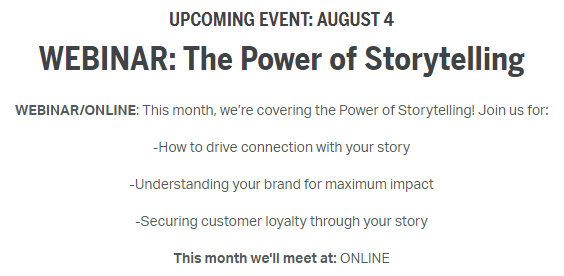
A few hours after finishing my revision of Bredemarket’s work process, I attended this month’s Orange County (California) Freelancers Union SPARK webinar. I’ve shared some things from SPARK meetings in the past (July’s happy hour, May’s AB2257 discussion), and I’m going to share some things from the August meeting also.

Jung and the restless

This meeting (which also happened to be the national Freelancers Union meeting for the month; our chapter rules!) was led by Cara Raffele, who spoke about “The Power of Storytelling.”

From https://www.freelancersunion.org/community/spark-events/#spark–monthly-theme, although it might have changed by the time you read this.

I’m not going to talk about the ENTIRE meeting, but will focus on the last part of the meeting, during which Raffele discussed “understanding your brand for maximum impact,” or brand archetypes.

The idea of archetypes started with Carl Jung, who defined them as images and themes that derive from the collective unconscious.

Jung claimed to identify a large number of archetypes but paid special attention to four. Jung labeled these archetypes the Self, the Persona, the Shadow and the Anima/Animus.

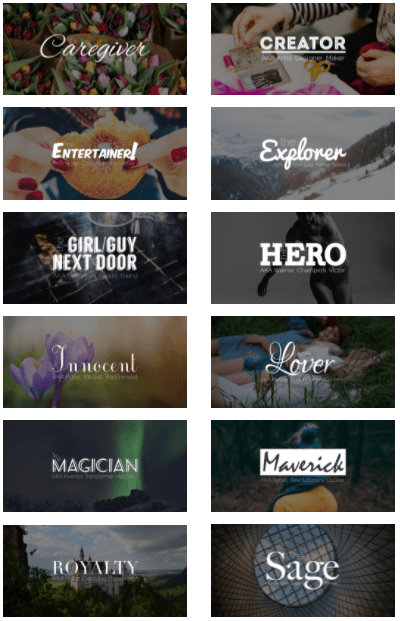
In modern-day marketing, this “large number of archetypes” has been boiled down to twelve, and it was these twelve that Raffele referenced in her presentation.

Twelve archetypes. From https://www.kayeputnam.com/brandality-archetypes/. More about Kaye Putnam later.

Raffele encouraged all of us freelancers to listen to all twelve, and then to select multiple archetypes (not just one) that seemed to reflect our freelance brands. So I iterated a first cut at the archetypes that I believed applied to Bredemarket; my preliminary list included Sage, Creator, and Explorer.

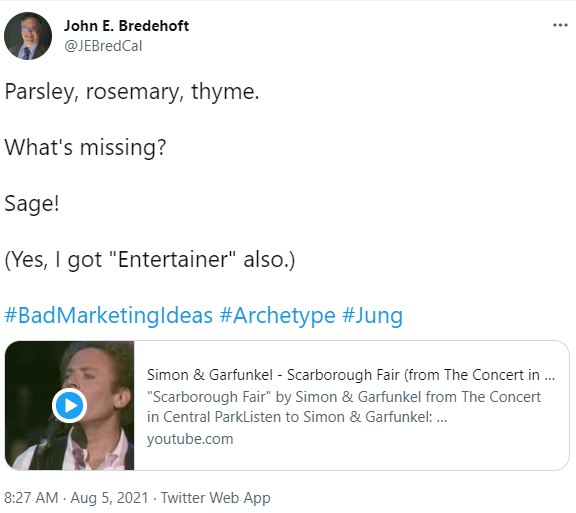
Why Sage? That particular one resonated with me because of my experiences with my clients (educating on benefits vs. features, expanding the understanding of law enforcement agency stakeholders), and because of the way I’ve been marketing myself anyway. After all, when I self-reference as the biometric content marketing expert and the biometric proposal writing expert, then it’s obvious that I can add the sage to my clients’ parsley, rosemary, and thyme. (Sorry, couldn’t resist, even though I know it’s bad.)

But after guessing that Bredemarket is Sage with a pinch of Creator and Explorer, I realized that I might not know myself as well as I thought, so I asked if there were some type of online “archetypes test,” similar to the online Meyers-Briggs personality tests, that could help you semi-independently discern your archetypes.

Raffele responded by pointing us to Kaye Putnam and her online Brand Personality Quiz.

(One aside before moving on to Putnam’s test. A few of you realize that I did not come up with the section title “Jung and the restless” on my own. Yes, I stole it from a Steve Taylor song title (and he stole it from a soap opera). I used the title even though Taylor is frankly not that positive about secular psychology. But he did say “some of my best friends are shrinks.” Oh, and that’s obviously Gym Nicholson of Undercover fame on guitar.)

From https://www.youtube.com/watch?v=5JNOMb_IG8I.

My “Brand Personality Quiz” results, and Kaye Putnam’s recommendations

If you’ve taken an online Meyers-Briggs personality test, or any other similar online test, the process of the Brand Personality Quiz will seem familiar to you. Putnam’s quiz asks you a series of independent questions, some of which have as many as twelve options. It then tabulates your answers against attributes of the twelve brand archetypes, and produces a final result listing a primary brand archetype and some secondary archetypes.

Here are my results.

So if you take Putnam’s quiz as gospel, I was somewhat accurate in my initial self-assessment.

  • Note that “Sage” came first and “Explorer” came second in the quiz results, and those were two of the archetypes I initially tweeted about before taking the quiz.
  • Considering the personal writing style I use in my blog, tweets, and elsewhere, “Entertainer” wasn’t much of a surprise either.
  • Upon further personal reflection, “Royalty” makes sense also. (So bow before me, serfs.)

And after reading Putnam’s description of “Creator” and its emphasis on visual presentation (rather than textual presentation), I can see why this was NOT on the list.

I did not draw this myself. Originally created by Jleedev using Inkscape and GIMP. Redrawn as SVG by Ben Liblit using Inkscape. – Own work, Public Domain, https://commons.wikimedia.org/w/index.php?curid=1692938

Along with my results, Putnam provided a link that allowed me to download a brief description of my primary archetype, Sage. Now this brief description doesn’t include all of the detail found in Putnam’s 12 Brandfluency courses (one for each archetype), but it does include many actionable items.

The “Sage Inspiration Kit” provides useful tips for Sage businesspeople to include in their brand marketing. The kit asserts that if the tips are followed, the results will produce emotional responses in potential clients that will increase brand attractiveness, thus allowing businesspeople to win more business (and win better business).

Tips are provided on the following:

  • Color.
  • Typography.
  • Words.

Obviously that’s a lot of stuff to absorb, even in this brief kit. (The paid course offers tips in additional areas.) And even if I wanted to, I couldn’t change all the colors and fonts in my marketing overnight.

But I could look at Putnam’s word suggestions.

Ignoring the expert

Now Kaye Putnam’s word suggestions are freely available to anyone, but I’m not going to just copy all of them and reproduce them here. Request them yourself. (The link is for the Sage archetype)

But I’ll offer comments on a few of the 18 words and phrases in the kit.

From https://xkcd.com/386/. Attribution-NonCommercial 2.5 Generic (CC BY-NC 2.5).

First off, I’m NOT going to use “think tank” in Bredemarket’s marketing. Perhaps this phrase may resonate for a larger firm, or even for a smaller firm with a team of people addressing their clients’ needs. But it would take a lot of stretching to describer a solopreneur think tank.

Another term that DOESN’T make sense for Bredemarket is “engineering.” Now obviously engineering is a good thing, although I’ve seen cases where engineering is overemphasized. But it doesn’t really make sense for my business, in which I make a point of emphasizing my ability to communicate engineering concepts to non-engineers. The same issues apply with the phrase “the code.”

I won’t go into all of my concerns, but there are several “Sage words” in the list that I would never use for Bredemarket, or would use very sparingly.

And that’s…OK

Remember, of course, that Stuart Smalley is not a licensed practitioner. By http://www.tvacres.com/words_stuart.htm, Fair use, https://en.wikipedia.org/w/index.php?curid=31855280

When someone gives you advice, whether it’s Kaye Putnam or John Bredehoft, you have to judge whether the advice is good for YOU.

Even if you narrow a brand down to one archetype, there are innumerable differences between individuals who align with this archetype. One size does not fit all, and I personally may love the term “experiment” but hate the terms listed above.

Now perhaps I may be wrong in rejecting Putnam’s advice. Perhaps there’s a really, really good reason why I should sprinkle the phrase “think tank” through all of my marketing materials.

But in the end it’s up to the recipient to decide whether or not to follow the advice of the expert. That applies to people giving advice to me, and that also applies to the advice that I give to my clients. (If a client insists on using the phrase “best of breed,” I can’t stop the client from doing so.)

But several of those words and phrases DO seem like good ideas, and I’ll probably make a concerted effort to sprinkle the GOOD words and phrases throughout Bredemarket’s website, social media channels, proposals, and other marketing.

Even though this might require me to re-revise the content creation process that I just revised.

Oh well. It’s good to…experiment with things. After all, Bredemarket is in effect a laboratory in which I like to try solutions out myself before I try to make a case for them with my clients. It’s easier to speak to research-based proven solutions than ones with which I have no experience at all.

By Rembrandt – The Yorck Project (2002) 10.000 Meisterwerke der Malerei (DVD-ROM), distributed by DIRECTMEDIA Publishing GmbH. ISBN: 3936122202., Public Domain, https://commons.wikimedia.org/w/index.php?curid=157824

Did that paragraph sound sage-like? I got six of the words/phrases into that paragraph!

Oh, and if you’re looking for a Royally Entertaining and Exploring Sage…

Bredemarket offers clients deep experience in content marketing, proposals, and strategy. I can offer expert advice to biometrics firms, since (as noted above) I am a biometric content marketing expert and a biometric proposal writing expert. However, this expert advice can also be provided to other technology firms, and to general business.

You can read here about how my content creation process ensures that the final written content (a) advances your GOAL, (b) communicates your BENEFITS, and (c) speaks to your TARGET AUDIENCE.

If Bredemarket can fill a gap in your company’s needs (NOTE TO SELF: DO NOT MENTION PARSLEY. DO NOT MENTION PARSLEY. DO NOT MENTION PARSLEY.), then feel free to contact me and we can discuss your needs and possible solutions.

Communities, selling, and service offerings

The infamous content calendar says that today is proposal day, but I’m going to ignore the infamous content calendar and talk about a bunch of things other than proposals. (Well, I’ll mention proposals once, I guess.)

First, I’ll talk about the new glasses that I received yesterday.

In addition to a new frame style, this new set has the transition sunglass tint but WITHOUT the computer tint. (The Costco optical person said that I didn’t need a separate computer tint these days. I don’t know if he was right, but I trusted him.) My last set of glasses had both the transition sunglass tint AND the computer tint, which meant that they had a purple color at times. Now my tint in the sun will be brown rather than purple.

But enough about that.

Let’s get to the meat of this post, in which I’ll talk about the communities that I’ve joined since starting Bredemarket, what led me to purchase something from one of those communities, and one of two actionable items (and an action) that I took from that purchase.

Communities

Before I became a free agent, I was an employee of a multinational firm with thousands of employees throughout North America and thousands of additional employees throughout the rest of the world. One of the company’s VPs established an online community to support her nationwide organization of people, including myself in California, my direct supervisor in Massachusetts, and a bunch of people in those states, Minnesota, Tennessee, and everywhere else under the sun. I was able to participate in that online community even after I moved out of that VP’s group due to a corporate reorganization. (Thanks Teresa.)

With free agency and sole proprietorship came the loss of that community. (No, the VP obviously wouldn’t let me engage with that community when I was no longer an employee.) But over the next several months I joined three other communities. As it turns out, I interacted with all three of these communities over the course of the last two days.

  • On Thursday at 10:00 am, I joined the weekly “town hall” for the employees and associates of SMA, Inc. I am officially an associate of SMA, albeit with a very specialized skill set (more on that later). To support its people, SMA convenes a weekly “town hall” that addresses company issues and also addresses the interests of SMA’s leadership. Every week, for example, there is an “art talk” that delves into a particular artist or artistic topic.
  • On Thursday at 6:00 pm, I joined the monthly meeting of the Orange County, California chapter (“SPARK OC”: Facebook, Instagram) of the Freelancers Union. This monthly gathering happened to be a “happy hour,” although I disregarded the injunction to bring my favorite cocktail.

  • Finally, today at 8:00 am, I joined a paid workshop hosted by Jay Clouse of the Jay Clouse empire of entities. The topic? “Invisible Selling.” Due to early hour, I didn’t have a beer, but had a Nespresso instead. The rest of this post deals with that workshop and the results from that workshop.

The invisible selling of “Invisible Selling”

I’m not going to recount that Clouse covered in his one-hour workshop. After all, I paid for the course, and (most of) you didn’t. But perhaps it would be helpful if I described how I was invisibly sold on “Invisible Selling.”

I first encountered Jay Clouse via LinkedIn Learning. (Another thing that I lost when I was no longer an employee was access to my employer’s online courses from Udemy and others, but LinkedIn Learning has filled the gap.) I had long since forgotten which Clouse course I took and when I took it, but I checked my LinkedIn profile and found that I had taken his “Freelancing Foundations” course back in September 2020.

After taking the course, I ended up joining his “Freelancing School” community, participating in various online meetups, and engaging with Clouse’s offerings in other ways.

All for free.

Then I received a couple of emails from him about his (then) upcoming “Invisible Selling” course.

I deduced from the description that it would meet my needs, and figured that $40 was a reasonable price. Plus, I trusted Clouse based upon my interactions with him and his community over the last several months.

So I signed up.

The results of my attending “Invisible Selling”

As I said before, I’m not going to recount Clouse’s presentation. But in my particular instance, I derived two actionable tasks within the first 30 minutes of the workshop.

  1. The first task, which could potentially be worth between five dollars and tens of thousands of dollars to me, was to make sure that I am anticipating potential client objections up front, and addressing them. I’m going to devote some time to that in the future. And as you can see below, I started to address one objection even before I heard of Clouse’s workshop.
  2. The second task is one that I cannot discuss publicly at this time. However, it could potentially be worth more than tens of thousands of dollars to me. Maybe I’ll talk about it someday.

Service Offerings

One potential client objection that I’m already addressing is that my offerings do not fit my potential clients’ needs. I’m addressing this by broadening my offerings.

Many of you will recall that when I started, I came up with a bunch of packaged “services” that I could sell to potential clients as is, or with some adaptation to meet the clients’ needs. Over the first few months of Bredemarket’s existence, I sold various clients my Bredemarket 400 Short Writing Service, my Bredemarket 2800 Medium Writing Service, and my Bredemarket 404 Web/Social Media Checkup. I still sell these services today.

But much of my business today doesn’t derive from these prepackaged services. Well, technically it does, if you read the description of my Bredemarket 4000 Long Writing Service:

The long writing service does not have a “standard” offering per se, because of the variability of what may be needed. Work is billed at an hourly rate.

Some of Bredemarket’s more lucrative work comes from ongoing hourly relationships that I have established with several clients. They use me as needed, sometimes more frequently, sometimes less so, but I’ve kept them happy.

“I just wanted to truly say thank you for putting these templates together. I worked on this…last week and it was extremely simple to use and I thought really provided a professional advantage and tool to give the customer….TRULY THANK YOU!”

Why do these customers work with me? Well, while I have a number of customers employing various technologies, the vast majority of my customers are focused on biometrics. And I am the biometric content marketing expert and the biometric proposal writing expert, because I said I am. (The other John Bredehoft, the one who owns Total Plumbing Services, taught me the importance of self-promotion.)

But what if a client wants to pick my biometric brain and not pay hundreds or thousands or tens of thousands of dollars to do so?

Well, for the past month I’ve been addressing that price point also via Bredemarket Premium. Certain posts on this Bredemarket blog delve deeply into my quarter century-plus of biometrics knowledge. These posts are only available to subscribers, at the cost of $5 per month. Here’s an excerpt from the public view of one of these posts:

So to my mind I’ve covered the “Bredemarket doesn’t address my price point” objection. (Prove me wrong. Please.)

As I said before, I need to do a better job of anticipating and addressing other potential objections to using Bredemarket to help you communicate your firm’s benefits. And I’ll work on that.

But if your objection is that you don’t like my glasses, I can’t help you. You can’t please everyone.

And a reminder that if I’ve brilliantly addressed all of your potential objections, or even if I haven’t, and if you’re ready to talk about how I can help you: