Posted this on the socials but not the blog.
If you are a U.S. sole proprietor using Calendly…
…don’t forget to x out your Friday calendar so no one schedules Calendly meetings on that day.

Identity/biometrics/technology marketing and writing services

Posted this on the socials but not the blog.
If you are a U.S. sole proprietor using Calendly…
…don’t forget to x out your Friday calendar so no one schedules Calendly meetings on that day.

You are the CMO, marketing leader, or other leader at an identity, biometric, or technology firm.
You’ve made the decision to work with Bredemarket to create your content, proposal, or analysis.
You’ve gone to the https://bredemarket.com/cpa/ page and scheduled a “Free 30 minute content needs assessment” with me on my Calendly calendar. We will talk via Google Meet.
You’ve answered the preliminary questions I asked in the meeting request, including:
So…what now?
I will make it real simple. I will ask you a single simple question:
“Why?”
We have 30 minutes to chat, and at the end of that time you and I will jointly determine
See you soon.

(All images Imagen 3)
You probably have meetings with potential customers. The common term for these meetings is the “discovery call.”
Because I’m contrarian, I never use the term “discovery call,” and instead just refer to a “30 minute content needs assessment.” I should add, a “FREE 30 minute content needs assessment.” (Although 99% of these initial meetings are free anyway.)
Whatever you call the meeting, your job in the meeting isn’t to be like Christopher Columbus and chart new lands and persist in the mistaken belief that you’re in China.
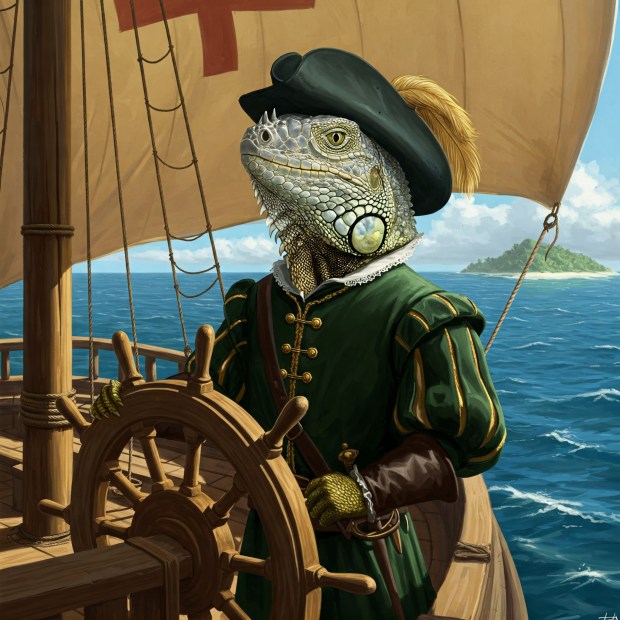
Your primary job is to LISTEN.
Using Bredemarket as an example, my primary goal in the meeting isn’t to blather on about my 30 years in biometrics, or my more than 30 years of writing, or how I was a former Radio Shack Battery Club card holder, or how I shook Gerald Ford’s hand once.
There is a well-known marketer who starts every one of their webinars with a five-minute introductory video that describes how great the marketer is. After sitting through a few of these introductions, I resolved to intentionally attend the next webinar five minutes later so that I didn’t have to sit through that again. But as time passed, I found I wasn’t attending any of the marketer’s webinars at all.
Returning to Bredemarket, my goal for the initial meeting is to listen and focus upon what the potential customer needs.
Another in-vogue term is “pain points,” and that’s a term that I actually DO use. The potential customer has a problem, and maybe Bredemarket can help solve it, or maybe Bredemarket can’t.
And I’m not going to know that if I don’t let the potential customer speak.
Now if you’re a potential customer that needs content, proposal, or analysis marketing and writing services, you can read about Bredemarket’s services on my “CPA” page.
And you can decide whether you want to book a “Free 30 minute content needs assessment” with me.
(Part of the biometric product marketing expert series)
Is your firm asking the following questions?
Bredemarket can help you answer these questions.
For those who don’t know, or who missed my previous discussion on the topic, Bredemarket performs analyses that contain one or more of the following:
Bredemarket analyses only use publicly available data.
These analyses can range in size from very small to very large. On the very small side, I briefly analyzed the markets of three prospect firms in advance of calls with them. On the large side, I’ve performed analyses that take between one and six weeks to complete.
Obviously I can’t provide specifics upon the analyses I’ve already performed since those are confidential to my customers, but I always discuss the customers’ needs before launching the analysis to ensure that the final product is what you want. I also provide drafts along the way in case we need to perform a course correction.
Do you need a market, competitor, or self analysis? Contact me. Or book a meeting with me at calendly.com/bredemarket to talk about your needs (and check the “Market/competitor analysis” check box).
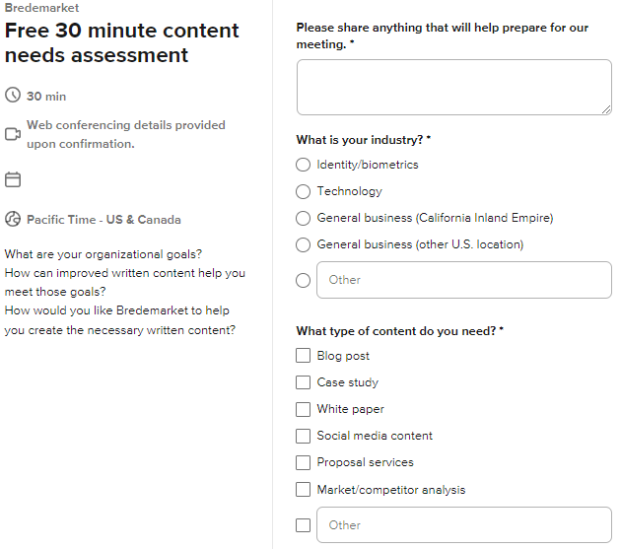
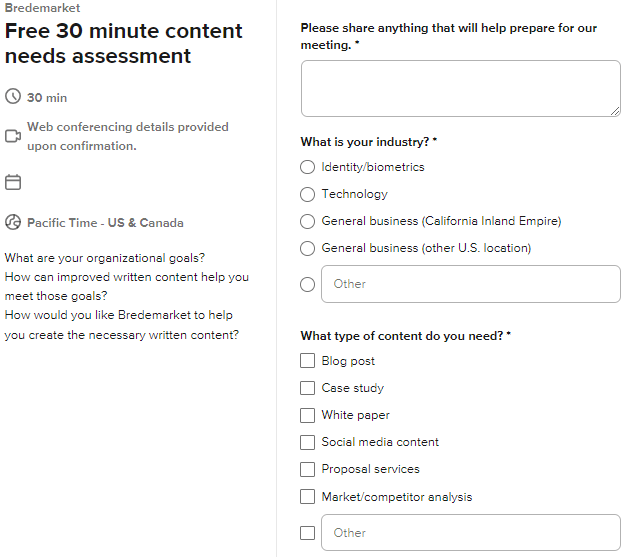
If you book a free 30 minute meeting with Bredemarket, you’ll now find an additional option in the “What Type of Content Do You Need?” section: Market/competitor analysis. I’ve done these for years, but never added the option to the form.
My analyses ONLY use publicly available information that is NOT subject to NDA. So you won’t get access to the analyses I’ve performed for other clients, and they won’t get access to the analysis I prepare for you.
While I primarily provide these analyses in the identity/biometrics industry, I’m open to discussing analysis needs in other industries.
Book a meeting to discuss your content needs.
I’m enjoying my latest project with one of Bredemarket’s clients, because it allows me to do something I normally don’t do as a consultant.
Write emails.
Normally it’s not economically feasible for me to write emails for Bredemarket, since I (for once) agree with the experts and keep my emails in the 100-word range. Because my normal minimum word length is 400 words, I usually don’t write emails for clients.
Except when the demand generation director on this client’s project envisions AN ENTIRE SEQUENCE of emails.
You see, the demand generation director…um…demanded that I write an entire email sequence.

Actually, EVERY email in the sequence includes a link to go to the landing page and request a meeting. These are called “discovery meetings” in the trade, but you don’t have to call them that if you don’t want to. As noted above, I refer to my client meeting as a “content needs assessment.” Call the meetings wildebeests if you feel like it.
Back to my client’s demand generation director. The sequence of emails they requested tells a story. But rather than telling a short story in a single email, this sequence includes multiple emails, in which the content in each email builds upon the previous email, like chapters in a book.
Which leads me to Charles Dickens.

When 20th and 21st century readers encounter the works of Charles Dickens, we are handed a complete novel.
But that’s not how Dickens published his stories. Dickens’ tales were published in serial form.
Most of the novels, including Nicholas Nickleby, Dombey and Son, David Copperfield, Bleak House, Little Dorrit, and Our Mutual Friend, appeared in monthly parts following a very specific formula developed by Dickens and his publishers with the release of Dickens’s first full-length novel The Pickwick Papers (1836 – 37). The Pickwick Papers appeared in 20 parts over a period of 19 months. (The last part was a “double issue” that included parts 19 and 20). Each part contained 32 pages of letter press, 2 illustrations, various advertisements, and came wrapped in a flimsy green-paper front and back cover. The price for each part was one shilling (except for the last “double issue,” which was two). This price was very cheap compared to the standard price of a book, which at the time was 31 shillings 6 pence.
From https://dickens.ucsc.edu/resources/faq/by-the-word.html.
Other than cost savings, why did Dickens and his publishers share his content in serial form?
Dickens’s 20-part formula was successful for a number or reasons: each monthly number created a demand for the next since the public, often enamored of Dickens’s latest inventions, eagerly awaited the publication of a new part; the publishers, who earned profits from the sale of numbers each month, could partially recover their expenses for one issue before publishing the next; and the author himself, who received payment each time he produced 32 pages of text (and not necessarily a certain number of words), did not have to wait until the book was completed to receive payment.
From https://dickens.ucsc.edu/resources/faq/by-the-word.html.
And there was one other extremely personal benefit for Charles Dickens.
It was largely on the strength of his generous monthly stipend for The Pickwick Papers that Dickens was able to marry Catherine Hogarth in 1836.
From https://dickens.ucsc.edu/resources/faq/by-the-word.html.

So serialization helped Charles Dickens create demand, generate wealth, AND get the girl. Can’t argue with that. (Although they subsequently separated.)
I am not Charles Dickens, but I’m trying to incorporate storytelling into Bredemarket’s work.
For example, the email sequence I created for the demand generation director shares details about how the problems the prospects may face, and how the client has helped their customers overcome these problems.
It all fits into the client story.
What’s the most important question to ask before telling a client story?

No, what ISN’T the most important question.
As I’ve said before, WHY is the most important question.
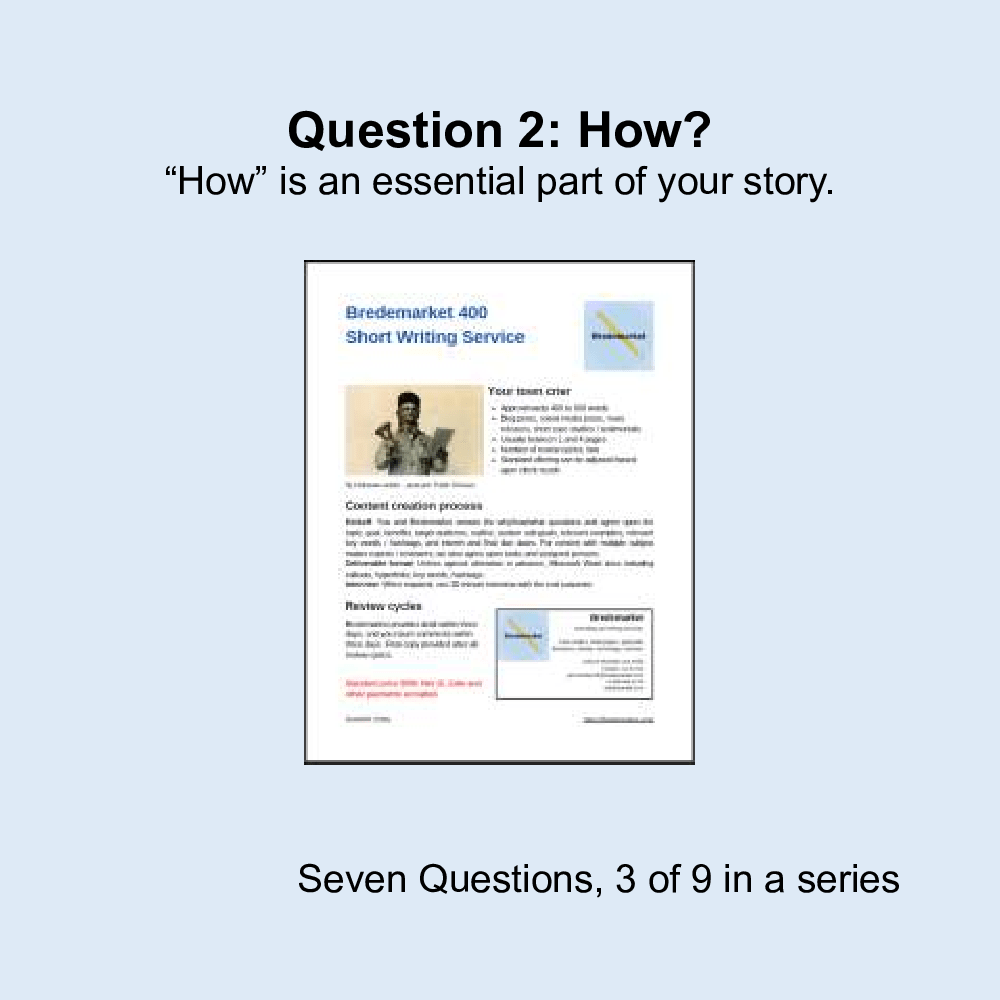
If you’d like to see all seven of the questions that your content creator should ask you, look below. And no, it’s not in seven serial mini-books, but in a single volume.
Although I did serialize the questions on Instagram. Chuck would be proud.






As an independent contractor who doesn’t HAVE to keep set hours this is technically none of your business, but I’m letting you know anyway. San Bernardino County has messaged me about something…and it potentially affects you.
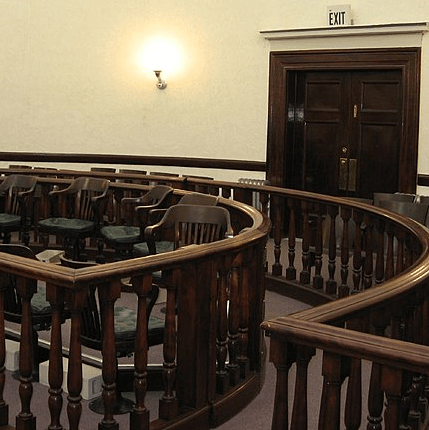
I may have limited availability during the week of February 5-9 due to a jury duty summons.
And because of the confidentiality of jury proceedings, that’s all that I will have to say about THAT.
Currently the Bredemarket Calendly page marks me as completely unavailable during the week of February 5-9. I will adjust this as needed.
P.S. Years ago when I received a jury duty summons that potentially involved biometric evidence, I disclosed that I worked for a company that competed with the jurisdiction’s biometric provider. In this case, the PROSECUTION excused me from service.


 Bredemarket