Ryanair runs a flight (FR4756) from Lanzarote, in the (Spanish) Canary Islands, to Bristol (England). Since the United Kingdom is not part of the European Union, its citizens must undergo biometric checks as part of the Entry/Exit System (EES). And that takes time.
“Eighty-nine passengers booked on flight FR4756 to Bristol were reportedly stuck in non-European Union (EU) lines awaiting passport checks. The airline held the aircraft for around an hour but ultimately departed without dozens of customers, offloading their checked baggage before takeoff.”
Ryanair claimed it was the passengers’ fault:
“Should these passengers have presented at the boarding gate desk before it closed, they would have boarded this flight.”
But when it takes longer to get through an airport’s security than you expect, a new type of friction results: incensed passengers.
Predictably, the airline industry is urging that EES be delayed. Kinda like what happened over here, where REAL ID still hasn’t really been implemented.
Brooke Staggs wrote a blog post detailing 13 highlights at Ontario International Airport. I’m not going to go through all 13, but I did want to highlight three of them.
Yes, Ontario Airport is international
Staggs highlighted the, um, arrival of a new airport at ONT: STARLUX Airlines, flying nonstop to and from Taipei, Taiwan.
STARLUX flies from Ontario to Taipei four days a week (Monday, Wednesday, Friday, and Saturday). Because you cross the international date line, the flight takes two days (but really less than a day).
Existing international service expands
Of course, Volaris has been at ONT for some time, but this year they added flights to Los Cabos (SJD), León (BJX) and Morelia (MLM). This is in addition to its existing service to Guadalajara (GDL), and totals 28 weekly flights in all with at least three flights per week to each destination.
On the domestic front
United Airlines flies nonstop from Ontario to Chicago’s O’Hare Airport. These are daily flights year-round. Somehow I got the idea that they are seasonal, but they are not.
If you want Portillo’s but don’t want to drive all the way to Moreno Valley or Buena Park, just drive to Ontario and fly to O’Hare.
Europeans generally do not celebrate the U.S. Thanksgiving, unless they spent time in this country and like the food.
But for most Europeans this will be another Thursday. Actually it’s already Thursday in Europe. Good morning.
And Europe is also ahead of the U.S. in biometric entry AND exit. Just ask the Swiss.
“Switzerland’s busiest international hub, Zurich Airport is swept up in the EU-wide upgrade to how third-country nationals are registered at Schengen borders, with the rollout of the EU Entry/Exit System.”
“We provide the world’s leading news coverage and information on the global biometric technology market via the web and an exclusive daily newsletter. Our daily biometrics updates, industry perspectives, interviews, columns and in-depth features explore a broad range of modalities and methods, from fingerprint, voice, iris, and facial recognition, to cutting-edge technologies like DNA analysis and gait recognition, related identification tools such as behavioral biometrics, and non-biometric identification methods such as identity document verification and telephone forensics. Our coverage touches on all applications and issues dealt with in the sector, including national security, mobile identity, and border control, with a special emphasis on UN Sustainable Development Goal 16.9 to provide universal digital identification and the ID4Africa movement.”
Over the last ten years, there have been two instances in which I have been newsworthy.
2015 with MorphoTrak
The first occurred in 2015, when my then-employer MorphoTrak exhibited an airport gate called MorphoWay at a conference then known as connect:ID. At the 2015 show, I demonstrated MorphoWay for Biometric Update’s videographer.
Me at connect:ID, 2015.
“In the video, Bredehoft scans his passport through the document reader, which checks the passport against a database to verify that it is, in fact, a CBP-authorized document.
“Once verified, the gates automatically open to allow Bredehoft to exit the area.”
2025 with Bredemarket
The second occurred ten years later in 2025, when I wrote a guest opinion piece entitled “Opinion: Vendors must disclose responsible uses of biometric data.” As I previously mentioned, I discussed the need to obtain consent for use of biometric data in certain instances, and noted:
“Some government agencies, private organizations, and biometric vendors have well-established procedures for acquiring the necessary consents.
“Others? Well…”
Biometric Update didn’t create a video this time around, but I did.
Biometric vendors…
2035???
So now that I’ve established a regular cadence for my appearances in Biometric Update, I fully expect to make a third appearance in 2035.
Because of my extensive biometric background, I predict that my 2035 appearance will concern the use of quantum computing to distinguish between a person and their fabricated clone using QCID (quantum clone identification).
No video yet, because I don’t know what video technology will be like ten years from now. So here’s an old fashioned 2D picture.
Currently, passengers must verify their identity at multiple checkpoints throughout a single journey, leading to delays and increased congestion at airports. To address this challenge, Facephi has developed technology that enables identity validation before arriving at the airport, reducing wait times and ensuring a seamless and secure travel experience. This innovation has already been successfully tested in collaboration with IATA through a proof of concept conducted last November.
The idea of creating an ecosystem in which identity is known throughout the entire passenger journey is not new to Facephi, of course. I remember that Safran developed a similar concept in the 2010s before it sold off Morpho, MorphoTrust, MorphoTrak, and Morpho Detection. And I’ve previously discussed the SITA-IDEMIA-Indico “Digital Travel Ecosystem.”
But however it’s accomplished, seamless travel benefits everyone…except the terrorists.
I’m a member of a local Facebook “news” group, and the group just emphatically stated that expression of opinions is NOT allowed in that group.
Because facts are free of bias. (Supposedly. I should address that topic in another post.)
Because this post includes two contentious opinions, it’s no surprise that I will NEVER share this post in that local news group. Their loss.
Actually the post is off-topic for the news group anyway. But as you will see, it is entirely on-topic for Bredemarket. I’ll explain, after I discuss a couple of songs and their singers.
Two Facts and One Opinion About “Girl from the North Country”
“Girl from the North Country” is a Bob Dylan song, which he started writing in 1962 while in England. The song was recorded in New York in 1963 and released that same year on the album “The Freewheelin’ Bob Dylan.”
I care about Dylan’s cover of his own song, released several years later on the 1969 album “Nashville Skyline.” But Dylan had a special guest on this album: Johnny Cash.
Here are two facts about the 1969 version:
Bob Dylan has a distinctive voice.
Johnny Cash has a distinctive voice.
These are facts, not opinions, since I am not casting a value judgement on whether they are any good at singing. For the record, I love Bob Dylan’s solo songs, and I love Johnny Cash’s solo songs.
Now my opinion: the 1969 version of “Girl from the North Country” is an unmitigated disaster, because the distinctive voices do not blend at all.
If you’ve never heard this version of the song, let me provide a play-by-play account.
The song begins with Dylan and Cash strumming their guitars, accompanied by a backing band of Nashville stars. (Not Starrs.)
Dylan then sings the first verse, in a lower key than his original version, and the listeners were introduced to the newest version of Bob Dylan. Shed of a rock band, he has not returned to his early folk days, but appears in a new version of a peaceful, satisfied country crooner. More versions of Dylan were to follow.
Then we get the second verse, in which Johnny Cash picks up the story about the girl. Cash himself appears in a new guise, having moved beyond the Memphis rockabilly sound and the horn-infused “Ring of Fire” sound. Cash now entered a period in which he associated with people such as Dylan who were leap years away from both traditional country and the newer countrypolitan sound. Cash, like Dylan, would continue to travel all over the musical map, gaining fame at the end of his life by covering Nine Inch Nails.
Back to 1969. After Cash sings the second verse, Dylan returns to sing the third. Everything is going fine so far.
Then (again, in my opinion) all hell breaks loose at the 1:52 mark in the song, because now the two sing together.
Sort of.
Cash starts singing the fourth verse, Dylan joins in a second later, and then they kinda sorta sing the words of the fourth and fifth verses at kinda sorta the same time, with some harmonizing—some intentional, some unintentional when they couldn’t hit the notes. Hear the result on YouTube.
Now I will admit that my negative opinion of the Dylan-Cash duet on “Girl of the North Country” is not universal. A high school friend who shall remain anonymous (just call her “Editor Extraordinaire” and old school Rick Dees fan) thinks this version is charming. I find it amusing in a not-so-good way.
As far as I’m concerned, this collaboration didn’t work.
Which brings us to Christina Aguilera.
Three Facts and One Opinion About “Birds of Prey”
In 2010 Aguilera released her sixth album, “Bionic,” a massive 18-track album featuring a more electronic sound and numerous collaborations with Nicki Minaj, Sia, Linda Perry, and others.
I care about the Deluxe edition, with an even more massive total of 23 tracks.
One of which was co-written and produced by the (then) four members of the UK band Ladytron. As OC Weekly (R.I.P.) documented at the time, Aguilera was a fan of the quartet:
Ladytron followers were startled to learn that Christina Aguilera was not only a fan, but had also already worked with the band on a variety of songs to be released in the near future.
“We went in with no expectations; the whole thing was a massive surprise,” explains Wu. “But it was incredible. She was so musically talented, a vocalist who really knows her voice. The first takes sounded really amazing, and while we’d made demos, it was only when her voice was on them that it all came to life.
One of the songs was “Birds of Prey.” Not to be confused with “Bird of Prey” or “Sunset (Bird of Prey),” the Aguilera-Ladytron version builds upon the usual Ladytron vocal delivery from Helen Marine and Mira Aroyo by adding Christina Aguilera to the mix.
Which brings me to my three facts about this song:
Christina Aguilera has a distinctive voice, with a four-octave range that she frequently exercises to the fullest.
Helen Marnie has a distinctive voice, featured as the light “singing voice” of Ladytron.
Mira Aroyo has a distinctive voice, whose spoken word delivery blends with Marnie’s in many classic Ladytron songs. (For example, “Seventeen.”)
In my opinion, this vocal collaboration—unlike the Dylan-Cash one mentioned earlier—works out beautifully. Aguilera naturally opens the song (it’s her album after all), but as the song progresses you hear Marnie lightly chiming in and Aroyo whispering, building up to the closing of the song. Hear it here.
Again, this opinion is not universal—Aroyo in particular is an acquired taste—but the combination seems to work.
But what do “Girl from the North Country” and “Birds of Prey” have to do with B2B sales—whoops, I mean collaboration? And Bredemarket?
The art of collaboration
Bredemarket’s services are built upon the principle that I work together with my clients. My process includes a lot of references to “Bredemarket and you,” because we are both involved in every step, from the seven questions I address at the beginning to the iterative drafts and reviews that occur throughout.
But that isn’t the only way to manage a project, as I noted in June 2023. There are two others.
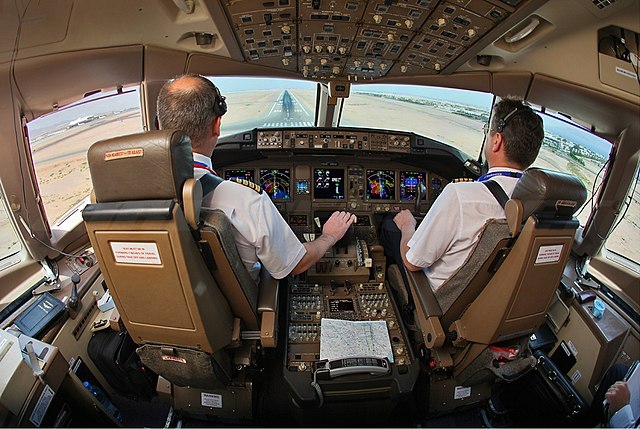
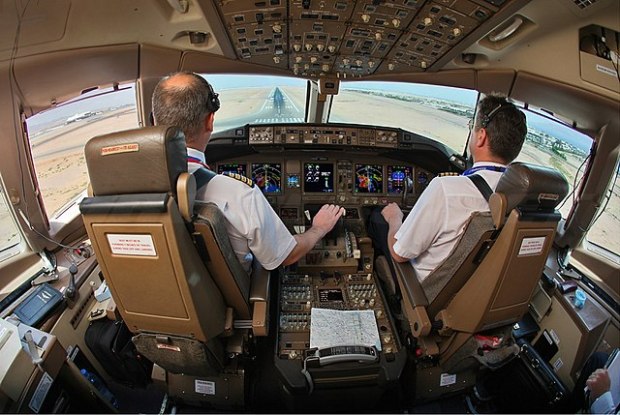
The first approach is to yield all control to the expert. You sit back, relax, and tell your content marketing consultant to do whatever they want. They provide the text, and you pay the consultant with no questions asked. The content marketing consultant is the pilot here.
The second approach is to retain all control yourself. You tell the content marketing consultant exactly what you want, and exactly what words to say to describe your best-of-breed, game-changing, paradigm-shifting, outcome-optimizing solution. (That last sentence was painful to write, but I did it for you.) The content marketing consultant follows your exact commands and produces the copy with the exact words you want. You are the pilot here.
So which of these two methods is the best way to create content?
Thinking about “de plane” used in the Fantasy Island television series (image CC BY-SA 3.0) makes me think about travel. Mr. Roarke’s and Tattoo’s guests didn’t have to worry about identifying themselves to disembark from the plane and enter the island. But WE certainly do…and different countries and entities need to adopt standards to facilitate this.
I’ve previously observed that standards often don’t emerge, like Athena, from ivory towers. They emerge when a very powerful entity or person (for example, Microsoft or Taylor Swift) says that THIS is the standard, and waits for the world to comply.
Of course, there can be issues when MULTIPLE powerful entities or people try to champion competing standards.
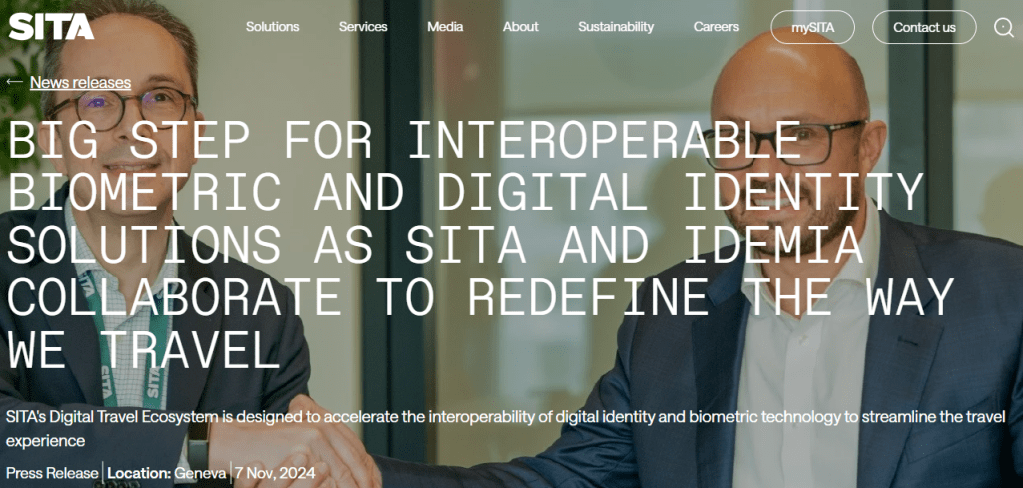
SITA, the global leader in air transport technology, and IDEMIA Public Security, a world leader in digital technologies, biometrics, and security have announced a collaboration to advance interoperability, trust, and data security through a globally recognized Digital Travel Ecosystem.
Add Indico to the partnership, and perhaps the parties may be on to something.
The goal is to create “an open, secure, and interoperable framework that ensures a travelers’ digital identity is trusted globally, without the need for direct integrations between issuers and verifiers.” It is intentionally decentralized, giving the traveler control over their identity.
Perhaps it’s a fantasy to think that others will buy in. Will they?
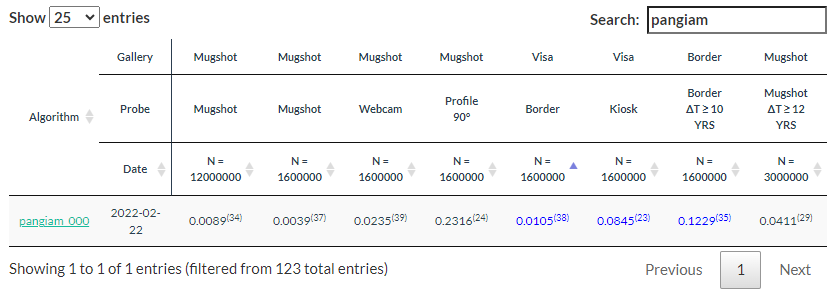
Things change. Pangiam, a company that didn’t even exist a few years ago, and that started off by acquiring a one-off project from a local government agency, is now itself a friendly acquisition target (pending stockholder and regulatory approvals).
From MWAA to Pangiam
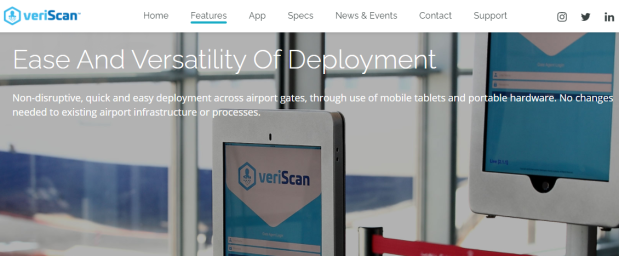
Back when I worked for IDEMIA and helped to market its border control solutions, one of our competitors for airport business was an airport itself—specifically, the Metropolitan Washington Airports Authority. Rather than buying a biometric exit solution from someone else, the MWAA developed its own, called veriScan.
2021 image from the former airportveriscan website.
ALEXANDRIA, Va., March 19, 2021 /PRNewswire/ — Pangiam, a technology-based security and travel services provider, announced today that it has acquired veriScan, an integrated biometric facial recognition system for airports and airlines, from the Metropolitan Washington Airports Authority (“Airports Authority”). Terms of the transaction were not disclosed.
So what will Pangiam work on next? Where will it expand? What will it acquire?
Nothing.
Enter BigBear.ai
Pangiam itself is now an acquisition target.
COLUMBIA, MD.— November 6, 2023 — BigBear.ai (NYSE: BBAI), a leading provider of AI-enabled business intelligence solutions, today announced a definitive merger agreement to acquire Pangiam Intermediate Holdings, LLC (Pangiam), a leader in Vision AI for the global trade, travel, and digital identity industries, for approximately $70 million in an all-stock transaction. The combined company will create one of the industry’s most comprehensive Vision AI portfolios, combining Pangiam’s facial recognition and advanced biometrics with BigBear.ai’s computer vision capabilities, positioning the company as a foundational leader in one of the fastest growing categories for the application of AI. The proposed acquisition is expected to close in the first quarter of 2024, subject to customary closing conditions, including approval by the holders of a majority of BigBear.ai’s outstanding common shares and receipt of regulatory approval.
Yet another example of how biometrics is now just a minor part of general artificial intelligence efforts. Identify a face or a grenade, it’s all the same.
Anyway, let’s check back in a few months. Because of the technology involved, this proposed acquisition will DEFINITELY merit government review.
MCLEAN, Va., May 2, 2023 /PRNewswire/ — The West Virginia University Research Corporation (WVURC) and Pangiam, a leading trade a travel technology company, announced a new partnership to conduct research and develop new, cutting-edge artificial intelligence, machine learning and computer vision technologies for commercial and government applications.
Pangiam and WVURC will work together to launch Pangiam Bridge, a cutting-edge artificial intelligence driven solution for customs authorities worldwide. Pangiam Bridge will allow customs officials to automate portions of the customs inspection process for baggage and cargo. Jim McLaughlin, Pangiam Chief Technology Officer, said, “we are excited to grow Pangiam’s artificial intelligence work in partnership with West Virginia University and continued development of Pangiam Bridge for customs authorities.”
Pangiam Bridge is obviously not ready for prime time yet; it’s not even mentioned on Pangiam’s Products and Services page, nor is it mentioned anywhere else on Pangiam’s website. The only mention of Pangiam Bridge is in this press release, which isn’t surprising considering that this is a research effort. But if the research holds out, then many of the manual processes used by customs agents may be significantly reduced or eliminated entirely.
Project DARTMOUTH is the collaboration between Pangiam and Google Cloud, named after the 1956 Dartmouth Summer Research Project on Artificial Intelligence. Project DARTMOUTH utilizes AI and pattern analysis technologies to digest and analyze vast amounts of data in real-time and identify potential prohibited items in carry-on baggage, checked baggage, airline cargo and shipments.











 Bredemarket