I’m jumping ahead in the year-end post ridiculousness to cite Bredemarket’s two most notable accomplishments this year. Not to detract from my other accomplishments this year, but these two were biggies.
The second was my go-to-market effort for a Bredemarket client in September, which I discussed (without mentioning my participation) here. And there’s a video for that effort also.
Recent go-to-market.
I’ve accomplished many other things this year: client analyses, blog posts (both individually and in series), consultations, presentations, press releases, proposals, requirements documents, sales playbooks, and many more.
And I still have three more weeks to accomplish things.
I’m going to limit my thoughts to two of the four changes that Integrated Biometrics mentioned.
Decentralized systems
When I started in the biometrics industry in 1994, an automated fingerprint identification system (AFIS) was usually a centralized system. Tenprint and latent examiners at the state capital (there was no federal IAFIS back then) would work in buildings at or near a huge minicomputer that held the state’s fingerprint records. Perhaps there may have been a few remote tenprint and latent workstations connected by modem, and perhaps there were some livescan stations scattered around, but for the most part these client/server systems had a single server in a state computer room. (Well, except for the Western Identification Network, but WIN was ahead of its time.)
Fast forward 30 years, and while this model may work in the United States, it may not work elsewhere.
What if you don’t have internet or cellular communications? (Yes, cellular. Modern edge devices are a topic addressed in the Integrated Biometrics article that I won’t go into here.)
Or what if the communications are so incredibly slow that it would take forever to submit a search to the capital city, and return results to the originator?
This is where decentralized systems come into play. Rather than requiring everyone to ping the same central hub, the biometric database is distributed and synchronized among multiple servers in multiple locations.
Or maybe you’re getting ahead of me here and realizing that “servers” is too limiting. What if you could put all or part of a biometric database on your smartphone, so you can search a captured biometric against a database immediately without waiting for network communication time?
Such decentralized systems were impossible in 1994, but they are certainly possible today. And IB360 lets partners build their own biometric systems with decentralization and synchronization.
Speaking of building…
Demand for speed
As I mentioned, I’ve been in the biometric industry since 1994, and although my early years were spent in a pre-contract proposals role, I’ve seen enough post-contract deployments to know that they take a long time. Whether you were dealing with Printrak, NEC, Sagem Morpho, or the upstart Cogent, it would take many months if not years to deploy a fingerprint system.
For the most part, this is still true today with “pre-made” systems from NEC, IDEMIA, Thales, and the others.
And it’s also true if you decide to deploy your own “custom-built” fingerprint or biometric system from scratch.
Either way, there is a lot of engineering, integration, and orchestration that must take place before a system is deployed. You can’t take an AFIS for Bullhead City, Arizona and deploy it in Anaheim, California…or the state of Tennessee…or the nation of Switzerland. You need to perform months of tailoring/configuration first.
Integrated Biometrics asserts that waiting years for a biometric system is far too long.
Other changes
I’ll let you read the Integrated Biometrics article to learn about the other two evolutionary changes: more powerful hardware (I’ve alluded to this), and a myriad of use cases.
All of these changes have impacted the biometric market, and prompted Integrated Biometrics to introduce IB360. To read about this modular software suite and its benefits, visit the IB360 product page.
Skipping the “leading provider” stuff, we get to this:
“Integrated Biometrics (IB)…formally announced today the launch of IB360, transforming the speed and cost to deploy identity systems. The IB360 platform is a low-code toolset of SDK-based software modules that allows our partners and integrators to more efficiently create biometric identity-based solutions with minimal development cycles.”
Las Vegas is a destination visited by over 40 million people per year from all over the world. And the casino hotels know that they’re hungry for food, and they hope the hungry people will stay on property.
So do they serve Caesars Burgers?
Um, no. 40 million people don’t eat the same thing.
This becomes very clear if you visit the Bacchanal Buffet at Caesars Palace, with over 250 items prepared in 10 kitchens.
“From Roman-style pizza to Carne Asada Tacos inspired by the food trucks of L. A., there’s something for everyone. Find a world of flavor at our nine live-action cooking stations. Indulge in originals like slow-cooked prime rib, smoked beef brisket, crab, and wood-fired pizza. Or try something different, like whole Ahi Tuna Poke, roasted duck, or Singaporean Blue Crab and seasonal agua frescas.”
(Imagen 4)
There is literally something for everyone. And the hungry person salivating for Ahi Tuna Poke doesn’t care about the beef brisket.
Which brings us to local police automated fingerprint identification system (AFIS) proposals.
Variety for hungry people
If you had asked me in September 1994 (before I started at Printrak in October) the target audience for local police AFIS, I would have replied, “fingerprint people.”
That answer would be incorrect.
Tenprint and latent people
Because, even if you limit things to the criminal AFIS world, there are (at least) two types of fingerprint people: tenprint examiners, and latent examiners. I asked my buddy Bredebot to summarize the stereotypical differences between the two. Here is some of what he said:
“‘Assembly line‘ comparisons: Because tenprint comparisons use high-quality, known impressions taken under controlled conditions, their work can be automated and is often perceived as a high-volume, less complex task. This is in contrast to the specialized analysis required for latent prints.
“Artistic and subjective: Because latent prints are often smudged, distorted, and incomplete, examiners must make subjective judgments about their suitability for comparison. This has led to the criticism that the process is more of an art than a science.”
Bredebot has never attended an International Association for Identification conference, but I have. Many many years ago I attended a session on tenprint examiner certification. Latent examiners had this way cool certification and some people thought that more tenprint examiners should participate in their way cool certification program. As I recall, this meeting way heavily attended…by latent folks. Even today, the number of Certified Latent Print Examiners (CLPEs) is far greater than the number of Certified Tenprint Examiners (CTPEs).
Other people
But you can’t procure an AFIS by talking to tenprint and latent people alone.
As I noted years ago, other people get involved in a local police AFIS procurement, using Ontario, California as an example:
(Imagen 4)
The field investigators who run across biometric evidence at the scene of a crime, such as a knife with a fingerprint on it or a video feed showing someone breaking into a liquor store.
The information technologies (IT) people who are responsible for ensuring that Ontario, California’s biometric data is sent to San Bernardino County, the state of California, perhaps other systems such as the Western Identification Network, and the Federal Bureau of Investigation.
The purchasing agent who has to make sure that all of Ontario’s purchases comply with purchasing laws and regulations.
The privacy advocate who needs to ensure that the biometric data complies with state and national privacy laws.
The mayor (still Paul Leon as I write this), who has to deal with angry citizens asking why their catalytic converters are being stolen from their vehicles, and demanding to know what the mayor is doing about it.
Probably a dozen other stakeholders that I haven’t talked about yet, but who are influenced by the city’s purchasing decision.
Feeding the hungry people
So even a relatively simple B2B product has multiple target audiences.
Should product marketers apply the same one-dimensional messaging to all of them?
Um, no.
If you did that, purchasing agents would fall asleep at mentions of “level 3 detail,” while latent examiners would abandon their usual attention to detail when confronted by privacy references to the California Information Practices Act of 1977. (The CCPA, CPRA, and CPPA apply to private entities.)
So, whether you like it or not, you need separate messaging for each of your categories of hungry people.
(Imagen 4)
One time, as part of an account-based marketing effort, I had to construct a multi-variable messaging matrix…for a product that is arguably simpler than an AFIS.
And yes, I used Microsoft Excel.
And I can use my mad Excel skillz for you also, if your company needs content, proposal, or analysis assistance in your technology product marketing operations. Contact Bredemarket at https://bredemarket.com/mark/.
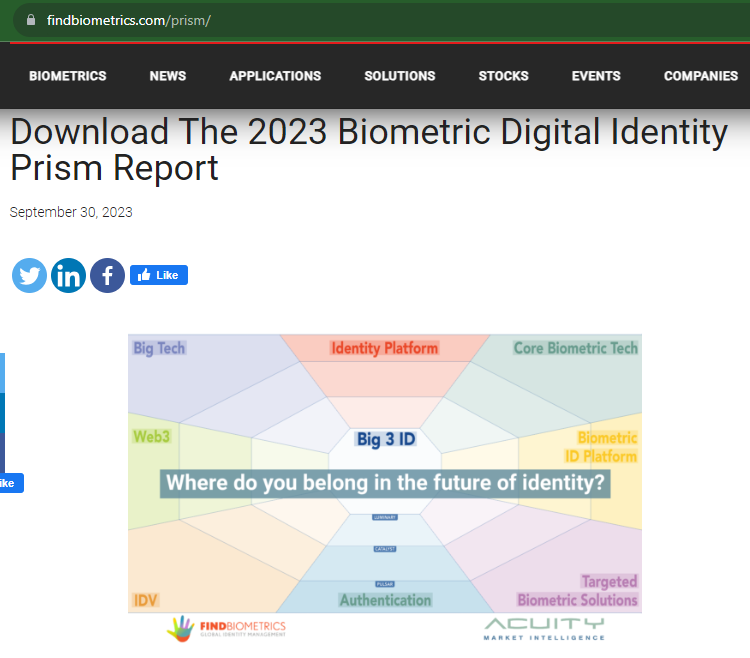
On September 30, FindBiometrics and Acuity Market Intelligence released the production version of the Biometric Digital Identity Prism Report. You can request to download it here.
But FindBiometrics and Acuity Market Intelligence didn’t invent the Big 3. The concept has been around for 40 years. And two of today’s Big 3 weren’t in the Big 3 when things started. Oh, and there weren’t always 3; sometimes there were 4, and some could argue that there were 5.
So how did we get from the Big 3 of 40 years ago to the Big 3 of today?
The Big 3 in the 1980s
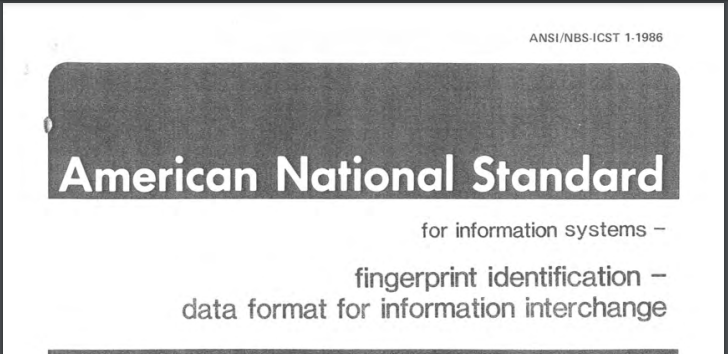
Back in 1986 (eight years before I learned how to spell AFIS) the American National Standards Institute, in conjunction with the National Bureau of Standards, issued ANSI/NBS-ICST 1-1986, a data format for information interchange of fingerprints. The PDF of this long-superseded standard is available here.
When creating this standard, ANSI and the NBS worked with a number of law enforcement agencies, as well as companies in the nascent fingerprint industry. There is a whole list of companies cited at the beginning of the standard, but I’d like to name four of them.
De La Rue Printrak, Inc.
Identix, Inc.
Morpho Systems
NEC Information Systems, Inc.
While all four of these companies produced computerized fingerprinting equipment, three of them had successfully produced automated fingerprint identification systems, or AFIS. As Chapter 6 of the Fingerprint Sourcebook subsequently noted:
Morpho Systems resulted from French AFIS efforts, separate from those of the FBI. These efforts launched Morpho’s long-standing relationship with the French National Police, as well as a similar relationship (now former relationship) with Pierce County, Washington.
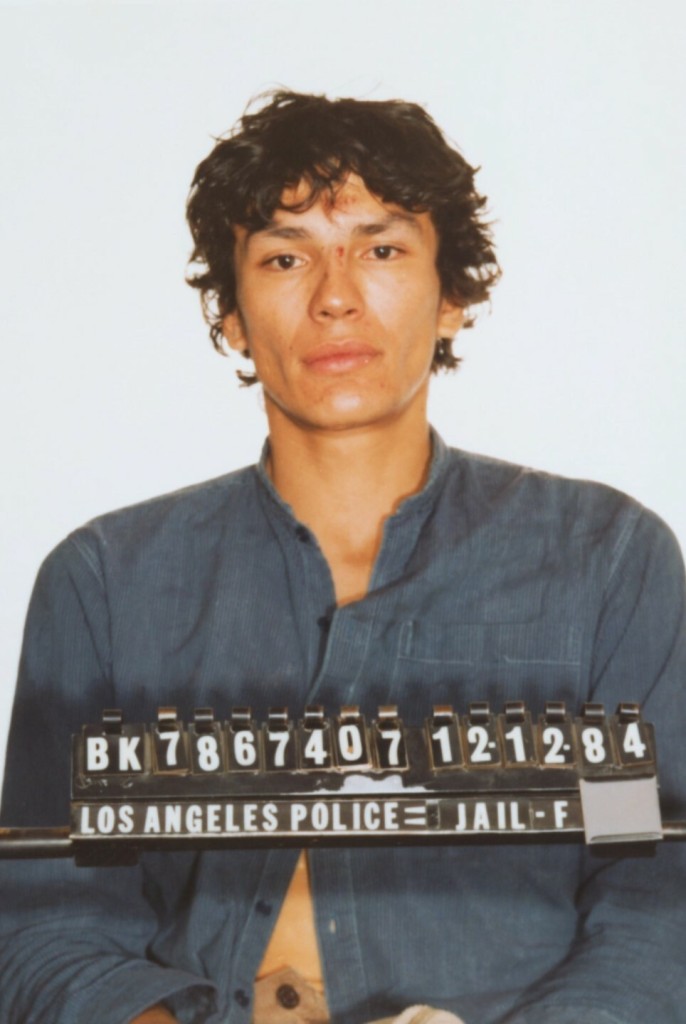
NEC had deployed AFIS equipment for the National Police Academy of Japan, and (after some prodding; read Chapter 6 for the story) the city of San Francisco. Eventually the state of California obtained an NEC system, which played a part in the identification of “Night Stalker” Richard Ramirez.
After the success of the San Francisco and California AFIS systems, many other jurisdictions began clamoring for AFIS of their own, and turned to these three vendors to supply them.
The Big 4 in the 1990s
But in 1990, these three firms were joined by a fourth upstart, Cogent Systems of South Pasadena, California.
While customers initially preferred the Big 3 to the upstart, Cogent Systems eventually installed a statewide system in Ohio and a border control system for the U.S. government, plus a vast number of local systems at the county and city level.
Between 1991 and 1994, the (Immigfation and Naturalization Service) conducted several studies of automated fingerprint systems, primarily in the San Diego, California, Border Patrol Sector. These studies demonstrated to the INS the feasibility of using a biometric fingerprint identification system to identify apprehended aliens on a large scale. In September 1994, Congress provided almost $30 million for the INS to deploy its fingerprint identification system. In October 1994, the INS began using the system, called IDENT, first in the San Diego Border Patrol Sector and then throughout the rest of the Southwest Border.
I was a proposal writer for Printrak (divested by De La Rue) in the 1990s, and competed against Cogent, Morpho, and NEC in AFIS procurements. By the time I moved from proposals to product management, the next redefinition of the “big” vendors occurred.
The Big 3 in 2003
There are a lot of name changes that affected AFIS participants, one of which was the 1988 name change of the National Bureau of Standards to the National Institute of Standards and Technology (NIST). As fingerprints and other biometric modalities were increasingly employed by government agencies, NIST began conducting tests of biometric systems. These tests continue to this day, as I have previously noted.
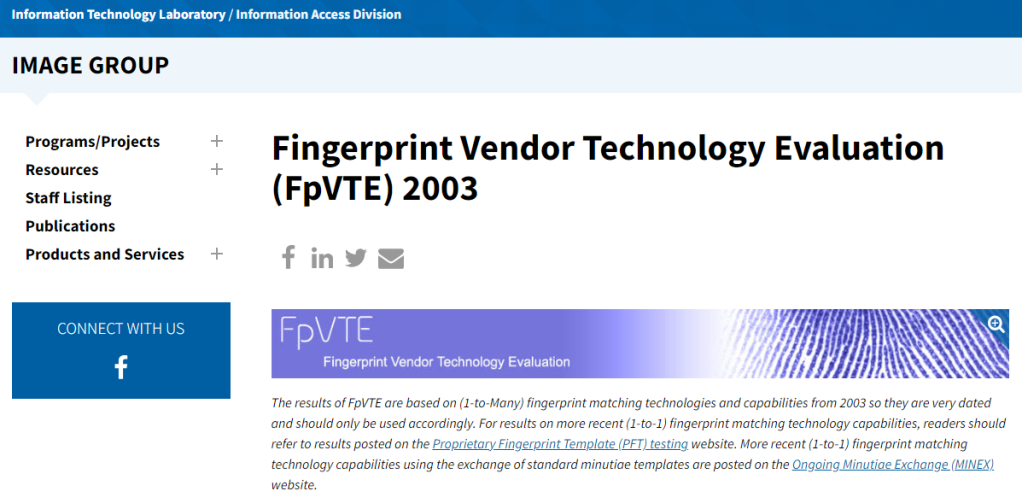
One of NIST’s first tests was the Fingerprint Vendor Technology Evaluation of 2003 (FpVTE 2003).
For those who are familiar with NIST testing, it’s no surprise that the test was thorough:
FpVTE 2003 consists of multiple tests performed with combinations of fingers (e.g., single fingers, two index fingers, four to ten fingers) and different types and qualities of operational fingerprints (e.g., flat livescan images from visa applicants, multi-finger slap livescan images from present-day booking or background check systems, or rolled and flat inked fingerprints from legacy criminal databases).
Eighteen vendors submitted their fingerprint algorithms to NIST for one or more of the various tests, including Bioscrypt, Cogent Systems, Identix, SAGEM MORPHO (SAGEM had acquired Morpho Systems), NEC, and Motorola (which had acquired Printrak). And at the conclusion of the testing, the FpVTE 2003 summary (PDF) made this statement:
Of the systems tested, NEC, SAGEM, and Cogent produced the most accurate results.
Which would have been great news if I were a product manager at NEC, SAGEM, and Cogent.
Unfortunately, I was a product manager at Motorola.
The effect of this report was…not good, and at least partially (but not fully) contributed to Motorola’s loss of its long-standing client, the Royal Canadian Mounted Police, to Cogent.
The Big 3, 4, or 5 after 2003
So what happened in the years after FpVTE was released? Opinions vary, but here are three possible explanations for what happened next.
Did the Big 3 become the Big 4 again?
Now I probably have a bit of bias in this area since I was a Motorola employee, but I maintain that Motorola overcame this temporary setback and vaulted back into the Big 4 within a couple of years. Among other things, Motorola deployed a national 1000 pixels-per-inch (PPI) system in Sweden several years before the FBI did.
Did the Big 3 remain the Big 3?
Motorola’s arch-enemies at Sagem Morpho had a different opinion, which was revealed when the state of West Virginia finally got around to deploying its own AFIS. A bit ironic, since the national FBI AFIS system IAFIS was located in West Virginia, or perhaps not.
Anyway, Motorola had a very effective sales staff, as was apparent when the state issued its Request for Proposal (RFP) and explicitly said that the state wanted a Motorola AFIS.
That didn’t stop Cogent, Identix, NEC, and Sagem Morpho from bidding on the project.
After the award, Dorothy Bullard and I requested copies of all of the proposals for evaluation. While Motorola (to no one’s surprise) won the competition, Dorothy and I believed that we shouldn’t have won. In particular, our arch-enemies at Sagem Morpho raised a compelling argument that it should be the chosen vendor.
Their argument? Here’s my summary: “Your RFP says that you want a Motorola AFIS. The states of Kansas (see page 6 of this PDF) and New Mexico (see this PDF) USED to have a Motorola AFIS…but replaced their systems with our MetaMorpho AFIS because it’s BETTER than the Motorola AFIS.”
But were Cogent, Motorola, NEC, and Sagem Morpho the only “big” players?
Did the Big 3 become the Big 5?
While the Big 3/Big 4 took a lot of the headlines, there were a number of other companies vying for attention. (I’ve talked about this before, but it’s worthwhile to review it again.)
Identix, while making some efforts in the AFIS market, concentrated on creating live scan fingerprinting machines, where it competed (sometimes in court) against companies such as Digital Biometrics and Bioscrypt.
The fingerprint companies started to compete against facial recognition companies, including Viisage and Visionics.
Oh, and there were also iris companies such as Iridian.
And there were other ways to identify people. Even before 9/11 mandated REAL ID (which we may get any year now), Polaroid was making great efforts to improve driver’s licenses to serve as a reliable form of identification.
In short, there were a bunch of small identity companies all over the place.
But in the course of a few short years, Dr. Joseph Atick (initially) and Robert LaPenta (subsequently) concentrated on acquiring and merging those companies into a single firm, L-1 Identity Solutions.
These multiple mergers resulted in former competitors Identix and Digital Biometrics, and former competitors Viisage and Visionics, becoming part of one big happy family. (A multinational big happy family when you count Bioscrypt.) Eventually this company offered fingerprint, face, iris, driver’s license, and passport solutions, something that none of the Big 3/Big 4 could claim (although Sagem Morpho had a facial recognition offering). And L-1 had federal contracts and state contracts that could match anything that the Big 3/Big 4 offered.
So while L-1 didn’t have a state AFIS contract like Cogent, Motorola, NEC, and Sagem Morpho did, you could argue that L-1 was important enough to be ranked with the big boys.
So for the sake of argument let’s assume that there was a Big 5, and L-1 Identity Solutions was part of it, along with the three big boys Motorola, NEC, and Safran (who had acquired Sagem and thus now owned Sagem Morpho), and the independent Cogent Systems. These five companies competed fiercly with each other (see West Virginia, above).
In a two-year period, everything would change.
The Big 3 after 2009
Hang on to your seats.
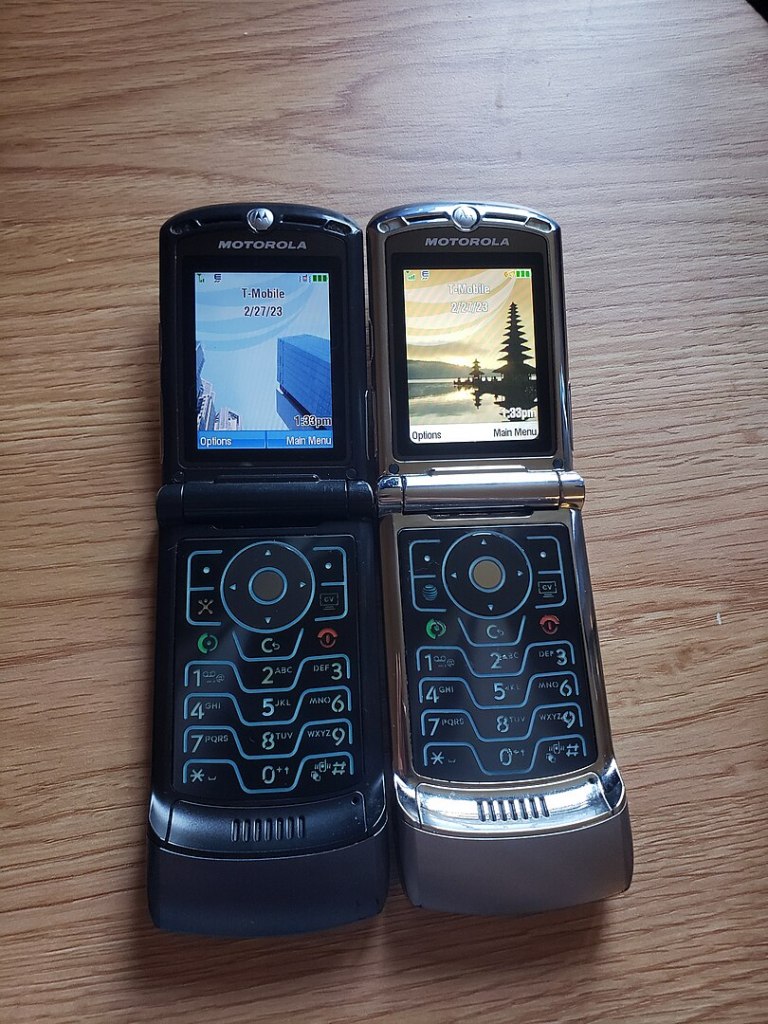
The Motorola RAZR was hugely popular…until it wasn’t. Eventually Motorola split into two companies and sold off others, including the “Printrak” Biometric Business Unit. By NextG50 – Own work, CC BY-SA 4.0, https://commons.wikimedia.org/w/index.php?curid=130206087
By 2009, Safran (resulting from the merger of Sagem and Snecma) was an international powerhouse in aerospace and defense and also had identity/biometric interests. Motorola, in the meantime, was no longer enjoying the success of its RAZR phone and was looking at trimming down (prior to its eventual, um, bifurcation). In response to these dynamics, Safran announced its intent to purchase Motorola’s Biometric Business Unit in October 2008, an effort that was finalized in April 2009. The Biometric Business Unit (adopting its former name Printrak) was acquired by Sagem Morpho and became MorphoTrak. On a personal level, Dorothy Bullard moved out of Proposals and I moved into Proposals, where I got to work with my new best friends that had previously slammed Motorola for losing the Kansas and New Mexico deals. (Seriously, Cindy and Ron are great folks.)
By 2011, Safran decided that it needed additional identity capabilities, so it acquired L-1 Identity Solutions and renamed the acquisition as MorphoTrust.
If you’re keeping notes, the Big 5 have now become the Big 3: 3M, Safran, and NEC (the one constant in all of this).
While there were subsequent changes (3M sold Cogent and other pieces to Gemalto, Safran sold all of Morpho to Advent International/Oberthur to form IDEMIA, and Gemalto was acquired by Thales), the Big 3 has remained constant over the last decade.
And that’s where we are today…pending future developments.
If Alphabet or Amazon reverse their current reluctance to market their biometric offerings to governments, the entire landscape could change again.
Or perhaps a new AI-fueled competitor could emerge.
The 1 Biometric Content Marketing Expert
This was written by John Bredehoft of Bredemarket.
If you work for the Big 3 or the Little 80+ and need marketing and writing services, the biometric content marketing expert can help you. There are several ways to get in touch:
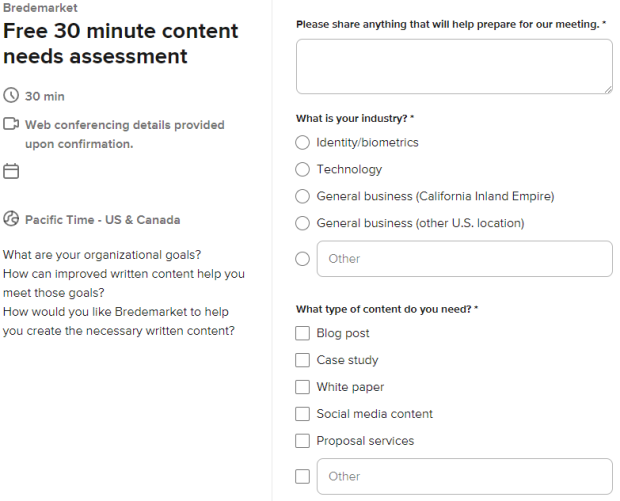
Book a meeting with me at calendly.com/bredemarket. Be sure to fill out the information form so I can best help you.
I know that “when you wear a blindfold you cannot see” is one of those seemingly obvious truths, like “the heat was hot” (the band America) or “water is wet” (a preschool teacher).
You would never intentionally blindfold yourself while driving a car, or while performing any other activity that requires your vision.
Al-Faraq’s client was a “hardcore” American salesperson who was presenting to a Middle Eastern investment firm. His hardcore presentation didn’t go well, especially when he started slamming his hand on the table.
To see how the investment firm reacted, see the original post. (Although I guess you already figured out that the client didn’t get the money. Al-Faraq didn’t bury the lede.)
What the client did BEFORE he slammed his hand on the table
But when I read Al-Faraq’s description of the meeting, I realized that his client lost his audience long before the client pounded the table. Al-Faraq’s post includes this key sentence.
Middle Easterners value cultivating relationships. In fact, this source asserts that “[i]nitial meetings are all about relationship building.” Diving into a presentation during the first meeting before your audience knows about you is understandably upsetting.
But this is not limited to business with Middle Easterners.
Diving into a presentation without understanding your audience is a serious mistake in any culture.
The Work Lady does her homework
Many years ago, before Motorola Solutions and Motorola Mobility were formed, there was one Motorola. And one year when I was at Motorola, our Biometric User’s Conference engaged Jan McInnis, The Work Lady, as one of our speakers.
When she spoke at our conference, McInnis did not just dive into her morning presentation unprepared. Before her session, she spent some time with the conference organizers and asked questions about her audience, so that she could understand them better and why this “AFIS” thing was so important to these people.
She didn’t just do that for us. It’s a standard part of her process.
Prior to the event, Jan has a conference call with your conference committee to incorporate specific challenges your group is facing into her keynote!
Her homework makes all the difference for her audiences.
Focus on the customer
McInnis, Al-Faraq, and many of you understand that to have success with a customer, you have to understand the customer. As Ali Al-Faraq says: “Knowing your audience is key!”
Don’t intentionally blindfold yourself before approaching your customer.
Today my content calendar says that I’m supposed to be posting about social media, so I’m going to discuss a LinkedIn article. That fits, doesn’t it?
Seriously, Mike French has posted his long-awaited (by me, anyway) article on the need for automated fingerprint identification system (AFIS) benchmarks. And his perspective is valuable.
People enter the AFIS industry in different ways. I entered the industry as a writer, and therefore needed some time to master the forensic and technical concepts. Mike came from the forensic disciplines, having worked in the Latent Print Unit at the King County Sheriff’s Office before joining Sagem Morpho, which became MorphoTrak, which became IDEMIA Identity & Security N.A.
Because of this background, Mike obviously has an appreciation for a law enforcement agency’s forensic requirements, and why it is important for the agency to conduct its own benchmark of AFIS vendors. As Mike notes, more and more agencies are choosing to rely on independent measurements based on test data. This may not be the best course for an agency.






 Bredemarket