“I am currently working as a Temporary Recruiting Assistant, assisting the company in finding a suitable candidate to fill an open position.
“After reading your background information, I believe that you have the experience and abilities that are highly qualified for this position.
“If you are interested in this opportunity, you are more than welcome to get back to me and I will be happy to provide you with more information about the position.
“Thank you for your time and look forward to your reply!
“Amanda Rodriguez
Temporary Recruitment Assistant | Administrative Support in Talent Acquisition”
I don’t know Spencer Stuart but they presumably wouldn’t hire a clown like this, even in a temporary capacity.
Here’s my reply, but the account disappeared before I could send it.
“If you are truly targeting anti-fraud identity verification product marketing professionals, your pitch itself sounds like it was written by a scammer fraudster. Even in his current condition, Kevin Mitnick wouldn’t fall for this scam.”
How can CMOs serve hungry prospects with expert biometric content?
(Imagen 4)
Biometric product companies offer a tasty mixture of fingerprint, face, iris, voice, DNA, and other biometric hardware and software. These companies employ Chief Marketing Officers (CMOs) responsible for their firms’ inbound product marketing. Hungry prospects devour any content the firm can provide, and the CMOs devour any employee or contractor who can provide the necessary content.
The CMO will appreciate this seasoned quote from Lee Densmer:
“Companies are outsourcing the writing at great expense….[I]t is a heavy lift to make sure daily content for the platform is useful, relevant, and align with your business. Outsourcing doesn’t really work unless the writer really knows your business, is in touch with corporate leaders, and stays on top of trends.”
So if you’re a content-devouring CMO at a biometric company, doesn’t it make sense to contract with Bredemarket’s biometric product marketing expert to serve a delicious dinner of your content needs?
I have positioned Bredemarket so I can fill the gaps in a Chief Marketing Officer’s existing content plan, or a Chief Revenue Officer’s proposal plan, or a Chief Strategy Officer’s existing analysis plan.
But what if you don’t have a plan?
Bredemarket can help you too.
This post describes how I can plug into your existing plan, or how I can help you create a plan if you don’t have one.
But first let’s dispense with the theory of how to properly do things, because it’s silly.
What theory says
If you read LinkedIn for any length of time, you will run across content marketers and copywriters and other Professional Content Experts.
These 17x certified PCEs are all too willing to tell you The Correct Way For Companies To Engage With Writing Contractors.
Because the way your company engages with contractors I s completely wrong.
Here is The Correct Way:
“When engaging with a contractor, you must provide the contractor with a detailed content brief that answers all 42 questions your contractor will ask or may ask. Failure to do this brands you as a failed substandard company.”
Bredemarket rarely receives any kind of brief from my clients. Sometimes we get a paragraph. Or sometimes we just get a couple of sentences:
“A local Utah paper ran an article about how our end customer used our solution to solve world hunger. Here’s the article; get additional information from the guy quoted in the article and write a blog post about it.”
These two sentences would drive a Professional Content Expert up a wall, because they don’t answer all 42 questions.
So what?
It’s a starting point. If I were given that, I could start.
So forget the theory of The Correct Way For Companies To Engage With Writing Contractors, and just start writing (but thinking first).
If you have a plan (or at least an idea)
Many of my clients have a content, proposal, or analysis plan—or at least an idea of what they need. There are many times when I simply plug in to a client’s existing plan. Here are some examples:
One client’s CMO needed a twice-a-month series of blog posts to promote one of their company’s services. The service featured multiple facets, so I had plenty to write about. So I plugged into the existing system and wrote.
Another client needed a series of case studies to grab the attention of their prospects. Again, the client’s product addressed multiple markets, and the variety of customer case studies gave me plenty to write about. So I plugged into the existing system and wrote.
Multiple clients have asked me to manage and/or write proposals for them. Two of the clients (one being SMA) had very well-defined capture management and proposal processes. The others didn’t—I was the de facto expert in the (virtual) room—but they knew which Request for Proposal (RFP) or Request for Information (RFI) required a response. So I plugged into the existing system and wrote.
Multiple clients (mainly in the identity/biometric realm) have asked me to perform analyses. Whether they had an established analysis process or not, they knew what they wanted. So I plugged into the existing system and wrote.
So I easily completed these one-off (or twelve-off) tasks, responding to my clients’ well-defined requests.
But others face the challenge of not knowing what they want.
The beautiful thing about the seven questions is that you can not only apply them to a particular piece of content such as a blog post, but to an entire content-proposal-analysis strategy.
And here I DO mean strategy, not tactics.
There are other methods to derive a strategy, but this is as good as any.
So if you book a free meeting with me to figure out a strategy, we can work through these questions to jointly understand your company, your products, and the material you need. I haven’t the slightest idea how our conversation will progress, but perhaps I may end up asking you questions like this:
WHY do your competitors suck?
HOW do your prospects make purchasing decisions?
WHAT do your salespeople need to close deals (conversion)?
What are your GOALS to move prospects through your funnel?
You get the idea. As we talk through things, perhaps you and I will get ideas about how Bredemarket can help you.
Or maybe not. Maybe it turns out you need a web designer, or a videographer, or a demand generation expert, or an accountant.
But if we determine that Bredemarket can help you, then we can create the plan and figure out how I can best execute on the plan. A competitor analysis? A series of blog posts? We will figure it out.
Then I’ll plug into the new existing system and write.
A call to action
Your content, proposals, and analyses will presumably incorporate a call to action.
It’s no surprise that this post also has one.
Visit my “content for tech marketers” page, read about what we can do together, and book a free 30 minute content needs assessment. You can book it at the top of the page or the bottom, whatever turns you on.
But let’s move. Your competitors are already moving.
Once again I’m painting a picture, this time of two people: the IT chick, deftly wielding her slide rule as she sizes up hardware and software, and the finance dude, deftly wielding his calculator as he tabulates profit, loss, and other money stuff. Each of them in their own little worlds.
“Many years ago, my friend Ed Hill, a Managing Director with Protiviti at the time, coined the expression ‘there is no such thing as IT risk. There is only business risk.’”
“The [Qualsys] report reveals a persistent disconnect between cybersecurity operations and business outcomes. While 49% of respondents reported having formal risk programmes, only 30% link them directly to business objectives. Even fewer (18%) use integrated risk scenarios that consider both business processes and financial exposure.”
I admit that I often draw a clear distinction between technical risk and business risk. For example, the supposedly separate questions regarding whether a third-party risk management (TPRM) algorithm is accurate, and what happens if an end customer sues your company because the end customer’s personally identifiable information was breached on your partner company’s system.
Imagen 4.
So make sure that when your IT chick wields her slide rule, the tool has an embedded calculator on it to quantify the financial effects of her IT decisions.
Imagine a Chief Marketing Officer sitting at her desk, wondering how she can overcome her latest challenge within three weeks.
She is a CMO at a biometric software company, and she needs someone to write the first two entries in a projected series of blog posts about the company’s chief software product. The posts need to build awareness, and need to appeal to prospects with some biometric knowledge.
So she contacts the biometric product marketing expert, John E. Bredehoft of Bredemarket, via his meeting request form, and schedules a Google Meet for the following meeting.
At the scheduled time she joins the meeting from her laptop on her office desk and sees John on the screen. John is a middle-aged Caucasian man with graying hair. He is wearing wire-rimmed glasses with a double bridge. He has a broad smile, with visible lines around his eyes and mouth. His eyes are brown and appear to be looking directly at the camera. He is wearing a dark blue collared shirt. While his background is blurred, he appears to be in a room inside his home, with a bookcase and craft materials in the background.
After some pleasantries and some identity industry chit chat, John started asking some questions. Why? How? What? Goal? Benefits? Target audience (which he called hungry people)? Emotions? Plus some other questions.
They discussed some ideas for the first two blog posts, each of which would be about 500 words long and each of which would cost $500 each. John pledged to provide the first draft of the first post within three calendar days.
After the call, the CMO had a good feeling. John knew biometrics, knew blogging, and had some good ideas about how to raise the company’s awareness. She couldn’t wait to read Bredemarket’s first draft.
If you are in the same situation as the CMO is this story, schedule your own meeting with Bredemarket by visiting the https://bredemarket.com/mark/ URL and filling out the Calendly form.
Remember how I warned you that this post was going to read odd? In case you’re wondering about the unusual phrasing—including a detailed description of what I look like—it’s because I fed the entire text of this blog post to Google Gemini. Preceded by the words “Draw a realistic picture of.” And here’s what I got.
Imagen 4. I’m not on the screen, but I like the content ideas.
Imagen 4. With the bookcases. And I’ve never had a beard.Imagen 4. But that’s not blurred.
These three questions, as well as others—there are more than seven—form the first part of Bredemarket’s engagement with its clients. I ask, then I act.
I ask, then I act.
If you would like to learn more about Bredemarket’s marketing and writing services, visit my “Content for Tech Marketers” page at bredemarket.com/mark.
The Meta properties are great for driving engagement, but Meta’s odd and untimely application of its rules can be maddening.
I was checking my personal Facebook account this afternoon when I noticed a “Profile has some issues” message and clicked on the “View details” button to see why my profile had a gold restricted minus sign.
Profile has some issues.
When I clicked on the button I found a list of 11 issues encompassing my personal profile, the Bredemarket page, and the Bredemarket groups.
I got flagged because Facebook said my content could “trick people to visit…a website.”
We removed your post. You figure out what happened.
But even after removing the parenthetical comment I got flagged again.
Eventually I just posted a link with no text on Facebook, and since that time have studiously avoided posting calls to action on Facebook posts.
But this past issue remains a present issue because my account is restricted…and I’m supposed to do something about it. But without a DeLorean I’m not sure what. I can’t remove the offending posts since Facebook already did so.
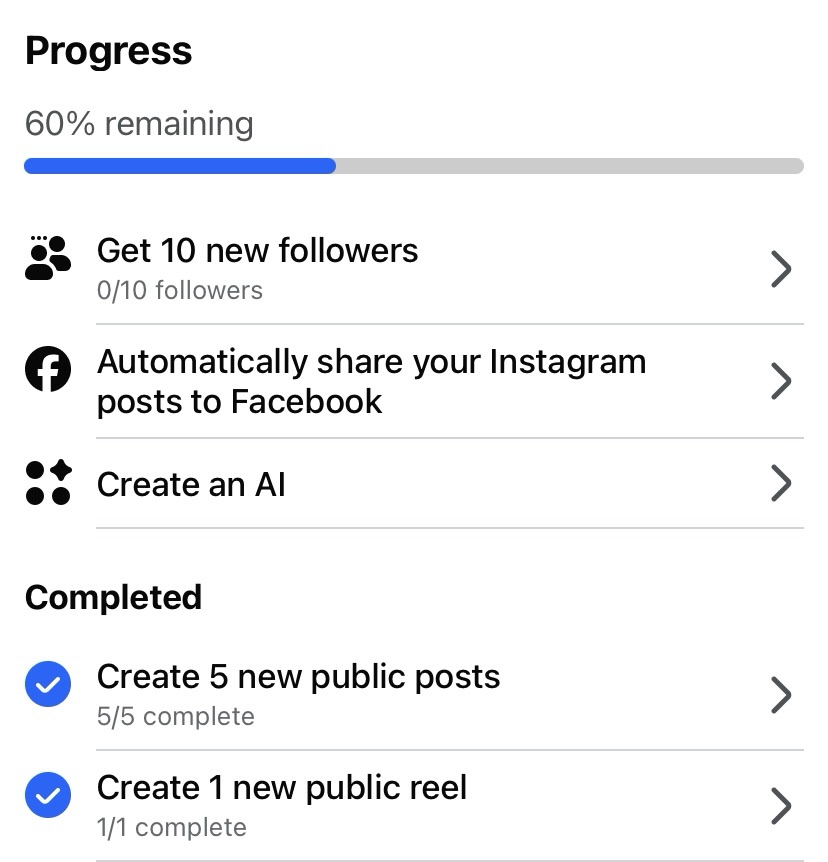
My personal Facebook account is technically a “professional” account, and therefore has Meta’s silly weekly contests. I have the content part down, but I’m NOT creating a Meta personal AI bot. (The Bredemarket Instagram account has two.)








 Bredemarket