The sixth factor of authentication?
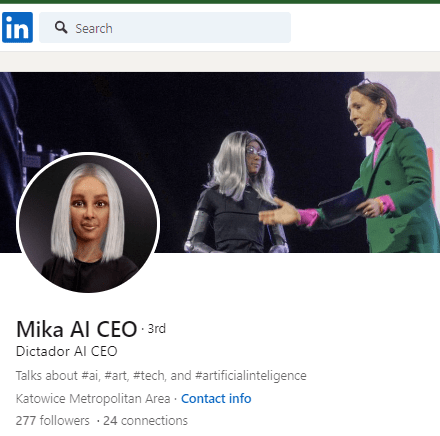
Hey, I’m famous for something.
But if you want Bredemarket to write about your identity/biometric firm’s FIVE (not four) factors of authentication, contact me.
Identity/biometrics/technology marketing and writing services
The sixth factor of authentication?
Hey, I’m famous for something.
But if you want Bredemarket to write about your identity/biometric firm’s FIVE (not four) factors of authentication, contact me.
In the United States, it is a criminal offense for a person to claim they are a health professional when they are not. But what about a non-person entity?
Often technology companies seek regulatory approval before claiming that their hardware or software can be used for medical purposes.
Consumer-grade generative AI responses are another matter. Maybe.
“AI companies have now mostly abandoned the once-standard practice of including medical disclaimers and warnings in response to health questions.”
A study led by Sonali Sharma analyzed historical responses to medical questions since 2022. The study included OpenAI, Anthropic, DeepSeek, Google, and xAI. It included both answers to user health questions and analysis of medical images. Note that there is a difference between medical-grade image analysis products used by professionals, and general-purpose image analysis performed by a consumer-facing tool.
Dharma’s conclusion? Generative AI’s “I’m not a doctor” warnings have declined since 2022.
But at least one company claims that users ARE warned.
“An OpenAI spokesperson…pointed to the terms of service. These say that outputs are not intended to diagnose health conditions and that users are ultimately responsible.”
The applicable clause in OpenAI’s TOS can be found in section 9, Medical Use.
“Our Services are not intended for use in the diagnosis or treatment of any health condition. You are responsible for complying with applicable laws for any use of our Services in a medical or healthcare context.”
4479

But the claim “it’s in the TOS” sometimes isn’t sufficient.
Of course, one way to keep generative AI companies in line is to expose them to the Rod of Ridicule. When the bots provide bad medical advice, expose them:
“Maxwell claimed that in the first message Tessa sent, the bot told her that eating disorder recovery and sustainable weight loss can coexist. Then, it recommended that she should aim to lose 1-2 pounds per week. Tessa also suggested counting calories, regular weigh-ins, and measuring body fat with calipers.
“‘If I had accessed this chatbot when I was in the throes of my eating disorder, I would NOT have gotten help for my ED. If I had not gotten help, I would not still be alive today,” Maxwell wrote on the social media site. “Every single thing Tessa suggested were things that led to my eating disorder.’”
The organization hosting the bot, the National Eating Disorders Association (NEDA), withdrew the bot within a week.
How can we, um, diagnose additional harmful recommendations delivered without disclaimers?
Maybe a “The Bots Want to Kill You” contest is in order. Contestants would gather reproducible prompts for consumer-grade generative AI applications. The prompt most likely to result in a person’s demise would receive a prize of…well, that still has to be worked out.
(Imagen 4)
(Part of the biometric product marketing expert series)
How many of you have heard of the Certified Products List (CPL)?
This list, part of the FBI’s Biometric Specifications website (FBI Biospecs), contains fingerprint card printers, fingerprint card scan systems, identification flats systems, live scan systems, mobile ID devices, and other products. Presence on the CPL indicates that the product complies with a relevant image quality specification such as Appendix F of the Electronic Biometric Transmission Specification.
The Certified Products List has existed since the 1990s and includes a number of products with which I am familiar. These products come from companies past and present, including 3M Cogent, Aware, Biometrics4All, Cross Match, DataWorks Plus, IDEMIA Identity & Security France, Identicator, Mentalix, Morpho, Motorola, NEC Technologies, Printrak, Sagem Defense Securite, Thales, and many others.
As of June 26, 2025, it also references companies such as Shenzhen Interface Cognition Technology Co., Ltd. and Shenzhen Zhi Ang Science and Technology Co., Ltd.
Those and other listings caused heartburn for the bipartisan Members of the U.S. House of Representatives Select Committee on the Chinese Communist Party.
So they sent a strongly worded letter.
“We write to respectfully urge the FBI to put an end to its ongoing certification of products from Chinese military-linked and surveillance companies—including companies blacklisted or red-flagged by the U.S. government—that could be used to spy on Americans, strengthen the repressive surveillance state of the People’s Republic of China (PRC), and otherwise threaten U.S. national security.”
Interestingly enough, they make a big deal of Hikvision products on the list, but I searched the CPL multiple times and found no Hikvision products.
And it’s important to note the FBI’s own caveat about the CPL:
“The Certified Product List (CPL) provides users with a list of products that have been tested and are in compliance with Next Generation Identification image quality specifications (IQS) regarding the capture of friction ridge images. Specifications and standards other than image quality may still need to be met. Appearance on the CPL is not, and should not be construed as, an FBI endorsement, nor should it be relied upon for any requirement beyond IQS. Users should contact their State CJIS Systems Officer (CSO) or Information Security Officer (ISO) to ensure compliance with the necessary policies and/or guidelines.“
In other words, the ONLY purpose of the CPL is to indicate whether the products in question meet technology standards. It has nothing to do with export controls or any other criteria that any law enforcement agency needs to follow when buying a product.
But the FBI isn’t the only agency “promoting” Chinese biometrics.
Wait until the Select Committee discovers the Department of Commerce’s NIST FRTE lists, including the FRTE 1:1 and FRTE 1:N lists. The tops of these lists (previously known as FRVT) include many Chinese companies.
And actually, the FRTE testing includes facial recognition products that inspired U.S. export bans. Fingerprint devices are harder to use to repress people.
What happens if the concern extends beyond China, to products produced in France and products produced in Canada?
Regarding the strongly worded letter, Biometric Update added one detail:
“As of this writing, the FBI has not issued a public response. Whether the bureau will move to decertify the flagged companies or push back on the committee’s recommendations remains to be seen. But with multiple national security statutes already in place, and Congress signaling a willingness to legislate further, the days of quiet certification for foreign adversary-linked tech firms may be numbered.”
From MIT:
“What if we could permanently remove the toxic ‘forever chemicals’ contaminating our water?”
You mean remove them…um…forever?
Hear the audio discussion of Enspired Solutions, Denise Kay, Meng Wang, and per- and polyfluoroalkyl substances (PFAS) here: https://www.technologyreview.com/2025/07/22/1117638/fighting-forever-chemicals-and-startup-fatigue/
Does your tech firm need prospect-facing text content?
Bredemarket creates written content for tech marketers that attracts prospects.
Does your tech firm need prospect-facing text content?
Bredemarket creates written content for tech marketers that attracts prospects.
Does your tech firm need prospect-facing text content?
Bredemarket creates written content for tech marketers that attracts prospects.
After a short break I’ve revived the Bredemarket Instagram account.
I announced the revival in a reel which incorporated Instagram licensed music. I’m trying to be a good blogger and comply with commercial restrictions, so the version below is a silent version.
To hear the version with sound, visit the Meta properties: Instagram, Facebook, and Threads.
Or better still, think about the song I really wanted to incorporate except Instagram didn’t have it. Start this Spotify track, and when you reach the 1:20 mark, start playing the silent video.
(Imagen 4)
What do you do when you’re just starting out and face an immediate challenge?
Jennifer Zimmerman shared a story about Thomas Keller of the French Laundry:
“When a food critic made a reservation, Keller reportedly reached out and asked them not to write a review. Not because he couldn’t take the heat, but because his young chefs weren’t ready for that kind of scrutiny.
“In short: he stepped in to protect them. He gave them cover.”
Zimmerman classified this as a lesson in team leadership, but I also see a business leadership lesson here. And maybe a thin skin, common to many of us.
Most businesses are not fully formed by day one. Bredemarket certainly wasn’t when I started in 2020; I’ll let you know if it ever gets fully formed.
Chef Thomas Keller realized that it would take time for the French Laundry staff to work together well, so when MacKenzie Chung Fegan arrived at the restaurant, he ensured there wouldn’t be a review that evening. (Fegan hadn’t planned one anyway.)
Then again, Keller has a love-hate relationship with reviewers anyway, so perhaps his motives weren’t that altruistic. From Eater:
“After New York Times critic Pete Wells wrote an unflattering review in 2016 in which he referenced a mushroom soup as appetizing-looking as ‘bong water,’ Keller and his team have taken to giving critics an uncomfortable ‘gotcha’ gift of soup served in a literal weed-ready bong….”

Ceci n’est pas un bang.
But how should business owners and marketers react to a bad review? I admit I’m not that good at this. When someone whom I respect unsubscribed from the Bredemarket Instagram account, I failed to restrain all my disappointment.
But I didn’t serve the person soup in a bong.
Oh, and one more thing.
If in 1969 I was creating videos about a 1993 standard issued by the National Institute of Standards and Technology (an agency that didn’t exist under that name in 1969)…
…I must have been a genius little boy.