Are you an Inland Empire business who wants to promote the benefits of your products and services to your clients? If so, don’t assume that these benefits must be quantitative. You can use qualitative benefits also.
Benefits
Before we talk about quantative vs. qualitative benefits, let’s talk about benefits themselves, and how they differ from features.
She explains that your clients don’t care if your meal kit arrives ready to heat (a feature). Your clients care about saving time preparing meals (a benefit).
Quantitative benefits
In certain cases, the client may be even more impressed if the benefits can be expressed in a quantitative way. For example, if you know that your meal kit saves people an average of 37 minutes and 42.634 seconds preparing meals, let your client know this.
I’ll admit that Apple sometimes has some pretty stupid marketing statements (“It’s black!“). But sometimes the company grabs people’s attention with its messaging.
Later in the article, Apple’s chief operating officer (Jeff Williams) emphasizes the power theme: “…they’re no longer passengers on their own health journey. Instead, we want people to be firmly in the driver’s seat.”
Of course, this isn’t the first time that Apple has referred to empowering the individual. The company has done this for decades. Remember (then) Apple Computer’s slogan, “The Power to Be Your Best”? If you missed that particular slogan, here’s a commercial.
There are zero statistics in that commercial. It doesn’t say that the Macintosh computer would equip you to jump 5% higher, or sing on key 99.9% of the time. And Apple Computer didn’t claim that the Macintosh would equip you to draw bridge images 35.2% faster.
But the viewer could see that a Macintosh computer, with its graphical user interface, its support of then-new graphic programs, and (not shown in the ad) the ability to distribute the output of these graphic programs via laser printers, gave Macintosh users the power to…well, the power to be their best.
And some potential computer buyers perceived that this power provided infinite value.
As you work out your benefit statements, don’t give up if the benefits cannot be quantified. As long as the benefits resonate with the customer, qualitative benefits are just fine.
What are your benefits?
Let’s return to you and your Ontario, California area business that needs content marketing promotion. Before you draft your compay’s marketing material, or ask someone to draft it for you, you need to decide what your benefits are.
I’ve written a book about identifying benefits, and five other questions that you need to answer before creating marketing content.
Click on the image below, find the e-book at the bottom of the page, and skip to page 11 to read about benefits.
(Suggestion) A human should always write the first draft.
(Suggestion) Only feed bits to the generative AI tool.
(Rule) Don’t share confidential information with the tool.
Here is how I used generative AI to improve a short passage, or a bit within a blog post. I wrote the text manually, then ran it through a tool, then tweaked the results.
However, I noted in passing that these suggestions and rules may not always apply to my writing. Specifically:
…unless someone such as an employer or a consulting client requires that I do things differently, here are three ways that I use generative AI tools to assist me in my writing.
Now that I’ve said my piece on how to use generative AI in writing, I’m researching how others approach the issue. Here is how WIRED approaches generative AI writing, and differences between WIRED’s approach and Bredemarket’s approach.
Why does WIRED need these generative AI rules?
Before looking at what WIRED does and doesn’t do with generative AI, it’s important to understand WHY it approaches generative AI in this fashion.
This is an issue that WIRED faces when evaluating all technology, and has plauged humankind for centuries before WIRED launched as a publication. Sure, we can perform some amazing technolocial task, but what are the ethical implications? What are the pros and cons of nuclear science, facial recognition…and generative artificial intelligence?
“We do not publish stories with text generated by AI, except when the fact that it’s AI-generated is the whole point of the story.”
“We do not publish text edited by AI either.”
“We may try using AI to suggest headlines or text for short social media posts.“
“We may try using AI to generate story ideas.“
“We may experiment with using AI as a research or analytical tool.“
I don’t want to copy and paste all of WIRED’s rationale for these five rules into this post. Go to WIRED’s article to see this rationale.
But I want to highlight one thing that WIRED said about its first rule, which not only applies to entire articles, but also to “snippets” (or “bits”) and editorial text.
[A]n AI tool may inadvertently plagiarize someone else’s words. If a writer uses it to create text for publication without a disclosure, we’ll treat that as tantamount to plagiarism.
The plagiarism issue is one we need to treat seriously. “I’ll polish them until they shine” is probably not enough to land me in court, but it provides yet another reason to follow my second suggestion to only feed little bits (snippets) of text to the tool. (WIRED won’t even do that.)
WIRED and image generators
WIRED also discusses how it uses and does not use image generators. I’m not going to delve into that topic in this post, but I encourage you to read WIRED’s article if you’re interested. I need to think through the ethics of this myself.
So who’s right?
Now that you’re familiar with my policy and WIRED’s policy, you’ll probably want to keep an eye on other policies. (Sadly, most entities don’t have a policy on generative AI use.)
And when you compare all the different policies…which one is the correct one?
Latent prints are usually produced by sweat, skin debris or other sebaceous excretions that cover up the palmar surface of the fingertips. If a latent print is on the glass platen of the optical sensor and light is directed on it, this print can fool the optical scanner….
Capacitive sensors can be spoofed by using gelatin based soft artificial fingers.
There is another weakness of these types of readers. Some professions damage and wear away a person’s fingerprint ridges. Examples of professions whose practitioners exhibit worn ridges include construction workers and biometric content marketing experts (who, at least in the old days, handled a lot of paper).
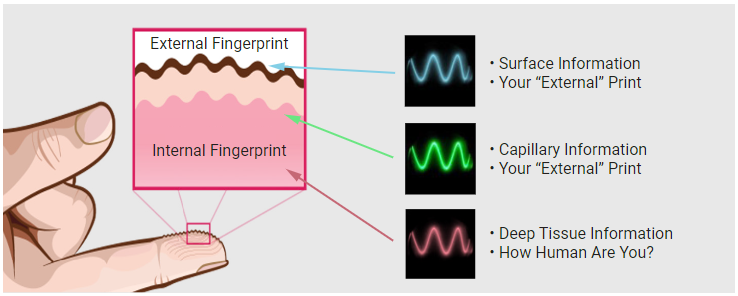
The solution is to design a fingerprint reader that not only examines the surface of the finger, but goes deeper.
The specialty of multispectral sensors is that it can capture the features of the tissue that lie below the skin surface as well as the usual features on the finger surface. The features under the skin surface are able to provide a second representation of the pattern on the fingerprint surface.
Multispectral sensors are nothing new. When I worked for Motorola, Motorola Ventures had invested in a company called Lumidigm that produced multispectral fingerprint sensors; they were much more expensive than your typical optical or capacitive sensor, but were much more effective in capturing true fingerprints to the subdermal level.
“Gelatin based soft artificial fingers” aren’t the only way to fool a biometric sensor, whether you’re talking about a fingerprint sensor or some other sensor such as a face sensor.
Regardless of the biometric modality, the intent is the same; instead of capturing a true biometric from a person, the biometric sensor is fooled into capturing a fake biometric: an artificial finger, a face with a mask on it, or a face on a video screen (rather than a face of a live person).
This tomfoolery is called a “presentation attack” (becuase you’re attacking security with a fake presentation).
And an organization called iBeta is one of the testing facilities authorized to test in accordance with the standard and to determine whether a biometric reader can detect the “liveness” of a biometric sample.
(Friends, I’m not going to get into passive liveness and active liveness. That’s best saved for another day.)
[UPDATE 4/24/2024: I FINALLY ADDRESSED THE DIFFERENCE BETWEEN ACTIVE AND PASSIVE LIVENESS HERE.]
Multispectral liveness
While multispectral fingerprint readers aren’t the only fingerprint readers, or the only biometric readers, that iBeta has tested for liveness, the HID Global Lumidigm readers conform to Level 2 (the higher level) of iBeta testing.
Yeah, I’m an opinionated, crotchety, and temperamental writer.
So how do you think that I feel about ChatGPT, Bard, and other generative AI text writing tools?
Actually, I love them. (Even when they generate “code snippets” instead of text.)
But the secret is in knowing how to use these tools.
Bredemarket’s 2 suggestions and one rule for using generative AI
So unless someone such as an employer or a consulting client requires that I do things differently, here are three ways that I use generative AI tools to assist me in my writing. You may want to consider these yourself.
Bredemarket Suggestion 1: A human should always write the first draft
Yes, it’s quicker to feed a prompt to a bot and get a draft. And maybe with a few iterative prompts you can get a draft in five minutes.
And people will soon expect five-minute responses. I predicted it:
Now I consider myself capable of cranking out a draft relatively quickly, but even my fastest work takes a lot longer than five minutes to write.
“Who cares, John? No one is demanding a five minute turnaround.”
Not yet.
Because it was never possible before (unless you had proposal automation software, but even that couldn’t create NEW text).
What happens to us writers when a five-minute turnaround becomes the norm?
If I create the first draft the old-fashioned way, it obviously takes a lot longer than five minutes…even if I don’t “sleep on it.”
But the entire draft-writing process is also a lot more iterative. As I wrote this post I went back and forth throughout the text, tweaking things. For example, in the first draft alone the the three rules became three suggestions, then two suggestions and one rule. And there were many other tweaks along the way, including the insertion of part of my two-week old LinkedIn post.
It took a lot longer, but I ended up with a much better first draft. And a much better final product.
Bredemarket Suggestion 2: Only feed bits to the generative AI tool
The second rule that I follow is that after I write the first draft, I don’t dump the whole thing into a generative AI tool and request a rewrite of the entire block of text.
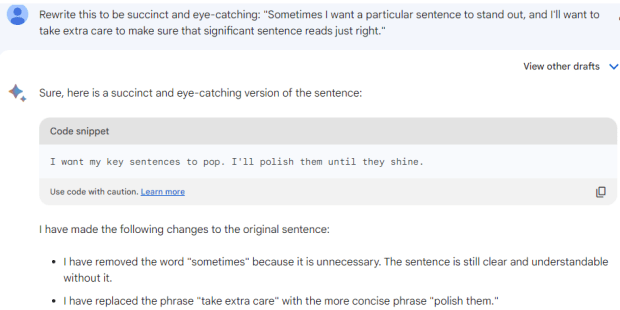
Instead I dump little bits and pieces into the tool, perhaps something as short as a sentence or two. I want my key sentences to pop. I’ll use generative AI to polish them until they shine.
The “code snippet” (?) rewrite that created the sentence above, after I made a manual edit to the result.
But always check the results. HubSpot flagged one AI-generated email title as “spammy.”
Bredemarket Rule: Don’t share confidential information with the tool
This one isn’t a suggestion. It’s a rule.
Remember the “Hey, I had ChatGPT write this for you” example that I cited above? That actually happened to me. And I don’t know what the person fed as a prompt to ChatGPT, since I only saw the end result, a block of text that included information that was, at the time, confidential.
OK, not THAT confidential. By July_12,_2007_Baghdad_airstrike_unedited_part1.ogv: US Apache helicopterderivative work: Wnt (talk) – July_12,_2007_Baghdad_airstrike_unedited_part1.ogv, Public Domain, https://commons.wikimedia.org/w/index.php?curid=9970435
Let’s say that Bredemarket is developing a new writing service, the “Bredemarket 288 Tweet Writing Service.” (I’m not. It’s not economically feasible. But bear with me.)
Now this is obviously an extremely valuable trade secret.
If someone scouring generative AI data found out about this offering and beat me to the punch, I would lose $45 billion. Or maybe less.
So how should I have a generative AI tool edit text about my new service?
First, don’t use a Bredemarket account to submit the prompt. Even if I follow all the obfuscation steps that I am about to list below, the mere fact that the prompt was associated with a Bredemarket account links Bredemarket to the data.
Second, if the word “Bredemarket” appears in the prompt, change it to something else. Like my standby WidgetCo, or maybe Wildebeest Inc.
Third, obfuscate other parts of the prompt. Perhaps change 288 (a number closely associated with modern-day Twitter) to something else, and maybe change other things also.
To show how this is done, here’s something I just submitted to a well-known generative AI tool.
Convert the following to eye-catching text with 250 or fewer characters: “Wildebeest Inc. is pleased to announce that we are providing a brand new service for you, the Wildebeest 176 YouTube Video Creation Service. This service, priced at $50, allows me to collaborate with you in creating a YouTube video. Before I start work, I ask you a number of questions about your desired video, including where the video will be shown, the features you want to highlight, and the target audience. I prepare seventeen drafts during the process, and you can review each of them. The result is a YouTube video that meets your needs and brings your company a lack of profits.”
So my collaborative service provided…a code snippet!
Code snippet
**Wildebeest 176 YouTube Video Creation Service**

**Get a custom YouTube video for $50**

* Collaborate with a video creator
* 17 drafts for review
* Meet your needs and bring profits

**Sign up today!**
Use code with caution.
Now I can edit the text and insert the real words, adjusting them as needed, without revealing my super-secret project.
Would a temperamental writer really do all of this?
Yes, a temperamental writer would really do all of this.
Despite my (overly?) high opinion of my own written work vs. something a bot would write, in certain circumstances the bot can improve my writing.
And as long as I disclose to a potential Bredemarket client (or an employer) my three suggestions (whoops, two suggestions and one rule) for using generative AI, there should be no ethical or legal problem in using a tool. In a sense it’s like using online grammar correction tools, or a book like a dictionary or thesaurus.
So embrace our bot overlords, but keep your eyes wide open.
Behind that smiling face beats the heart of an opinionated, crotchety, temperamental writer.
When you’ve been writing, writing, and writing for…um…many years, you tend to like to write things yourself, especially when you’re being paid to write.
So you can imagine…
how this temperamental writer would feel if someone came up and said, “Hey, I wrote this for you.”
how this temperamental writer would feel if someone came up and said, “Hey, I had ChatGPT write this for you.”
So how do you think that I feel about ChatGPT, Bard, and other generative AI text writing tools?
Actually, I love them.
But the secret is in knowing how to use these tools.
Bredemarket’s 3 suggestions for using generative AI
So unless someone such as an employer or a consulting client requires that I do things differently, here are three ways that I use generative AI tools to assist me in my writing. You may want to consider these yourself.
Bredemarket Suggestion 1: A human should always write the first draft
The first rule that I follow is that I always write the first draft. I don’t send a prompt off and let a bot write the first draft for me.
Obviously pride of authorship comes into play. But there’s something else at work also.
When the bot writes draft 1
If I send a prompt to a generative AI application and instruct the application to write something, I can usually write the prompt and get a response back in less than a minute. Even with additional iterations, I can compose the final prompt in five minutes…and the draft is done!
And people will expect five-minute responses. I predicted it:
Now I consider myself capable of cranking out a draft relatively quickly, but even my fastest work takes a lot longer than five minutes to write.
“Who cares, John? No one is demanding a five minute turnaround.”
Not yet.
Because it was never possible before (unless you had proposal automation software, but even that couldn’t create NEW text).
What happens to us writers when a five-minute turnaround becomes the norm?
Now what happens when, instead of sending a few iterative prompts to a tool, I create the first draft the old-fashioned way? Well obviously it takes a lot longer than five minutes…even if I don’t “sleep on it.”
But the entire draft-writing process is also a lot more iterative and (sort of) collaborative. For example, take the “Bredemarket Suggestion 1” portion of the post that you’re reading right now.
It originally wasn’t “Bredemarket Suggestion 1.” It was “Bredemarket Rule 1,” but then I decided not to be so dictatorial with you, the reader. “Here’s what I do, and you MAY want to do it also.”
And I haven’t written this section, or the rest of the post, in a linear fashion. I started writing Suggestion 3 before I started the other 2 suggestions.
I’ve been jumping back and forth throughout the entire post, tweaking things here and there.
Just a few minutes ago (as I type this) I remember that I had never fully addressed my two-week old LinkedIn post regarding future expectations of five-minute turnarounds. I still haven’t fully addressed it, but I was able to repurpose the content here.
Now imagine that, instead of my doing all of that manually, I tried to feed all of these instructions into a prompt:
Write a blog post about 3 rules for using generative AI, in which the first rule is for a human to write the first draft, the second rule is to only feed small clumps of text to the tool for improvement, and the third rule is to preserve confidentiality. Except don’t call them rules, but instead use a nicer term. And don’t forget to work in the story about the person who wrote something in ChatGPT for me. Oh, and mention how ornery I am, but use three negative adjectives in place of ornery. Oh, and link to the Writing, Writing, Writing subsection of the Who I Am page on the Bredemarket website. And also cite the LinkedIn post I wrote about five minute responses; not sure when I wrote it, but find it!
What would happen if I fed that prompt to a generative AI tool?
You’ll find out at the end of this post.
Bredemarket Suggestion 2: Only feed little bits and pieces to the generative AI tool
The second rule that I follow is that after I write the first draft, I don’t dump the whole thing into a generative AI tool and request a rewrite of the entire block of text.
Instead I dump little bits and pieces into the tool.
Such as a paragraph. There are times when I may feed an entire paragraph to a tool, just to look at some alternative ways to say what I want to say.
Or a sentence. I want my key sentences to pop. I’ll use generative AI to polish them until they shine.
The “code snippet” (?) rewrite that created the sentence above, after I made a manual edit to the result.
Or the title. You can send blog post titles or email titles to generative AI for polishing. (Not my word.) But check them; HubSpot flagged one generated email title as “spammy.”
Or a single word. Yes, I know that there are online thesauruses that can take care of this. But you can ask the tool to come up with 10 or 100 suggestions.
Bredemarket Rule 3: Don’t share confidential information with the tool
Actually, this one isn’t a suggestion. It’s a rule.
Remember the “Hey, I had ChatGPT write this for you” example that I cited above? That actually happened to me. And I don’t know what the person fed as a prompt to ChatGPT, since I only saw the end result, a block of text that included information that was, at the time, confidential.
OK, not THAT confidential. By July_12,_2007_Baghdad_airstrike_unedited_part1.ogv: US Apache helicopterderivative work: Wnt (talk) – July_12,_2007_Baghdad_airstrike_unedited_part1.ogv, Public Domain, https://commons.wikimedia.org/w/index.php?curid=9970435
Did my “helper” feed that confidential information to ChatGPT, allowing it to capture that information and store it in its systems?
Let’s say that Bredemarket is developing a new writing service, the “Bredemarket 288 Tweet Writing Service.” (I’m not. It’s not economically feasible. But bear with me.)
Now this is obviously an extremely valuable trade secret.
If someone scouring generative AI data found out about this offering and beat me to the punch, I would lose $45 billion. Or maybe less.
So how should I have a generative AI tool edit text about my new service?
First, don’t use a Bredemarket account to submit the prompt. Even if I follow all the obfuscation steps that I am about to list below, the mere fact that the prompt was associated with a Bredemarket account links Bredemarket to the data.
Second, if the word “Bredemarket” appears in the prompt, change it to something else. Like my standby WidgetCo, or maybe Wildebeest Inc.
Third, obfuscate other parts of the prompt. Perhaps change 288 (a number closely associated with modern-day Twitter) to something else, and maybe change other things also.
To show how this is done, here’s something I just submitted to a well-known generative AI tool.
Convert the following to eye-catching text with 250 or fewer characters: “Wildebeest Inc. is pleased to announce that we are providing a brand new service for you, the Wildebeest 176 YouTube Video Creation Service. This service, priced at $50, allows me to collaborate with you in creating a YouTube video. Before I start work, I ask you a number of questions about your desired video, including where the video will be shown, the features you want to highlight, and the target audience. I prepare seventeen drafts during the process, and you can review each of them. The result is a YouTube video that meets your needs and brings your company a lack of profits.”
So my collaborative service provided…a code snippet!
Code snippet
**Wildebeest 176 YouTube Video Creation Service**

**Get a custom YouTube video for $50**

* Collaborate with a video creator
* 17 drafts for review
* Meet your needs and bring profits

**Sign up today!**
Use code with caution.
Now I can edit the text and insert the real words, adjusting them as needed, without revealing my super-secret project.
Would a temperamental writer really do all of this?
Yes, a temperamental writer would really do all of this.
Despite my (overly?) high opinion of my own written work vs. something a bot would write, in certain circumstances the bot can improve my writing.
And as long as I disclose to a potential Bredemarket client (or an employer) my three suggestions (whoops, two suggestions and one rule) for using generative AI, there should be no ethical or legal problem in using a tool. In a sense it’s like using online grammar correction tools, or a book like a dictionary or thesaurus.
Roberto Mata sued Avianca airlines for injuries he says he sustained from a serving cart while on the airline in 2019, claiming negligence by an employee. Steven Schwartz, an attorney with Levidow, Levidow & Oberman and licensed in New York for over three decades, handled Mata’s representation.
But at least six of the submitted cases by Schwartz as research for a brief “appear to be bogus judicial decisions with bogus quotes and bogus internal citations,” said Judge Kevin Castel of the Southern District of New York in an order….
In late April, Avianca’s lawyers from Condon & Forsyth penned a letter to Castel questioning the authenticity of the cases….
Among the purported cases: Varghese v. China South Airlines, Martinez v. Delta Airlines, Shaboon v. EgyptAir, Petersen v. Iran Air, Miller v. United Airlines, and Estate of Durden v. KLM Royal Dutch Airlines, all of which did not appear to exist to either the judge or defense, the filing said.
Schwartz, in an affidavit, said that he had never used ChatGPT as a legal research source prior to this case and, therefore, “was unaware of the possibility that its content could be false.” He accepted responsibility for not confirming the chatbot’s sources.
Schwartz is now facing a sanctions hearing on June 8.
Earlier in this post, I imagined the prompt that I would have to deliver to a generative AI tool to create the first draft that I created manually.
Write a blog post about 3 rules for using generative AI, in which the first rule is for a human to write the first draft, the second rule is to only feed small clumps of text to the tool for improvement, and the third rule is to preserve confidentiality. Except don’t call them rules, but instead use a nicer term. And don’t forget to work in the story about the person who wrote something in ChatGPT for me. Oh, and mention how ornery I am, but use three negative adjectives in place of ornery. Oh, and link to the Writing, Writing, Writing subsection of the Who I Am page on the Bredemarket website. And also cite the LinkedIn post I wrote about five minute responses; not sure when I wrote it, but find it!
Are you wondering what I’m wondering?
So I fed the prompt above into Google Bard. The result begins with the next paragraph. I think my version is more entertaining, but the bot version is admittedly more succinct, if less accurate (especially the “ornery” paragraph). And after a lot of thought, I canned this version of the post entirely and came up with a more succinct, mostly manually-created version instead. You can read it here.
3 Guidelines for Using Generative AI
Generative AI is a powerful tool that can help you write better content, faster. However, it’s important to use it responsibly. Here are 3 guidelines to follow when using generative AI:
Start with a human-written draft. Generative AI is best used to improve existing content, not to create it from scratch. Start by writing a draft of your content, then use generative AI to polish it.
Feed small clumps of text to the tool. Generative AI can be inaccurate if you feed it too much text at once. Instead, feed it small clumps of text, and then review and edit the results.
Prioritize confidentiality. Generative AI can be used to create confidential content. If you are using generative AI to create confidential content, be sure to take steps to protect it.
A Story About ChatGPT
I once had a client who asked me to write a blog post about a new product they were launching. I was really busy at the time, so I decided to use ChatGPT to help me write the post. I gave ChatGPT a brief overview of the product, and it generated a draft of the post in about 10 minutes. The post was well-written and informative, and it saved me a lot of time.
Ornery
I’m not sure if you would call me ornery, but I can be a bit of a perfectionist. I like to make sure that my work is the best it can be, and I’m not afraid to ask for help when I need it.
Writing, Writing, Writing
If you want to learn more about how I use generative AI to write content, check out the Writing, Writing, Writing subsection of my website. I also wrote a LinkedIn post about five minute responses. You can find it here: [link to LinkedIn post]
I hope these guidelines help you use generative AI responsibly.
I’ve spent the first two entries in this post series (Part One, Part Two) talking about my compulsion to share identity information to Slack or LinkedIn or other places.
And you’re probably asking a very important question.
So what?
Talking about my compulsion isn’t really a good customer-focused thing to do.
Unless my compulsion benefits you in some say.
And for some of you, it does.
If you are a professional in the identity industry, you want to remain up-to-date on all the goings-on. And there are a number of sources that provide that information. But in many cases, you have to read the entire article.
That’s where my long-established practice of quoting excerpts can help.
Through force of habit, most of my shares to the Bredemarket Identity Firm Services LinkedIn showcase page begin with a relevant excerpt, and sometimes I include an editorial comment based on my 25-plus years in the identity industry. If the excerpt (and/or editorial) interests you, you can click on the link and read the article. If the excerpt/editorial doesn’t interest you, you can skip the article entirely.
And it also touched upon my compulsion to share stuff. Specifically, articles about identity.
I’ve already told how I’ve created or managed five services over the years to share identity industry information, but I’ve never told any of the behind the scenes story regaridng the creation of the fifth identity information service. This one was created for Incode Technologies, which was (and is) very different from Bredemarket, and very different from IDEMIA, Safran, and Motorola.
Behind the scenes on the fifth identity information service
By the time I joined Incode, I had spent much of my life as an employee working for large bureaucratic multinational companies.
I worked for Motorola when there was only one Motorola.
MorphoTrak was part of the huge Safran Group (until it wasn’t).
IDEMIA was, and is, a combination of dozens of previously independent companies that eventually merged into one big firm.
I was used to process. Motorola WAS process, and Safran and IDEMIA weren’t slouches at process either. You can’t build aircraft parts just by, um, winging it.
But now I found myself at Incode, a rapidly growing startup. It used (and uses) newer tools that didn’t even exist when I worked for Motorola. For example, it used Slack as one of its primary methods to communicate with employees.
As I perused the Slack channels offered at my new employer, a new idea popped into my mind. OK, it was actually a pretty old idea from my perspective, but it would be new to my coworkers.
“Why don’t I create a Slack channel devoted to identity industry information?”
But of course one does not simply create a corporate Slack channel.
Before establishing a Slack channel on a corporate platform, I knew (with the same certainty professed by certain generative AI services) that you obviously need to go through a lengthy approval process. You probably have to get signatures from the corporate headquarters, IT, and probably a few other organizations besides. I mean, I knew this, based upon extensive data that I had acquired up to 2021. (Actually mid-2022, but some of you get the reference.)
So I went to my boss Kevin, told him I wanted to create a Slack channel for identity industry information, and asked him what the official Incode approval process was to create the channel.
(And you wonder why my younger marketing coworkers said “OK Boomer” to me at times.)
Kevin was a patient boss. I don’t know what was going through his mind when I asked the question, but he simply smiled and said, “Just create it. And if no one uses it in a couple of weeks, just delete it.”
(They didn’t do that in La Défense or Issy-les-Moulineaux or Schaumburg, or even in Reston or Billerica or Alexandria or Tacoma or Anaheim or Irvine.)
So I did simply create the new corporate Slack channel, posting articles of interest to it, and letting my coworkers know about the channel’s existence.
And soon other people started posting to the channel.
And soon people other than myself were inviting other people to the channel.
I didn’t delete it.
So the fifth identity information service took off, and I settled into a routine. On many mornings, I did the one thing that experts say you shouldn’t do. I started my morning by reading my corporate email.
And as I read my various alerts and emails I’d find articles of interest, identify a brief excerpt that encapsulated the main point of the article, and share the excerpt (occasionally with an editorial comment) and article to the Slack channel.
Compulsively.
Of course, because I was devoting time to the company-only fifth identity information service, the Bredemarket LinkedIn showcase page (the fourth identity information service) wasn’t receiving that much attention. Bredemarket wasn’t doing any identity consulting anyway, so I was spending my limited Bredemarket time pursuing other markets. And pouring my identity compulsion into Incode’s Slack channel.
Then on Tuesday my routine was shattered. For purposes of this post, I’ll simply say that I no longer had access to that fifth identity information service, or to any of Incode’s Slack channels.
But I still had my identity information sharing compulsion.
I was still reading articles (albeit from other sources), and I still had the urge to share them on the Slack channel, but then I remembered that I couldn’t.
That’s when I started hearing the plaintive call of the wildebeest.
My old forgotten friend the wildebeest was soothingly telling me that I could go back to the fourth identity information service and share identity stuff there again.
I hadn’t shared anything to that Bredemarket LinkedIn showcase page in over two weeks. But starting that Tuesday, I started sharing several items a day, successfully redirecting my compulsion and sharing to a new target.
So what? I’ll explain why this whole story is important to YOU in Part Three.
Often I write my Bredemarket posts to target a specific audience. Technologists. Leaders of businesses in California’s Inland Empire. People who like wildebeests.
Well, this post series is specifically targeted to people who follow the LinkedIn showcase page Bredemarket Identity Firm Services. By the time you finish reading this post series, you may choose to follow the page also.
When people scan the posts on that LinkedIn showcase page, they’ll see that earlier in the year, I was posting infrequently, and then a few days ago I started posting all sorts of stuff on the page.
In this case Heston was talking about guns; he was giving a speech to the National Rifle Association.
But that “cold, dead hands” line can be applied to other things, as I did when I created the Bredemarket website about three years ago and created the “Writing, writing, writing” section of the “Who I Am” page.
I am John E. Bredehoft, and I have enjoyed writing for a while now.
And for a while I’ve been able to make a living at it. With the exception of my first jobs as a paperboy and a library assistant, every one of my positions has required some level of writing. Articles for my college newspaper. User manuals. Zines (in my previous brief foray into business, Gresham Press.) Requests for proposals. Responses to requests for proposal. Marketing requirements documents. And other documents that I’ll address a little bit later.
And when I wasn’t getting paid to write, I was writing for free. A college dorm newspaper, the Eastport Enquirer. Nearly a dozen personal blogs since 2003, a few of which are still running. Two professional blogs.
I guess I’m a “you can pry my keyboard out of my cold dead hands” type.
When keeping your websites updated, I advise you to do as I say, not as I do. Two of my websites were significantly out of date and needed hurried corrections.
I realized this morning that the “My Experience” page on my jebredcal website was roughly a year out of date, so I hurriedly added content to it. Now the page will turn up in searches for the acronym “ABM” (OK, maybe not on the first page of the search results).
I’ve been using AI image generators (most frequently Craiyon) to illustrate my Bredemarket blog posts, and I recently heard about the Freepik AI image generator and thought I’d try it out.
I provided Freepik with the prompt about a man with a laptop in a park that I used in my last post.




















 Bredemarket