“Lost Recognition” illustrates that facial recognition isn’t always available.
Lost Recognition. Google/Canva.
Technologically, this video was assembled in Canva using images from Google Gemini and audio (without the video) from Google Lyria.
But who cares?
I don’t create videos for Bredemarket clients, but I do provide words that address prospect needs…such as the requirement to let a person access a building on a dark night.
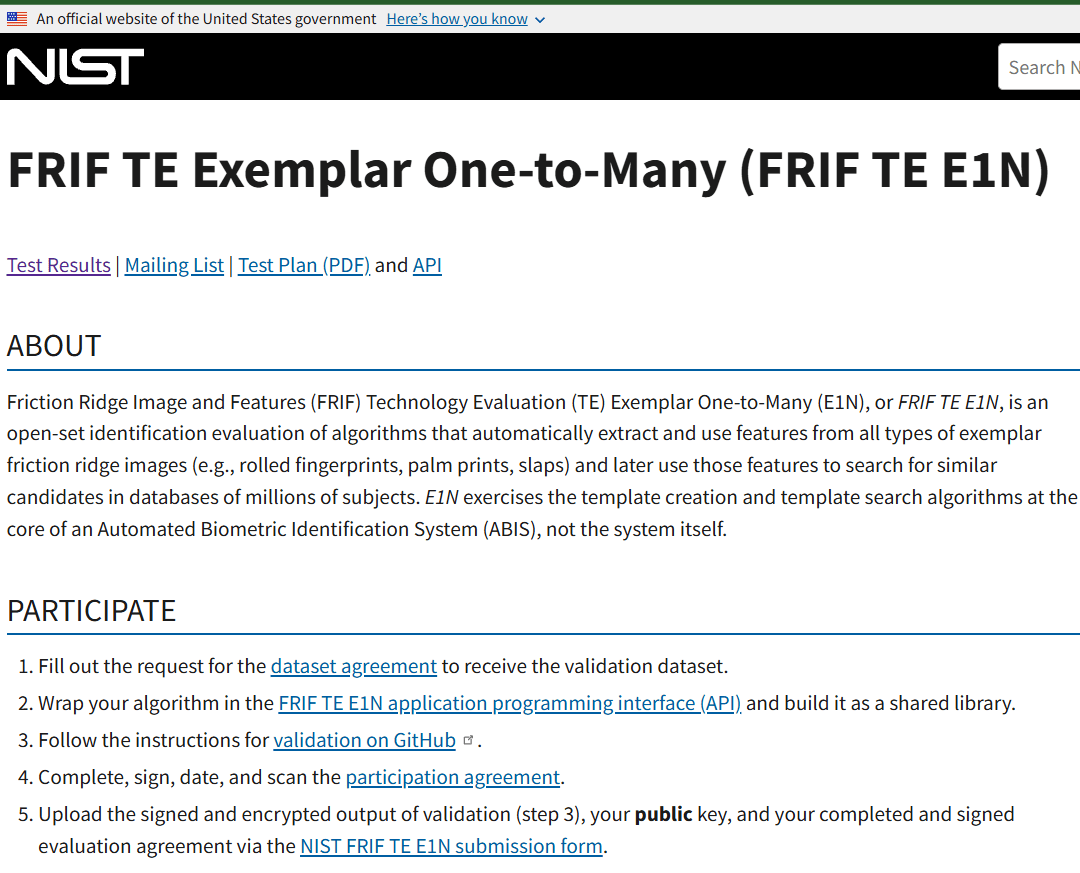
ROC (previously known as Rank One Computing) posted this about its latest resukts in the NIST Friction Ridge Image and Features Technology Evaluation Exemplar One-to-Many (FRIF TE E1N) evaluation.
“ROC’s performance in the NIST FRIF TE E1N evaluation, including #1 global ranking in Class B slap fingerprints, a critical capture format for high-scale civil and government identity programs, proves that American technology can now lead at the highest levels of global biometric performance….
“The NIST Friction Ridge Image and Features Technology Evaluation Exemplar One-to-Many evaluation, known as NIST FRIF TE E1N, evaluates one-to-many fingerprint identification at massive scale, testing how accurately algorithms can identify a subject from large enrollment repositories. Across the evaluation, ROC delivered top-tier performance in every category tested, including Class A, Class B, and Class C. “
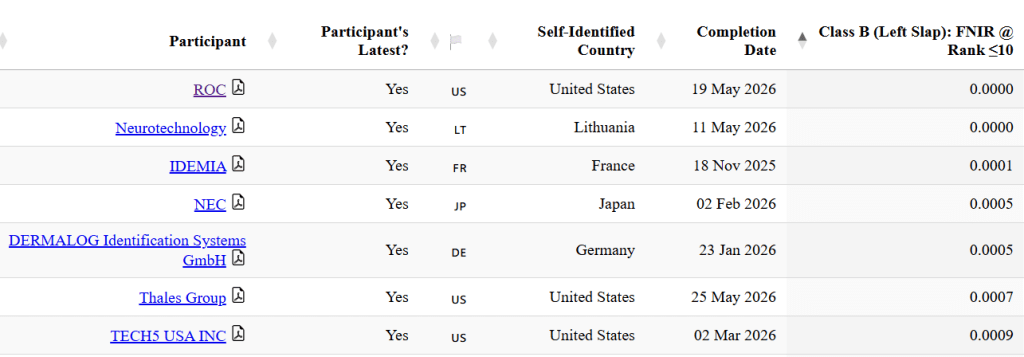
As with every NIST biometric test, FRIF yields a massive amount of data. Just looking at the Class B slap data alone, here is what you can find, showing the top 7 entries out of 12 for the Class B Left Slap FNIR (another acronym: false negativce identification rate) at rank less than or equal to 10. Even this view excludes all other slap data and all other ranking data (1, 2, and 5).
(Data captured Friday, May 29, 2026 and may become outdated when new algorithms are tested.)
National Institute of Standards and Technology.
With this massive wealth of data, just about every vendor probably performed well in something, which is why ROC took the time to point out why Class B slap results are important.
“ROC’s most significant milestone came in Class B slap fingerprints. This performance is especially important for high-scale ABIS environments, including national ID programs, border management, civil enrollment, and high-stakes criminal justice workflows, where handling immense scale without sacrificing accuracy is mandatory.”
Although ROC may be the only entity trumpeting May results, other vendors have promotede earlier NIST FRIF TE E1N achievements, including IDEMIA, Identy.IO, Innovatrics, and Neurotechnology.
But they’re foreign. (As is Thales Group, for those keeping score.)
“NHI visibility and AI agent visibility feel like the same problem. They’re not. A service account is relatively static. It was created for a purpose, it has credentials, it authenticates to something. You can find it, document it, rotate its credentials, put it in a vault. That’s a solvable problem with existing tooling.
“An AI agent is different in almost every dimension that matters. It’s dynamic. It’s often ephemeral. It doesn’t have a fixed identity. It borrows one, or several. It makes decisions at runtime about what it needs to access. And it operates at machine speed, which means by the time your SIEM fires an alert, the transaction is already done.”
After encountering yet another Facebook post that seemed to go on forever, I asked Google Gemini the “why” question.
But note the last sentence of my prompt.
Why do people who use AI authored text for Facebook posts choose text that is twice as long as it needs to be? Answer succinctly.
Google Gemini’s succinct reply
People generally use overly long AI-generated text for Facebook posts for a few key reasons:
The “Default” Bias: Most AI models are trained to be thorough and helpful, so their default output leans verbose. Users often just copy and paste the first result without editing it down.
Perceived Value: There is a psychological bias where users feel a longer, more detailed post looks higher-effort, more authoritative, or more “professional,” even if it’s repetitive.
Keyword Stuffing: Users sometimes ask the AI to include specific hashtags, emojis, and keywords for algorithmic reach, which naturally inflates the word count.
Lack of Curation: Many people using AI for casual social media don’t want to spend time editing, defeating the purpose of using a “shortcut” tool in the first place.
If your prospects don’t know who you are, create customer-focused content that explains how your company can solve prospect problems—and increase awareness of the company’s solutions.
Because product invisibility is (usually) bad.
For the longer, more bombastic version of this post, click here.
And to get my help in content creation, click here.
There’s privacy, and there’s privacy. And this post, unlike the last one, is set on the other side of the Atlantic.
In October 2025, Interpol issued a red notice for the Chief Executive Officer of currency exchange Cinkciarz after Polish authorities charged him with orchestrating a fraud and money laundering scheme.
Naturally, the ongoing affair is being heavily reported in the Polish media…minus one teeny tiny detail.
The CEO’s last name.
Polish publications only identify him as “Marcin P.” due to Polish privacy laws.
The U.S. Marshals Service is under no obligation to comply with these laws, and printed the CEO’s last name in its media release. But on the slight chance that a Polish citizen may be reading the Bredemarket blog, I won’t reprint it here.
But Marcin P. is only a suspect
Of course, Marcin has not been convicted of a crime. But if he is eventually convicted. Polish law WILL allow publication of his last name.
“The case concerns the former president of a trade union organisation from 1985 to 2002, against whom charges were brought for forgery, abuse of trust, fraud and theft. The case involved several million ‘Luxembourg Francs’ (the Euro banknotes were introduced in 2002) and hundreds of victims. The individual had confessed and was sentenced in 2007 for various offences to a prison sentence of six years, with a two-year suspended sentence….
“A TV program was broadcast in 2018, followed by a radio show in 2022. In the meantime, the individual filed a legal request in 2020 to prohibit the media outlet ‘from mentioning the name and publishing the image of the claimant on its TV broadcasts, radio programs, and websites in connection with its activities related to […], under penalty of a fine’….
“[T]he Court of Appeal found that the dissemination of the image and the publication of the name and surname were not necessary to achieve the goal of information.”
To date, I know of no case in the United States in which a convicted criminal’s name has been suppressed.
Here’s another instance where I take an old post and completely contradict it. Flying against the flock, as it were.
But before I launch into the topic of this post, I want to share a video that Daniel Solove originally shared. The video was originally created by Apple to emphasize the privacy features of its Safari browser. Just the Safari browser, not anything else like, say, where your car is.
The title of the video just coincidentally happens to be “Flock.”
And now for something completely different.
When is a Law Enforcement Camera a Law Enforcement Camera?
“Basically, Flock Safety is controversial, and some people are going to oppose ANYTHING they do. Even when Flock Safety technology protects people from dangerous drivers.
“My view is that if a camera is used by a law enforcement agency, and there is no law prohibiting the law enforcement agency from using a camera for a particular purpose, then the agency can use the camera. There appears to be no such law in Georgia, so I’m not bent out of shape over this.
“What are your thoughts? Is this a privacy violation?”
Comments, we get comments
I received a comment on the March post that felt my “particular purpose” comment ignored the fact that the cameras can be used for other purposes…and ARE being used for other purposes. Without a search warrant. Here are a few excerpts from the comment:
“Every single one of these cameras takes images of every vehicle passing by on public roadways, even ones that are not owned or driven by a suspected criminal or the vehicle itself being suspected of being involved any crime. From there the images are processed by AI software logging the vehicles description and license plate number, along with the location of every one of the cameras that captured the same vehicle passing by along with a date and time of each passing, then that data is logged into a searchable database that can be searched by law enforcement up to 30 days (less or more in some places) without needing a search warrant signed by a judge….They can just search for anyone’s vehicles data regardless if there’s probable cause or not to do so.
“Law enforcement require a warrant prior to putting a GPS on someone’s vehicle, they are required to get a warrant before getting a persons cell phone ping and gps data from a mobile phone service company, but these systems are trying to be a loophole and pass any warrant requirements but provide the same type of private data that the other techniques require a search warrant for.”
The only comment I’ll offer is that it’s wise to make a distinction between how the cameras should be used and how the cameras are potentially used. Assuming that a law enforcement officer can search the database without a warrant, I believe that the officer should have probable cause to do so. The officer should not use a Flock database to stalk a romantic interest.
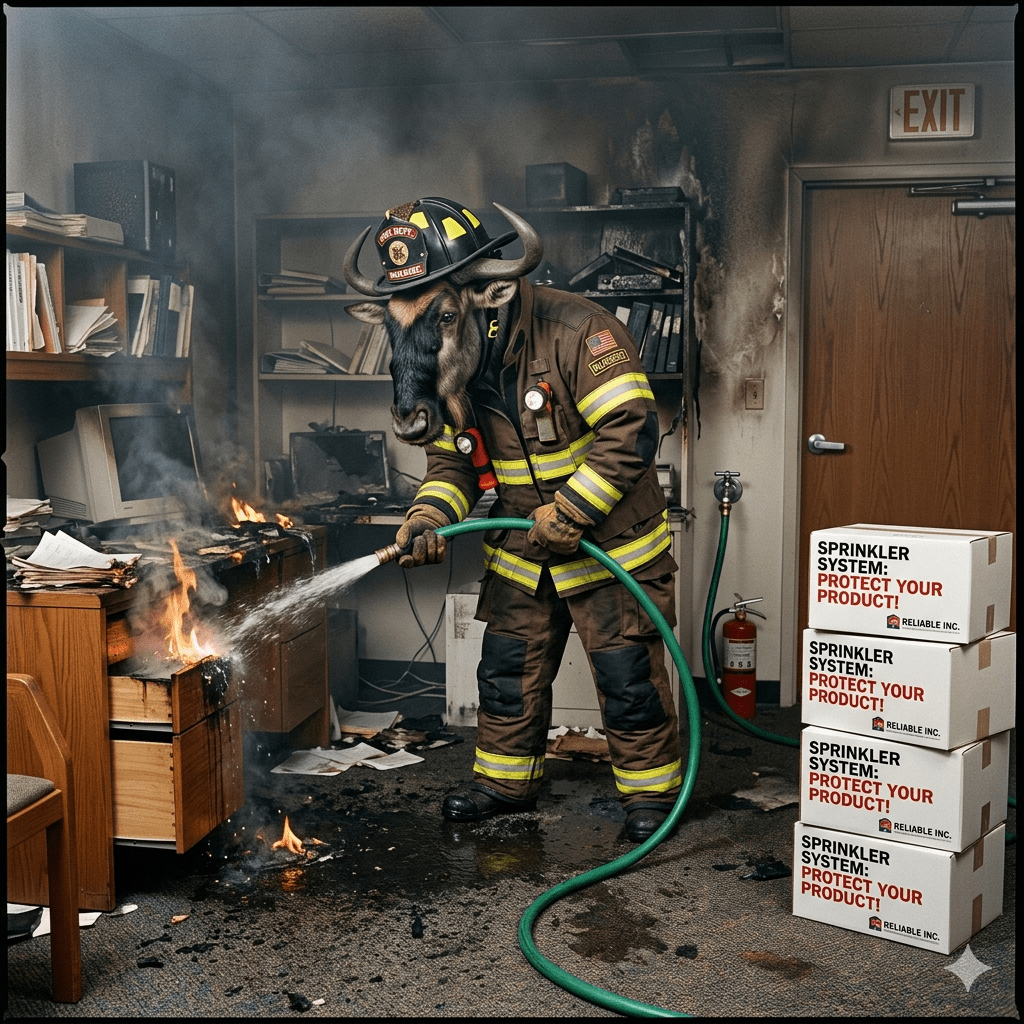
Two weeks ago, I thought it was a mistake to prioritize daily fires over long-term strategic planning. But blog posts are ephemeral (like AI agents) and a conversation with Google Gemini made me realize I had it backward.
Before, sprinkler systems outranked firefighting
On May 12 I wrote a post entitled “Is Your Identity/Biometric Firm Too Busy Putting Out Fires to Install a Sprinkler System?” Its thesis:
“Your identity/biometric firm needs experienced product marketing contract help because you are drowning in work. But because you’re drowning in work you can’t take the time to set up that contract.”
Google Gemini.
I won’t get into the resolution of the post, but note the inherent value judgment contained within the content.
Manually putting out fires (NEVER with gasoline) is reactive, displays a lack of planning, and is therefore denigrated.
Installing a sprinkler system is proactive, displays a bias toward strategic long-term planning, and is therefore elevated.
So if the prospect takes the time to sign that contract with Bredemarket, I will ensure that the process is as frictionless as possible. I already know the identity/biometric terminology, and Bredemarket’s “seven questions” process removes the need for you to develop a briefing book for me.
Nice and stable, like installing a sprinkler system.
But then I began asking questions—in this case, with Google Gemini. Not with the distinctive Bredebot persona, but with Gemini’s natural voice. And as I engaged in a messaging and positioning dialogue, Gemini hit me between the eyes with this observation.
“[Bredehoft] notes that many biometric firms are “too busy putting out fires to install a sprinkler system.”
“The “Fire” is an immediate, looming RFP deadline….A consultant like Bredehoft is brought in as an emergency firefighter to secure that short-term win.
“The “Sprinkler System” is long-term product marketing (building consistent messaging, positioning products, and writing educational white papers)….
“[C]onsulting clients are notoriously reactive. They are far more likely to open their wallets for immediate help with an active proposal than for long-term strategic brand-building.”
Then it hit me.
The firefighter is the GOOD guy.
Google Gemini. The little kid’s admiration is unparalleled.
After, firefighting outranks sprinkler systems
Prospects call in a consultant because they want something yesterday and, as my home page phrases it, “don’t have the time to craft their own content.”
And not just proposal content with money on the line as Gemini explained. Maybe the prospects need a blog post right now; no immediate contract, but invaluable positioning. Or maybe they even need an emergency analysis. (Hey, it could happen.)
When you’re in the middle of a fire, you don’t have time to train a rookie. I already know the identity world, so we can get straight to bailing out your firm.
I will fight your fire, and then maybe later on we can discuss more strategic topics.
But first we need that pesky contract, or the equivalent. (“John, we’ll pay you $500 net 15 for that blog post.”)










 Bredemarket