Working remotely at Pro Desk Space in Fullerton this morning.
Like a good neighbor.


Identity/biometrics/technology marketing and writing services


Tech marketers, who can help you form your product’s story?

Some technical marketers are expert at spinning soft fluffy stories about how their AI-powered toilet paper can cure cancer…which can be very persuasive as long as the prospects don’t ask any questions.
Be prepared to answer the tough questions. Expert testimonials. Independent assessments of your product’s accuracy. Customer case studies.
Analyze your product’s weaknesses. (And the threats, if you’re a SWOT groupie.)

Tech marketers, who can help you tell your product’s story?

Bredemarket hasn’t sent a mass mailing lately.
Sure, I have a template for my current mailing, but it’s adjustable for each prospect. Rather than send it to everyone at once, I bring up the template one-by-one and tweak it to each individual prospect.
I definitely had to perform some tweaking when I started mailing some particular technology prospects.
I initially learned about these prospects via Ryn Bennett in the spring of 2024. These companies provide AI-enhanced proposal response software, and all strive to make the proposal process more efficient while improving accuracy.
Back in the spring of 2024 I had reached out to many of these prospects. I created a landing page specific to them, and I also created a presentation for the group. I subsequently adjusted this presentation for more general use.
And time passed.

And now it’s August 2025, and I’m reaching out to these prospects again. But not all of them; one company didn’t survive to the end of 2024.

But my marketing has evolved since spring 2024, and I make a big push for Bredemarket’s content-proposal-analysis service, or what I call a “CPA” service.

Here’s an excerpt from my August 2025 email template.
Bredemarket has helped over 20 firms solve the content problem:
- Compelling content creation: blog posts, case studies and testimonials, LinkedIn articles and posts, white papers. I’ve established firms’ positioning in the market and attracted prospects and sales.
- Winning proposal development: managing, writing, and editing services. I’ve won millions of dollars’ worth of proposals as a Bredemarket consultant and employee to several tech firms.
- Actionable analysis: Marketing, product, and competitive analyses. I’ve helped firms understand their strengths and weaknesses relative to the market.
But when emailed my spring 2024 proposal firm prospects, I made one slight edit.
My “CPA” became a “C_A,” and I removed the “Winning proposal development” bullet.
Because these prospects are never going to buy proposal services from me.
Not when they have their own AI-enhanced proposal response tools for proposal responses.
But I forgot to alter the logo at the end of the emails. Whoops.

But you don’t need to wait for me to email you. If you are a technology marketer that needs consulting help for content services, or analysis services…or even proposal services, set up a free meeting with Bredemarket.

It all seemed to promising back in June, when Arteco Partners appeared at Graber Olives’ salesroom (converted into an auditorium) and announced its intent to partner with Graber Olives to reopen the facility for olives and events.
But yesterday David Allen revealed that Arteco Partners appears to have backed out, presumably because the costs exceeded the possible revenue.
So what’s next?

Why do I have a sudden interest in things that happened at Morpho nearly 10 years ago, and at Printrak over 20 years ago? I’ll explain at the end of this post.
Let’s start by looking at my former employer Printrak. In the summer of 1996 Printrak became a publicly traded company, and had secured the four-letter ticker “AFIS” back when an automated fingerprint identification system was THE biometric solution. (Face schmace. Iris schmiris. Voice schmoice.)
But then Printrak began to get bigger.
These acquisitions, costing millions of dollars each, increased the capabilities of Printrak. Several years later, I would be part of creating a “digital justice solution” that married AFIS, CAD, RMS, mugshot, and other services.
But not yet. Before that could happen, Printrak changed dramatically.
There used to be an online document that listed the entire negotiation history of what happened after these acquisitions, but I can no longer access that document. Instead, I found a document that lists the final results:
“ITEM 5. OTHER EVENTS On August 28, 2000, Printrak International Inc. (the “Registrant”) issued a press release regarding an agreement (the “Merger Agreement”) among Motorola, Inc. (“Motorola”), the Registrant, Panther Acquisition Corp., a wholly-owned subsidiary of Motorola (“Acquisition Sub”) and the Giles Living Trust UDT dated December 17, 1993, The Giles Family Foundation, and The Smith Family Revocable Trust dated October 2, 1992 (collectively referred to herein as the “Registrant’s Majority Stockholders”) pursuant to which Acquisition Sub will be merged (the “Merger”) with and into Registrant, with Registrant surviving the Merger as a wholly-owned subsidiary of Motorola. On August 28, 2000 the Registrant’s Majority Stockholders executed a written consent of stockholders approving the terms and authorizing the execution of the Merger Agreement by the Registrant. Under the Merger Agreement, Motorola has agreed to pay $12.1406 per share for all the outstanding common stock and common stock equivalents of Registrant for an aggregate merger consideration of approximately $160 million.”
In the language above, the two “Giles” entities were controlled by Richard Giles, who had joined De La Rue Printrak and then purchased the Printrak part from De La Rue. The Smith Family Revocable Trust was controlled by Charles Smith, another Printrak employee. While Printrak was a publicly traded entity, Richard Giles held over half the shares, and therefore had the power to sell, provided that the deal received the proper approvals from the United States, Argentina, Brazil, Germany, Romania, and other countries.
Why did Motorola want to acquire Printrak? Because Motorola needed a CAD product to pair with its significant business in police radios. And among Printrak’s acquisitions was a division with a CAD product, making that acquisition by far the most significant of the three acquisitions from 1997. Microfiche went nowhere, and the fact that the present company DataWorks Plus was founded in 2000 in Greenville, South Carolina is no accident.
But returning to Printrak, its growth through acquisitions made Printrak itself an acquisition target.

Fast forward a few years, and a lot had happened at the Motorola company that Printrak joined. I won’t go into the history of Motorola during that decade, but by 2008 the company was shedding businesses that weren’t critically important. The CAD and RMS business was critically important, but the fingerprint business—the original pre-1997 Printrak—was not.
Which naturally attracted the attention of a large French aerospace/defense company, Safran. This company, itself the merger of two firms, had its own fingerprint identification technology, but I’ll let Ken Moses and his co-authors (including Scott Swann) tell this part of the story:
“In the late 1970s, a computer engineering subsidiary of France’s largest financial institution responded to a request by the French Ministry of Interior to work on automated fingerprint processing for the French National Police. Later, this company joined with the Morphologic Mathematics Laboratory at the Paris School of Mines to form a subsidiary called Morpho Systems that went on to develop a functioning [AFIS].”
Morpho Systems and its North American subsidiary were acquired by several companies in succession, the last being Safran.
And Safran thought that Motorola’s “Biometric Business Unit” would complement its existing biometric activities. So Safran purchased the unit (including me) from the willing seller Motorola, which became part of MorphoTrak.
But Safran wasn’t done acquiring. As I previously noted:
“By 2011, Safran decided that it needed additional identity capabilities, so it acquired L-1 Identity Solutions and renamed the acquisition as MorphoTrust.”
Along the way Safran also acquired a controlling stake in GE Homeland Protection, which it renamed Morpho Detection.
These various acquisitions strengthened Safran’s identity and biometric capabilities, which was good because Safran’s competitors were also busy. Eventually the entire identity and security business was renamed “Morpho” after the little old French company from the 20th century. This was a major division within Safran’s empire…
…but Safran remained an aerospace/defense company, and Morpho was a distraction.
A distraction that attracted the attention of Advent International. Advent had acquired a company called Oberthur Technologies in 2011, with the intent of improving it and selling it for a profit. Advent decided that an Initial Public Offering (IPO) would be a way to realize this profit, but Oberthur withdrew its IPO in 2015.
Would Oberthur be a more attractive IPO if it was combined with another entity, such as the non-aerospace/defense part of Safran?
The upshot was that Advent and Safran started talking, resulting in a sale that created the combined (mostly) Advent-controlled entity OT-Morpho. But a name change happened a few months later.
I won’t get into the subsequent history of IDEMIA, in which Advent has spun off one part of IDEMIA, and may be spinning off another.
The point I want to make? Morpho’s growth through acquisitions made Morpho itself an acquisition target.
Now before someone slams me, I’m not making any predictions, just some observations.
Now let’s look at my former employer Incode. Unlike Printrak, Incode is not a publicly-traded firm. Like IDEMIA, Incode is held by private investors, although in Incode’s case there are multiple investors, not just one. Incode’s investors include General Atlantic, Softbank, J. P. Morgan, and others.
Lately Incode has been on an acquisition spree of its own.
Now remember that Incode’s investors didn’t invest just because they want to see cool technologies. They invested because they want to make money. And these moves potentially strenghthen Incode so that its investors may make a profit through an Incode IPO…
…or an acquisition of Incode by another entity, which would continue the consolidation of the identity/biometric industry.

Tech marketers, who can help you tell your product’s story?

Today’s word is continuous. A word that your technology solution prospects need to understand.
The Identity Jedi just shared the dirty little secret that we all know but aren’t willing to admit.
“[A]ccess reviews aren’t inherently about security — they’re about satisfying auditors.”
The Jedi’s assumption is that the access review is a periodic one, completely satisfied by manually checking boxes.
Because it’s easier to evaluate whether a box is checked than to evaluate whether the system is truly secure, and people who no longer deserve access don’t have it.
But companies move beyond check boxes anyway, because they realize the other point that the Identity Jedi made.
“Instead of waiting for quarterly reviews, implement continuous access evaluation that flags high-risk or out-of-policy access the moment it happens — not months later.”
Many cybersecurity and TPRM vendors have implemented continuous access evaluation. Has yours?
And if you are a vendor of a continued access evaluation solution, do your prospects know about why it’s critically important, and the benefits that such a solution provides?
If you haven’t told your prospects about the benefits of continuous access evaluation, it’s time.
And I can help.
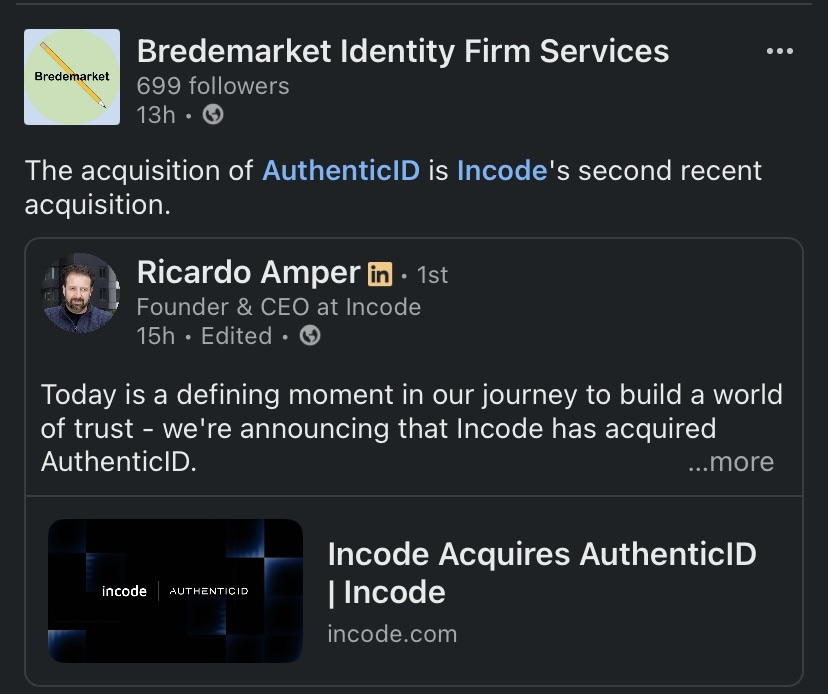
In case you missed it, I reshared Ricardo Amper’s announcement on LinkedIn.
Then re-reshared it on Instagram and elsewhere.
Incode’s announcement is here.

 Bredemarket