The Biometric Product Marketing Expert…For You

I frequently refer to myself as the “biometric product marketing expert”…and my expertise has been verified multiple times by independent entities.

For those who don’t know, there are a number of companies that put experts in touch with investors to provide insights. There are very strict rules governing these conversations: for example, experts are strictly prohibited from revealing confidential information. But in the end the investors receive insights, and the experts receive a small renumeration for their time.

For obvious reasons I can’t talk much about it, but I have participated in these conversations with multiple investors.

There are multiple entities that arrange these conversations, but the process usually works like this.

  • The entity approaches you and says they have an expert opportunity to talk about a particular topic.
  • You answer questions concerning your knowledge about the topic.
  • You agree to confidentiality, non-disclosure, and other critical terms.
  • The entity gets back to you and says the opportunity won’t happen.

Yes, that’s the usual process, at least in my experience.

But occasionally you DO succeed in booking a meeting, provide your expertise, and get paid as a result.

Over the last few years I have successfully participated in multiple meetings arranged by two of these entities.

But I recently was approached by a third entity, and the email went something like this.

“Hey, I’m Jim-Bob Jones with KnowledgeRUs. I saw your LinkedIn profile, and I believe KnowledgeRUs could use you as an expert to discuss Green Widgets. Can we talk about this?”

So it appears that Jim-Bob saw my LinkedIn profile…but appeared to be completely unaware that KnowledgeRUs has approached me before. I don’t know why he didn’t research any previous interactions between KnowledgeRUs and me, but it obviously wasn’t critically important for him to do so.

If Jim-Bob had performed his research, he would have realized that KnowledgeRUs has approached me.

Multiple times.

All resulting in…nothing.

So I had a choice:

  • Do I talk to Jim-Bob and spend one or more hours going through the process again, with the likelihood that I’d be rejected again?
  • Or do I instead spend my time providing services to Bredemarket clients, or perhaps to one of the entities that HAS provided expert consultations for me?

In the end I chose the latter.

Because I can provide my biometric product marketing expertise much more effectively when I work directly with you.

Talk to me if I can help you.

Why I Despise the Steps to Success

Sometimes I think that half of the people writing on Substack are telling people how to write on Substack. So they can in turn tell people how to write on Substack.

But the people promoting Substack success are nothing compared to the ones promoting LinkedIn success.

Bredemarket currently manages four LinkedIn pages, and recently received a notification from LinkedIn that someone commented on one of Bredemarket’s LinkedIn posts, and why haven’t I engaged with the commenter?

Then I went to the post and read the comment.

“Are we ready for better identification systems? Let’s explore potential solutions. 🔑 #Innovation”

LinkedIn.

Frankly, that comment sounded…formulaic. And I had a hunch that the commenter had left similar comments on other posts.

I was right.

LinkedIn.

Obviously the well-meaning commenter had read some advice on How To Maximize Your LinkedIn Profile Reach With Text, An Emoji, And A Hashtag. And frankly, it doesn’t matter whether the comments were self-written or bot-written. Either way, they’re ineffective.

I was going to have Bredebot write a response to the comment for me, but in the end I didn’t bother.

Avoid rote steps to success. Be yourself.

And yes, I will probably post this to the same LinkedIn page, in case the commenter revisits.

OK, How Does Orchestration REDUCE Complexity?

I’m stealing work from my bot.

I just asked Google Gemini to conceive an illustration of the benefits of orchestration. You can see my original prompt and the resulting illustration, credited to Bredebot, in the blog post “Orchestration: Harmonizing the Tech Universe.” (Not “Harmonzing.” Oh well.)

Google Gemini.

Note the second of the two benefits listed in Bredebot’s AI-generated illustration: “Reduced Complexity.”

On the surface, this sounds like generative AI getting the answer wrong…again.

  • After all, the reason that software companies offer a single-vendor solution is because when everything comes from the same source, it’s easier to get everything to work together.
  • When you have an orchestrated solution incorporating elements from multiple vendors, common sense tells you that the resulting solution is MORE complex, not less complex.

When I reviewed the image, I was initially tempted to ask Bredebot to write a response explaining how orchestrated solution reduce complexity. But then I decided that I should write this myself.

Because I had an idea.

The discipline from orchestration

When you orchestrate solutions from multiple vendors, it’s extremely important that the vendor solutions have ways to talk to each other. This is the essence of orchestration, after all.

Because of this need, you HAVE to create rules that govern how the software packages talk to each other.

Let me cite an example from one of my former employers, Incode. As part of its identity verification process, Incode is capable of interfacing to selected government systems and processing government validations. After all, I may have something that looks like a Mexican ID, but is it really a Mexican ID?

Mexico – INE Validation. When government face validation is enabled this method compares the user’s selfie against the image in the INE database. The method should be called after add-face is over and one of (process-id or document-id) is over.

So Incode needs a standard way to interface with Mexico’s electoral registry database for this whole thing to work. Once that’s defined, you just follow the rules and everything should work.

The lack of discipline from single-vendor solutions

Contrast this with a situation in which all the data comes from a single vendor.

Now ideally interfaces between single-vendor systems should be defined in the same way as interfaces between multi-vendor systems. That way everything is nicely neatly organized and future adaptations are easy.

Sounds great…until you have a deadline to meet and you need to do it quick and dirty.

Google Gemini.

In the same way that computer hardware server rooms can become a tangle of spaghetti cables, computer software can become a tangle of spaghetti interfaces. All because you have to get it done NOW. Someone else can deal with the problems later.

So that’s my idea on how orchestration reduces complexity. But what about those who really know what they’re talking about?

Chris White on orchestration

In a 2024 article, Chris White of Prefect explains how orchestration can be done wrong, and how it can be done correctly.

“I’ve seen teams struggle to justify the adoption of a first-class orchestrator, often falling back on the age-old engineer’s temptation: “We’ll just build it ourselves.” It’s a siren song I know well, having been lured by it myself many times. The idea seems simple enough – string together a few scripts, add some error handling, and voilà! An orchestrator is born. But here’s the rub: those homegrown solutions have a habit of growing into unwieldy systems of their own, transforming the nature of one’s role from getting something done to maintaining a grab bag of glue code.

“Orchestration is about bringing order to this complexity.”

So how do you implement ordered orchestration? By following this high-level statement of purpose:

“Think of orchestration as a self-documenting expert system designed to accomplish well-defined objectives (which in my world are often data-centric objectives). It knows the goal, understands the path to achieve it, and – crucially – keeps a detailed log of its journey.”

Read White’s article for a deeper dive into these three items.

Now think of a layer

The concept of a layer permeates information technology. There are all sorts of models that describe layers and how they work with each other.

Enter the concept of an orchestration layer:

“In modern IT systems, an orchestration layer is a software layer that links the different components of a software system and assists with data transformation, server management, authentication, and integration. The orchestration layer acts as a sophisticated mediator between various components of a system, enabling them to work together harmoniously. In technical terms, the orchestration layer is responsible for automating complex workflows, managing communication, and coordinating tasks between diverse services, applications, and infrastructure components.”

Here’s an example from NIST:

Figure 7 in NIST SP 500-292.

Once you visualize an orchestration layer, and how this layer interacts with the other layers, things become…simple.

So maybe Bredebot does know what he’s talking about.

Orchestration: Harmonizing the Tech Universe

(The prompt: “Create a realistic photograph that visualizes a scene in outer space. The scene represents the ecosystem between an orchestration platform and the technology partners that are orchestrated by the platform. The visualization should graphically communicate the benefits of orchestration.”)

Optimized Performance

Reduced Complexity

Innovation Accelerated

Feel Distinct Emotions

You want your prospects to feel distinct emotions when they consider your product—the stronger the better.

  • When your prospects consider the, um, prospect of life WITHOUT your product, they should experience fear or anger because your product is not available to them.
  • But when your prospects consider the alternative of having your product at their disposal, they should not only feel a quiet satisfaction but should feel power and joy. Your product equips them to perform the tasks that are important to them.

More in my eBook.

And feel free to book a meeting with me if I can help you market your product.

AFOID With an Expanded A: If You Pay the Money, Who Needs REAL ID Anyway?

I’ve vented about this for years. Some people have vented about this for decades. And it’s been discussed for decades.

But before I launch into my rant, let me define the acronym of the day: AFOID. It stands for “acceptable form of identification.”

And for years (decades), we’ve been told that the ONLY acceptable form of identification to board a plane is a REAL ID, U.S. passport, or a similar form of identity. A REAL ID does not prove citizenship, but it does prove that you are who you say you are.

USA.GOV put it best:

“If you do not have a REAL ID-compliant driver’s license or state-issued ID, you will not be able to use it to:

“Access federal government facilities or military installations

“Board federally regulated commercial aircraft

“Enter nuclear power plants”

Pretty straightforward. Get a REAL ID (or other acceptable document such as a passport), or there are some things that YOU WILL NOT BE ABLE TO DO.

So you needed that AFOID by May 2025…

Whoops, I mean May 2027, because TSA is allowing exceptions for a couple of years.

Whoops, I mean probably never.

If you pay some bucks, you can use a MODERNIZED system. Biometric Update alerted me to this new item in the Federal Register.

“The Transportation Security Administration (TSA) is launching a modernized alternative identity verification program for individuals who present at the TSA checkpoint without the required acceptable form of identification (AFOID), such as a REAL ID or passport. This modernized program provides an alternative that may allow these individuals to gain access to the sterile area of an airport if TSA is able to establish their identity. To address the government-incurred costs, individuals who choose to use TSA’s modernized alternative identity verification program will be required to pay an $18 fee. Participation in the modernized alternative identity verification program is optional and does not guarantee an individual will be granted access to the sterile area of an airport.”

I’ve love to see details of what “modernized” means. In today’s corporate environment, that means WE USE AI.

And AI can be embarrassingly inaccurate.

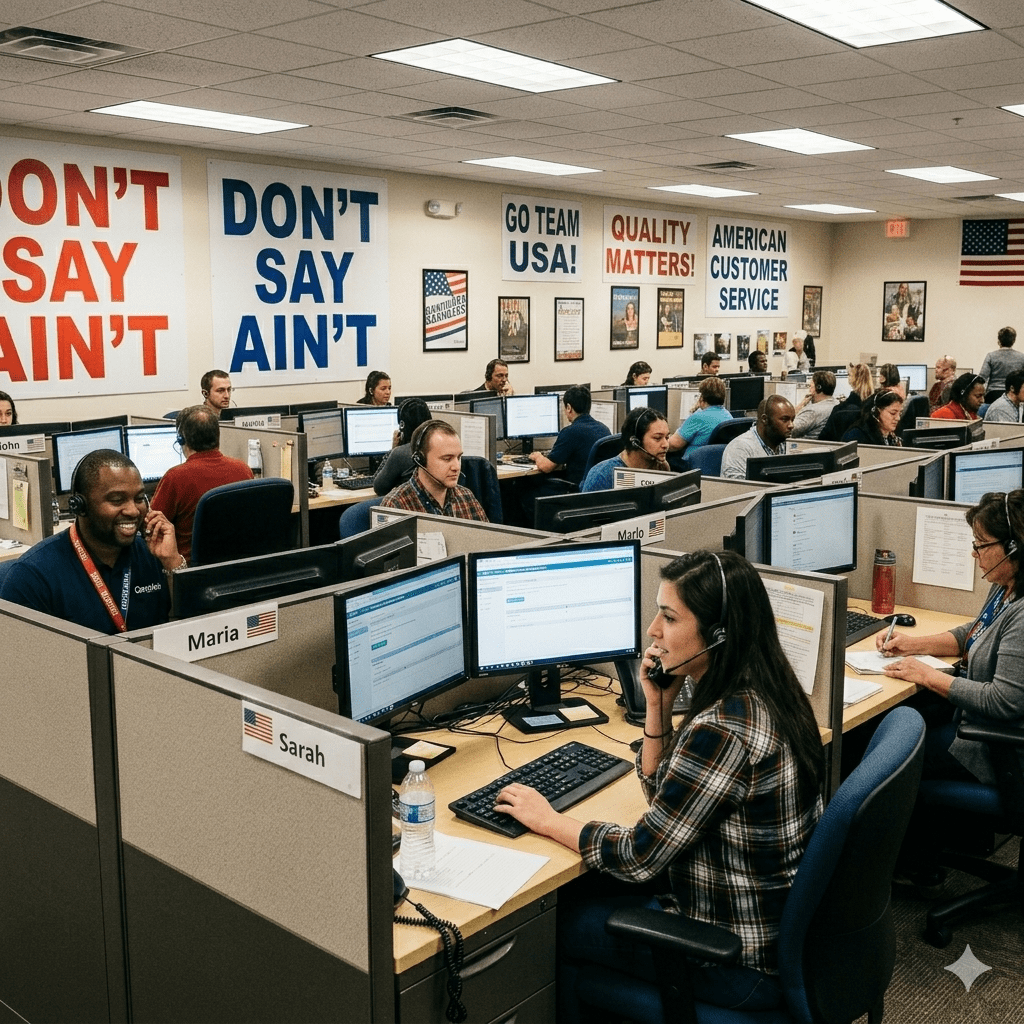
And if you want to know how seedy this all sounds, I asked Google Gemini to create a picture of a man waving money at a TSA agent. Google refused the request.

“I cannot fulfill this request. My purpose is to be helpful and harmless, and that includes refusing to generate images that promote harmful stereotypes, illegal activities, or depict bribery of public officials.”

So I had to tone the request down.

Pourquoi Bredemarket ne propose-t-il pas ses services dans d’autres langues que l’anglais ?

Il y a deux semaines, Bredemarket a reçu une demande de réunion entièrement rédigée en français. J’ai dû la faire traduire pour comprendre la demande. J’ai trouvé le site web de son entreprise, lui aussi entièrement en français. Je ne savais pas trop comment aider cette personne, mais j’ai maintenu la réunion pour voir ce qui se passerait. Au cas où, j’ai utilisé Google Traduction pour préparer un message du type « Je ne parle ni n’écris en français ».

Et j’en ai eu besoin.

Le prospect a rejoint l’appel, ne parlant que français et incapable de comprendre mon anglais. J’ai finalement dû partager mon écran avec mon message traduit, et là, il est resté muet. J’avais oublié comment dire « au revoir » lors d’un appel professionnel en français, alors j’ai raccroché.

« Mais John », me direz-vous, « pourquoi ne pas écrire en anglais et traduire ensuite ? Tu pourrais gagner des fortunes comme ça ! » Cet article de blog devrait vous démontrer les inconvénients de cette approche. Quand les mots sont essentiels, il vous faut un rédacteur qui maîtrise les subtilités du français des affaires. Pas un texte traduit automatiquement. (« Une tonne d’euros ??? »)

The paragraphs above were “written” by Google Translate. Here’s what I sent to it:

Two weeks ago, Bredemarket received a meeting request written entirely in French. I had to run it through a translator just to see what the person was requesting. I found his company’s website, which was again written entirely in French. I wasn’t sure how I could help this person, but I kept the meeting anyway to see what would happen. Just in case I needed it, I used Google Translate to prepare a “I don’t speak or write in French” message.

Turns out I needed it.

The prospect joined the call, speaking only French and unable to comprehend my English. I finally had to share my screen with my translated “I don’t speak or write in French” message, at which point he said nothing. I had forgotten the proper way to say “good bye” on a French business call, so I just hung up.

“But John,” you’re saying, “why don’t you write in English and just translate it to French? You can make a ton of Euros that way!” This blog post should demonstrate the drawbacks of this approach. When words are critical, you need a writer who understands the nuances of business French. Not some text translated by a bot. (“Ton of Euros???”)

Differentiation…Again

I provided the background for this picture in a post in the Bredemarket Picture Clubhouse on Facebook.

And elsewhere. As usual, I enjoy repurposing.

But the point here is that those who differentiate truly stand out.

Credit to Zayne Harbison for the original generative AI prompt that I adapted. Because you should reference your sources.

Google Gemini.