Bredemarket creates content.
If you want me to create yours, talk to me. https://bredemarket.com/mark/
(Grok)

Identity/biometrics/technology marketing and writing services

Bredemarket creates content.
If you want me to create yours, talk to me. https://bredemarket.com/mark/
(Grok)

(Part of the biometric product marketing expert series)
Inland Empire locals know why THIS infamous song is stuck in my head today.
For those who don’t know the story, Rob Pilatus and Fab Morvan performed as the band Milli Vanilli and released an extremely successful album produced by Frank Farian. The title? “Girl You Know It’s True.”
But while we were listening to and watching Pilatus and Morvan sing, we were actually hearing the voices of Charles Shaw, John Davis, and Brad Howell. So technically this wasn’t a modern deepfake: rather than imitating the voice of a known person, Shaw et al were providing the voice of an unknown person. But the purpose was still deception.
Anyway, the ruse was revealed, Pilatus and Morvan were sacrificed, and things got worse.
“Pilatus, in particular, found it hard to cope, battling substance abuse and legal troubles. His tragic death in 1998 from a suspected overdose marked a sad epilogue to the Milli Vanilli saga.”
But there were certainly other examples of voice deepfakes in the 20th century…take Rich Little.
So deepfake voices aren’t a new problem. It’s just that they’re a lot easier to create today…which means that a lot of fraudsters can use them easily.
And if you are an identity/biometric marketing leader who needs Bredemarket’s help to market your anti-deepfake product, schedule a free meeting with me at https://bredemarket.com/mark/.
(Part of the biometric product marketing expert series)
Whether you are a human or a non-person entity (NPE) with facial recognition capability, you rely on visual cues to positively identify or authenticate a person. Let’s face it; many people resemble each other, but specific facial expressions or emotions are not always shared by people who otherwise look alike.

But in one of those oddities that fill the biometric world, you can have TOO MUCH expression. Part 3 of International Civil Aviation Organization (ICAO) Document 9303, which governs machine readable travel documents, mandates that faces on travel documents must maintain a neutral expression without smiling. At the time (2003) it was believed that the facial recognition algorithms would work best if the subject were expressionless. I don’t know if that holds true today.

But once the smile is erased, any other removal of expression or emotion degrades identification capability significantly. For example, closing the eyes not only degrades facial recognition, but is obviously fatal to iris recognition.

And if you remove the landmarks upon which facial recognition depends, identification is impossible.

While expression or lack thereof does not invalidate the assumption of permanence of the biometric authentication factor, it does govern the ability of people and machines to perform identification or authentication.

As some of you know, my generative AI tool of choice has been Google Gemini, which incorporates guardrails against portraying celebrities. Grok has fewer guardrails.
My main purpose in creating the two Bill and Hillary Clinton videos (at the beginning of this compilation reel) was to see how Grok would handle references to copyrighted music. I didn’t expect to hear actual songs, but would Grok try to approximate the sounds of Lindsey-Stevie-Christine era Mac and the Sex Pistols? You be the judge.
And as for Prince and Johnny…you be the judge of that also.
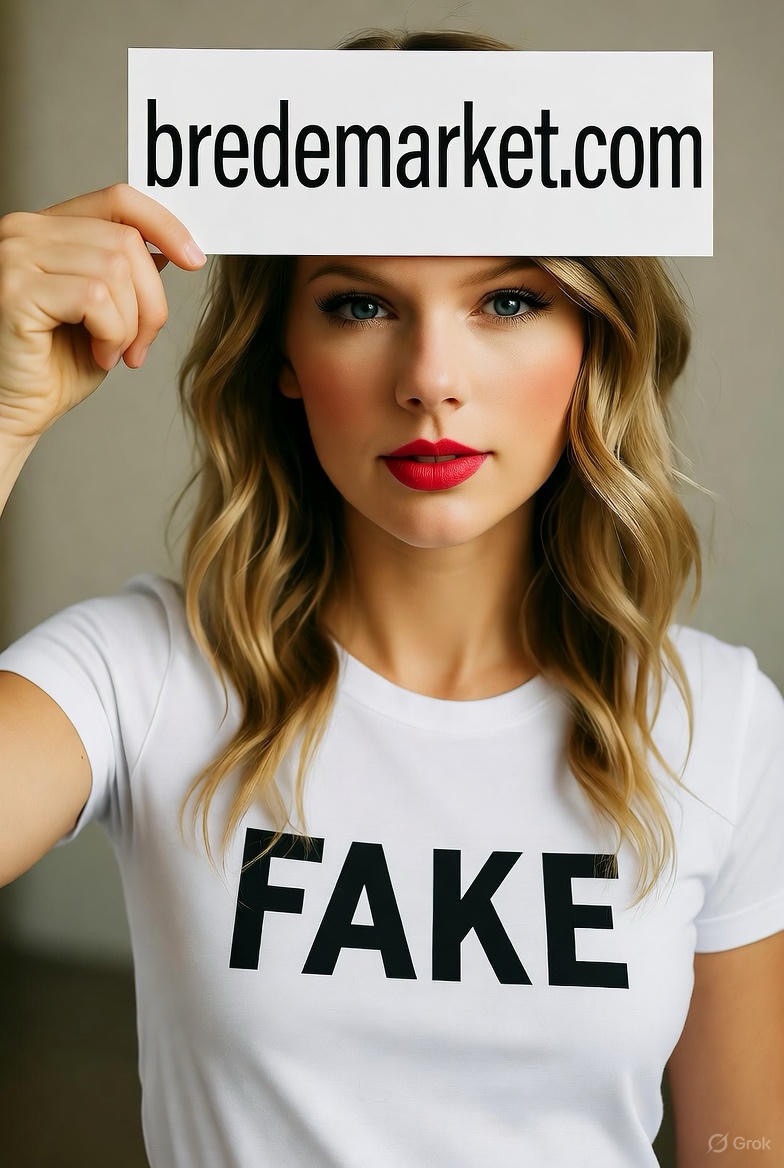
Using Grok for evil: a deepfake celebrity endorsement of Bredemarket?
Although in the video the fake Taylor Swift ends up looking a little like a fake Drew Barrymore.
Needless to say, I’m taking great care to fully disclose that this is a deepfake.
But some people don’t.
Access by the biometric product marketing expert bredemarket.com/mark

Most of my recent generative GI experiments have centered on Google Gemini…which has its limitations:
“Google Gemini imposes severe restrictions against creating pictures of famous figures. You can’t create a picture of President Taylor Swift, for example.”
Why does Google impose such limits? Because it is very sensitive to misleading the public, fearful that the average person would see such a picture and mistakenly assume that Taylor Swift IS the President. In our litigious society, perhaps this is valid.
But we know that other generative AI services don’t have such restrictions.
“One common accusation about Grok is that it lacks the guardrails that other AI services have.”
During a few spare moments this morning, I signed up for a Bredemarket Grok account. I have a personal X (Twitter) account, but haven’t used it in a long time, so this was a fresh sign up.,
And you know the first thing that I tried to do.

Grok created it with no problem. Actually, there is a problem, because Grok apparently is not a large multimodal model and cannot precisely generate text in its image generator. But hey, no one will notice “TWIRSHIITE BOUSE,” will they?
But wait, there’s more! After I generated the image, I saw a button to generate a video. I thought that this required the paid service, but apparently the free service allows limited video generation.
I may be conducting some video experiments some time soon. But will I maintain my ethics…and my sanity?

Solved with Bredemarket. Technology product marketing expert.
Book a meeting: https://bredemarket.com/mark/
I am tired of the phrase “evolving digital landscape.”

Tomorrow, the second Monday in October, is National Kick Butt Day.
If there is any goal you want to accomplish, just do it.
Such as an awareness goal.
Or a marketing leader goal to schedule a meeting with Bredemarket: https://bredemarket.com/mark/
Two other holidays are celebrated on Monday, but I won’t wade into that culture war right now.

 Bredemarket