The Māori relationship between digital identity and collective identity

I live in the United States in a fairly industrialized society with a heavy focus on individual rights, and a (general) preference toward a focus on the brain and body rather than the soul.

This view shapes how I approach a number of topics, including biometrics and digital identity. For example, if my biometrics are encoded on a physical card or in some type of digital representation, I merely think of this as a way to individually identify myself from other individuals.

Frank Hersey of Biometric Update notes that my attitude is not universal. Hersey cites an article in New Zealand’s Gisborne Herald entitled “Maori experts call for closer involvement in creation of taonga.”

Yes, taonga. As you can see, the Maori people have their own language. (And their own views on the individual, society, and identity.) While there is no direct translation of “taonga” to English, the word has been described to mean a treasured possession.

I don’t know about you, but when I look at the ridges on the tips of my fingers, “treasured possession” is not the first thought that comes to mind.

And that’s the problem.

Maori data experts say there has been a lack of undertsanding about te ao Māori (Māori world view) and data sovereignty principles by the Government in the process of making two new data laws.

From https://www.gisborneherald.co.nz/local-news/20220128/taking-charge-of-data/

The Gisborne Herald quotes Dr. Warren Williams regarding how the two data laws (The Digital Identity Services Trust Framework and The Consumer Data Right) could affect the Maori.

Data is a taonga (treasured possession) for me. It is something to be cherished, protected and cared for. And with that comes responsibility….

Māori want to be able to protect our data. We want to have real ownership of our data. We want to understand where it has been stored.

Where there is physical storage of data, can we access that? Or those who hold our data, are they looking after it in a way that is respectful?

Sovereignty is not just ownership but also how it’s cared for, how it’s looked after, how it’s shared. If I say I give you permission to share data about myself to a certain group, sometimes the holder of that data can refuse because it’s private.

From https://www.gisborneherald.co.nz/local-news/20220128/taking-charge-of-data/

This data perspective is literally foreign to many government bureaucrats and policy advocates in North America, the European Union, and other more industrialized societies. Can you imagine someone in Brussels, Belgium or Springfield, Illinois talking about being “respectful” while “caring” for data?

So now let’s move to another Maori word, “tikanga,” which leads us to discuss a profound difference between Western individual perspectives and Maori collective perspectives. This was discussed in that great cultural publication Computerworld, in its description of the “Tikanga in Technology” project.

The project’s focus is on how tikanga Māori (customary protocols) and Mātauranga Māori (indigenous knowledge) inform “the construction of digital identities and relational responsibilities to data.  … The world is undergoing disruptive change as rapid advances in data linkage and powerful digital technologies converge. For Indigenous peoples, these innovations are a double-edged sword, creating vast potential for improved well-being as well as major risks of group exploitation and harm. The current narrow focus on individual data rights and protection is failing us. We need a profoundly different approach—one that recognises collective identities and allows data to be understood through a wider set of ontological realities.”

From https://www.computerworld.com/article/3575393/indigenous-data-sovereignty-and-how-maori-are-leading-the-way.html

Even in our society, identification is not a completely individualistic activity. One common example is how an individual’s DNA can be used to identify a relative who may have engaged in criminal activity, or who may have been a victim of an untimely death (criminal or otherwise). We as a society are struggling with the ramifications of this, and trying to balance the need to satisfy a public good with the need for privacy, including how I can inadvertently (or purposely) reveal something that may violate the privacy of another person.

Another example is when the needs of a biometric modality such as facial recognition are affected by religious or societal needs that cause people to shield that particular biometric. Religious mandates in certain groups to veil one’s face have recently been joined by medical mandates in certain groups to mask one’s face, causing uproars and changes in the biometric world.

Sometimes, the biometric rules adjust, such as Apple’s allowance to use a different identification method (such as something you know) when a face is obscured.

Sometimes, the biometric rules don’t adjust, and your local driver’s license bureau declares, “if you shield your face, you can’t get an identification card.”

The Maori are taking this concern with the collective (vs. the individual) a step further, with their concern about “group exploitation and harm.”

So how do these views of the collective impact people such as myself, who toss out phrases such as “identification of individuals” from decades of habit?

Who said something about marketing channels that lack content?

Good evening, loyal readers. Although I’ve tested your loyalty lately.

This is my first post on the Bredemarket blog since December 24.

As in nearly a month ago.

Now who was it that said “If your marketing channels lack content, your potential customers may not know that you exist”?

Oh, yeah. That was me.

So what happened? Why haven’t I been posting anything here in nearly a month?

Well, business picked up considerably, and I haven’t had the spare time to conceive and write new blog posts.

(Incidentally, it turns out that the “(non-identity) proposal consulting contract” that I referenced in my December 10 post will extend beyond Tuesday, January 25. The end customer granted an extension to the proposal due date, and we’re taking advantage of the extension.)

And I already have two new projects lined up, as well as some continuing work.

Now I just have to figure out a way to continue my own marketing efforts.

Because as someone once said, “If your channels lack content, your potential customers may forget about you. And that’s NOT good for business.”

Perhaps I should hire myself to create content for myself. That would result in some interesting entries in my accounting system. And would I issue a 1099 to myself?

The “market” is closed until Monday

The market is closed.

By FuriousGeorge1 from (optional) – Flickr, CC BY 2.0, https://commons.wikimedia.org/w/index.php?curid=2488362

Bredemarket just took care of some final items, and is now on vacation/holiday.

Well, until Monday. Proposal work is proposal work.

But until then, I hope those who celebrate Christmas have a happy one, and those who don’t have a happy weekend.

From defund the police to fund the police. But what about technology?

There’s been a tactical reversal by some cities.

Defund the police, then re-fund the police

In November, the Portland Oregon City Council unanimously voted to increase police funding, a little over a year after the city reduced police funding in the wake of the Black Lives Matter movement.

Now this month, Oakland California has also decided to increase police funding after similarly defunding the police in the past. This vote was not unanimous, but the City Council was very much in favor of the measure.

By Taymaz Valley – https://www.flickr.com/photos/taymazvalley/49974424258, CC BY 2.0, https://commons.wikimedia.org/w/index.php?curid=91013003

Not that Oakland has returned to the former status quo.

[Mayor Libby] Schaaf applauded the vote in a statement, saying that residents “spoke up for a comprehensive approach to public safety — one that includes prevention, intervention, and addressing crime’s root causes, as well as an adequately staffed police department.”

From https://www.police1.com/patrol-issues/articles/oakland-backtracks-votes-to-add-police-as-crimes-surge-MDirxJZAHV41wyxg/

So while Oakland doesn’t believe that police are the solution to EVERY problem, it feels that police are necessary as part of a comprehensive approach. The city had 78 homicides in 2019, 109 in 2020, and 129 so far in 2021. Granted that it’s difficult to compare year-over-year statistics in the COVID age, but clearly defunding the police hasn’t been a major success.

But if crime is to be addressed by a comprehensive approach including “prevention, intervention, … addressing crime’s root causes, … (and) an adequately staffed police department…

…what about police technology?

What about police technology?

Portland and Oakland have a lot in common. Not only have they defunded and re-funded the police, but both have participated in the “facial recognition is evil” movement.

Oakland was the third U.S. city to limit the use of facial recognition, back in July 2019.

A city ordinance … prohibits the city of Oakland from “acquiring, obtaining, retaining, requesting, or accessing” facial recognition technology….

From https://www.vice.com/en/article/zmpaex/oakland-becomes-third-us-city-to-ban-facial-recognition-xz

Portland joined the movement later, in September 2020. But when it did, it made Oakland and other cities look like havens of right-wing totalitarianism.

The Portland City Council has passed the toughest facial recognition ban in the US, blocking both public and private use of the technology. Other cities such as BostonSan Franciscoand Oakland have passed laws barring public institutions from using facial recognition, but Portland is the first to prohibit private use.

From https://www.theverge.com/2020/9/9/21429960/portland-passes-strongest-facial-recognition-ban-us-public-private-technology
The Mayor of Portland, Ore. Ted Wheeler. By Naval Surface Warriors – 180421-N-UK248-023, Public Domain, https://commons.wikimedia.org/w/index.php?curid=91766933

Mayor Ted Wheeler noted, “Portlanders should never be in fear of having their right of privacy be exploited by either their government or by a private institution.”

Coincidentally, I was talking to someone this afternoon about some of the marketing work that I performed in 2015 for then-MorphoTrak’s video analytics offering. The market analysis included both government customers (some with acronyms, some without) and potential private customers such as large retail chains.

In 2015, we hadn’t yet seen the movements that would result in dampening both market segments in cities like Portland. (Perpetual Lineup didn’t appear until 2016, while Gender Shades didn’t appear until 2018.)

Flash – ah ah, robber of the universe

But there’s something else that I didn’t imagine in 2015, and that’s the new rage that’s sweeping the nation.

Flash!

By Dynamite Entertainment, Fair use, https://en.wikipedia.org/w/index.php?curid=57669050
Normally I add the music to the end of the post, but I stuck it in the middle this time as a camp break before this post suddently gets really serious. From https://www.youtube.com/watch?v=LfmrHTdXgK4

Specifically, flash mobs. And not the fun kind, but the “flash rob” kind.

District Attorney Chesa Boudin, who is facing a recall election in June, called this weekend’s brazen robberies “absolutely unacceptable” and was preparing tough charges against those arrested during the criminal bedlam in Union Square….

Boudin said his office was eagerly awaiting more arrests and plans to announce felony charges on Tuesday. He said 25 individuals are still at large in connection with the Union Square burglaries on Friday night….

“We know that when it comes to property crime in particular, sadly San Francisco police are spread thin,” said Boudin. “They’re not able to respond to every single 911 call, they’re only making arrests at about 3% of reported thefts.”

From https://sanfrancisco.cbslocal.com/2021/11/23/smash-and-grab-embattled-san-francisco-district-attorney-chesa-boudin-prosecution/

So there are no arrests in 97% of reported thefts in San Francisco.

To be honest, this is not a “new” rage that is sweeping the nation.

In fact, “flash robs” were occurring as early as 2012 in places like…Portland, Oregon.

If only there were a technology that could recognize flash rob participants and other thieves even when the police WEREN’T present.

A technology that is continuously tested by the U.S. government for accuracy, demographic effects (see this PDF and the individual “report cards” from the 1:1 tests), and other factors.

Does anyone know of any technology that would fill this need?

Perhaps Oakland and Portland could adopt it.

The probability of determining the probability of matching fingerprints

I’m on the periphery of the forensic science/law enforcement world.

By CBS Television – eBay itemphoto frontphoto back, Public Domain, https://commons.wikimedia.org/w/index.php?curid=74918903

Yes, I have completed training on forensic face recognition, but that doesn’t qualify me as an expert in courtroom testimony. (Forensic face recognition expert testimony isn’t admissible in court anyway, but you get the idea.)

But even I am well aware that the forensic world changed dramatically in 2009.

Before 2009, the dialog below only represents a slight exaggeration.

Question: Why do you say that these two fingerprints belong to the same person?

Answer: Because I said so.

After 2009, specifically after the release of what is called “the NAS report,” there has been an effort to make forensic science…a science.

Ideally, this means that when a fingerprint expert testifies in court, the expert can state that there is a 99.9978% probability that two fingerprints belong to the same person. Or something like that.

Ideally.

We’re not there yet, as this 2017 IAI position paper implicitly states.

It is the position of the IAl that examiners are encouraged to articulate conclusion decisions as specifically as possible, as to not overstate decisions regarding source attribution. In addition to stating conclusions, examiners are encouraged to state the basis for resulting conclusions; including the associative strength and limitations. The strength and limitations of conclusions may include the quality and quantity of data, the validity of method/mathematical model used, and the repeatability of the conclusion. Examiners are encouraged to continually reassess methods and/or mathematical models used to arrive at the best conclusions possible.

International Association for Identification, Position Statement on Conclusions, Qualified Opinions, and Probability Modeling, February 5, 2017.

In other words, while the IAI discourages the use of the old “Because I said so” articulation, the conclusions stated in court lean more toward qualitative rather than quantitative criteria. There’s not a probabilistic model for fingerprints.

Or, as Mike French notes, there’s not a publicly available probabilistic model.

As organizations like the Center for Statistics and Applications in Forensic Evidence (CSAFE) explore the viability of statistical modeling in pattern evidence disciplines, they will probably notice that AFIS (automated fingerprint identification system) vendors have already done decades of research, and those vendors have fielded operational systems, to solve the same type of problem forensic researchers are now investigating. 

From https://www.linkedin.com/pulse/do-afis-vendors-hold-key-measuring-latent-print-probative-mike-french-1e/

French notes a number of challenges to using AFIS vendor data to derive probabilistic models for fingerprints, but the chief challenge is the fact that the AFIS vendor data is proprietary and therefore carefully guarded. After all, AFIS vendors understandably don’t want their competitors to be able to reverse engineer their algorithms.

If you read French’s article, you’ll see that even if the AFIS vendors made all of the relevant data available, significant testing would still have to take place before reliable, fit for purpose probabilistic models can be created.

Are there other ways to develop a probabilistic fingerprint model? Maybe, but these would require (among other things) access to a lot of fingerprints, and considering the resistance of privacy advocates to biometric collection—even when such collection can mitigate privacy advocate concern about biometric inaccuracy—the chances of collecting a bunch of fingerprints for a probability study are approximately 23 (and me?) in 7 billion.

The positive (?) correlation between consulting success and meeting count

If you saw my post from December 6, I mentioned that I have a scheduling conflict at the time of Jay Clouse’s Friday, December 17 Annual Planning Workshop. In my time zone, the workshop takes place between 7:00 am and 9:00 am, and I have a meeting during part of that time.

Come to think of it, I also have a meeting conflict at that time on Thursday, December 16.

And on Monday, December 20.

And a bunch of other days.

On Monday, December 6, I started a (non-identity) proposal consulting contract that will require a significant number of hours until the proposal is submitted on approximately Tuesday, January 25.

This is by far the biggest consulting contract that I have ever landed. I’d throw a party for myself, but I’m pretty busy. Between this proposal consulting contract, my other continuing consulting work, end of year health care enrollment. and other tasks, I can’t exactly party all the time.

No this, isn’t a selfie. For one, I’ve never owned leather pants. Fair use, https://en.wikipedia.org/w/index.php?curid=14872497

The “significant hours” that I’m spending on this particular proposal are roughly equivalent to the hours that I spent every week as an employee before I started consulting.

Actually, it’s not exactly the same as being an employee. For example, there won’t be a holiday party this month attached to this consulting gig. (Although because of budget cuts, my former employer had stopped the annual holiday parties anyway.)

This proposal contract has one big similarity to my former employee lifestyle.

A ton of meetings.

Now I’ve had meetings for my other consulting gigs, but for most projects there’s only one or two meetings for the entire project.

I’m only a week into this consulting gig, and I’m already averaging three meetings per day.

Not representative of my meetings, which take place online rather than in an oval shaped office. By Series: Reagan White House Photographs, 1/20/1981 – 1/20/1989Collection: White House Photographic Collection, 1/20/1981 – 1/20/1989 – https://catalog.archives.gov/id/12013683, Public Domain, https://commons.wikimedia.org/w/index.php?curid=92513242

None of these thrice-daily meetings lasts longer than an hour, and I bet that some of you have many more than three meetings per day. But the meeting time does add up.

Luckily I organize a number of these meetings myself, so I can ensure that my meetings never last longer than an hour.

(I don’t like meetings. The best person to arrange a meeting is a person who doesn’t like meetings. Such a person will get the meeting business done as soon as possible, before people fall asleep or run away screaming in agony.)

And the two people who (so far) have arranged the remainder of my meetings for this proposal project feel the same way.

Now I can’t guarantee that all of the meetings for this proposal will be short and sweet, and in fact expect that the meetings between Christmas and New Year’s may be longer than an hour. (Yes, meetings between Christmas and New Year’s. It’s proposal work.)

But at least the meetings keep me out of trouble.

Bredemarket’s three goals for 2022 (the 12/6/2021 5:35 pm edition)

It’s goal time again.

But before setting goals for 2022, let’s take a look back.

How did I do in 2021?

Long-time readers will recall that as of January 8, 2021, I had five (actually six) goals for Bredemarket. So how did I do?

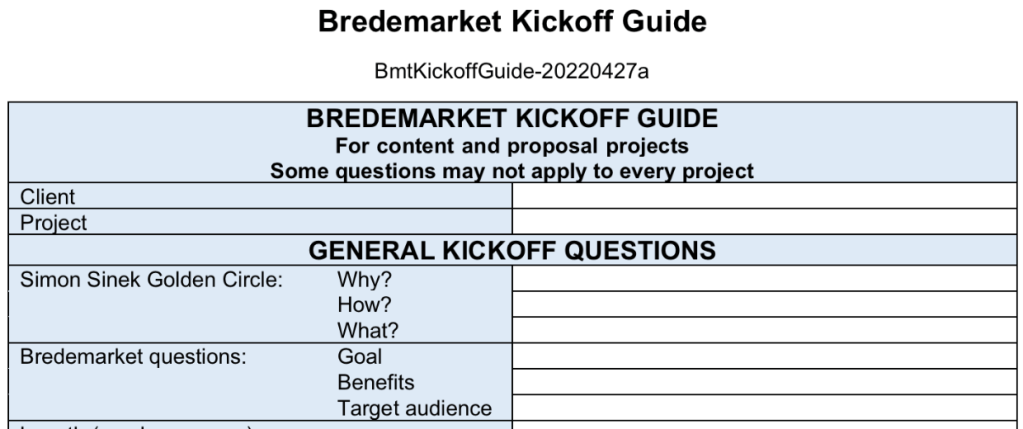
Goal 1: Help my clients to communicate and reach (and understand) their goals. Accomplished, and I got better at this over the year after I developed an intake form to look at my clients’ overall goals, benefits, and target audiences.

Goal 2: Pursue multiple income streams. Mostly accomplished, including income streams from new sources, although I’m still working on the local income stream.

Goal 3: Pursue multiple communication streams. Mostly accomplished, including a new LinkedIn showcase page, a new Instagram account, and a budding commitment to video. The podcast isn’t as active as it could be, though.

Goal 4: Eat my own iguana (actually wildebeest) food. Accomplished in a variety of ways, including submitting my own Request for Information (RFI) responses on behalf of Bredemarket.

Goal 5: Have fun. Accomplished (perhaps too much). I’m not sure how many people enjoy the YouTube music videos that are appended to more and more of my posts these days.

Goal 6: Be prepared to change. Accomplished so far, as I’ve rolled with the changes that took place in 2021.

But am I prepared for perhaps even greater changes in 2022?

What will I do in 2022?

The first tweak that I made to my goals for next year is that I’m defining fewer of them. I recently heard a suggestion that it’s best to only set two or three goals, rather than a slew of goals. Therefore some of my older goals, such as “have fun” and “be prepared to change,” are going to fall by the wayside.

The second tweak that I made is to make the goals SMARTer. While my 2021 goals were time-bound, they lacked specificity or measurability.

The third tweak…well, you’ll see it in a minute.

So what will I do in 2022?

Goal 1: Realize Bredemarket revenue from biometrics/identity, technology, and local business clients, as well as one other category to be determined. This goal encourages me to continue to realize biometrics/identity and technology revenue, start to realize local revenue, and to pursue revenue from a source that I haven’t even thought of yet.

Now the person who suggested that a business should only set two or three goals also stated that the business should define steps to realize each of these goals. I’m not going to share these steps here, in part because I haven’t figured then out yet. But I’m going to need to pursue some specific actions to continue established business and start new business.

And I obviously can make this goal smarter by targeting specific revenue amounts, which I’ve done in Goal 3.

Goal 2: Establish Bredemarket as a recognized authority in its market segments. Now I’m not talking about self-proclamation here (I’ve already done that for biometric content marketing and biometric proposal writing; I’m talking about having others recognize me in some substantive way. References from others are more powerful anyway.

Again, I need to figure out how to do this, and may even need to revise the goal to make it SMARTer once I figure this out.

Goal 3: This one’s a secret. I’ve set another goal that I’m not sharing publicly, but that clearly fits the SMART criteria. Now I have to see if I can do it.

OK, my goals are set. (Unless I change them.) Let’s see if I can meet them.

But if YOU need more robust goals…

If you think that my goal-setting process is too simple for you, and you would like to commit to a more robust process with annual and quarterly goals, as well as definition of the tasks that will help you accomplish the goals, you might want to sign up for Jay Clouse’s Annual Planning Workshop on Friday, December 17.

I will not be joining you, however. Not because I don’t think Jay Clouse’s workshops are of value; they certainly are (I created action items after attending his Invisible Selling workshop).

I won’t be joining you because I have a scheduling conflict.

(I may say more about my scheduling conflict in a future post.)

Livin’ on the edge (improving video analytics efficiency)

During the last few years of my corporate career, I became involved in video analytics. While there is some overlap between video analytics and biometrics, video analytics is somewhat broader because it not only identifies individuals (via incorporation of facial recognition), but can also count people (for example, to enforce COVID capacity limits), or identify objects (for example, a particular backpack of interest that could contain an explosive device).

Because video analytics involves video rather than still images, there’s much more data that has to move from the cameras to the processing servers. For this reason, some video analytic applications take advantage of edge computing, where the analysis happens right at the edge device, removing the need to clog network bandwidth with complete video feeds.

Perhaps the edge devices only isolate the video of interest and send it off for processing. Or perhaps all of the processing takes place at the edge device.

However, as biometric and video analytics provider NEC has noted, there is a cost to edge computing.

[B]ecause cooling is difficult to manage and electricity consumption is restricted in edge devices, high-performance processors such as GPUs used in high-performance servers are not available, and processing capacity is constrained.

From https://www.nec.com/en/press/202112/global_20211201_01.html

NEC is developing a solution to address this processing capacity constraint.

Application of NEC’s newly developed gradual deep learning-based object detection technology enables efficient, high-speed, and high-precision detection of subjects from a large amount of images, even in an edge device with limited processing capacity, and enables simultaneous processing of images from multiple cameras in real time.

From https://www.nec.com/en/press/202112/global_20211201_01.html

One benefit of using software to perform the necessary calculations is that it lessens the need to upgrade hardware. As NEC and other video analytics providers well know, many organizations have already invested a lot of money in their camera systems, and would prefer software that operates with the current hardware, rather than obtaining software that requires a complete hardware replacement.

NEC’s new software isn’t available yet, but the company aims to commercialize it in 2022.

And now for the music video that is at best tangentially related to NEC’s technology advance. (And no, I don’t know if NEC’s facial recognition technology has been tested with masking of one side of the face.)

From https://www.youtube.com/watch?v=7nqcL0mjMjw

DNA mixture interpretation outside of the forensic laboratory? Apparently not yet.

(Part of the biometric product marketing expert series)

The National Institute of Standards and Technology has published a draft report entitled DNA Mixture Interpretation: A Scientific Foundation Review.

As NIST explains:

This report, currently published in draft form, reviews the methods that forensic laboratories use to interpret evidence containing a mixture of DNA from two or more people.

From https://www.nist.gov/dna-mixture-interpretation-nist-scientific-foundation-review

The problem of mixtures is more pronounced in DNA analysis than in analysis of other biometrics. You aren’t going to encounter two overlapping irises or two overlapping faces in the real world. (Well, not normally.)

By Olli Niemitalo – Own work, CC0, https://commons.wikimedia.org/w/index.php?curid=18707318

You can certainly encounter overlapping voices (in a recorded conversation) or overlapping fingerprints (when two or more people touched the same item).

But there are methods to separate one biometric sample from another.

It’s a little more complicated when you’re dealing with DNA.

Distinguishing one person’s DNA from another in these mixtures, estimating how many individuals contributed DNA, determining whether the DNA is even relevant or is from contamination, or whether there is a trace amount of suspect or victim DNA make DNA mixture interpretation inherently more challenging than examining single-source samples. These issues, if not properly considered and communicated, can lead to misunderstandings regarding the strength and relevance of the DNA evidence in a case.

From the Abstract in https://doi.org/10.6028/NIST.IR.8351-draft%C2%A0

As some of you know, I have experience with “rapid DNA” instruments that provide a mostly-automated way to analyze DNA samples. Because these instruments are mostly automated and designed for use by non-scientific personnel, they are not able to analyze all of the types of DNA that would be analyzed by a forensic laboratory.

Therefore, this draft document is silent on the topic of rapid DNA, despite the fact that co-author Peter Vallone has years of experience in rapid DNA.

I am not a scientist, but in my view the absence of any reference to rapid DNA strongly suggests that it’s premature at this time to apply these instruments to DNA mixtures, such as rape cases in which both the assailant’s and the victim’s DNA are present in a sample.

Granted, there may be rape cases in which the DNA of the assailant may be present with no mixture.

You have to be REALLY careful before claiming that rapid DNA instruments can be used to wipe out the backlog of rape test kits. However, rapid DNA can be used to clear less complicated DNA cases so that the laboratories can concentrate on the more complex cases.

96 Smiles: All about the Shipley Business Development Lifecycle

And when the sun comes up
I’ll be on top

? and the Mysterians, “96 Tears.” From https://genius.com/And-the-mysterians-96-tears-lyrics

I carved out some time late Wednesday morning to take a look at a book that I acquired back in late October.

The book is the 2019 edition of the Shipley Business Development Lifecycle Guide, which I won at a raffle at the APMP Western Chapter Training Day. (And yes, I won it in the presence of my SMA colleagues. But hey, good information comes from a variety of places.)

Now even though this book has a 2019 date, I’ve been familiar with the Shipley Business Development Lifecycle for a long, long time.

The first part of the Shipley Business Development Lifecycle. From http://sbdl.shipleywins.com/.

In fact, it was my late 1990s exposure to the Shipley lifecycle that prompted me to LEAVE proposals (the first time).

Let me explain.

As the Shipley Business Development Lifecycle points out, in the ideal world there are a number of proposal preparation steps that take place BEFORE a Request for Proposals (RFP) is issued. In this ideal world, the following conversation would take place after final RFP release:

Well, the RFP just dropped, and it’s almost exactly what we expected. A few tweaks in the interface requirements, but everything else is identical to our mockup. So we can just polish our previous plans, perform several more sanity checks, and win this!

It’s no surprise that sometimes situations are NOT ideal, and perhaps this conversation may take place instead:

Hey, our customer just released an RFP for a new system. I had no idea that they were going to release an RFP this year. Well, we’ve been the incumbent for years, and the people using our software seem to like us. I think. I don’t know the person who actually released the RFP, but my cousin’s brother-in-law knows him. As long as we come in with the lowest price, we’re certain to win this!

Obviously (or hopefully) most RFP releases are somewhere between these two extremes. But it got me thinking: what would it be like to move to the left on the Shipley timeline and participate in the pre-RFP release activities?

I ended up becoming a product manager, and later in my career (after a second stint in Proposals) became a strategic marketer and corporate strategist. But even in these other positions, I continued to dabble in proposals, primarily as a subject matter expert.

So I was already somewhat familiar with the contents of the Shipley guide, but now I had the entire guide in my hands. (I think I had a Shipley book twenty years ago, but I no longer have it.) This allowed me to review the contents at my leisure.

OK, maybe not THAT relaxed. My eyes have to be open, for one thing. (And certain paper products belong in the bathroom, not the living room.)

One nice thing about the printed guide: rather than numbering all the steps sequentially from 1 to 96, they are numbered within each phase. The steps in Phase 0 (Market Segmentation) are numbered from 0.1 to 0.6, the steps in Phase 1 (Long-Term Positioning) from 1.1 to 1.6, and so forth.

The lifecycle is much less imposing that way. If you tell management that you want to implement a 96-step process to win a customer, management will probably tell you to take a hike. (Even Martin Luther didn’t write 96 theses.) A 7-phase process is more palatable. (Marketing!)

After Phases 0 and 1, the Shipley Business Development Lifecycle contains 5 other phases:

Phase 2, Opportunity Assessment8 steps
Phase 3, Capture/Opportunity Planning15 steps
Phase 4, Proposal Planning31 steps
Phase 5, Proposal Development18 steps
Phase 6, Post-Submittal Activities12 steps
The final five (of seven) phases in the Shipley Business Develoopment Lifecycle.

The proposal planning phase (Phase 4) deserves a mention, since this is the phase in which Shipley practitioners outline the proposal, draft the executive summary, and update the winning price…all before the RFP is issued.

Obviously you have to know your customer really well to do all of that in advance, and if you don’t know your customer, your competitor probably already does.

Needless to say, I’m not going to duplicate the entire book here; it’s copyrighted, after all. But I do want to highlight the final step in the process, which is either step 6.12 or step 96 depending upon how you number things.

Hold a victory party (win or lose), including review teams.

Actually, you can tailor this step and hold TWO victory parties: one to celebrate that you got the proposal out the door, and a second if you win the contract.

Regardless of how many victory parties you actually hold, be sure to invite all of the contributors. It’s in your self-interest to do so.

Contributors who feel appreciated are more inclined to support subsequent proposal efforts.

Shipley Associates, Shipley Business Development Lifecycle Guide (2019 edition), page 82.

So that’s a few highlights. I only got a chance to look at a portion of the book on Wednesday morning, but it contains a wealth of valuable information for proposal managers/writers AND capture managers AND strategic marketers, corporate strategiests, and product managers.

Enough to make you happy so that you don’t cry. (I couldn’t leave this out.)