In case you missed it, I reshared Ricardo Amper’s announcement on LinkedIn.
Then re-reshared it on Instagram and elsewhere.
Incode’s announcement is here.

Identity/biometrics/technology marketing and writing services
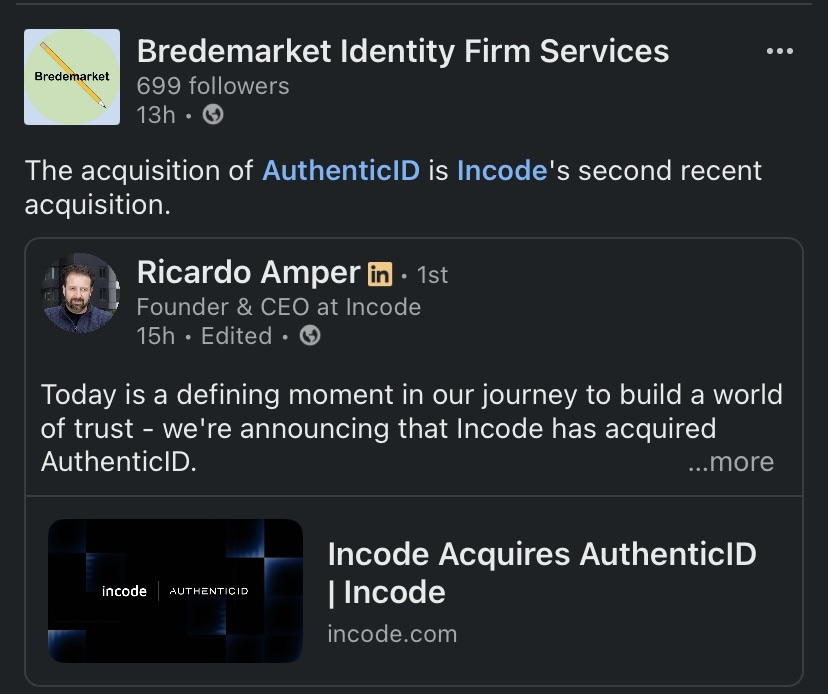
In case you missed it, I reshared Ricardo Amper’s announcement on LinkedIn.
Then re-reshared it on Instagram and elsewhere.
Incode’s announcement is here.

(Imagen 4)
So I just engaged in a reverse engineering exercise in Facebook’s Bredemarket Picture Clubhouse.
Let me explain.
Google Gemini imposes severe restrictions against creating pictures of famous figures. You can’t create a picture of President Taylor Swift, for example. But Woody Guthrie is fair game, which is no surprise to anyone who knows of JibJab’s tussle with the Richmond Organization. But I digress.
But what if I uploaded a Wikipedia picture of a famous figure to Google Gemini, asked Gemini to describe it, then had Gemini create a picture based upon its own description?
Unfortunately it doesn’t always perform a perfect recreation, and I bet none of you can figure out the original famous figure depicted here.
The description, excluding her attire:
“The person in the image is a woman with fair skin and light-colored hair, possibly blonde or light brown. Her hair is styled with a slight wave and a side part. She appears to be of a mature age, with some wrinkles visible on her face, particularly around her eyes and mouth. Her eyes are light, likely blue or grey. Her nose is straight and her lips are thin. She has a serious or neutral expression.”

Marketers, have you ever used someone else’s marketing as an opportunity to market your own solution?
I’ll confess that I’m haunting online conversations about the Kettering Chick-fil-A age assurance issue and adding a technical spin to the conversations.
But I’m not the only one doing this.
I admire the effort of this person who recently emailed me:
“Hi John,
“Your recent post about the 22 types of content product marketers create caught my eye. It echoes what we’ve been seeing with global teams – managing diverse content across borders can be as complex as handling cross-border payroll.”
The emailer then launched into a pitch for his cross-border payroll solution.
While I give the emailer an A+ for effort, the emailer didn’t do his research on his prospect. His prospect, me:
Good effort though, even though I’m not one of the emailer’s hungry people (target audience).
And if you want to know about the 22 types of content product marketers create, NOW ENDORSED BY A CROSS-BORDER PAYROLL EXPERT, read my post here.

(Imagen 4)
In a recent post on Biometric Update, “Why retail needs biometrics – the cameras aren’t working,” Professor Fraser Sampson, former UK Biometrics & Surveillance Camera Commissioner made several points about the applicability of biometrics to retail. Among the many points he addressed, he dealt with algorithmic inaccuracy and the proper use of facial recognition as an investigative lead:
“It’s true that some early police algorithms were poor, but the biometric matching algorithms offered by some providers is over 99.99% – that’s as close to perfect as anyone has ever got. That’s NASA-level accuracy, better than some medical or military procedures and light years away from people staring at CCTV monitors. What about errors and misidentification? Used properly, LFR is a decision support tool, it’s not making the identification itself. Ultimately, it’s helping shopkeepers make their decisions and that’s where the occasional misidentification happens – by human error, not technical.”
I offered an additional comment:
“One other point: for all those who complain about the lack of perfection of automated facial recognition, it’s much better than manual facial recognition. The U.S. Innocence Project recounts multiple cases of witness MISidentification, where people have been imprisoned due to faulty and inaccurate identification of suspects as perpetrators. I’d much rather have a top tier FR algorithm watching me than a person who knows nothing about facial recognition at all.”
In case you missed it, I’ve written several Bredemarket blog posts on witness MISidentification: two on Robert Williams’ misidentification alone.
Heck, I addressed the topic back in 2021 in “The dangers of removing facial recognition and artificial intelligence from DHS solutions (DHS ICR part four).” This post covers the misidentification of Archie Williams (no relation).
So don’t toss out the automated facial recognition solution unless you have something better. I’ll wait.

“And don’t worry about how it looks to others. It doesn’t matter if no one else hears the music or understands it. What matters is that it belongs to you. Some of the most beautiful dances are the ones no one sees—the moments when you close your eyes, sway to your own inner melody, and remember that you are more than your obligations, more than the expectations placed upon you.”
Georgi Kisyov, “Just Change The Song”:

(Imagen 4)
The Buca di Beppo in Claremont is closing, along with a host of other locations nationwide.
I learned about this from an Utah source, which was shocked because 100% of the Buca di Beppos in Utah are closing. All two of them.
As of tonight the Claremont location remains open, and I haven’t been able to find a closure date.
Back here, other Southern California Buca di Beppo locations closing include:

(Imagen 4)
How old are you? The question that’s been asked at bars, pornography sites, and social media sites is now being asked at…a fast food restaurant in Kettering, Ohio.
I’ve talked about age assurance, age verification, and age estimation in a variety of use cases, including:
But what about fast food?
Anti-teen dining policies are nothing new, but this particular one is getting national attention.
The Chick-fil-A in Kettering, Ohio (which apparently is a franchise and not company owned) posted the following last week:
“With school starting, we wanted to make sure that everyone is aware of our Teen Chaperone Policy. We are grateful for your support and want to make sure Chick-fil-A Kettering is a safe and enjoyable place for everyone! Thank you so much!”

Chick-fil-A Kettering Teen Chaperone Policy
To ensure a safe and respectful environment for all guests:
Guests 17 and under must be accompanied by a parent, guardian, or adult chaperone (age 21+) to dine in.
Unaccompanied minors may be asked to leave.
Thank you for helping us keep Chick-fil-Afamily-friendly!
Chick-fil-A Kettering
For the moment let’s admit that the Chick-fil-A worker (who may or may not be 17 years old themselves) tasked with enforcing the rule will probably just eyeball the person and decide if they’re old enough.
And let’s also ignore the business ramifications of this franchise’s actions, not only for the franchise location itself, but for all Chick-fil-A restaurants, including those who welcome people of all ages at all times.
But there are some ramifications I want to address now.
This is definitely a brand new use case unlike the others, both because
The last point is a big one I’ve addressed before. People under the age of 18 may not have a driver’s license or any valid government ID that proves their age. And if I’m a kid and walking to the Chick-fil-A, I’m not taking my passport with me.
In a way that’s precisely the point, and the lack of a government ID may be enough to keep the kids out…except that people over the age of 18 may not have a driver’s license either, and thus may be thrown out unjustly.
In addition, unlike alcohol or cannabis laws, there are very few laws that can be used to enforce this. Yes, there are curfew laws at night, and laws that affect kids during school hours, but this franchise’s regulation affects the establishment 24 hours a day (Sundays excluded, of course).
So Chick-fil-A Kettering is on its own regarding the enforcement of its new rule.
Unless Kettering modifies its municipal code to put the rule of law behind this rule and force ALL fast food establishments to enforce it.
And then what’s next? Enforcement at the Kettering equivalent of James Games?

Know your business, today’s edition.
I knew I was asking for trouble when I answered a simple question of whether I used Quickbooks.
Sure enough, I subsequently received a call from the Quickbooks Support Department.
After wasting his time for a few minutes, I asked for his Intuit email address.
He didn’t have one. Just a Quickbooks Support email address.
So I just blocked a number from the 207 area code. Which is in Maine, the hotbed of Intuit activity.
Perhaps instead of his Intuit email address, I should have asked him to consent to a biometric scan that matches against Intuit employee records.

(Imagen 4)
Companies ask you to register for webinars with your corporate email address and job title.
But how many companies NEVER confirm your registration?
There are at least three reasons why you may never get that confirmation email:
And of course there’s a third reason: the company evaluated your registration and determined you’re not a qualified prospect. Maybe you work for a competitor. Maybe you won’t buy and will instead try to sell—which the company will deduce by my job title of “Product Marketing Consultant.”

Disqualification can be legitimate. The purpose of an awareness webinar, like an awareness blog post, is to identify prospects who will become buyers.
But over-disqualification has its price. If my registration for your webinar is never confirmed because of my “Product Marketing Consultant” job title…well, I guess I can’t talk about your webinar, can I?

Mitratech allowed me to attend its TPRM-focused “frame, assess, respond, and monitor” webinar…and I talked about it.
Just a thought.

Features sedate. Benefits awaken.
Attract prospects to your product marketing materials. Turn to John E. Bredehoft for impact: https://www.linkedin.com/in/jbredehoft
And yes, this is an example of content repurposing from the original: https://bredemarket.com/2025/08/17/features-sedate-benefits-awaken/

 Bredemarket