Things I Ask Gemini While Sitting On Euclid Waiting For the Parade

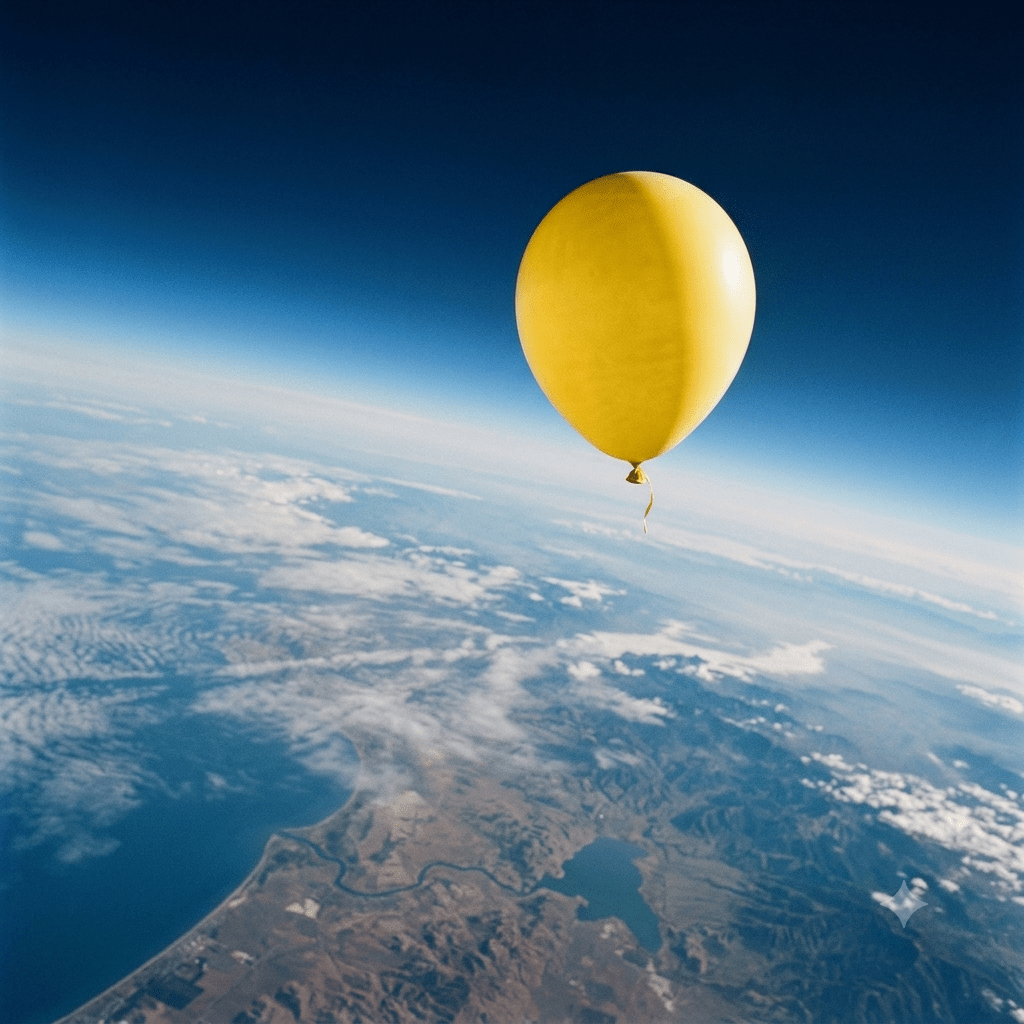
That escaping birthday balloon has quite a journey ahead of it. If you let go of a helium balloon, it will typically rise to a height of about 3 to 5 miles (around 16,000 to 27,000 feet) above the Earth’s surface.
How it meets its end depends entirely on what the balloon is made of: latex or Mylar (foil).
Here is exactly what happens as it climbs.

The Science of the Ascent

As the balloon rises, two major environmental changes occur:

  1. Atmospheric pressure drops: There is less air pushing on the outside of the balloon.
  2. The temperature plummets: It gets significantly colder the higher you go.
    Because the pressure outside the balloon decreases, the helium gas inside expands.

Scenario A: The Toy Latex Balloon (The “Pop” Ending)

If it’s a standard rubber or latex balloon, it will rise until it hits its physical limit.

  • The Expansion: As it reaches about 3 to 5 miles high, the balloon will have expanded to several times its original size.
  • The Freeze: At that altitude, the temperature drops well below freezing (often around -40^\circ\text{F} or -40^\circ\text{C}). This causes the latex to undergo “brittle fracturing.”
  • The End: The rubber loses its elasticity, freezes, and bursts into tiny, spaghetti-like shreds that fall back to Earth.

Scenario B: The Mylar/Foil Balloon (The “Float” Ending)

Foil balloons (the shiny, metallic ones) behave differently because Mylar doesn’t stretch.

  • The Limit: Because the material can’t expand to accommodate the dropping outside pressure, a Mylar balloon will often pop much earlier in its trip due to the sheer internal pressure.
  • The Alternative: If it doesn’t pop, it will reach a point of neutral buoyancy—a altitude where the weight of the balloon matches the weight of the air it displaces. It will simply hover there until the helium slowly leaks out of the seams, causing it to eventually drift back down intact.

The Exception: Weather Balloons

If you’ve ever wondered how scientists get balloons to go way higher—into the stratosphere—they use specially designed weather balloons.
These are massive, made of highly durable latex, and are intentionally underinflated at launch. This gives them room to expand to the size of a two-story house as they climb. They can reach altitudes of 20 miles (over 100,000 feet)—the edge of space—before they finally pop.


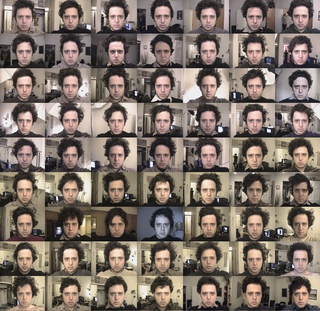
Noah Kalina Everyday and NIST Face and Iris Testing

(Image By Noah Kalina – https://flickr.com/photos/arvadacenter/7205535002/, Fair use, https://en.wikipedia.org/w/index.php?curid=69354953)

When the National Institute of Standards and Technology (NIST) performs biometric testing, it generally uses government data from law enforcement, homeland security, and similar sources.

Plus some specialized data that government databases can’t match.

On January 10, 2000, Noah Kalina took a selfie. The next day, he took another. And he kept on doing it every day, with some exceptions, for many years. (Here he is on June 1, 2026.) By centering his nose in the center of the frame, the pictures provide a consistent chronicle of Kalina’s appearance, along with the exact day on which the pictures were taken. NIST purchased rights to some of these photos to use in its age estimation testing. Since NIST knew Kalina’s true age on any given day, it could measure an age estimation algorithm’s accuracy.

But that’s not why I’m writing about Noah Kalina.

Let’s move to irises

Consider the irises of the face, how they are captured. They are usually captured with expensive cameras that take a picture from a short distance away.

But what if a normal camera captured a person, and their irises? Could the camera images yield useful information?

James Matey wanted to find out.

[The Kalina images] “provide us with interesting opportunities to explore the effects of time lapse on iris recognition employed on images that were not originally intended for iris recognition. NIST obtained a license from Kalina to use a subset (7 half years from 2009-2015) of original, high resolution, digital images in biometric studies.”

So were they useful?

“…even though the majority of the images in this dataset did not provide solid matches, there are instances where mated iris image pairs from visible light images that were not obtained for the purpose of iris recognition match with match scores corresponding to a false match rate of 0:1% at a true accept rate of 1% . Though such performance is not useful in applications such as access control, there are cases where it may be useful.”

No, your irises can’t be easily captured in 2026, but what about later?

Let Me Explain

If you’re a fingerprint biometric firm and need Bredemarket, I can’t help you this month. I’m already working with one of your competitors.

Likewise, if you’re a face biometric firm and need Bredemarket, I can’t help you this month. I’m already working with one of YOUR competitors.

So where am I seeking clients, if not fingerprint or face companies?

Tell you later.