
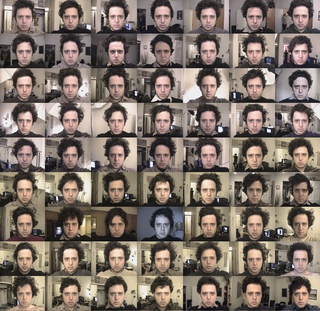
(Image By Noah Kalina – https://flickr.com/photos/arvadacenter/7205535002/, Fair use, https://en.wikipedia.org/w/index.php?curid=69354953)
When the National Institute of Standards and Technology (NIST) performs biometric testing, it generally uses government data from law enforcement, homeland security, and similar sources.
Plus some specialized data that government databases can’t match.
On January 10, 2000, Noah Kalina took a selfie. The next day, he took another. And he kept on doing it every day, with some exceptions, for many years. (Here he is on June 1, 2026.) By centering his nose in the center of the frame, the pictures provide a consistent chronicle of Kalina’s appearance, along with the exact day on which the pictures were taken. NIST purchased rights to some of these photos to use in its age estimation testing. Since NIST knew Kalina’s true age on any given day, it could measure an age estimation algorithm’s accuracy.
But that’s not why I’m writing about Noah Kalina.
Let’s move to irises
Consider the irises of the face, how they are captured. They are usually captured with expensive cameras that take a picture from a short distance away.
But what if a normal camera captured a person, and their irises? Could the camera images yield useful information?
James Matey wanted to find out.
[The Kalina images] “provide us with interesting opportunities to explore the effects of time lapse on iris recognition employed on images that were not originally intended for iris recognition. NIST obtained a license from Kalina to use a subset (7 half years from 2009-2015) of original, high resolution, digital images in biometric studies.”
So were they useful?
“…even though the majority of the images in this dataset did not provide solid matches, there are instances where mated iris image pairs from visible light images that were not obtained for the purpose of iris recognition match with match scores corresponding to a false match rate of 0:1% at a true accept rate of 1% . Though such performance is not useful in applications such as access control, there are cases where it may be useful.”
No, your irises can’t be easily captured in 2026, but what about later?

 Bredemarket