
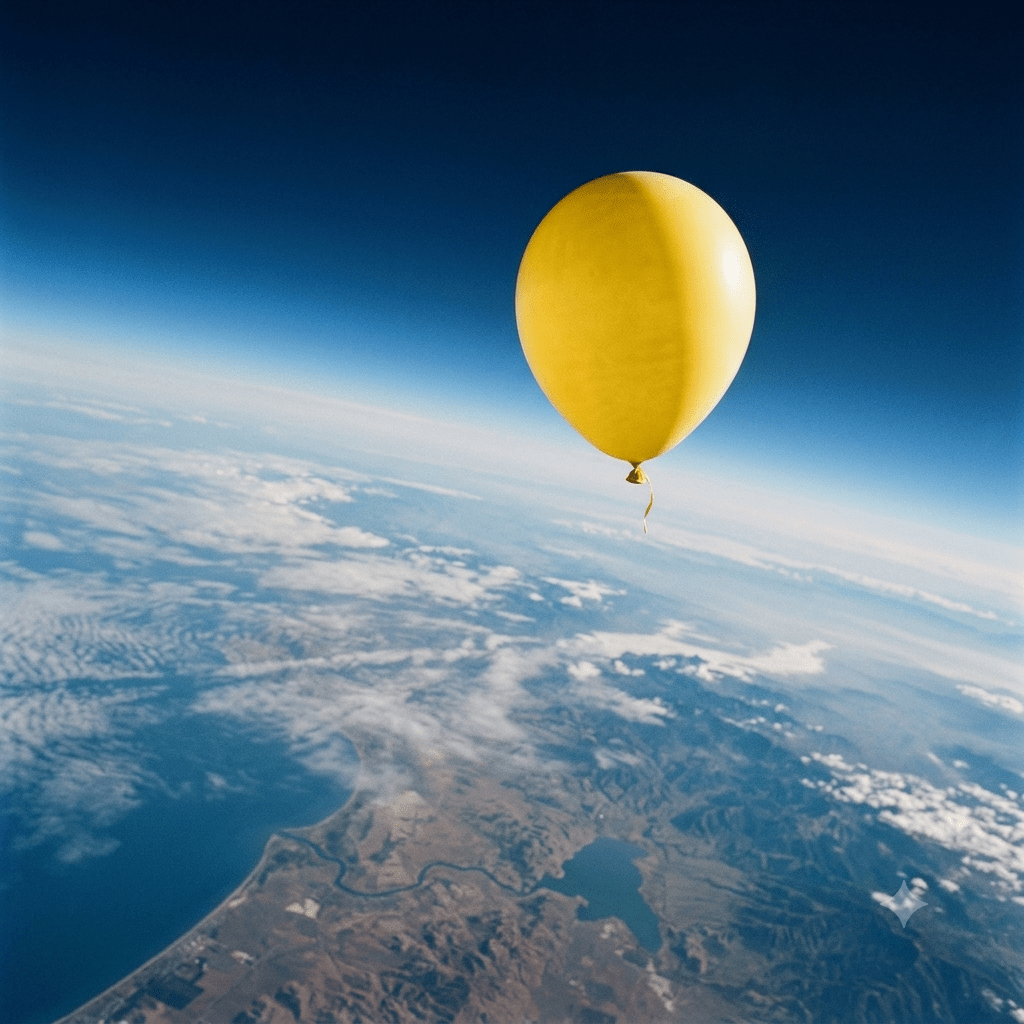
That escaping birthday balloon has quite a journey ahead of it. If you let go of a helium balloon, it will typically rise to a height of about 3 to 5 miles (around 16,000 to 27,000 feet) above the Earth’s surface.
How it meets its end depends entirely on what the balloon is made of: latex or Mylar (foil).
Here is exactly what happens as it climbs.
The Science of the Ascent
As the balloon rises, two major environmental changes occur:
- Atmospheric pressure drops: There is less air pushing on the outside of the balloon.
- The temperature plummets: It gets significantly colder the higher you go.
Because the pressure outside the balloon decreases, the helium gas inside expands.
Scenario A: The Toy Latex Balloon (The “Pop” Ending)
If it’s a standard rubber or latex balloon, it will rise until it hits its physical limit.
- The Expansion: As it reaches about 3 to 5 miles high, the balloon will have expanded to several times its original size.
- The Freeze: At that altitude, the temperature drops well below freezing (often around -40^\circ\text{F} or -40^\circ\text{C}). This causes the latex to undergo “brittle fracturing.”
- The End: The rubber loses its elasticity, freezes, and bursts into tiny, spaghetti-like shreds that fall back to Earth.
Scenario B: The Mylar/Foil Balloon (The “Float” Ending)
Foil balloons (the shiny, metallic ones) behave differently because Mylar doesn’t stretch.
- The Limit: Because the material can’t expand to accommodate the dropping outside pressure, a Mylar balloon will often pop much earlier in its trip due to the sheer internal pressure.
- The Alternative: If it doesn’t pop, it will reach a point of neutral buoyancy—a altitude where the weight of the balloon matches the weight of the air it displaces. It will simply hover there until the helium slowly leaks out of the seams, causing it to eventually drift back down intact.
The Exception: Weather Balloons
If you’ve ever wondered how scientists get balloons to go way higher—into the stratosphere—they use specially designed weather balloons.
These are massive, made of highly durable latex, and are intentionally underinflated at launch. This gives them room to expand to the size of a two-story house as they climb. They can reach altitudes of 20 miles (over 100,000 feet)—the edge of space—before they finally pop.

 Bredemarket