I had previously designated a payment card to use with Amazon One (Card #1). When I went to check out and provided my palm, I was asked to insert this card.
The reader said there was a problem with this card, so I inserted a different card (Card #2) and the payment processed on that card.
After my purchase I went back to my Amazon One app…which still showed Card #1 as my purchase card.
So I figured I should pre-investigate what was necessary to enroll in the Amazon One palm vein system once I arrived at the store.
My first discovery was that Amazon One has its own app, separate from the Amazon app. I don’t know how many apps Amazon has, but if Amazon and Meta ever merge (Amameta?), I will need a separate phone just for its apps.
So I downloaded Amazon One, linked it to my Amazon account, and waited for the instructions on how to enroll my palm at an Amazon location…
…only to find that Amazon One wanted to take pictures of both my palms, right there on my smartphone. Just like any contactless fingerprint app.
Enrolled in Amazon One.
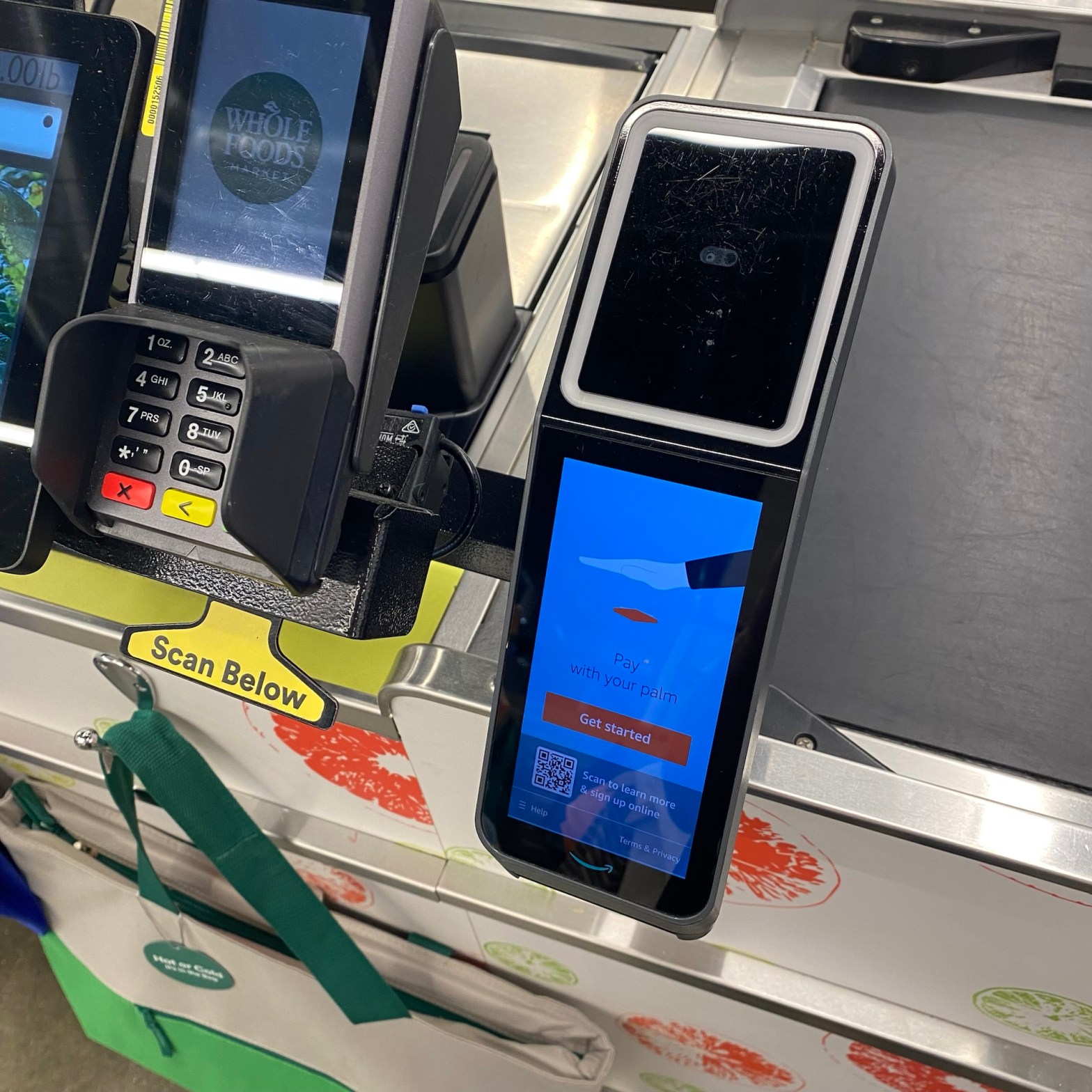
So I am now enrolled, and I have confirmed that my local Amazon Fresh accepts Amazon Go.
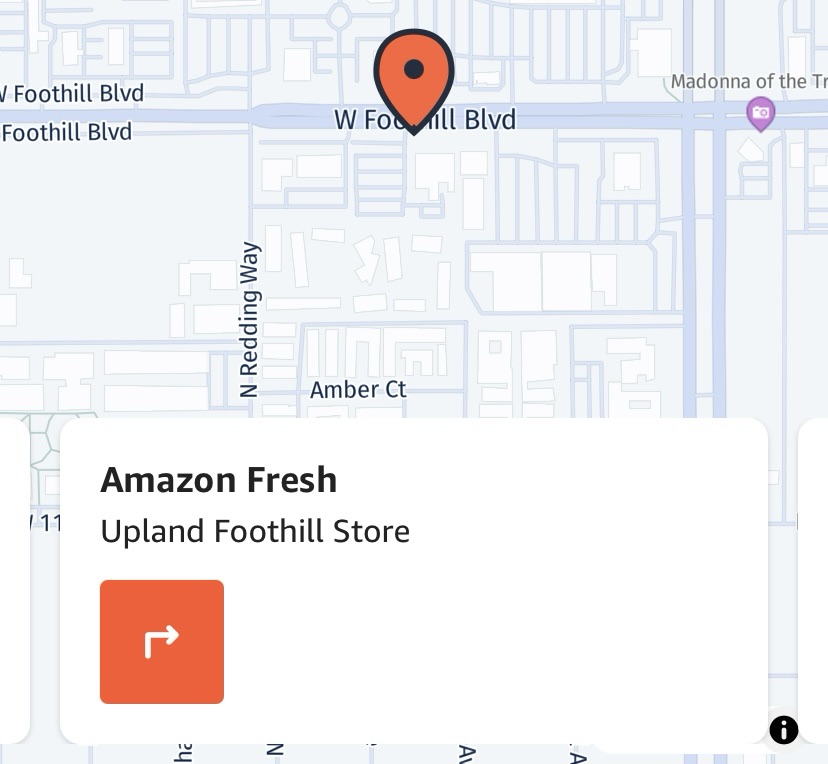
Um…that is not East Foothill.
However, as even non-locals will realize, this is NOT 235 East Foothill, but WEST Foothill. So much for geolocation. (And the location of the Madonna of the Trail statue is wrong also, but I digress.)
Work Address: 235 E. Foothill Blvd, Upland, CA, 91786
Pay Rate: $17.80 per hour
Availability Requirements: Shift availability is dependent on operational needs.
Part-time: Shift availability required 3 days per week, including Saturday and Sunday
Flex-time: Must be available 2 weekdays between Monday-Friday and 1 weekend day/evening between Saturday-Sunday. May be scheduled up to 8 hours weekly, with additional shifts offered based on store availability.
Shifts are between 4 a.m. and 12 a.m. and may be up to 8 hours long
Are there/will there be too many Dollar Trees in or near Ontario, California?
This used to be my Alpha Beta, a grocery store chain acquired by Kroger and Albertsons.
Then it became a 99 Cents Only Store. (Actually a 99.99 Cents Only Store, but close enough.) And we know what happened there.
Now this location, on Mountain Avenue near D St. in Ontario, California, is slated to become a Dollar Tree. (Actually a Dollar Twenty Five Tree, but close enough.)
Just like the former 99 Cents Only Store on Euclid near Francis, which has already reopened as a Dollar Tree.
And just like the three Dollar Trees within a two mile radius in Ontario, Upland, and Montclair.
Maybe it’s just me, but I doubt all of them will survive. The dollar store market hasn’t gotten appreciably better.
Expect heavy large business lobbying against this proposed ballot measure in Upland. Because if they have to pay a debilitating $865 in fees, they’ll shutter their business and join Elon and Chevron in Texas.
“Under the existing system, each $20,000 a business makes is taxed in $54 increments. Businesses reach the $864 cap when they have roughly $320,000 in gross sales….
“If approved by voters, the Nov. 5 measure would mean businesses would pay $50 for every $100,000 they generate in revenue….Meanwhile, the measure would increase the cap on business license taxes to $29,500.”
For the record, Bredemarket is based in Ontario, and I’m glad I’m not subject to Upland’s current licensing fees.
A person in Upland, California posted this on the local NextDoor. While anecdotal and not statistical, in this case the geolocation capabilities of a device (in this case AirPods) identified someone in possession of a stolen vehicle.
There is a popular practice in which people ARE well aware of the original message, but only some of them discern the hidden message, or metamessage, behind those words.
And you don’t have to look to business communication to find examples of this. Take the romantic world, in which the statement “If you go out with me I’ll treat you like the princess you are!” conveys the metamessage of predatory desperation. In the business world, “Let me take that under consideration” means that the speaker is not considering the proposal for a nanosecond.
Sometimes many of us can’t discern the metamessage until long after the message is stated.
Remember the message that Whitney Houston gave to Diane Sawyer?
Respect: We treat others as we would like to be treated ourselves. We do not tolerate abusive or disrespectful treatment. Ruthlessness, callousness and arrogance don’t belong here.
Integrity: We work with customers and prospects openly, honestly and sincerely. When we say we will do something, we will do it; when we say we cannot or will not do something, then we won’t do it.
Communication: We have an obligation to communicate. Here, we take the time to talk with one another…and to listen. We believe that information is meant to move and that information moves people.
Excellence: We are satisfied with nothing less than the very best in everything we do. We will continue to raise the bar for everyone. The great fun here will be for all of us to discover just how good we can really be.
Now to be fair to Houston, the cocaine detected in her toxicology report may not have been CRACK cocaine, and cocaine was not the only substance detected. But now we know that while crack may have been “wack,” cocaine was OK, and marijuana, Xanax, and other things were OK too.
I have no desire to be fair to Enron, but I guess we can say that “the very best in everything we do” can be defined as “maximizing personal value,” that there isn’t an “obligation to communicate” EVERYTHING, and that falsifying records does not necessarily mean ruthlessness or arrogance.
When the metamessage agrees with the message
How often do you roll your eyes in amusement when a business says something?
Conversely, how often do you nod your head in agreement when a business says something?
Now I’ll grant that there’s not universal agreement on whether Company X is truthful in its messaging. For every person who thinks that Apple is the last guardian of privacy on ths planet, there is someone else who is convinced that Apple is an evil corporation who has (and I quote an anonymous source) “become what they accused Microsoft of.”
But it doesn’t matter what the world thinks.
What matters is what your prospect thinks.
Does your prospect think your company is telling the truth?
Does your prospect think your company is lying?
Does your prospect need more information to make a decision?
How case studies help you reach message-metamessage agreement
One powerful way to convince a doubting prospect is via a case study.
It always helps when someone else is singing your company’s praises. Especially when the subject of the case study backs up what you’ve been claiming all along.





 Bredemarket