

Ready to commute from Upland to the Small Business Expo in Pasadena.
Tag Archives: transportation
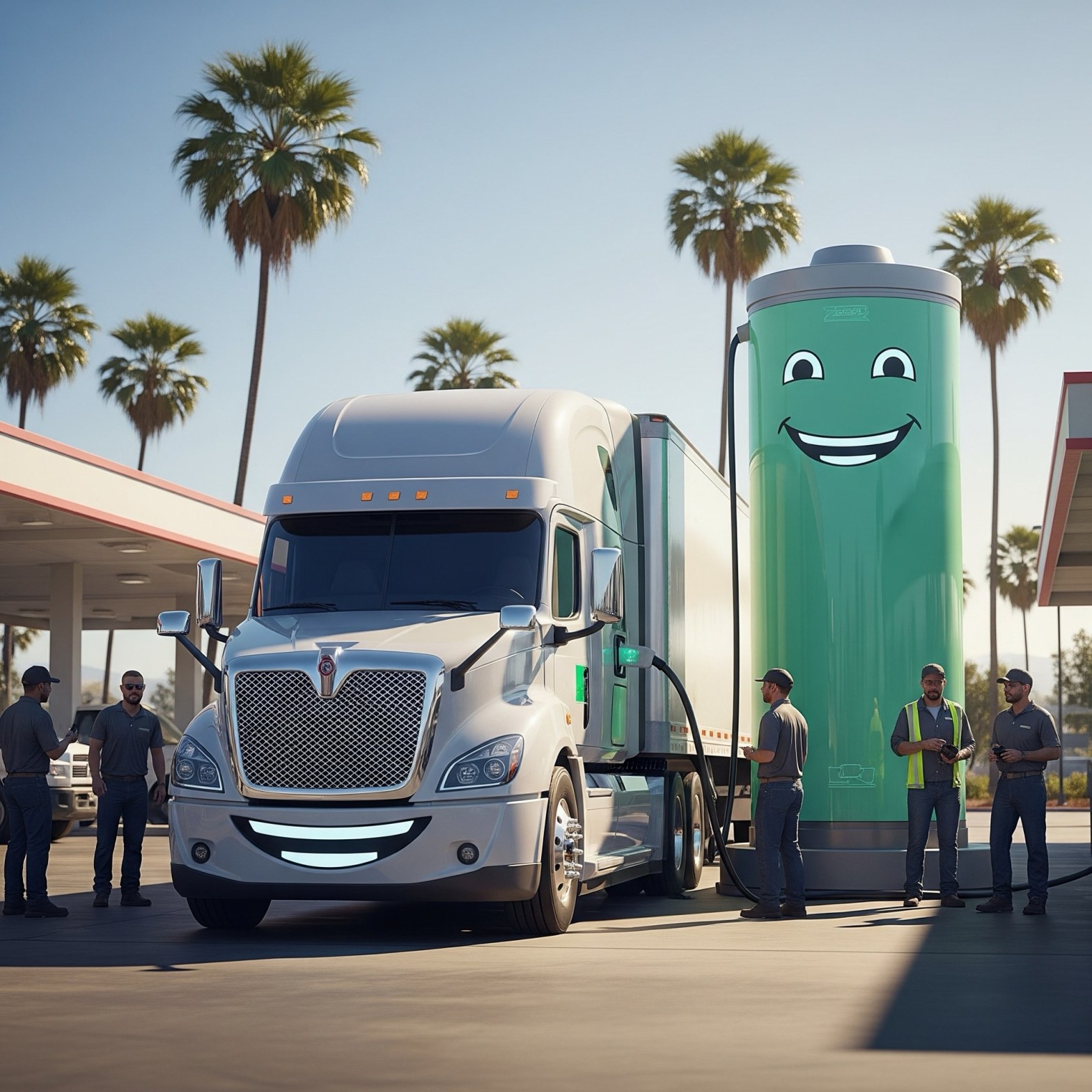
NFI is Charged Up
(Imagen 4)
It’s been over three years since I mentioned NFI Industries in the Bredemarket blog. At the time I said:
“NFI is working with Volvo, Daimler, and others on an ambitious project to “[o]perate the first 100% zero-emission drayage fleet in the U.S. with the deployment of 60 battery-electric tractors.” NFI wants to achieve this by 2023.”
Well, now it’s 2025, and NFI has nearly 90 battery-electric tractors. And a place to charge them:
“NFI and Prologis Mobility launched a new electric truck charging depot in Ontario, California. The 1 MW facility features 10 dedicated charging ports and charges up to 20 vehicles daily.”
Metal Injection Attack: The Ozzy Version

In my previous blog post about a fingerprint biometric security metal injection attack, I said:
“This metal injection attack isn’t from an Ozzy Osbourne video…”
Well, now there IS an Ozzy Osbourne video about the metal injection attack. The reel is on Instagram.
Will Entities Adopt the SITA-IDEMIA-Indico “Digital Travel Ecosystem”?

Thinking about “de plane” used in the Fantasy Island television series (image CC BY-SA 3.0) makes me think about travel. Mr. Roarke’s and Tattoo’s guests didn’t have to worry about identifying themselves to disembark from the plane and enter the island. But WE certainly do…and different countries and entities need to adopt standards to facilitate this.
I’ve previously observed that standards often don’t emerge, like Athena, from ivory towers. They emerge when a very powerful entity or person (for example, Microsoft or Taylor Swift) says that THIS is the standard, and waits for the world to comply.
Of course, there can be issues when MULTIPLE powerful entities or people try to champion competing standards.
But what if powerful entities band together?
SITA, the global leader in air transport technology, and IDEMIA Public Security, a world leader in digital technologies, biometrics, and security have announced a collaboration to advance interoperability, trust, and data security through a globally recognized Digital Travel Ecosystem.
Add Indico to the partnership, and perhaps the parties may be on to something.
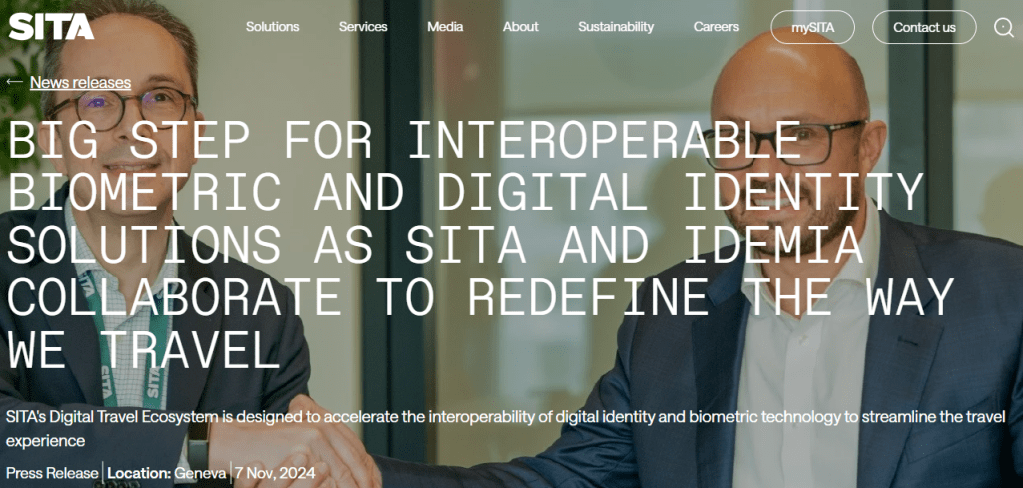
The goal is to create “an open, secure, and interoperable framework that ensures a travelers’ digital identity is trusted globally, without the need for direct integrations between issuers and verifiers.” It is intentionally decentralized, giving the traveler control over their identity.
Perhaps it’s a fantasy to think that others will buy in. Will they?
Or will they instead select Taylor’s version?

Do You Service These Seven Vertical Markets That Use Identity and Biometrics?

As Identity and biometrics solution providers know, their applications are found in a variety of vertical markets.
A LARGE variety of vertical markets.
Seven of these markets include financial services, travel and hospitality, government services, education, health, criminal applications, and venues. (Among others.)
Which three vertical markets does the Prism Project examine?
To start this post, I’m going to cheat and “appropriate” the work already performed by the Prism Project.
This effort is managed by Maxine Most’s Acuity Market Intelligence and supported by a variety of partners (including industry partners).
The Prism Project has identified 3 (so far) critical vertical markets for identity and biometrics. While this doesn’t pretend to be a comprehensive list, it’s a good starting point to illustrate the breadth of markets that benefit from identity and biometrics.
- The Prism Project has already released its report for financial services, which businesses can download here.
- The Prism Project has started to develop its report for travel and hospitality. You can preview the report here.
- Finally, the Prism Project plans to release a report addressing government services later in the year. For the latest status of this report, visit the Prism Project home page.
As you can see, identity and biometrics apply in wildly diverging vertical markets. You can use identity verification to open a bank account, enter your hotel room, or pay your taxes.
But those aren’t the only markets that use identity and biometrics.
Let me school you on two other markets, education and health
Let’s look at two markets that the Prism Project hasn’t covered…yet.
Education
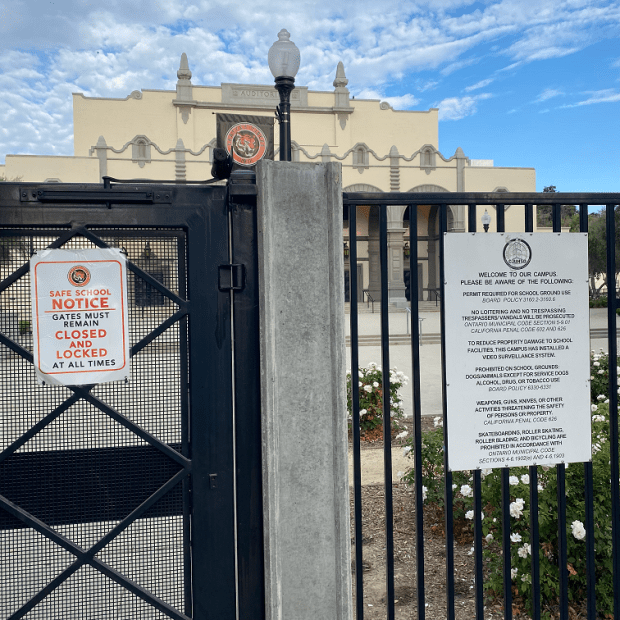
Another example of a market that uses identity and biometrics is the education market.
- Who is allowed on a physical campus? Students? Teachers? Staff? Parents and guardians?
- Who is NOT allowed on a physical campus? Expelled students? Fired faculty and staff?
- Who is taking that remotely-administered online test?
Bredemarket has written several posts about educational applications for identity and biometrics. You can read all my education writing on Bredemarket’s “Educational Identity” information page.
Health

Similarly Bredemarket has written several posts about healthcare applications for identity and biometrics, including some that dwell on the unique privacy legislation that covers healthcare. You can read all my health writing on Bredemarket’s “Health” information page. (It’s not called “Health Identity” because healthcare has both identity and technology aspects.)
Another source on finance
By the way, Bredemarket also has a page on “Financial Identity,” but the Prism Project’s content is more comprehensive.
But wait…there’s more!
So this is the point where Ed McMahon intones, “So Acuity Market Intelligence and Bredemarket have identified all five of the markets that benefit from the use of identity and biometrics!”

And you know how Johnny (Johnny Carson, or Johnny Bredehoft) would respond to that.

So let’s look at two more markets that benefit from the use of identity and biometrics-two markets that I know very well from the beginning and end of my time at Printrak/Motorola/MorphoTrak/IDEMIA.
Criminal applications
There are government services, and then there are government services.
I started my biometric journey over 29 years ago when I wrote proposals addressed to law enforcement agencies who wanted to find out who left their fingerprints on a crime scene, and whether the person being arrested was who they said they were.
I don’t know if Maxine Most is going to classify criminal applications as a subset of government services, but there are clear reasons that she may not want to do this.
- When you pay your taxes or apply for unemployment benefits, you WANT the biometric system to identify you correctly.
- When you steal a car or rob a bank, you do NOT want the biometric system to identify you correctly.
Big difference.
Stadiums, concert halls, and other venues
If someone asked me in late 2019 what my career five year plan was, I would have had a great story to tell.
As I was wrapping up over 24 years in identity and biometrics, I was about to help my then-employer IDEMIA enter a new market, the venue market. This market, which CLEAR was already exploring at the time, replaced the cumbersome ticketing process with the use of frictionless biometrics to enter sports stadiums, concert halls, trade shows, and related venues. Imagine using your face or IDEMIA’s contactless fingerprint solution MorphoWave to enter a venue, enter secure restricted areas, or even order food and beverages.
Imagine the convenience that benefit consumer and venue operator alike.
What could go wrong? I mean, the market was robust, and we certainly would NEVER face a situation in which all the stadiums and all the concert halls and all the trade shows would suddenly close down.

Since early 2020 when a worldwide pandemic DID shut down a lot of things, many identity/biometric firms have entered the venue market with a slew of solutions to benefit fans, teams, and venues alike.
And still more
There are many more vertical markets than these seven, ranging from agriculture to automobile access to computer physical/logical access to construction to customer service (mainly voice) to critical infrastructure to gaming (computer gaming) to gaming (gambling) to the gig economy to manufacturing to real estate to retail to telecommunications to transportation (planes, trains, buses, taxis, and cruise ships).
And all these markets have a biometric story to tell.
Can Bredemarket help you describe how your identity/biometric solution addresses one or more of these markets?
Four truths and a fable about the Ontario-San Antonio Heights “Mule Car”
Even people who live in Ontario, California may not know the story of the “mule car” in the median of Euclid Avenue at B St. You can see the mule car behind me in the “Cloudy days at the mule car” video below.
(And yes, sometimes the sun DOESN’T shine in Southern California.)
Four truths about the Ontario mule car
There are four things about the mule car that we know as fact.
1. The Ontario mule car began service in 1888
The single-car train line connected Ontario, North Ontario (North Ontario was later known as Upland), and San Antonio Heights (near 24th and Mountain today), and benefited local residents by providing an easy way to travel between the three establishments. As the Historical Marker Database website notes, more and more people settled on the master-planned Euclid Avenue in the years after Ontario was established in 1882, and the train line provided an easy way to travel north and south.
2. The Ontario mule car benefited from gravity
For those who are not familiar with San Antonio Heights, Upland, or Ontario, the northernmost community (San Antonio Heights) is near the mountains, and (according to the Electric Railway Historical Association) there is an elevation drop of 1200 feet over the ten miles from San Antonio Heights to Ontario.
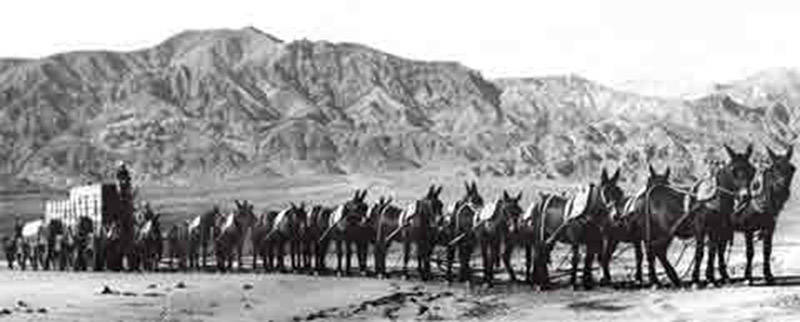
Of course, from the southern perspective of Ontario (see this Pacific Electric Railway page for a picture of the railway looking north), there is an increase in elevation of 1200 feet, which is why the mules were needed to pull the train up the hill. The uphill climb took about an hour.
Once the train reached San Antonio Heights and began its descent back to Ontario, the mules were no longer needed to pull the car.
[O]n the return trip the motive power climbed aboard a tiny trailer and coasted down with the car.
From http://www.erha.org/peeosah.htm
The downhill descent for the passengers (and the mules) took only 20 minutes. We’ll return to this later.
Since this is the Bredemarket blog, I can’t let this story pass without discussing the benefits of this system:
- Faster travel to on the southbound route to Ontario due to the faster downhill time.
- No use of power for the southbound route.
- Greater energy on the northbound route due to the rest that the mules received on the southbound journey.
(For additional information on benefits, click here.)
3. After electrification in 1895, the mule-less train line continued service until 1928
After several years, the train was electrified and the mules were no longer needed to power the train. This is when the train celebrated its heyday.
A thirty-acre amusement park was built by the company of San Antonio Heights, with a powerhouse adjoining. Heavy crowds were transported along Euclid Ave. in the early days, for the line connected Ontario with Upland, provided connections between the (Southern Pacific) Station at Ontario and the Santa Fe Station at Upland, and cared for the thongs bound for pleasure-seeking at the Park.
From http://www.erha.org/peeosah.htm
Unfortunately, I haven’t been able to find any additional information about the original 30-acre amusement park. Today’s “San Antonio Park” has ball fields, BBQ, picnic tables, a picnic shelter/gazebo, a playground, and restrooms, plus the historical San Antonio Heights Railroad Company Waiting Station. Fun, but not THAT fun.
And, of course, this provided benefits to various stakeholders:
- The rail line benefited from increased revenue from passengers who wanted to connect from other rail lines to get to destinations on the route, most notably the park.
- The park benefited from a convenient way to arrive, something that we seem to have lost today, since neither Ontario International Airport nor Los Angeles International Airport enjoy direct train service. (The Omnitrans 61 bus route goes to Ontario Airport every 20-30 minutes, and some day the Boring Company may establish a train connection.)
- Passengers benefited from an easy way to get to this park.
(For additional information on benefits, click here.)
Ownership of the train line passed from the Ontario Electric Company to the Pacific Light & Power Corporation in 1908, and eventually to Southern Pacific in 1912, where it became the Pacific Electric Ontario & San Antonio Heights Line.
Eventually this rail line, like all rail lines in Southern California, ran into hard times because of our growing adoption of motor bus and automobile travel.
Line cut back to La Cima on 4 July 1924; on 1 November 1924, cut back to Upland. On 6 October. 1928, Ontario-Upland Line abandoned…. In the abandonment hearing in 1928, PE produced records which tended to show that this line was hopelessly incapable of earning even operating expenses.
From http://www.erha.org/peeosah.htm
4. Today’s mule car at Euclid and B is a replica
If you visit the mule car at Euclid and B and wonder at how well-preserved it is, that’s because this isn’t the original 1887 mule car, which was lost to the winds of history. This is a replica, built in 1956-1957 and restored in approximately 1974. As the inscription on the plaque notes:

In 1956, William Richardson headed a group of citizens to have a replica of the original Mule Car constructed for the city’s 75th anniversary in 1957. With donated funds “a couple of prop guys from the MGM Studios in Hollywood” recreated it, working from old photos. After the 1957 Mule celebration, the Mule Car was stored in the City Yards, abandoned and forgotten.
In memory of their son Donald, who worked for the City of Ontario, Kip and Elinore Carlson and their friends restored the Mule Car and constructed this facility. On April 28, 1974, this Mule Car was dedicated “to the whole community.”
From https://www.hmdb.org/m.asp?m=37512
One fable about the Ontario mule car
There is one thing about the mule car that may or may not be true, but it makes for a good story. Both hmdb.org and erha.org, as well as other sites such as our local Best Western website, tell the story of what happened to the mules after the train route was electrified and the mules were no longer needed.
According to the sources, the mules were sold to a farmer, who put the mules to work on his farm. This worked out for the farmer…half of the time. When the mules were required to plow uphill, they did so with no complaints.
However, according to the story, the mules refused to work downhill.
They expected a ride for the downhill part.
Volvo LIGHTS heavy duty electric truck initiatives in Fontana, Ontario, and Chino
I recently learned that Bill Fries passed away earlier this month. You may not recognize his name, but people of a certain age are very familiar with his voice.
Fries, an advertising executive, provided the voice of the character “C.W. McCall” in the 1970s song “Convoy,” which dealt with truckers using citizens band (CB) radio to communicate with each other about driving conditions and “smokeys” (police officers enforcing the then-universal 55 mph speed limit). The music was provided by Chip Davis, famous today for Mannheim Steamroller.
Even today, truckers are an essential part of goods distribution in the United States.
Across the United States, more than 70% of all goods used in our daily lives—from food to manufactured products—are transported to our stores and homes by trucks. As the nation’s demand for goods continues to reach record levels, our cities are facing an increase in congestion, noise, and air pollution.
From https://www.lightsproject.com/
The statement on trucking above was taken from the Volvo LIGHTS website. LIGHTS is an acronym for Low Impact Green Heavy Transport Solutions, where “Low Impact” aims to reduce impacts on congestion, noise, and air pollution.
How? Via electricity. Specifically, via Volvo’s VNR Electric truck.

Regardless of how you feel about the good and bad points of fossil fuels, battery power, solar power, nuclear power, coal power, etc., battery power is a part of our transportation solutions. The Volvo LIGHTS project lists five community benefits from using electric trucks. All five are listed here, but I’m only going to highlight one of them.
Less Congestion from being able to make deliveries at night with much quieter truck engines
From https://www.lightsproject.com/community-benefits/
This particular benefit addresses both congestion and noise, and the other four benefits address these two impacts as well as the impact of air pollution.
Volvo LIGHTS is performing several proofs of concept, three of which are taking place in the Inland Empire.
Fontana (TEC Equipment)

From Volvo LIGHTS (additional details here, including the vehicles deployed and the charging infrastructure):
TEC Equipment owns the West Coast’s largest network of full service, heavy-duty truck dealerships. Through the Volvo LIGHTS project, they introduced a comprehensive sales and service strategy for battery electric trucks and provided fleet operators the opportunity to lease battery electric trucks from TEC Equipment for real-world trials.
In August 2021, TEC Equipment was named Volvo Trucks’ first EV Certified Dealer in North America, indicating that their maintenance and repair crew at their Fontana dealership is fully trained and equipped to meet the service needs of fleets operating these advanced zero-emission trucks.
Back in 2020, TEC Equipment commented on the initiative on its website:
“We are proud that our Fontana dealership will be first in in North America to pilot the Volvo VNR Electric model,” said David Thompson, president and CEO of TEC Equipment. “Through the Volvo LIGHTS project, we are gaining valuable hands-on experience for our drivers and maintenance staff to ensure that we are well prepared to support the widescale deployment of these advanced, zero-emission trucks throughout the Southern California freight corridor.”
Ontario (Dependable Supply Chain Services)

From Volvo LIGHTS (additional details here):
Dependable is demonstrating the ability for battery electric trucks and equipment to successfully transport goods in its daily routes, as well as at its warehouse facilities. To ensure the ongoing reliability of the trucks and maximize uptime, DHE is road testing Volvo’s remote diagnostic onboard technology, which will alert TEC Equipment in advance when its battery electric trucks need maintenance.
The onsite smart chargers use Greenlots’ cloud software to integrate with Volvo’s truck telematics to balance the needs of the vehicle, facility, and utility grid. To further mitigate grid impacts and energy costs, DHE also integrated onsite solar panels and hopes to garner the benefits of second-life batteries.
In this Vimeo, Dependable’s drivers identity other benefits of electric trucks, including an increased ability to hear emergency vehicles, as well as a decrease in smelly fuel-saturated clothes after your shift is over.
Incidentally, the references to “Greenlots” on the Volvo LIGHTS website for Dependable (and for NFI, below) are outdated. Shell acquired Greenlots in 2019, which now does business as Shell Recharge Solutions. Shell isn’t putting all of its eggs in the fossil fuels basket.
Chino (NFI Industries)
From Volvo LIGHTS (additional details here):
NFI is demonstrating the ability for battery electric trucks and equipment to successfully transport goods in its daily routes, as well as at its warehouse facilities. Having confidence that the trucks can reliably complete their routes was critical for NFI. Their fleets are road testing Volvo’s self-learning driveline control algorithms enabling drivers to optimize energy usage and range.
The onsite smart chargers use Greenlots’ cloud software to integrate with Volvo’s truck telematics to balance the needs of the vehicle, facility, and utility grid. To further mitigate grid impacts and energy costs, NFI continues to explore the viability of onsite solar panels.
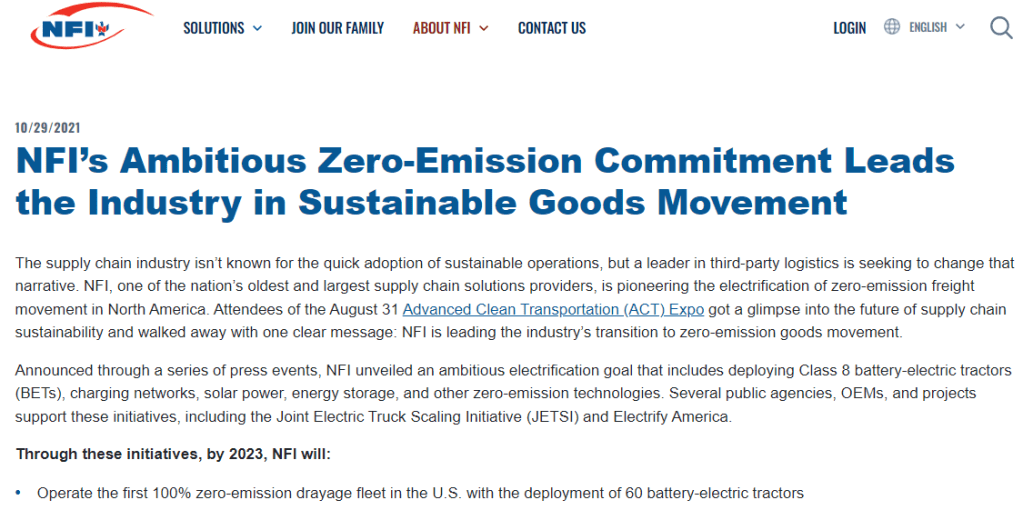
NFI is working with Volvo, Daimler, and others on an ambitious project to “[o]perate the first 100% zero-emission drayage fleet in the U.S. with the deployment of 60 battery-electric tractors.” NFI wants to achieve this by 2023.
What does this mean?
These and other initiatives allow trucking companies to realize the benefits described above, from improved distribution to nicer smelling uniforms. The initiatives also allow flexibility should our diesel supplies be threatened.
And the Inland Empire, with its extensive warehousing footprint, provides an ideal proving ground to see whether these technologies will work in practice.
But I don’t know that electric trucks will give us any good songs.
 Bredemarket