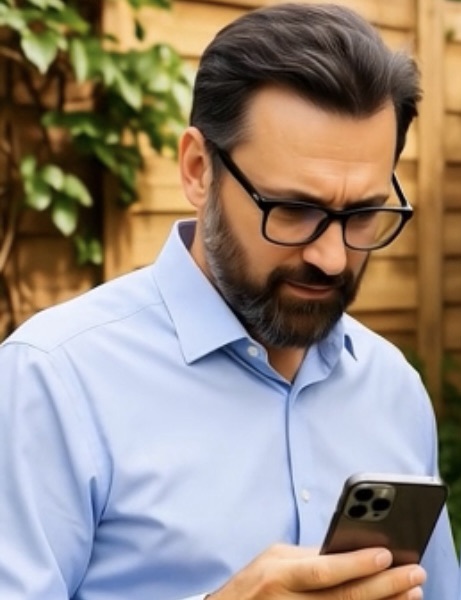
Sometimes we are so immersed in our virtual worlds that we miss the reality around us.
Tag Archives: smartphone
If You Can’t Develop a Product, Who Can?
Many people get ideas for products or services.
But if you have an idea for a software application, mobile app, or web solution and you don’t have the technical skills to create it yourself, how can you make your idea a reality?
One avenue is to engage with a product development firm that can perform all aspects of product development from concept to launch:
- design
- development
- testing
- launch

And if you engage with the right firm, you will receive expert handling of your development effort, an intuitive user-centered design for your solution, an agile and scalable product, and (most importantly) rapid time to market.

If you have product development needs, talk to Silicon Tech Solutions. Offering a complete suite of services (custom software development, digital transformation, product development, and IT outsourcing), Silicon Tech Solutions addresses multiple needs for small and mid-size businesses. With a team that has gained experience from employment at Amazon and Facebook and from multiple consulting projects, Silicon Tech Solutions is ready to help your firm.
Get more information from Silicon Tech Solutions by contacting them via Bredemarket at my Silicon Tech Solutions page.
Why Do We Trust SMS?
I hate to use the overused t word (trust), but in this case it’s justified.
“Scammers are aware that people are more likely to open and read a text message rather than an email The open rates for text messages are more than 90% while the open rates for emails is less than 30%. In addition, many email providers have filters that are able to identify and filter out phishing emails while the filtering capabilities on text messages is much less. Additionally, people tend to trust text messages more than emails. Text message also may prompt a quick response before the targeted victim can critically consider the legitimacy of the text message.”
From Scamicide, https://scamicide.com/2025/09/18/scam-of-the-day-september-19-2025-treasury-refund-text-smishing-scam/
What I can’t figure out is WHY text messages have such a high level of t[REDACTED]. Does SMS feel more personal?
The Courts and Passcode vs. Biometric Access to Your Smartphone: It’s Complicated
(With a special message at the end for facial recognition and cybersecurity marketing leaders)
Years ago, when I was in Mexico City on a business trip, one of my coworkers stated that he never uses biometrics to protect the data on his smartphone.
His rationale?
Government officials can compel you to use your biometrics to unlock your smartphone. They can’t compel you to provide your passcode to government officials.
Ironically, we both worked for a biometric company at the time.
But my former coworker isn’t the only one making this statement. With the recent protests, and with the recent searches of people crossing the U.S. border by plane or otherwise, this same advice is echoed everywhere.
But is it true?
As ZDNET says, it’s complicated.
Passcodes: it’s complicated
ZDNET quotes law firm managing partner Ignacio Alvarez on passcodes:
“But the majority of the courts have found that being required by law enforcement to give your code to your devices violates your Fifth Amendment right against self-incrimination.”
Note what Alvarez said: the MAJORITY of the courts. So if you end up before the “wrong” court, you might have to provide your passcode anyway.
ZDNET also quotes attorney Joseph Rosenbaum:
“Passwords or passcodes, because they represent information contained in a person’s mind, seem to generally be considered the same as requiring someone to testify against themselves in court or in a deposition,” he told ZDNET. “That information is more likely to be legally protected under the Fifth Amendment as potentially self-incriminating.”
Notice his “seem to generally be” and “more likely to be” language. Again, you could still be compelled to give your passcode.
But that’s the easy part.
Biometrics: it’s complicated
But passcodes are the easy part. Biometrics are much more of a gray area.

By NBC Television – eBayfrontback, Public Domain, https://commons.wikimedia.org/w/index.php?curid=33340402.
The rationale behind not giving up your biometric is similar to the rationale behind the Miranda warning. As Dragnet fans know, “Anything you say can and will be used against you in a court of law.” Regarding passcodes, the courts…well, some of the courts, hold that since a passcode can be “spoken,” it’s covered under Miranda and therefore can’t be given without violating your Fifth Amendment rights.
What about biometrics? (Excluding voice biometrics for the moment.)
“…since a biometric isn’t spoken, production of that biometric may not legally qualify as the act of testifying against yourself and therefore, you can be compelled to unlock a phone or an app without necessarily having your rights violated.”
Again, note the use of the words “may not.” It isn’t clear here either.
And even these wishy-washy definitions may change.
“This area of law is a seriously moving target. Over time, things could favor passcodes being non-testimonial or biometrics being testimonial.”
In other words, a few years from now lawyers may advise you to use biometrics rather than passcodes to protect your private data on your smartphone.
Or maybe they’ll say both methods protect you equally.
Or maybe they’ll say neither method protects you, and your private data is no longer private.
But most likely they’ll say “It depends.” In the same way that our 18,000 law enforcement agencies have 18,000 different definitions of forensic science, they could have 18,000 different definitions of Miranda rights.
And one more thing…

The formal announcement is embargoed until Monday, but Bredemarket has TWO openings to act as your on-demand marketing muscle for facial recognition or cybersecurity:
- compelling content creation
- winning proposal development
- actionable analysis
Book a call: https://bredemarket.com/cpa/
Earthquake Phone Alerts Work
Back when AOL keywords roamed the earth, you didn’t learn about an earthquake until you felt it. Now, sensors and smartphones attempt to provide advanced notice.
A little while ago my phone started beeping loudly. By the time I figured out why, I felt a strong jolt.
Luckily it was 90 miles away from me, and it was NOT a 6.0 as initially reported. (Helpful hint: an earthquake’s magnitude is never as initially reported.)
But it appears that many of us received advance warning.
Now if everyone can agree on the magnitude…

Getting Around the Warring Standards (Lightning vs. USB-C)
I’ve talked about standards to death, but what do you do when there are two standards? Do you support standard 1, or standard 2?
Yes.
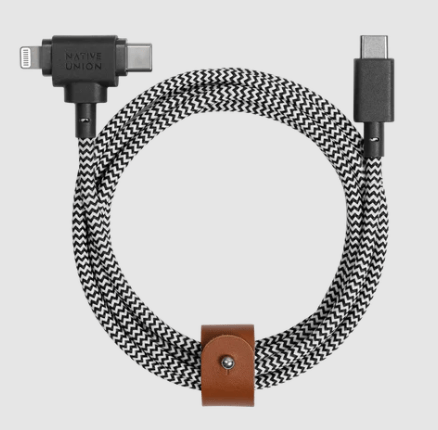
If you need to charge both USB-C and Lightning mobile devices, Native Union has the cable for you.
The ultimate cable you’ve been searching for is finally here. Solve all your power needs with a faster, more sustainable, more durable cable. Designed for superior convenience and versatility, this unique 2-in-1 connector houses both USB-C and Lightning connectors in a single head and is strong enough to withstand the most active all-day, all-device use.

As you can see from the image above (upper left corner), you can choose either the Lightning adapter or the USB-C adapter.
Sounds great…
…except that Apple is slowly discontinuing use of Lightning, to comply with European Union regulations in 2022. The 2023 iPhone 15 doesn’t offer Lightning at all, and over the next several years Lightning will go away as older Apple devices become obsolete.
But for now it’s a good cable.
There’s a Reason Why “Tech” is a Four-Letter Word

We often use the phrase “four-letter word” to refer to cuss words that shouldn’t be said in polite company. Occasionally, we have our own words that we personally consider to be four-letter words. (Such as “BIPA.”)
There are some times when we resign ourselves to the fact that “tech” can be a four-letter word also. But there’s actually a good reason for the problems we have with today’s technology.
Tech can be dim
Just this week I was doing something on my smartphone and my screen got really dim all of a sudden, with no explanation.
So I went to my phone’s settings, and my brightness setting was down at the lowest level.
For no reason.
“Any sufficiently advanced technology is indistinguishable from magic.”
– Arthur C. Clarke, quoted here.
So I increased my screen’s brightness, and everything was back to normal. Or so I thought.
A little while later, my screen got dim again, so I went to the brightness setting…and was told that my brightness was very high. (Could have fooled me.)
I can’t remember what I did next (because when you are trying to fix something you can NEVER remember what you did next), but later my screen brightness was fine.
For no reason.

Was Arthur C. Clarke right? And if so, WHY was he right?
Perhaps it’s selective memory, but I don’t recall having this many technology problems when I was younger.
The shift to multi-purpose devices
Part of the reason for the increasing complexity of technology is that we make fewer and fewer single-purpose devices, and are manufacturing more and more multi-purpose devices.
One example of the shift: if I want to write a letter today, I can write it on my smartphone. (Assuming the screen is bright enough.) This same smartphone can perform my banking activities, play games, keep track of Bredemarket’s earnings…oh, and make phone calls.
Smartphones are an example of technologial convergence:
Technological convergence is a term that describes bringing previously unrelated technologies together, often in a single device. Smartphones might be the best possible example of such a convergence. Prior to the widespread adoption of smartphones, consumers generally relied on a collection of single-purpose devices. Some of these devices included telephones, wrist watches, digital cameras and global positioning system (GPS) navigators. Today, even low-end smartphones combine the functionality of all these separate devices, easily replacing them in a single device.
From a consumer perspective, technological convergence is often synonymous with innovation.
From https://www.techtarget.com/searchdatacenter/definition/technological-convergence
And the smartphone example certainly demonstrates innovation from the previous-generation single-purpose devices.
When I was a kid, if I wanted to write a letter, I had two choices:
- I could set a piece of paper on the table and write the letter with a writing implement such as a pen or pencil.
- I could roll a piece of paper into a typewriter and type the letter.
These were, for the most part, single purpose devices. Sure I could make a paper airplane out of the piece of paper, but I couldn’t use the typewriter to play a game or make a phone call.

Turning our attention to the typewriter, it certainly was a manufacturing marvel, and intricate precision was required to design the hammers that would hit the typewritter ribbon and leave their impressions on the piece of paper. And typewriters could break, and repairmen (back then they were mostly men) could fix them.
A smartphone is much more innovative than a smartphone. But it’s infinitely harder to figure out what is wrong with a smartphone.
The smartphone hardware alone is incredibly complex, with components from a multitude of manufacturers. Add the complexities of the operating system and all the different types of software that are loaded on a smartphone, and a single problem could result from a myriad of causes.
No wonder it seems like magic, even for the best of us.
Explaining technology
But this complexity has provided a number of jobs:
- The helpful person at your cellular service provider who has acquired just enough information to recognize and fix an errant application.
- The many people in call centers (the legitimate call centers, not the “we found a problem with your Windows computer” call scammers) who perform the same tasks at a distance.

- All the people who write instructions on how to use and fix all of our multi-purpose devices, from smartphones to computers to remote controls.
Oh, and the people that somehow have to succinctly explain to prospects why these multi-purpose devices are so great.
Because no one’s going to run into problems with technology unless they acquire the technology. And your firm has to get them to acquire your technology.
Crafting a technology marketing piece
So your firm’s marketer or writer has to craft some type of content that will make a prospect aware of your technology, and/or induce the prospect to consider purchasing the technology, and/or ideally convert the prospect into a paying customer.
Before your marketer or writer crafts the content, they have to answer some basic questions.

Using a very simple single-purpose example of a hammer, here are the questions with explanations:
- Why does the prospect need this technology? And why do you provide this technology? This rationale for why you are in business, and why your product exists, will help you make the sale. Does your prospect want to buy a hammer from a company that got tired of manufacturing plastic drink stirrers, or do they want to buy a hammer from a forester who wants to empower people to build useful items?
- How does your firm provide this technology? If I want to insert a nail into a piece of wood, do I need to attach your device to an automobile or an aircraft carrier? No, the hammer will fit in your hand. (Assuming you have hands.)
- What is the technology? Notice that the “why” and “how” questions come before the “what” question, because “why” and “how” are more critical. But you still have to explain what the technology is (with the caveat I mention below). Perhaps some of your prospects have no idea what a hammer is. Don’t assume they already know.
- What is the goal of the technology? Does a hammer help you floss your teeth? No, it puts nails into wood.
- What are the benefits of the technology? When I previously said that you should explain what the technology is, most prospects aren’t looking for detailed schematics. They primarily care about what the technology will do for them. For example, that hammer can keep their wooden structure from falling down. They don’t care about the exact composition of the metal in the hammer head.
- Finally, who is the target audience for the technology? I don’t want to read through an entire marketing blurb and order a basic hammer, only to discover later that the product won’t help me keep two diamonds together but is really intended for wood. So don’t send an email to jewelers about your hammer. They have their own tools.

(UPDATE OCTOBER 23, 2023: “SIX QUESTIONS YOUR CONTENT CREATOR SHOULD ASK YOU IS SO 2022. DOWNLOAD THE NEWER “SEVEN QUESTIONS YOUR CONTENT CREATOR SHOULD ASK YOU” HERE.)
Once you answer these questions (more about the six questions in the Bredemarket e-book available here), your marketer or writer can craft your content.
Or, if you need help, Bredemarket (the technology content marketing expert) can craft your content, whether it’s a blog post, case study, white paper, or something else.
I’ve helped other technology firms explain their “hammers” to their target audiences, explaining the benefits, and answering the essential “why” questions about the hammers.
Can I help your technology firm communicate your message? Contact me.

- Email me at john.bredehoft@bredemarket.com.
- Book a meeting with me at calendly.com/bredemarket.
- Contact me at bredemarket.com/contact/.
- Subscribe to my mailing list at http://eepurl.com/hdHIaT.

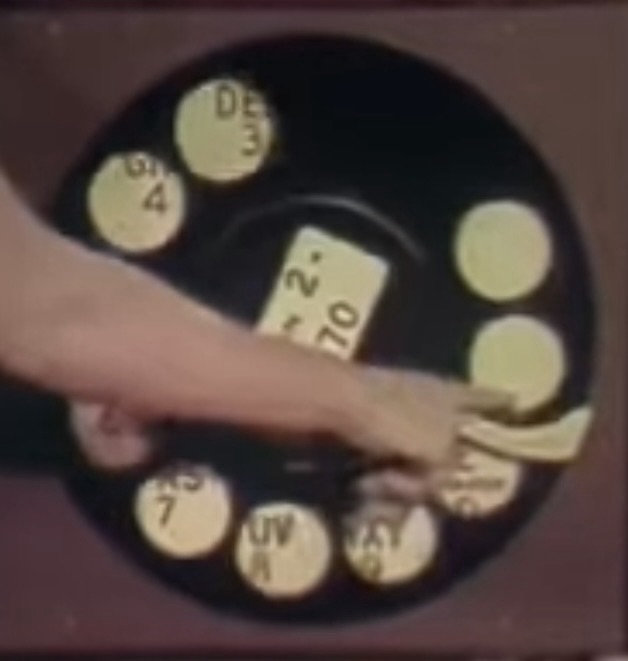
When Writers Talk: Hanging on the Telephone
I self-describe as a “you can pry my keyboard out of my cold dead hands” person who likes to use physical or virtual keyboards to communicate. But what about using a telephone handset (when used for voice rather than data purposes)? That’s a different matter entirely.

If you have a personality that gravitates away from verbal communication, you sometimes find that you need to get out of your comfort z…I mean, you need to stray from your normal routine and use your non-preferred communication method.
I just did that earlier this week, and refrained from sending an email or other written message, instead choosing to use good old-fashioned voice communications to contact someone. And it worked, showing that voice and written communication do not have to compete with each other, and can complement each other.
This post takes a look at how writers function, both in textual and verbal environments, and what can happen when writers stray from their normal routine (or comfort zone).
The flip side of my written compulsion
I’ve talked before about my compulsion to write. Whether on a piece of paper, a typewriter (yes, I’m that old), a computer, or a smartphone, I am very accustomed to putting words to a text-based medium.

Maybe I’m TOO accustomed to typing words into devices.
- I communicate to a number of different people on WhatsApp, but recently took a break from non-business WhatsApp communications for a few days—probably to the relief of my friends who saw my FREQUENT written comments at ALL hours. (“Not a text from John again…”)
- Which reminds me; I have to ask my younger German daughter if she has returned from her out-of-country trip.
- And I also need to ask my artist friend if she has set up her art room yet…
It may not surprise you to learn that my VERBAL communications are less frequent. While I’m not mute in front of crowds, I gravitate toward written rather than verbal communications when I have the choice.
This preference is not uncommon, and Highly Sensitive Refuge speculates that there is a reason for this.
If you have noticed that it’s easier and more enjoyable for you to write rather than speak out your emotions, thoughts, and experiences, you might be a highly sensitive person (HSP). Highly sensitive people are the roughly 30% of the population who are wired at a brain level to process all information more deeply. This makes them more sensitive to the world around them, both emotionally and physically.
In other words: if you’re a highly sensitive person, you’re experiencing the world very differently than others do. You think more deeply, feel more strongly, and have a lot going on in your head. That can make it hard to get your words out — unless you have the time to sort them out in writing.
From https://highlysensitiverefuge.com/do-you-prefer-writing-to-speaking/

I’m not sure if I am a 100% match to the descriptions above; for example, I believe I have a LESSER awareness to environmental subtleties. However, I certainly tend to be sensitive about some things. (Are my WhatsApp friends tired of my incessant messages?) And you already know that I enjoy the process of working in my brain through drafts 0.5 and 1.0 of a piece of content.
But there are drawbacks to staying within your comfort zone.
Excuse me. Sorry, but there’s something going on in my head that I have to address.
Why I’m tired of the phrase “comfort zone”
I’ve decided that I’m tired of the phrase “comfort zone,” in the same way that I’m tired of “game changer,” “thinking out of the box,” and (shudder) “best of breed.”
There’s nothing inherently wrong with the phrase “comfort zone.” Unlike the other phrases above, the literal meaning does not radically differ from the common usage. But “comfort zone” has reached an oversaturation point.

Now I’ll grant that some of these 65,200,000 search results are non-psychological and refer to air conditioning and other things, but the phrase “comfort zone” is used an awful lot.
I wasn’t sure what would be better. So I asked my buddy Google Bard.
In my view, a couple of these (“safe space,” “your comfort bubble”) are just as bad as “comfort zone,” but “normal routine” and “what you’re used to” are much better and less jargon-y than “comfort zone.”
So I’ll use that instead.
OK now, where we were?
Returning to the flip side of my words obsession
Sorry about that.
But there are drawbacks to straying from your normal routine. Sometimes written communication just doesn’t cut it. (“Doesn’t cut it” is another piece of jargon I should eliminate. But one per post is enough.)
I don’t know how many times I’ve had this exchange with coworkers, friends, and family.
PERSON: Did you resolve the issue with Jane?
ME: I emailed her a couple of days ago but haven’t heard back.
PERSON: Why don’t you pick up the phone and call her?
ME: I’ll email her again. Or maybe I’ll text her.
PERSON: CALL HER!
ME, IRRITATED: OK, I’ll call her!
From a meaningful apocryphal conversation. Not put to music…yet.
When I strayed from my normal routine, good things happened
I thought about this during a recent interchange with one of my Bredemarket clients.
I had emailed a question to the client, and the very busy client said they would get back to me with the answer. After a while, I emailed the client again. And again.
At this point I started to get worried. (Maybe I am sensitive. A bit.)
But before I jumped to the wrong conclusion, I decided that I had better pick up the phone and call the client.
Not that day, but the next day. I mean, you can’t be rash about things like that.
So the next day I did pick up the phone and called the client…but the client wasn’t available.
A few minutes later, I received an email with an explanation for the delay (the busy client had been even busier than usual due to unanticipated circumstances), AND the client provided the answer to my question. Everything was very good.
All solved by a simple phone call.
Maybe I should do this more often.

“Not a phone call from John again…”