Because at that time, a TPRM firm had a need for content marketing and product marketing services, and Bredemarket started consulting for the firm.
I was very busy for 2 1/2 months, and the firm was happy with my work. And I got to dive into TPRM issues in great detail:
The incredibly large number of third parties that a vendor deals with…possibly numbering into the hundreds. If hundreds of third parties have YOUR data, and just ONE of those third parties is breached, bad things can happen.
The delicate balance between automated and manual work. News flash: if you look at my prior employers, you will see that I’ve dealt with this issue for over 30 years.
Organizational process maturity. News flash: I used to work for Motorola.
All the NIST standards related to TPRM, including NIST’s discussion of FARM (Frame, Assess, Respond, and Monitor). News flash: I’ve known NIST standards for many years.
Other relevant standards such as SOC 2. News flash: identity verification firms deal with SOC 2 also.
Fourth-party, fifth-party, and other risks. News flash: anyone that was around when AIDS emerged already knows about nth-party risk.
But for internal reasons that I can’t disclose (NDA, you know), the firm had to end my contract.
Never mind, I thought. I had amassed an incredible 75 days of TPRM experience—or about the same time that it takes for a BAD TPRM vendor to complete an assessment.
But how could I use this?
TPRM firm 2
Why not put my vast experience to use with another TPRM firm? (Honoring the first firm’s NDA, of course.)
So I applied for a product marketing position with another TPRM firm, highlighting my TPRM consulting experience.
The company decided to move forward with other candidates.
The firm had another product marketing opening, so I applied again.
The company decided to move forward with other candidates.
Even if this company had a third position, I couldn’t apply for it because of its “maximum 2 applications in 60 days” rule.
TPRM firm 3
Luckily for me, another TPRM firm had a product marketing opening. TPRM is active; the identity/biometrics industry isn’t hiring this many product marketers.
So I applied on Monday, June 2 and received an email confirmation:
And received a detailed email on Tuesday, June 3 outlining the firm’s hiring process.
And received a third email on Wednesday, June 4:
“Thank you for your application for the Senior Product Marketing Manager position at REDACTED. We really appreciate your interest in joining our company and we want to thank you for the time and energy you invested in your application to us.
“We received a large number of applications, and after carefully reviewing all of them, unfortunately, we have to inform you that this time we won’t be able to invite you to the next round of our hiring process.
“Due to the high number of applications, we are unfortunately not able to provide individual feedback to your application at this early stage of the process.
“Again, we really appreciated your application and we would welcome you to apply to REDACTED in the future. Be sure to keep up to date with future roles at REDACTED by following us on LinkedIn and our other social channels.
“We wish you all the best in your job search.”
Unfortunately, I apparently did not have “impressive credentials.” Oh well.
TPRM firm 4?
What now?
If nothing else, I will continue to write about TPRM and the issues I listed above.
And if any TPRM firm wants to use my technology experience and hire me as a full-time product marketer, contact my personal LinkedIn account: https://www.linkedin.com/in/jbredehoft
I’m motivated to help your firm succeed, and make your competitors regret passing on me.
Sadly, despite my delusions of grandeur and expositor syndrome (to be addressed in a future Bredemarket blog post), I don’t think any TPRM CMOs are quaking in their boots and fearfully crying, “We missed out on Bredehoft, and now he’s going to work for the enemy and crush us!”
Unlike some clickbait-like article titles, this one from Communications Today succinctly encapsulates the problem up front.
It’s not that the TPRM software is failing to find the red flags. Oh, it finds them!
But the folks at Gartner discovered something:
“A Gartner survey of approximately 900 third-party relationship owners…revealed that while 95% saw a third-party red flag in the past 12 months, only around half of them escalate it to compliance teams.”
Among other things, the relationship owners worry about “the perceived return on investment (ROI) of sharing information.”
And that’s not a software issue. It’s a process issue.
And this is not unique to the cybersecurity world. Let’s look at facial recognition.
Another case in point
I’ve said this over and over, but for U.S. criminal purposes, facial recognition results should ONLY be used as investigative leads.
It doesn’t matter whether they’re automated results, or if they have been reviewed by a trained forensic face examiner.
Facial recognition results should only be used as investigative leads.
Sorry for the repetition, but some people aren’t listening.
But it’s not the facial recognition vendors. Bredemarket has worked with numerous facial recognition vendors over the years, and of those who work with law enforcement, ALL of them have emphatically insisted that their software results should only be used as investigative leads.
And that’s not a software issue. It’s a process issue.
No amount of coding or AI can fix that.
I hope the TPRM folks don’t mind my detour into biometrics, but there’s a good reason for it.
Product marketing for TPRM and facial recognition
Some product marketers, including myself, believe that it’s not enough to educate prospects and customers about your product. You also need to educate them about proper use of the product, including legal and ethical concerns.
If you don’t, your customers will do dumb things in Europe, Illinois, or elsewhere—and blame you when they are caught.
Be a leader in your industry by doing or saying the right thing.
And now here’s a word from our sponsor.
Not the “CPA” guy again…
Bredemarket has openings
There’s a reason why this post specifically focused on cybersecurity and facial recognition.
If you need product marketing assistance with your product, Bredemarket has two openings. One for a cybersecurity client, and one for a facial recognition client.
“Delaying marketing your new app, because you’re a developer or a designer and marketing is outside your comfort zone.”
But it’s not just developers or designers who delay product marketing efforts.
Two reasons why product marketers don’t market
While it’s easy to blame the techie, non-techies can also delay a go-to-market effort. Even product marketers can and do delay a go-to-market effort. Not because of comfort zone issues, but for two other reasons.
Reason One: The good is the enemy of the perfect
The first was cited by Shatz in another context:
“Delaying launching your new product, because you want to make sure that it’s absolutely perfect, even though it’s already good enough for your purposes and it would be better to just launch it already.”
In the same way we want our product to be perfect, we often want our product marketing to be perfect. Thus the A version becomes the B version which becomes the C version until we run out of letters at Z and have to employ the Excel solution and create version AA, AB, and so forth.
Reason Two: Being on the wrong level of the three levels of importance
But there’s another reason for the frustratingly endless revision cycles: you can’t get all the reviewers to look at the first version, or the second.
We’ve all encountered situations where things that are critically important to us are merely important to others. I still remember the time when a company executive talked about how important a particular project was…and then left the room, conveying an unintended message.
And when things are relatively unimportant, they don’t happen.
And because of the delay, your product’s impact is diluted.
I spent most of the afternoon drafting the content for an email nurture campaign, and I’m fascinated by the use of the word “nurture” by product marketers and content marketers.
“Lead nurturing is the process of building relationships with your prospects with the goal of earning their business when they’re ready. Lead nurturing is important to inbound marketing because it’s your opportunity to provide value to your leads and customers and help them grow with your business.”
I’ve said it before: You’re not a sausage grinder making sausages. You’re a flower attracting bees.
First, create the correct messaging, both internal and external. If Sales has no material, they’re going to say whatever they want.
Second, get executive buy in on the messaging. And make sure they’ve bought in. One of my projects was doomed when I received no response, then kinda sorta got an OK, then later got a “why are we doing this?”
Third, communicate the messaging. That’s why you need the internal part.
I recently interviewed for a full-time position with an identity/biometrics company.
The hiring manager and I agreed that differentiation is sorely lacking in the industry.
However, the company did NOT agree that I was the person to lead their firm’s product differentiation efforts.
But this, combined with the upcoming completion of a Bredemarket project later this week, provides an opportunity.
Their loss is your gain
Bredemarket can now help others in the identity/biometric industry, including the hiring firm’s direct competitors, with THEIR differentiation—in the same way Bredemarket has differentiated other companies.
I won’t tell everything, but I will give away ONE of my secrets.
Which isn’t a secret.
My baby’s got a not-so-secret secret
As you probably know, I like to ask questions before starting a content, proposal, or analysis project. And the first of my questions is critical for differentiation.
Why?
No…that’s the question. Why?
The life experiences of founders are very different. After all, the reason Bill Gates got into the computer business is different than the reason Steve Jobs entered the business.
What if Jobs had never studied calligraphy at Reed?
“Before I can write a case study about how your Magnificent Gizmo cures bad breath, I need to understand WHY you’re in the good breath business in the first place. Did you have an unpleasant childhood experience? Were you abandoned at the altar? WHY did you care enough to create the Magnificent Gizmo in the first place?
“Once I (and you) agree on the why, everything else will flow from that, and your own end users will benefit in the process.”
Give me that origin story and I can differentiate you and your product. Whether it’s your breath gizmo or your identity verification solution, we now have a story that your foolish inferior competitors do not have.
THEY are just mere moneymakers.
YOU are the enlightened giving individual solving a problem that has bugged you for years, making the world a better place.
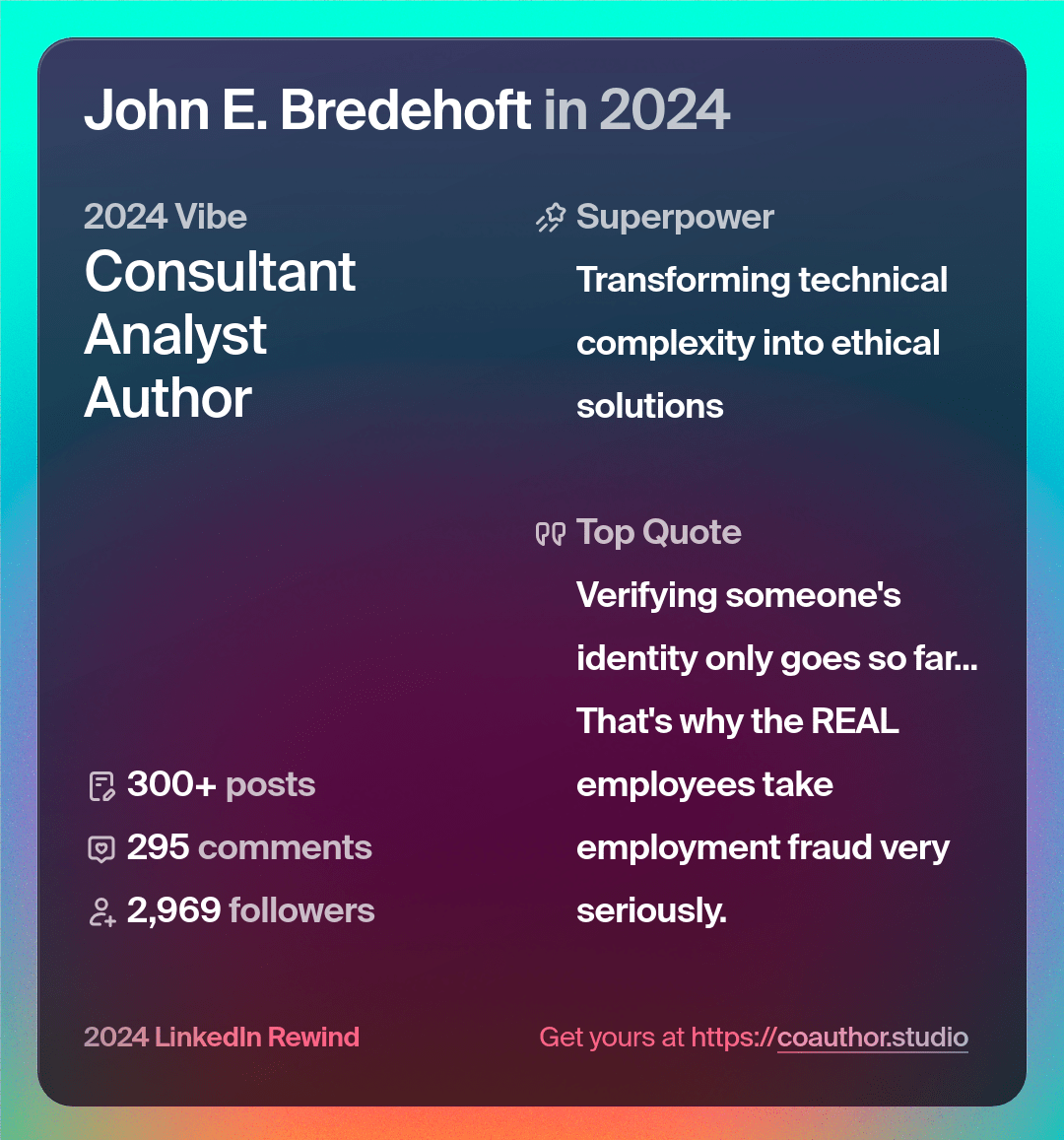
So I checked out Coauthor’s me-too LinkedIn-themed copycat of Spotify Wrapped, like many of you did. Here’s the (unedited) post it wrote for me—not too bad:
= = =
Here’s my 2024 LinkedIn Rewind, by Coauthor.studio:
After 30 years in identity and biometrics, 2024 showed me that verification only goes so far. The real challenge isn’t just confirming who someone is – it’s understanding what they might do.
From employment fraudsters with verified credentials to healthcare imposters with stolen birthdates, this year proved that identity verification alone can’t prevent deception. But it also showed how combining technical expertise with human insight can help protect organizations and individuals.
Key observations from 2024:
Identity verification without intent analysis is incomplete
Employment fraud evolves faster than verification methods
Through Bredemarket, I delivered over 100 content and analysis projects helping organizations navigate these challenges. I also conducted research on employment fraud tactics and moderated communities helping others avoid scams.
Looking ahead: 2025 will require even more sophisticated approaches to identity verification and fraud prevention. The fraudsters aren’t going away – but neither am I. I’ll continue helping organizations implement effective identity strategies while advocating for ethical AI use and employment practices.
To the wildebeests following along: remember that verification is just the start. The real value comes from understanding intent and building trust.
#fraud #identity #security #productmarketing
—
Get your 2024 LinkedIn Rewind! Go to coauthor.studio






 Bredemarket
