Today’s “biometrics is evil” post (Amazon One)

I can’t recall who recorded it, but there’s a radio commercial heard in Southern California (and probably nationwide) that intentionally ridicules people who willingly give up their own personally identifiable information (PII) for short-term gain. In the commercial, both the husband and the wife willingly give away all sorts of PII, including I believe their birth certificates.

While voluntary surrender of PII happens all the time (when was the last time you put your business card in a drawing bowl at a restaurant?), people REALLY freak out when the information that is provided is biometric in nature. But are the non-biometric alternatives any better?

TechCrunch, Amazon One, and Ten Dollars

TechCrunch recently posted “Amazon will pay you $10 in credit for your palm print biometrics.

If you think that the article details an insanely great way to make some easy money from Amazon, then you haven’t been paying attention to the media these last few years.

The article begins with a question:

How much is your palm print worth?

The article then describes how Amazon’s brick-and-mortar stores in several states have incorporated a new palm print scanner technology called “Amazon One.” This technology, which reads both friction ridge and vein information from a shopper’s palms. This then is then associated with a pre-filed credit card and allows the shopper to simply wave a palm to buy the items in the shopping cart.

There is nothing new under the sun

Amazon One is the latest take on processes that have been implemented several times before. I’ll cite three examples.

Pay By Touch. The first one that comes to my mind is Pay By Touch. While the management of the company was extremely sketchy, the technology (provided by Cogent, now part of Thales) was not. In many ways the business idea was ahead of its time, and it had to deal with challenging environmental conditions: the fingerprint readers used for purchases were positioned near the entrances/exits to grocery stores, which could get really cold in the winter. Couple this with the elderly population that used the devices, and it was sometimes difficult to read the fingers themselves. Yet, this relatively ancient implementation is somewhat similar to what Amazon is doing today.

University of Maryland Dining Hall. The second example occurred to me because it came from my former employer (MorphoTrak, then part of Safran and now part of IDEMIA), and was featured at a company user conference for which I coordinated speakers. There’s a video of this solution, but sadly it is not public. I did find an article describing the solution:

With the new system students will no longer need a UMD ID card to access their own meals…

Instead of pulling out a card, the students just wave their hand through a MorphoWave device. And this allows the students to pay for their meals QUICKLY. Good thing when you’re hungry.

This Pay and That Pay. But the most common example that everyone uses is Apple Pay, Google Pay, Samsung Pay, or whatever “pay” system is supported on your smartphone. Again, you don’t have to pull out a credit card or ID card. You just have to look at your phone or swipe your finger on the phone, and payment happens.

Amazon One is the downfall of civilization

I don’t know if TechCrunch editorialized against Pay By Touch or [insert phone vendor here] Pay, and it probably never heard of the MorphoWave implementation at the University of Maryland. But Amazon clearly makes TechCrunch queasy.

While the idea of contactlessly scanning your palm print to pay for goods during a pandemic might seem like a novel idea, it’s one to be met with caution and skepticism given Amazon’s past efforts in developing biometric technology. Amazon’s controversial facial recognition technology, which it historically sold to police and law enforcement, was the subject of lawsuits that allege the company violated state laws that bar the use of personal biometric data without permission.

Oh well, at least TechCrunch didn’t say that Amazon was racist. (If you haven’t already read it, please read the Security Industry Association’s “What Science Really Says About Facial Recognition Accuracy and Bias Concerns.” Unless you don’t like science.)

OK, back to Amazon and Amazon One. TechCrunch also quotes Albert Fox Cahn of the Surveillance Technology Oversight Project.

People Leaving the Cities, photo art by Zbigniew Libera, imagines a dystopian future in which people have to leave dying metropolises. By Zbigniew Libera – https://artmuseum.pl/pl/kolekcja/praca/libera-zbigniew-wyjscie-ludzi-z-miast, CC BY-SA 3.0, https://commons.wikimedia.org/w/index.php?curid=66055122.

“The dystopian future of science fiction is now. It’s horrifying that Amazon is asking people to sell their bodies, but it’s even worse that people are doing it for such a low price.”

“Sell their bodies.” Isn’t it even MORE dystopian when people “give their bodies away for free” when they sign up for Apple Pay, Google Pay, or Samsung Pay? While the Surveillance Technology Oversight Project (acronym STOP) expresses concern about digital wallets, there is a significant lack of horror in its description of them.

Digital wallets and contactless payment systems like smart chips have been around for years. The introduction of Apple Pay, Amazon Pay, and Google Pay have all contributed to the e-commerce movement, as have fast payment tools like Venmo and online budgeting applications. In response to COVID-19, the public is increasingly looking for ways to reduce or eliminate physical contact. With so many options already available, contactless payments will inevitably gain momentum….

Without strong federal laws regulating the use of our data, we’re left to rely on private companies that have consistently failed to protect our information. To prevent long-term surveillance, we need to limit the data collected and shared with the government to only what is needed. Any sort of monitoring must be secure, transparent, proportionate, temporary, and must allow for a consumer to find out about or be alerted to implications for their data. If we address these challenges now, at a time when we will be generating more and more electronic payment records, we can ensure our privacy is safeguarded.

So STOP isn’t calling for the complete elimination of Amazon Pay. But apparently it wants to eliminate Amazon One.

Is a world without Amazon One a world with less surveillance?

Whenever you propose to eliminate something, you need to look at the replacement and see if it is any better.

In 1998, Fox fired Bill Russell as the manager of the Los Angeles Dodgers. He had a win-loss percentage of .538. His replacement, Glenn Hoffman, lasted less than a season and had a percentage of .534. Hoffman’s replacement, true baseball man Davey Johnson, compiled a percentage of .503 over the next two seasons before he was fired. Should have stuck with Russell.

Anyone who decides (despite the science) that facial recognition is racist is going to have to rely on other methods to identify criminals, such as witness identification. Witness identification has documented inaccuracies.

And if you think that elimination of Amazon One from Amazon’s brick-and-mortar stores will lead to a privacy nirvana, think again. If you don’t use your palm to pay for things, you’re going to have to use a credit card, and that data will certainly be scanned by the FBI and the CIA and the BBC, B. B. King, and Doris Day. (And Matt Busby, of course.) And even if you use cash, the only way that you’ll preserve any semblance of your privacy is to pay anonymously and NOT tie the transaction to your Amazon account.

And if you’re going to do that, you might as well skip Whole Foods and go straight to Dollar General. Or maybe not, since Dollar General has its own app. And no one calls Dollar General dystopian. Wait, they do: “They tend to cluster, like scavengers feasting on the carcasses of the dead.”

I seemed to have strayed from the original point of this post.

But let me sum up. It appears that biometrics is evil, Amazon is evil, and Amazon biometrics are Double Secret Evil.

Maryland will soon deal with privacy stakeholders (and they CAN’T care about the GYRO method)

Just last week, I mentioned that the state of Utah appointed the Department of Government Operations’ first privacy officer. Now Maryland is getting into the act, and it’s worth taking a semi-deep dive into what Maryland is doing, and how it affects (or doesn’t affect) public safety.

By François Jouffroy – Christophe MOUSTIER (1994), Attribution, https://commons.wikimedia.org/w/index.php?curid=727606

According to Government Technology, the state of Maryland has created two new state information technology positions, one of which is the State Chief Privacy Officer. Because government, I will refer to this as the SCPO throughout the remainder of this post. If you are referring to this new position in verbal conversation, you can refer to the “Maryland skip-oh.” Or the “crab skip-oh.”

From https://teeherivar.com/product/maryland-is-for-crabs/. Fair use. Buy it if you like it. Virginians understand the origins of the phrase.

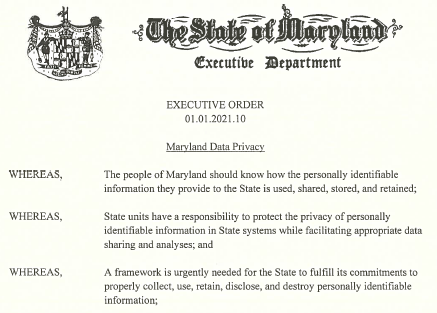
Governor Hogan announced the creation of the SCPO position via an Executive Order, a PDF of which can be found here.

Let me call out a few provisions in this executive order.

  • A.2. defines “personally identifiable information,” consisting of a person’s name in conjunction with other information, including but not limited to “[b]iometric information including an individual’s physiological or biological characteristics, including an individual’s deoxyribonucleic acid.” (Yes, that’s DNA.) Oh, and driver’s license numbers also.
  • At the same time, A.2 excludes “information collected, processed, or shared for the purposes of…public safety.”
  • But on the other hand, A.5 lists specific “state units” covered by certain provisions of the law, including both The Department of Public Safety and Correctional Services and the Department of State Police.
  • The reason for the listing of the state units is because every one of them will need to appoint “an agency privacy official” (C.2) who works with the SCPO.

There are other provisions, including the need for agency justification for the collection of personally identifiable information (PII), and the need to provide individuals with access to their collected PII along with the ability to correct or amend it.

But for law enforcement agencies in Maryland, the “public safety” exemption pretty much limits the applicability of THIS executive order (although other laws to correct public safety data would still apply).

Therefore, if some Maryland sheriff’s department releases an automated fingerprint identification system Request for Proposal (RFP) next month, you probably WON’T see a privacy advocate on the evaluation committee.

But what about an RFP released in 2022? Or an RFP released in a different state?

Be sure to keep up with relevant privacy legislation BEFORE it affects you.

You will soon deal with privacy stakeholders (and they won’t care about the GYRO method)

(Part of the biometric product marketing expert series)

I’ve written about the various stakeholders at government agencies who have an interest in biometrics procurements- not only in this post, but also in a post that is available to Bredemarket Premium subscribers. One of the stakeholders that appeared on my list was this one.

The privacy advocate who needs to ensure that the biometric data complies with state and national privacy laws.

Broken Liberty: Istanbul Archaeology Museum. By © Nevit Dilmen, CC BY-SA 3.0, https://commons.wikimedia.org/w/index.php?curid=1115936

If you haven’t encountered a privacy advocate in your marketing or proposal efforts…you will.

Utah Gov. Spencer Cox has appointed Christopher Bramwell as the Department of Government Operations’ first privacy officer….As privacy officer, Bramwell will be responsible for surveying and compiling information about state agencies’ privacy practices to discern which poses a risk to individual privacy. He will also work with the personal privacy oversight commission and state privacy officer to provide government privacy practice reports and recommendations.

Obviously this affects companies that work with government agencies on projects such as digital identity platforms. After all, mobile driver’s licenses contain a wealth of personally identifiable information (PII), and a privacy advocate will naturally be concerned about who has access to this PII.

But what about law enforcement? Do subjects in law enforcement databases have privacy rights that need to be respected? After all, law enforcement agencies legally share PII all the time.

However, there are limitations on what law enforcement agencies can share.

  • First off, remember that not everyone in a law enforcement database is an arrested individual. For example, agencies may maintain exclusion databases of police officers and crime victims. When biometric evidence is found at a crime scene, agencies may compare the evidence against the exclusion database to ensure that the evidence does not belong to someone who is NOT a suspect. (This can become an issue in DNA mixtures, by the way.)
  • Second off, even arrested individuals have rights that need to be respected. While arrested individuals lose some privacy rights (for example, prisoners’ cells can be searched and prisoners’ mail can be opened), a privacy advocate should ensure that any system does not deny prisoners protections to which they are entitled.

So expect to see a raised concern about privacy rights when dealing with law enforcement agencies. This concern will vary from jurisdiction to jurisdiction based upon the privacy (and biometric) laws that apply in each jurisdiction, but vendors that do business with government agencies need to stay abreast of privacy issues.

A little more about stakeholders, or actors, or whoever

Whether you’re talking about stakeholders in a government agency, stakeholders at a vendor, or external stakeholders, it’s important to identify all of the relevant stakeholders.

Or whatever you call them. I’ve been using the term “stakeholders” to refer to these people in this post and the prior posts, but there are other common terms that could be used. People who construct use cases refer to “actors.” Marketers will refer to “personas.”

Whatever term you use, it’s important to distinguish between these stakeholders/actors/personas/whatever. They have different motivations and need to be addressed in different ways.

When talking with Bredemarket clients, I often need to distinguish between the various stakeholders, because this can influence my messaging significantly. For example, if a key decision-maker is a privacy officer, and I’m communicating about a fingerprint identification system, I’m not going to waste a lot of time talking about the GYRO method.

My time wouldn’t be wasted effort if I were talking to a forensic examiner, but a privacy advocate just wouldn’t care. They would just sit in silence, internally musing about the chances that a single latent examiner’s “green” determination could somehow expose a private citizen to fraud or doxxing or something.

This is why I work with my clients to make sure that the messaging is appropriate for the stakeholder…and when necessary, the client and I jointly develop multiple messages for multiple stakeholders.

If you need such messaging help, please contact Bredemarket for advice and assistance. I can collaborate with you to ensure that the right messages go to the right stakeholders.

The business TikTok post that I couldn’t share with you

I had a really good post planned for today.

While I’m not a big creator of video content, I can certainly appreciate good content, and I planned to share some excellent video content with you.

There is a mobile car washing service in my hometown of Ontario, California. Now videos of mobile car washing are more exciting than videos of…well, videos of writers writing, but not by much. So if you want to grab someone’s attention, you have to put entertaining content into a mobile car washing video.

(No, not that.)

So this local mobile car washing service posted a video on TikTok that began with the service washing…a kid-size vehicle.

Completely cute and entertaining, so I decided to share it from the TikTok app to one of my Facebook groups, and then decided that I wanted to write a blog post about it.

So I went to share the video from the TikTok web page to this blog, and was told the video was not available. I investigated further, and found this on the account page.

Yes, you read that right – a COMPANY’S TikTok account is PRIVATE.

I went back to my TikTok app, navigated to the account, and confirmed that the video was still there (for those of us who were logged in and following the account) and that hundreds of people have seen it.

But I can’t share it with you, nor can I share any of the company’s other videos, which are restricted to “Followers only.”

But trust me, it was a really cute video.

Do we need smart cities, or are “average intelligence” cities good enough?

The Thales website has an article that apparently was originally written in late 2018 or early 2019, but was (as of today) last updated in October 2020. The article is entitled “Digital identity trends – 5 forces that are shaping 2020.”

For purposes of this post (and yes, “for purposes of this post” is a common phrase I use when encountering a listicle), I’m going to focus on the third of the five forces, an accelerating shift towards smart cities.

I first encountered smart cities six years ago, when MorphoTrak’s Vice President of Sales sent a colleague and myself to a smart cities conference. Inasmuch as MorphoTrak was a biometric company, I was obviously paying attention to the presentations that related to biometric identity, but I also paid attention to one of the speakers from my area – Acquanetta Warren, then (and now) mayor of the city of Fontana, California. I wasn’t able to find any accounts of her 2014 presentation, but Warren spoke about smart city needs in 2017.

Fontana (Calif.) Mayor Acquanetta Warren said that Smart City developments can be particularly important in light of natural disasters and emergencies, such as the destruction Hurricane Harvey caused in Texas.

“What happens when that happens?” Warren said. “Does everything stop? Are we able to text or email each other to let each other know ‘we’re trapped, we’re in these positions, come and help us?’ ”

Mayor Warren’s comments illustrate that there is clearly a continuum on the smart city spectrum. When you read some smart city concepts and implementations, you get a view of systems of systems tracking automobiles and parking spaces, calculating anticipated carbon monoxide levels, and doing other “smart” stuff.

Mayor Warren is interested in more basic needs, such as the ability of a Fontana citizen to get help if the San Andreas Fault does its thing.

Or, perhaps, less pressing needs, such as graffiti removal.

https://iframe.publicstuff.com/#?client_id=156 as of November 23, 2020.

This is a much simpler model than what Thales envisions in its article. In Fontana, I can report a graffiti violation anonymously. In the Thales model, “digital identity is the key that unlocks the individual’s access to a rich array of services and support.” And no, your Facebook or Google login doesn’t count.

Smarter cities worry privacy advocates, Back in 2018, the ACLU was urging public discussion about proposals in Portland, Maine to outfit street lights with wi-fi hotspots – and other monitoring sensors.

Proponents said there was nothing to worry about.

“We are very interested in deploying a variety of sensors that may be able to help with vehicle counts in intersections, numbers of pedestrians or bikes using a trail or bike path,” said Troy Moon, the city’s sustainability coordinator. “Some of these may look like a camera but only detect shapes.”

Opponents were not reassured.

“I always figured Big Brother was going to be some giant face on a wall, not a tiny camera hidden inside a light bulb,” said Chad Marlow, advocacy and policy counsel for the ACLU. “But what is particularly troubling here is the stealthy way in which the product is being marketed and pitched to the press; to wit, as an energy-efficient light bulb with built-in monitoring technology.”

And those who have followed the topic know that concerns have only accelerated since 2018. Just to cite one example, San Francisco has passed a strict ordinance regulating introduction of any surveillance technology.

This has resulted in a near-bifurcation in the adoption of smart city technologies, as countries such as India adopt a leading role in smart city adoption, while countries with greater privacy concerns such as the United States are slower to adopt the technologies.

I guess you can call these latter countries leaders in the “average intelligence” city movement. These countries will adopt some digital measures to improve city management, but will not go all out and do everything that is technologically possible. For example, a municipality may use technology such as Adobe Experience Manager Forms to enable digital form submission – but they’re not going to track your movements after you submit the form.

Because of the debate and the concerns, these latter countries will continue to be “average intelligence” cities in the future, while cities in other parts of the world will become smarter, for better or worse.