Customer Focus and Employee Focus

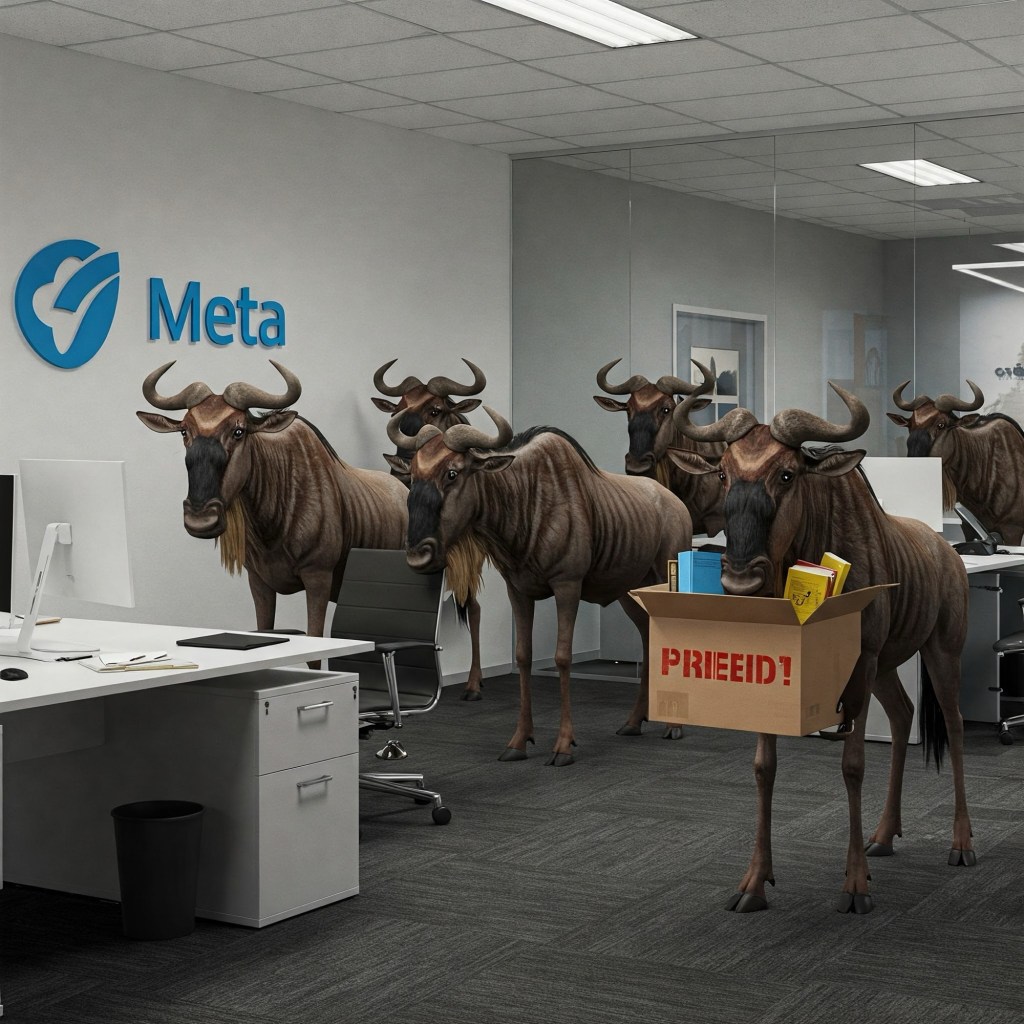
(All images Imagen 3)

When you market to your prospects and customers, will they believe what you say? Or will you be exposed as a liar?

The Bredemarket blog has talked incessantly about customer focus from a marketing perspective, noting that an entity’s marketing materials need to speak to the needs of the customer or the prospect, not the selling entity.

But customer focus alone is not enough. When the customers sign up, they have to deal with someone.

Unless the customer is stuck in answer bot hell (another issue entirely), they will deal with an employee.

The expendables 

And some employees are not happy, because they feel they are expendable.

Steve Craig of PEAK IDV recently shared a long quote from J.P. Morgan Chase’s Jamie Dimon. Here’s a short excerpt:

“Every area should be looking to be 10% more efficient. If I was running a department with a hundred people, I guarantee you, if I wanted to, I couldn’t run it with 90 and be more efficient. I guarantee you, I could do it.”

So J.P. Morgan Chase is doing very well, Dimon is doing very well, but he’s implicitly saying that his people suck.

Another CEO, Meta’s Mark Zuckerberg, is more explicit about how much his people suck.

“This is going to be an intense year, and I want to make sure we have the best people on our teams. I’ve decided to raise the bar on performance management and move out low performers faster.”
You may have noticed my intentional use of the word “entity” at the beginning of this post. Because while businesses have attracted much attention in the current culture of “layoffs will continue until morale improves,” these businesses are themselves “low performers” in the shedding people category. Chief DOGE Elon Musk, fresh from reducing X’s headcount, is coordinating layoffs in the public sector.

“Federal agencies were ordered by Donald Trump to fire mostly probationary staff, with as many as 200,000 workers set to be affected and some made to rush off the premises.”

Zuckerberg could only dream of saying “you’re fired” to 200,000 people. That dream would certainly increase his masculine energy, but for now Musk has trumped Zuckerberg on that front.

  • Do J.P. Morgan Chase’s employees matter to Jamie Dimon?
  • Do Meta’s employees matter to Mark Zuckerberg?
  • Do federal employees matter to Elon Musk and Donald Trump?

Regardless of the answer (and one could assert that they like the “good” employees and don’t want them to be harmed by the bad apples), their views are not universal.

The other extreme

Richard Branson (reportedly) does not put his needs first at the Virgin companies he runs.

Nor does he prioritize investors.

Oh, and if you’re one of Virgin’s customers…your happiness isn’t critically important either.

Branson’s stance is famous, and (literally) sounds foreign to the Dimons and Zuckerbergs of the world.

“So, my philosophy has always been, if you can put staff first, your customer second and shareholders third, effectively, in the end, the shareholders do well, the customers do better, and yourself are happy.”

You could argue that this is a means to an end, and that employee focus CAUSES customer focus. What if employee focus is missing?

“If the person who’s working for your company is not given the right tools, is not looked after, is not appreciated, they’re not gonna do things with a smile and therefore the customer will be treated in a way where often they won’t want to come back for more.”

Think about this the next time you have a problem with your Facebook account or at a Chase Bank or with your tax return.

Whether back office issues matter to customers

Of course I may be over reading into this, because I have said that the customer doesn’t care about your company. If you solve their problems, they don’t care if you’re hiring 200,000 people or firing 200,000 people.

If you solve their problems.

I can’t cite the source or the company, but I heard a horror story about an unhappy customer. The company had heavily bought into the “layoffs will continue until morale improves” philosophy, resulting in turnover in the employees who dealt with customers. When the customer raised an issue with the company, it made a point of saying that employee John Jones (not the employee’s real name) could have solved the customer’s problem long ago if the company hadn’t removed Jones from the account.

What about your company’s marketing?

So think about this in your marketing. Before you brag about your best places to work award, make sure that your prospect will see evidence of this in the employees they encounter.

“Our 8th annual LinkedIn Top Companies list highlights the 50 best large workplaces to grow your career in the U.S. right now. Fueled by unique LinkedIn data, the methodology analyzes various facets of career progression like promotion rates, skill development and more among employees at each company.”

Number 1 on LinkedIn’s April 2024 list? J.P. Morgan Chase.

Number 2? Amazon.

Number 6? UnitedHealth Group.

Um, maybe not.

In the meantime, take care of yourself, and each other.


Jerry Springer. By Justin Hoch, CC BY 2.0, https://commons.wikimedia.org/w/index.php?curid=16673259.

Lack of Differentiation Limits Your Available Talent

I’ve talked about differentiation ad nauseam, and even created a video about it last spring.

And I’ve provided some examples of lack of differentiation from my own industry:

  • (Company I) “Reimagine trust.”
  • (Company J) “To protect against fraud and financial crime, businesses online need to know and trust that their customers are who they claim to be — and that these customers continue to be trustworthy.”
  • (Company M) “Trust is the core of any successful business relationship. As the digital revolution continues to push businesses and financial industries towards digital-first services, gaining digital trust with consumers will be of utmost importance for survival.”
  • (Company O) “Create trust at onboarding and beyond with a complete, AI-powered digital identity solution built to help you know your customers online.”
  • (Company P) “Trust that users are who they say they are, and gain their trust by humanizing the identity experience.”
  • (Company V) “Stop fraud. Build trust. Identity verification made simple.”

This isn’t effective. Trust me.

But prospective customers aren’t the only ones who are turned off by “me-too” messaging.

Further ramifications of lack of differentiation

What about prospective employees who don’t want to apply to your company because they see no compelling reason to do so?

I’ll grant that the tech job market is so out of balance right now that people are applying to ANYTHING.

But the more choosy ones are…more choosy in their applications. Just like choosy mothers choose…you know.

I recently received this message from a product marketer after I shared a particular identity/biometric job description with them.

Not so sure that company is well positioned for evolving identity landscape.

From a selfish perspective, this benefits me, because I DID apply for this position while they DIDN’T. Reducing the competition increases my chances of getting the job.

But the company (which I’m not naming) doesn’t benefit, because at least one experienced identity verification product marketer doesn’t want to work for them.

So be sure to differentiate…as long as the differentiation resonates with your hungry people (target audience). If your audience is repelled by your differentiation, then that’s a problem with your customer focus.

From the Gary Fly / Brooks Group article “7 Tips for Implementing a Customer-Centric Strategy,” at https://brooksgroup.com/sales-training-blog/7-tips-implementing-customer-centric-strategy/.

Now Bredemarket can’t help you with your job search, because I’m certainly not an expert in that. But I can ask you questions that help you create content that conveys that your product is great and your competitors’ products…are not so good.

Visit Bredemarket’s “CPA” page to learn how I can help your firm’s content (and analysis, and proposals), and to schedule a meeting.

Bredemarket’s “CPA.”

Are You “Everybody Else”?

“Everybody uses ChatGPT.”

“Everybody uses the STAR method.”

Are you everybody else?

Not Everybody Uses ChatGPT

I’m sure I’ve tried ChatGPT at some point during the last two years.

But I don’t use it on a regular basis.

Even though whenever someone talks about generative AI, they usually talk about ChatGPT and nothing else.

So if I want to be like everybody else, I would use ChatGPT just like everybody else does. After all, I am a human and I need to be loved.

But if I were to use ChatGPT regularly, that would require me to create an account.

And I have too many accounts already.

Why not use the credentials of one of my existing accounts for generative AI work?

Not Everybody Uses the STAR Method

And if you want to send a prompt to ChatGPT, ask it to reformat a story based upon the STAR method.

For the few who don’t know what that acronym means, you’re obviously behind the times because everybody uses the STAR method.

The acronym STAR stands for Situation, Task, Action, Result. You can apply this in many situations: for example, during a job interview, you could describe one of your past accomplishments using this format.

After all, it only takes four steps.

But what if I can accomplish the same, um, result in THREE steps?

  1. Problem
  2. Solution
  3. Result

That’s the format that Bredemarket used when writing a dozen case studies for an identity/biometric client.

And it worked just fine.

The client’s prospects didn’t stop doing business with the client because it didn’t differentiate between the situation and the task, or the task and the action, or whatever.

The prospects wanted, um, results, not a deep outline.

Not Everybody Fails to Differentiate

I’ve railed about a lack of differentiation before, but for some odd reason the billions of workers in the world don’t listen to me.

They still think the key to success is to copy what everyone else is doing.

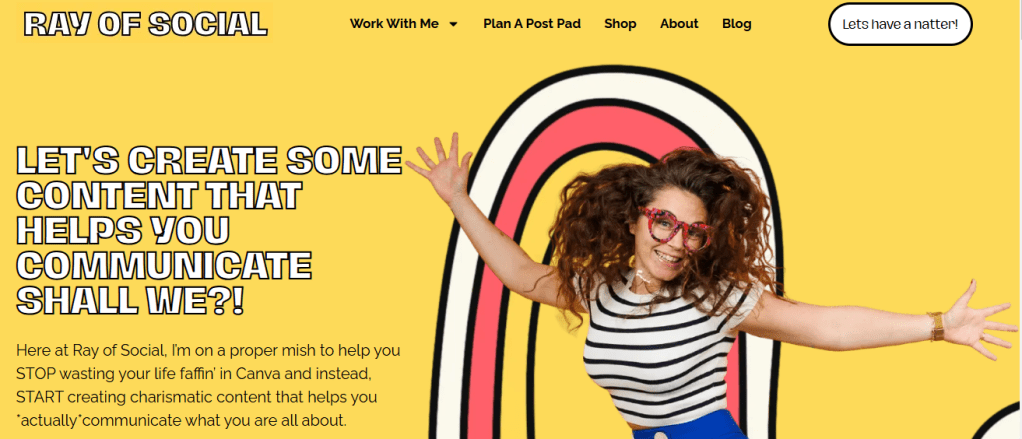
But if I were to intentionally adopt a yellow website them and wear retro glasses and sing a lot like Ray of Social’s Georgia Williams, that doesn’t mean that I can achieve the same results that she can.

For one, if you call her to have a natter about your mish, she probably won’t talk about wildebeests at all.

But she’s still doing OK.

You need to adopt your own tone of voice. I was just discussing this with a Bredemarket client regarding a critical piece of content that needs to be in the client’s own voice. Not mine. Not Georgia’s.

So communicate your way, use your preferred generative AI platform, and use your preferred storytelling method.

You be you.

Addendum about this post

Someone scheduled a half hour meeting with me this morning. While waiting for the person to show (they never did), I completed most of this post.

So the half hour wasn’t completely wasted.

(And it could very well be that the person had a valid reason for not showing. I will, or won’t, find out.)

Another addendum about this post

For those who caught my line

I would use ChatGPT just like everybody else does. After all, I am a human and I need to be loved.

here’s the video. But I want to hear Georgia singing it.

(Note to self: find the “This Charming Charlie” website, in which Charlie Brown cartoons are adapted to contain Smiths lyrics.)

Dare to Incorporate Authentic Quotes in Press Releases

Initialism

I have been amused by press releases for many years.

You’re reading along in the press release and then you get to a quote from an executive with the company issuing the press release.

“MegaCorp’s new best-of-breed revolutionary platform will increase artificial intelligence synergies and optimize blockchain outcomes,” said Silas Phelps, Chief Executive Officer and Strategist at MegaCorp. “Did I mention pickleball?” he added.

Sometimes the executive has even read the quote before publication. Or maybe not. Because in most cases the quote was written by someone else.

Inner Stall

“Drains to Ocean” album cover. https://ontarioemperor.bandcamp.com/album/drains-to-ocean.

I was amused by this practice so much that when I wrote a press release for a side project of mine in 2017, I called out the practice.

The marketing flack who is pretending to speak for Ontario Emperor put some new words in his mouth for this release. “Yes, I am self-proclaiming this to be the greatest electronic album ever,” stated Ontario. “And in all honesty, the songs are more developed than the ones on my previous releases. Each of the twelve songs evokes a particular mood, although I will leave it to the listener to determine what these moods may be.”

Empoprises’ John E. Bredehoft also had some words put into his mouth. “Our experience with Bandcamp has been very fruitful,” Bredehoft supposedly said. “We look forward to expanding our relationship with Bandcamp in the future.”

As an aside, the Ontario Emperor electronic album “Drains to Ocean” is still available for purchase ($8 “or more”) at https://ontarioemperor.bandcamp.com/album/drains-to-ocean. Or you can save yourself some money and listen to one of the songs, “For a Meaningful Apocryphal Animation,” for FREE by scrolling to the bottom of Bredemarket’s “Information” page. (And to the bottom of this post.)

One more aside that may be of interest to a few of you: the drain pictured above is a few buildings west of IDEMIA’s LaPalma office in Anaheim Hills.

But years later, the whole thing became less of a joke.

Climbing

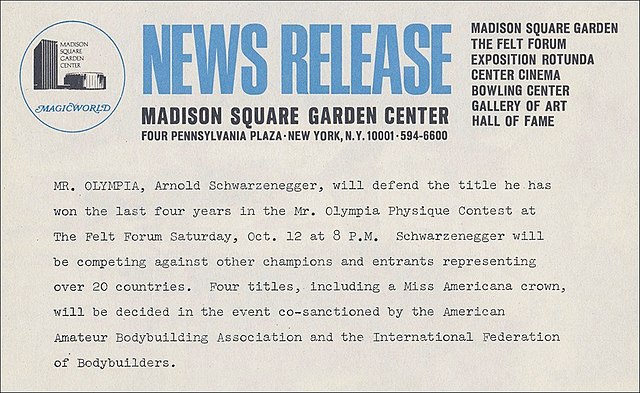
Madison Square Garden News Release 1974. Arnold wasn’t quoted. It wasn’t like he was an important government official or a wildly popular movie star or anything. – RMY Auctions, Public Domain, https://commons.wikimedia.org/w/index.php?curid=104969591.

Why?

Because one of Bredemarket’s clients required a draft press release, and I wrote the first draft, including quotes from “Executive X.”

Now I didn’t make these quotes up out of whole cloth, taking them from an internal client document.

But Executive X thought they were a little off, so the executive, myself, and a third person got together to hammer out a new quote that was more in line with something Executive X would say.

And I’m glad we did. Even though the vast majority of people who read the press release never knew Executive X, those who did know the executive would be pleased with the quote. Hopefully it sounded somewhat more authentic than the usual run-of-the-mill quotes found in press releases.

I stubbornly think that readers will reward authenticity someday. At least the good readers will.

But I failed in one respect. I didn’t create an apocryphal animation to go with the quote. But that’s a topic for another time.

Friction is Bad

Some time ago I read a story (which may or may not have been true) about an employer who called multiple job applicants to the office for a morning interview. As time passed and the employer didn’t interview anyone, some of the applicants got tired of waiting and left. At the end of the day, only one applicant remained. That applicant got the job.

  • The person who told the story thought that it demonstrated that perseverance pays off.
  • Most of the readers thought that it demonstrated that the employer was a jerk and that the work environment was probably toxic.

If this were to happen in real life, the employer would paradoxically lose out on the BEST candidates who had better things to do than sit around an office all day.

Why?

Because people avoid friction. If job applicants can obtain jobs without playing silly games, they will.

Friction is bad.

Waiting room in an airport.
Waiting room image by User:Mattes – Own work, Public Domain, https://commons.wikimedia.org/w/index.php?curid=1732601.

The evolution of fingerprint capture

When I started in the biometric industry 30 years ago, many police agencies were capturing fingerprints by putting ink on a person’s fingers and rolling/slapping the prints on a card.

That was messy and time-consuming, so companies like Digital Biometrics and Identix developed “livescan” devices, which did not require ANY ink and which let police agencies capture fingerprints by rolling/slapping the prints on a glass platen. This process could require a minute or two for the livescan operator to capture all fourteen images.

That’s a long time.

As I’ve previously noted, it was TOO long for some people in the federal government, who began asking in 2004 if technology could capture a complete set of fingerprints in 15 seconds.

20 years later, we can capture fingerprints (at least 8 of them) in a couple of seconds.

How?

By avoiding friction. Rather than forcing people to place their fingerprints on a card or a platen, “contactless” technology lets the “wave” (or “fly”) their fingers over a capture device, or hold their fingerprints in front of a smartphone camera.

Friction is bad.

The sound of silence

Despite what lyricists say, silence is NOT your old friend.

When a prospect wants to find out about your biometric solution, how does silence help you?

Let’s say that a prospect hears that MegaCorp offers a biometric solution, but MegaCorp’s blog and social media haven’t posted anything lately.

What are the chances that the prospect will search far and wide to find out about MegaCorp’s biometric solution?

Actually, the chances are better that the prospect won’t search at all, and will turn to the competitors who are NOT silent.

Blogging benefits: 55% more website visitors, 67% more leads, 13x more likely to enjoy positive ROI, 92% acquire customers.

Are you going to look for the information that is easily available, or the information that is hard to obtain?

Friction is bad.

Eating my own wildebeest food

I’m trying to reduce friction in Bredemarket’s own practices.

While I still use landing pages for some thing that require further explanation for some prospects, I’m trying to avoid them in some instances.

I’m working on a marketing campaign for a client, and my first “draft 0.5” of the campaign was loaded with friction.

  • The prospect had to open an email.
  • In the email, the prospect had to click on a landing page.
  • On the landing page, the prospect had to fill out a form to book a meeting.

Huge numbers of people drop out of the process at every step. So why not eliminate a step, and let the prospect book a meeting in a form embedded in the email?

Friction is bad.

And I’m applying this same principle to this post.

If your identity/biometric firm is desperate for content to convert prospects into paying customers, why don’t you schedule a free 30-minute meeting with Bredemarket to discuss your needs and what I can offer?

Incidentally, while I often repurpose blog content on Bredemarket’s social media channels, this post WON’T be one of them. I can’t embed a Calendly form into an Instagram or LinkedIn post.

And I can’t embed YouTube videos either.

From https://www.youtube.com/watch?v=nkUOACGtGfA.

Do You Know Your Identity/Biometric Competitors…And Yourself?

Do you need identity/biometric analysis from an informed analyst with 30 years of identity/biometric experience?

Do you need:

  • Competitor and competitor product analysis?
  • Industry analysis?
  • Use case analysis?
  • Analysis of your own company?

Book a free meeting with Bredemarket and discuss your needs. Click the image below to drive informed analysis with Bredemarket Identity Firm Services.

Drive informed analysis with Bredemarket Identity Firm Services

Bredemarket Under the Scope

You can plan all you want, but doing matters.

This week I originally planned to work on Monday, Tuesday, Thursday, and Friday and spend Wednesday at the B2B Marketing Expo at the Los Angeles Convention Center. I had figured out my Metrolink and Metro connections, signed up for a “speed networking” event, and even tied a planned blog post and LinkedIn post into my “CPA” marketing campaign.

‘Til Tuesday.

Now I worked Monday, Tuesday, Wednesday, and Thursday, and am taking most of Friday off.

Things move forward.

(Tunnel image CC BY-SA 3.0. I’m sorry.)

Important and not urgent, but how important?

Whether and how you delegate something depends upon its importance, especially if you recognize three levels of importance. Sometimes the very important and critically important items require a CPA, or Content-Proposal-Analysis marketing professional. (I know one.)

When importance is simple

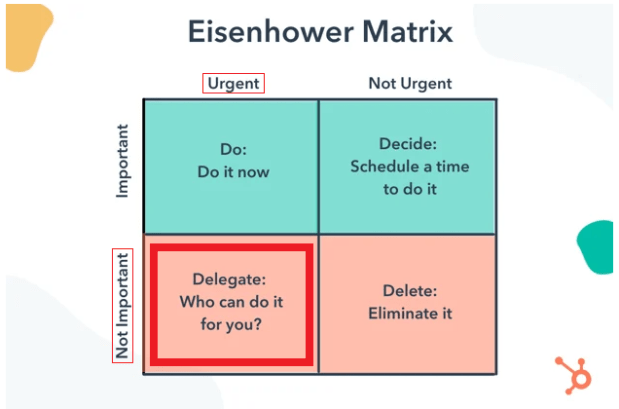
Last October I spent some time talking about the Eisenhower Matrix and its critical flaw, focusing upon the “important but not urgent” quadrant:

When you have a single level of importance, then decisions are pretty simple. For urgent things, do it yourself if it’s important, delegate it if it’s not.

When “importance” is more granular

But what if, instead of “Not Important” and “Important,” we had three levels of importance instead of just one? In other words, “Not Important,” “Important,” “Very Important,” and “Critically Important”?

A U.S. Navy plane flying over a Soviet ship in October 1962 is, um, classified as “Critically Important.” Oh, and it’s urgent. By USN – Dictionary of American Naval Aviation Squadrons Volume 2: The History of VP, VPB, VP(H) and VP(AM) Squadrons [4], Public Domain, https://commons.wikimedia.org/w/index.php?curid=7328539.

In that case, you not only consider whether to delegate something, but who should be delegated that thing. (Or, as you’ll see, WHAT should be delegated that thing.)

  • If the need is not important, delegate it, but it doesn’t really matter to whom or what you delegate it. ChatGPT or Bard is “good enough,” even if the result is awful.
  • If the need is important, delegate it to someone you trust to create very good content. Let them create the content, you approve it, and you’re done.
  • If the need is very important, then you may delegate some of the work, but you don’t want to delegate all of it. You need to be involved in the content creation process from the initial meeting, through the review of every draft, and of course for the final approval. The goal is stellar content.
  • If the need is critically important, then you probably don’t want to delegate the work and will want to do it yourself—unless you can find someone who is better than you in creating content.

As I noted in October, a more granular approach to importance increases the, um, importance of Bredemarket’s services.

  • In the simple Eisenhower Matrix model, Bredemarket handles the Not Important stuff while you handle the Important stuff.
  • In the “three levels of importance” model, Bredemarket handles the Very Important and Critically Important stuff. Because the merely Important stuff and the Not Important stuff doesn’t require my 30 years of technology, identity, and biometrics expertise.

Sometimes you need a CPA (but NOT a Certified Public Accountant)

But if your needs are critical, and you require the services of a CPA (Content-Proposal-Analysis marketing professional), then you need to learn what Bredemarket can do for you. Click on the image to learn more.

Bredemarket’s “CPA.”