Back in 2024 I wrote about contraction in the identity/biometric industry.
In retrospect, that industry has been lucky.
At the time I wrote this (yes, this is a scheduled post), I knew of few if any identity/biometric companies that had “right sized” half its staff. 10% maybe, but not 50%.
The mood at the time was that the world was changing and generative AI bots and non-person entities could replace people.
Yes, I am familiar with the party line that AI wouldn’t replace anyone, but would empower everyone to do their jobs more effectively.
The layoff trackers told a different story.
As did the AI gurus who proclaimed that many jobs would soon be obsolete.
Strangely enough, “AI guru” was not one of the jobs that was going away. Which is odd. It seems to me that giving inspirational talks would be the perfect job for a non-person entity.
But many people agreed that entry-level jobs were ripe for rightsizing, meaning that those at the beginnings of their careers would have a much harder time finding work.
“Hardware giant IBM plans to triple entry-level hiring in the U.S. in 2026, according to reporting from Bloomberg. Nickle LaMoreaux, IBM’s chief human resource officer, announced the initiative….’And yes, it’s for all these jobs that we’re being told AI can do,’ LaMoreaux said.”
Because IBM has separated what AI can do from what it can’t do. IBM’s new positions are “less focused on areas AI can actually automate — like coding — and more focused on people-forward areas like engaging with customers.”
Guess what? Bots are not engaging. Well, maybe they’re more engaging than AI gurus…
Can you use people?
But I will go one step further and claim that human product marketers and content writers are more engaging than bot product marketers and content writers.
Believe me, I’ve tested this. Bredebot can fake 30 years of experience, but it’s not genuine.
If you want to engage with your prospects, don’t assign the job to a bot. That’s human work.
I’ve previously noted that one possible sign of a scammer is when they don’t initiate a LinkedIn connection to you, but instead want you to initiate a LinkedIn connection to them. When a scammer is scamming, they can’t blow through a few thousand connection requests every day, so it’s better if the victims initiate the connection request themselves.
I immediately thought of this when I received an email from a Gmail account to one of my odd accounts entitled “Thinking of connecting.”
Um…why not just do it?
Here’s the text with the scammer’s alleged name changed:
“I saw your profile on LinkedIn and wanted to say hello. I’m Melania.
“I’ve always been interested in learning about different professional paths. This is just a friendly intro for the start of the week—no expectations on my end.”
Obviously I didn’t respond. Because I have no idea who the Gmail account holder REALLY is.
A day later, I received a second message that included the following:
“Things are actually pretty smooth and manageable on my end as the Operations Manager at Estée Lauder, so I’ve had some extra time to catch up with my network. I’d love to hear how your side of the world is treating you whenever you have a moment.”
Again, I didn’t respond. I didn’t even ask for “Melania’s” Estee Lauder email address (again, the emails are from a Gmail account).
Then we got to day three. Remember how Melania said she had viewed my LinkedIn profile? This was the next question she asked:
“Is it snowing where you are?”
Obviously she hadn’t read anything, and I was getting bored, so I blocked her from all email addresses.
Of all the KYx acronyms (Know Your Customer, Know Your Business, etc.), two that interest LinkedIn users are Know Your Employer and Know Your Employee. How do you fight fraudulent employers and employees? And how do your prospects learn about your fraud fighting?
“A recent development is scammers using the name of legitimate companies that are hiring and approaching their victims through LinkedIn’s direct messaging feature. They then create counterfeit websites that look like the websites of the legitimate companies they are posing as and ask the job seekers for personal information…”
And you can guess what happens with that personal information. It doesn’t land you a real job, that’s for sure.
In addition to the tips that Scamicide provides, I have an additional one. BEFORE you provide your resume, before you send them a connection request, or definitely before you engage on Telegram or WhatsApp, ask this question:
“Can you provide me with your corporate email address?”
This usually shuts scammers up very quickly.
But don’t forget that while job applicants are avoiding fraudulent employers, legitimate employers are avoiding fraudulent applicants…perhaps from North Korea.
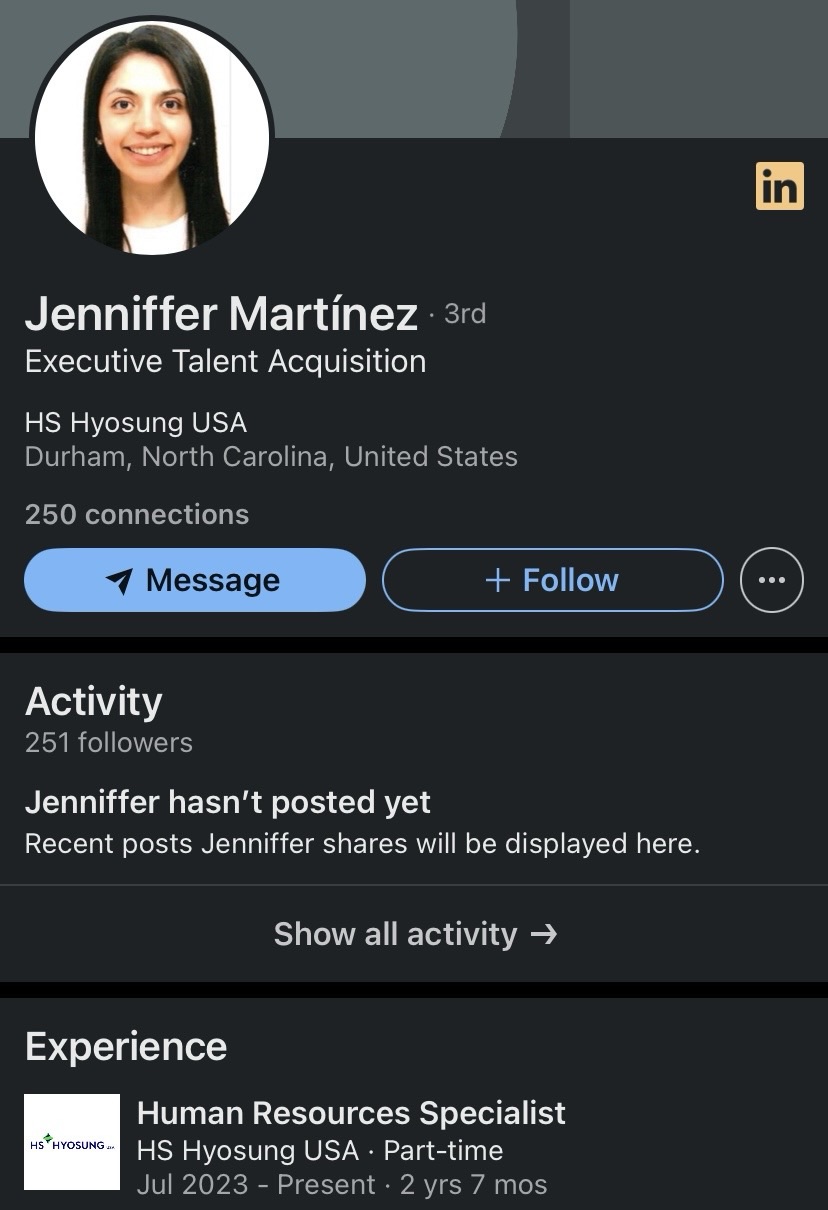
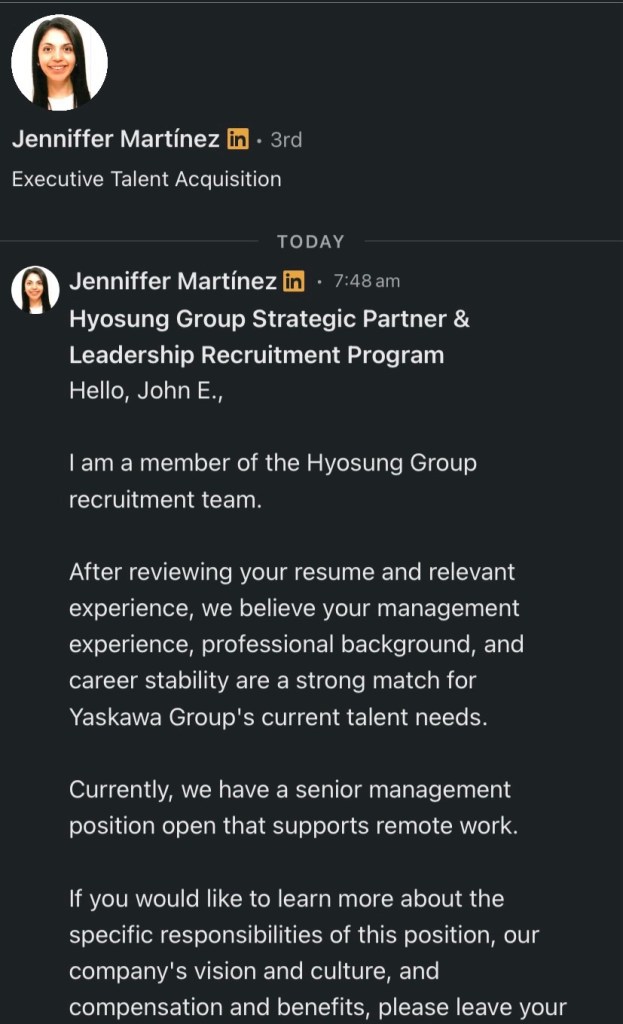
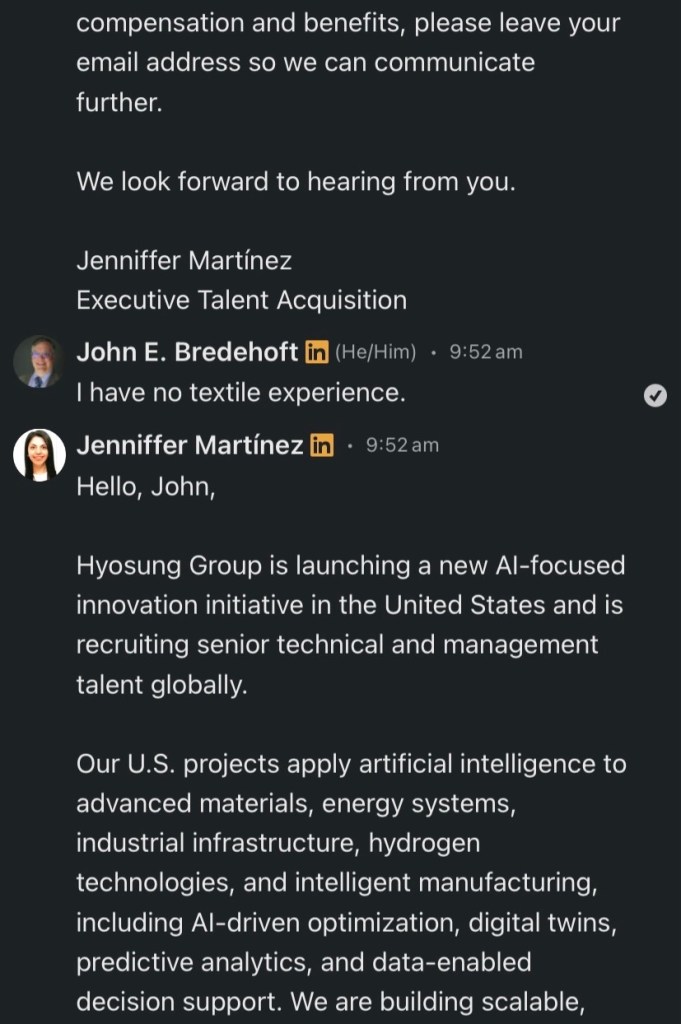
I was messaged on LinkedIn by Jenniffer Martinez, purportedly from HS Hyosung USA. She wanted my email address to send information about a job opportunity.
Why?
“After reviewing your resume and relevant experience, we believe your management experience, professional background, and career stability are a strong match for Yaskawa Group’s current talent needs.”
(Only now did I notice the reference to Yaskawa Group, whatever it is.)
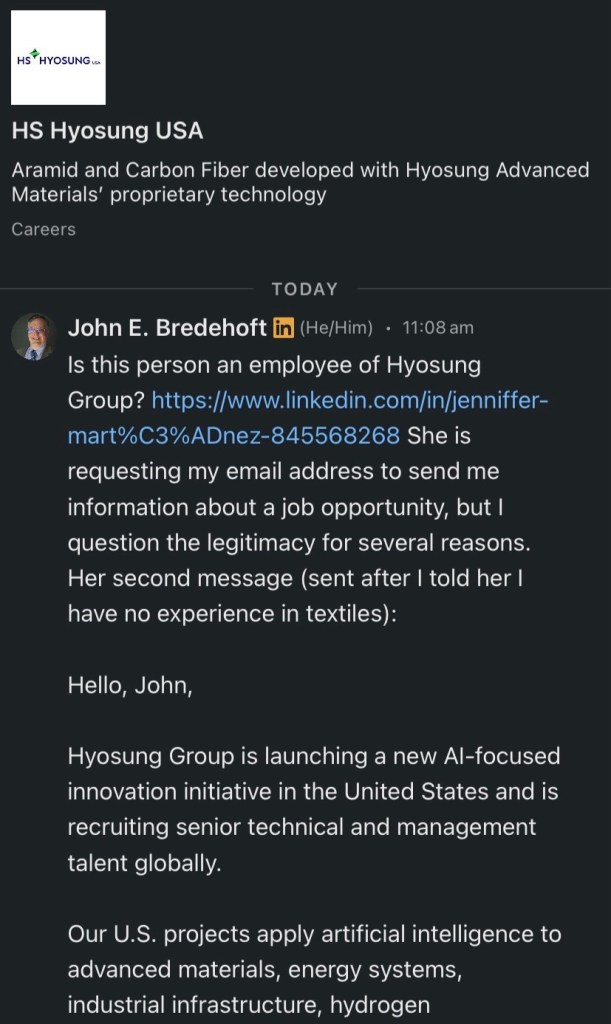
Eventually I told “Jenniffer” that I had contacted her employer directly.
By 11:30 she had deleted her entire conversation, which is why I took screen shots immediately.
And I never even got around to asking her for HER corporate email address.
No word from HS Hyosung USA, but it knows all about Jenniffer now (see final screen shot).
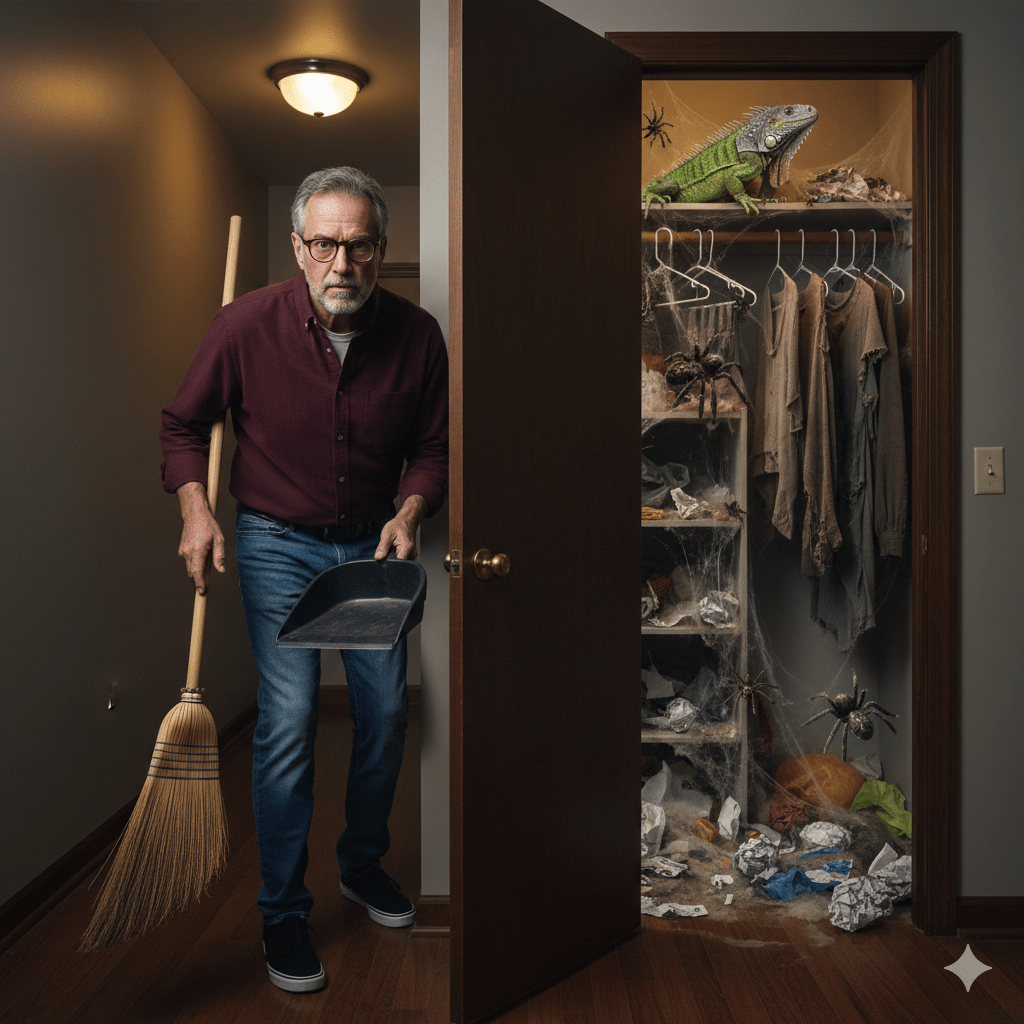
2025 has been a year of declutterring and focusing.
The declutterring is the hardest. I may still love that long sleeve shirt with holes in the right elbow. (Why always the right elbow? I’m left handed.) But it’s no longer good for me, and I should have gotten rid of it years ago.
Whether it’s a former friend—a great person who went silent and indifferent—or a newsletter from a company that rejected my 2023 job application and only contacted me afterwards because GDPR required it—the time has come to simplify and focus.
Now just a few hundred LinkedIn newsletters and email subscriptions to go.








 Bredemarket