Who Runs Your Company’s Marketing?

I found an open marketing position at Company X. 

Why was I looking at Company X?

Because I knew two people (long gone) at Company X, so the company came to mind.

Who runs marketing at Company X?

Because the open position was not an executive position, I searched LinkedIn for the company’s Chief Marketing Officer, or what the cool kids call the CMO. Anyone applying for the open position would want to talk to the CMO.

But I found:

  • No CMO on LinkedIn.
  • No Head of Marketing on LinkedIn.
  • No marketing head on Company X’s About Us page.
CMO-less.

But they’re hiring…a marketing manager.

Normally companies hire a marketing head, then let them build out their team. But in this case, Company X is starting in the middle by hiring a non-executive marketing manager.

Or maybe not. 

The CxxO and double duty

There’s a chance that one of the other executives at Company X is wearing the marketing hat, in addition to their other duties. 

This isn’t unusual in small startups, after all.

CxxO.

Now this makes it difficult for people outside the company who want to speak to the marketing head.

But who cares if it’s difficult for outsiders?

  • Yes it makes it hard for a marketing jobseeker to determine who the hiring authority is for an open marketing position.
  • And yes (because this blog is all about me) it makes it difficult for a product marketing consultant to pitch their services…especially when the two original contacts have left the company.

Making it hard for outsiders is actually GOOD for the company. Pesky outsiders can be pesky, especially if they’re calling at all hours and bumping their emails.

Who runs marketing at Company U?

But what’s happening on the inside of Company X, or at Company U (your company)?

  • Who determines what the marketing manager is supposed to do?
  • Who determines if the marketing manager is a success or failure?
  • Who determines the company’s marketing strategy?

And (again because this is all about me) who determines when the company needs outside consulting help, and who can answer the questions that the consultant will ask?

From the perspective of Bredemarket, I am much better off when a prospect company has a clear plan of how it can use my content-proposal-analysis services.

Does your company know what it wants to do?

(Imagen 4)

Solving Problems vs. Problem-solving

Marketers, let’s return to school and talk about the difference between solving problems and problem-solving. Afterwards we’ll go back to work.

Marchetti SP and P-S

Some time in 2008 or earlier, Carolyn Marchetti heard this:

“Problem-solving is what you do when you don’t know how to solve a problem.”

She contrasts this with solving problems, where you apply known techniques to a problem that has already been solved.

Marchetti approaches this from an education perspective, where students ideally learn solving problems AND problem-solving.

Shah SP and P-S

This distinction is not unique to Marchetti’s anonymous speaker. Sam J. Shah, also dealing with students, notes the need for problem-solving in certain scientific disciplines:

“[M]ost of the work done in fields as sterile as combinatorics or as messy as molecular biology involves navigating corridors of inquiry, trying (and often failing) to draw connections, and coming up with new lenses with which to look at problems. Frustration and dead ends are part and parcel of working in these fields.”

Bredemarket SP and P-S

We encounter these issues outside of school when we go to work.

  • For businesses, Bredemarket usually solves problems: your prospects don’t know about you, your prospects don’t know why they should care about you, your prospects lack information. There are known solutions.
  • Occasionally, Bredemarket engages in problem-solving, where there are questions without clear answers, and you and I work together to determine how to move forward.

Your company probably needs to both solve tactical problems and perform strategic problem-solving.

How?

I’ve worked on both the strategic and tactical levels. Let’s talk. https://bredemarket.com/cpa/

(Imagen 4)

Stealing and Awareness

The reason that I redirected the purpose of my Substack posts is because much of my audience there isn’t familiar with the…um…minutiae of biometrics and identity. (For example, my reference to minutiae would probably go right past all but two of my Substack subscribers.)

My Substack audience is best served with awareness content.

But awareness content is not only informative and educational.

Awareness of you

It also makes prospects aware of your company…which is critically important.

Last month I said the following about awareness:

“Technology marketers, do your prospects know who you are?

“If they don’t, then your competitors are taking your rightful revenue.

“Don’t let your competitors steal your money.”

Perhaps steal is a harsh word, but it’s accurate. 

Or perhaps a better word is indifference: your actions indicate that you don’t care whether customers buy from you or not. If you cared, you’d actually market your products.

Who needs marketing?

“Nonsense, John! We have a sales staff. Who needs marketers?”

Especially when content marketing may take up to 17 months to convert. That doesn’t help the current quarter.

But your sales staff cannot be everywhere. If your prospects don’t know about you and aren’t reaching out to you, then you have to reach out to them.

And the calls? “Hi, I’m Tom with WidgetCorp.” “With who?”

So how is that current quarter looking now?

You need marketing, now

Your current quarter and future quarters would look better if your secret salesperson were working for you. As Rhonda Salvestrini said:

“Content for your business is one of the best ways to drive organic traffic. It’s your secret salesperson because it’s out there working for you 24/7.”

But the secret salesperson won’t engage your prospects until you act to create that content.

Talk to Bredemarket about your content, proposal, and analysis needs: https://bredemarket.com/cpa/

Before your competitors steal more from you.

How to Isolate Your Unfocused Company

(StealthCo picture from Imagen 3)

So what are you doing, Jane?

“I’m a Scrum Master. Very busy.”

Who are you working for?

“I can’t tell you. We’re in stealth mode.”

When will you emerge?

“When we are ready to blow the world away.”

Um, how do you know that you will blow the world away?

“Our leader says so. And she knows what she’s talking about. She attended Stanford.”

But is anyone checking your assumptions?

“Of course. All 23 employees…forget I said that number.”

But what about your prospects? What are they saying?

“We know they will love it!”

Did they say they will love it?

“We know they will!”

What if the prospects learn about your stealth product and decide it sucks? And all the years you’ve spent developing in isolation are in vain because of a lack of true customer focus?

“That won’t happen. Our leader knows what she’s talking about. She founded one successful company, and uses that experience to guide us remotely from Texas.”

Who is this leader?

“Elizabeth Holmes. Have you heard of her?”

Elizabeth Holmes picture public domain.

Ending the Isolation

There are potentially valid reasons for entering stealth mode, including protecting trade secrets and keeping the competition away. 

But…there is a risk if you also keep the prospects away from your stealth mode operations and fail to engage with them. Who knows—maybe your prospects might have some ideas of what they need, and that information might be good to know. Your unicorn rockstar fearless dear leader may not know EVERYTHING.

If you want to work out a strategy for getting prospects engaged, let me ask you a few questions. Book a free meeting at https://bredemarket.com/cpa/

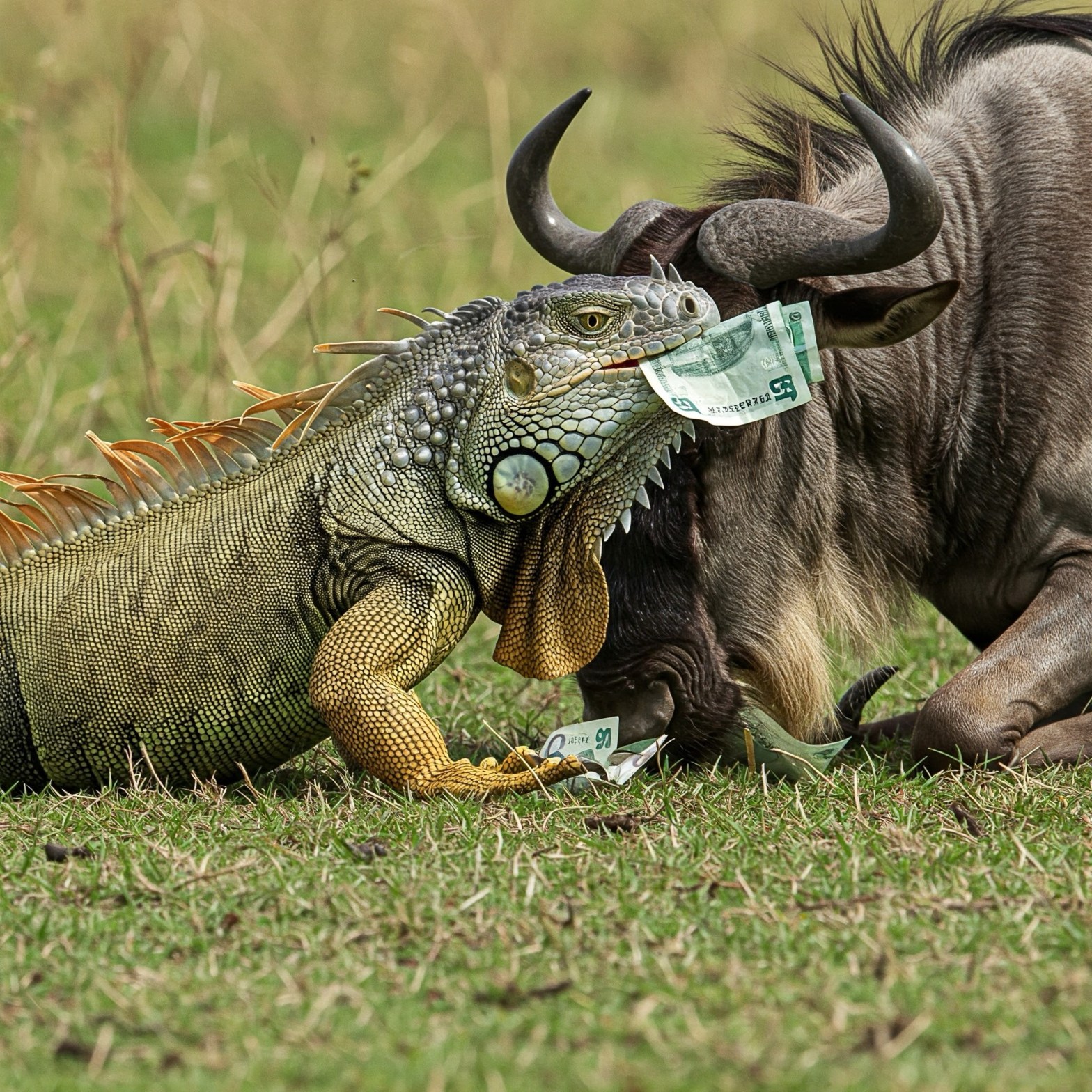
The Wildebeest Obviously Needs a Snack

It’s time for my (usually) once-a-month edition of Bredemarket’s LinkedIn newsletter, “The Wildebeest Speaks.”

And I revisited a topic that I originally visited in December 2023, but hopefully with a new perspective.

Go to LinkedIn and read the latest edition of my newsletter, “Who Are Your Hungry People?” It is at https://www.linkedin.com/pulse/who-your-hungry-people-bredemarket-xiafc/

Hungry wildebeest buffet images via Imagen 3.
Cheap Trick targets the audience, who responds in a Pavlovian way. https://www.youtube.com/watch?v=-qgpewMCVjs.

Frictionless Friction Ridges and Other Biometric Modalities

I wanted to write a list of the biometric modalities for which I provide experience.

So I started my usual list from memory: fingerprint, face, iris, voice, and DNA.

Then I stopped myself.

My experience with skin goes way beyond fingerprints, since I’ve spent over two decades working with palm prints.

(Can you say “Cambridgeshire method”? I knew you could. It was a 1990s method to use the 10 standard rolled fingerprint boxes to input palm prints into an automated fingerprint identification system. Because Cambridgeshire had a bias to action and didn’t want to wait for the standards folks to figure out how to enter palm prints. But I digress.)

So instead of saying fingerprints, I thought about saying friction ridges.

But there are two problems with this.

First, many people don’t know what “friction ridges” are. They’re the ridges that form on a person’s fingers, palms, toes, and feet, all of which can conceivably identify individuals.

But there’s a second problem. The word “friction” has two meanings: the one mentioned above, and a meaning that describes how biometric data is captured.

No, there is not a friction method to capture faces.
From https://www.youtube.com/watch?v=4XhWFHKWCSE.

No, there is not a friction method to capture faces. Squishing 

  • If you have to do something to provide your biometric data, such as press your fingers against a platen, that’s friction.
  • If you don’t have to do anything other than wave your fingers, hold your fingers in the air, or show your face as you stand near or walk by a camera, that’s frictionless.

More and more people capture friction ridges with frictionless methods. I did this years ago using MorphoWAVE at MorphoTrak facilities, and I did it today at Whole Foods Market.

So I could list my biometric modalities as friction ridge (fingerprint and palm print via both friction and frictionless capture methods), face, iris, voice, and DNA.

But I won’t.

Anyway, if you need content, proposal, or analysis assistance with any of these modalities, Bredemarket can help you. Book a meeting at https://bredemarket.com/cpa/

Why Replacing Your Employees with VLM NPE Bots Won’t Defeat Social Engineering

(Scammed bot finger picture from Imagen 3)

Your cybersecurity firm can provide the most amazing protection software to your clients, and the clients still won’t be safe.

Why not? Because of the human element. All it takes is one half-asleep employee to answer that “We received your $3,495 payment” email. Then all your protections go for naught.

The solution is simple: eliminate the humans.

Eliminating the human element

Companies are replacing humans with bots for other rea$on$. But an added benefit is that when you bring in the non-person entities (NPEs) who are never tired and never emotional, social engineering is no longer effective. Right?

Well, you can social engineer the bot NPEs also.

Birthday MINJA

Last month I wrote a post entitled “An ‘Injection’ Attack That Doesn’t Bypass Standard Channels?” It discussed a technique known as a memory injection attack (MINJA). In the post I was able to sort of (danged quotes!) get an LLM to say that Donald Trump was born on February 22, 1732.

(Image from a Google Gemini prompt and response)

Fooling vision-language models

But there are more serious instances in which bots can be fooled, according to Ben Dickson.

“Visual agents that understand graphical user interfaces and perform actions are becoming frontiers of competition in the AI arms race….

“These agents use vision-language models (VLMs) to interpret graphical user interfaces (GUI) like web pages or screenshots. Given a user request, the agent parses the visual information, locates the relevant elements on the page, and takes actions like clicking buttons or filling forms.”

Clicking buttons seems safe…until you realize that some buttons are so obviously scambait that most humans are smart enough NOT to click on them.

What about the NPE bots?

“They carefully designed and positioned adversarial pop-ups on web pages and tested their effects on several frontier VLMs, including different variants of GPT-4, Gemini, and Claude.

“The results of the experiments show that all tested models were highly susceptible to the adversarial pop-ups, with attack success rates (ASR) exceeding 80% on some tests.”

Educating your users

Your cybersecurity firm needs to educate. You need to warn humans about social engineering. And you need to warn AI masters that bots can also be social engineered.

But what if you can’t? What if your resources are already stretched thin?

If you need help with your cybersecurity product marketing, Bredemarket has an opening for a cybersecurity  client. I can offer

  • compelling content creation
  • winning proposal development
  • actionable analysis

If Bredemarket can help your stretched staff, book a free meeting with me: https://bredemarket.com/cpa/

Is Milwaukee Selling PII for Free Facial Recognition Software Access?

(Part of the biometric product marketing expert series)

Perhaps facial recognition product marketers have heard of stories like this. Or perhaps they haven’t.

Tight budgets. Demands that government agencies save money. Is this the solution?

“Milwaukee police are mulling a trade: 2.5 million mugshots for free use of facial recognition technology.

“Officials from the Milwaukee Police Department say swapping the photos with the software firm Biometrica will lead to quicker arrests and solving of crimes.”

Read the article at https://www.jsonline.com/story/news/crime/2025/04/25/milwaukee-police-considering-trading-mugshots-for-facial-recognition-tech/83084223007/

As expected, activists raised all sorts of other concerns about facial recognition in general. But there’s an outstanding question:

What will Biometrica do with the 2.5 million images?

  • Use them for algorithmic training? 
  • Allow other agencies to search them?
  • Something else?
  • And what happens to the images if another company acquires Biometrica and/or its data? (See 23andMe.)

Biometrica didn’t respond to a request for comment.

And other facial recognition vendors operate differently.

How does your company treat customer data?

And how do you tell your story?

Do you have the resources to market your product, or are your resources already stretched thin?

If you need help with your facial recognition product marketing, Bredemarket has an opening for a facial recognition client. I can offer

  • compelling content creation
  • winning proposal development
  • actionable analysis

If Bredemarket can help your stretched staff, book a free meeting with me: https://bredemarket.com/cpa/

(Wheelbarrows from Imagen 3)

Why Invela TPRM?

During my three months working with a third-party risk management (TPRM) client, I never heard anyone mention Invela.

Perhaps with reason. Although LinkedIn says the company was founded in 2024, it didn’t post its first blog until April 20, 2025, or its first LinkedIn posts until April 21.

But the second blog post, dated April 21, is the one that matters.

“Invela has officially launched a transformative network to bolster consumer protection and foster innovation within the open banking ecosystem. The Invela Network, developed in collaboration with industry-leading specialist partners, promises to revolutionize how financial institutions manage third-party risk…”

The post goes on to cite the Consumer Financial Protection Bureau (CFPB), but…well…that’s nice.

Invela’s TPRM solution specifically targets the open banking segment of the financial services industry. Open banking, featuring companies such as Plaid, Kong, and Camunda (among others), facilitates the interchange of financial data, rather than keeping it within each bank’s walled garden.

Which of course increases risk.

Hence companies such as Invela.

I was unable to find a “why” story for Invela that compared to the why story I previously found for Ubiety Technologies. Obviously the Invela people never read my book.

However, the principals at Invela come from companies such as Mastercard (although I could find no information on Invela’s CEO Steve Smith). But the Invela leadership team presumably knows their market. We will see if they know their marketing.

Which reminds me…if you need help with your cybersecurity product marketing, Bredemarket has an opening for a cybersecurity client. I can offer

  • compelling content creation
  • winning proposal development
  • actionable analysis

If Bredemarket can help your stretched staff, book a free meeting with me: https://bredemarket.com/cpa/