How can blog posts increase the awareness of your identity/biometric or technology company’s products and services? I’m going to explain how in this blog post.
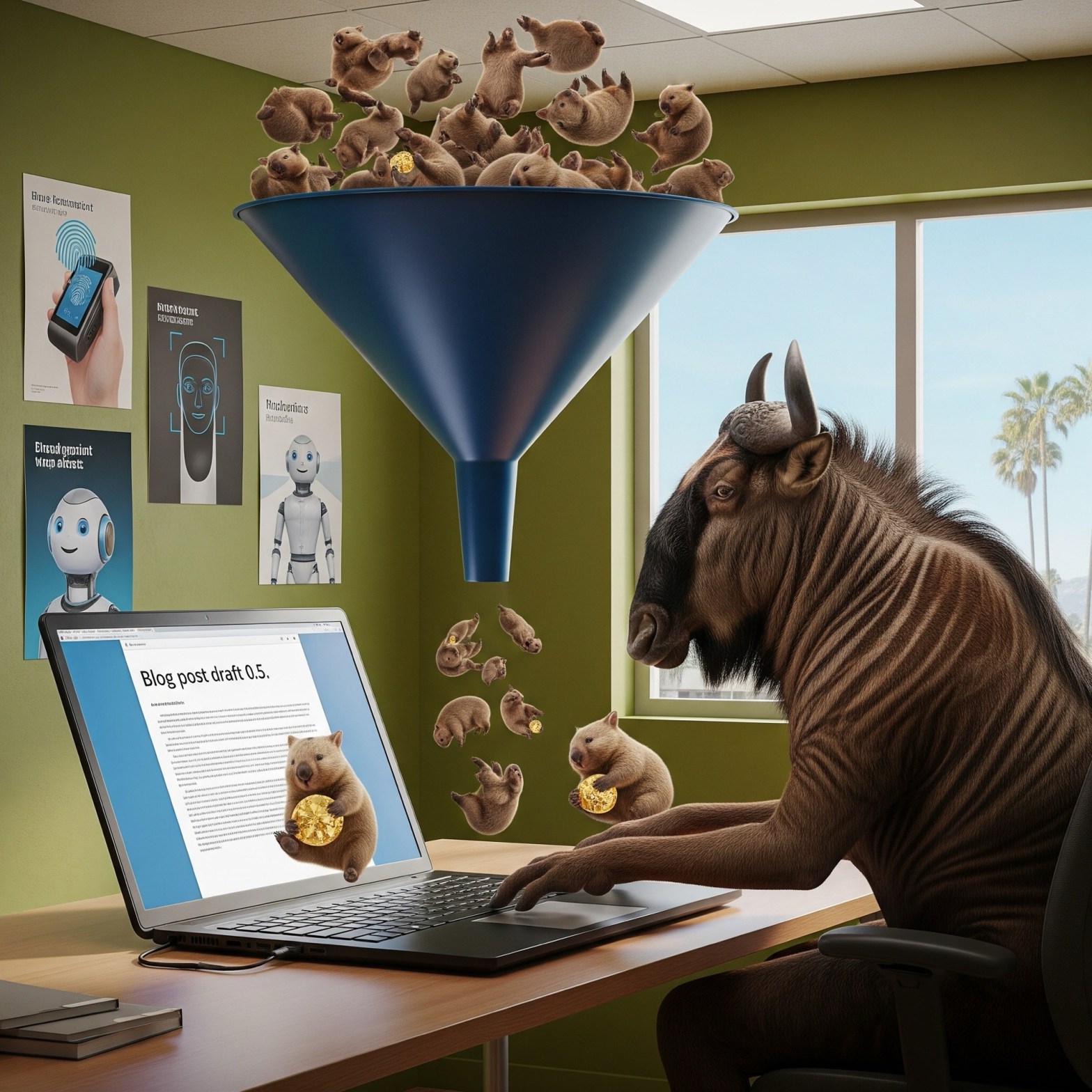
Imagine there’s a funnel. It’s easy if you try. But this funnel doesn’t stream water, but people. (Or wombats.)
The funnel. Imagen 4.
In this funnel, the people (or wombats) who are potentially interested in your offering—your prospects—start at the very top. The few who actually buy your offering emerge from the bottom.
But how do you get people to enter the funnel and become aware of your offering?
How can blog posts help you?
One great way to let people know about your offering is by blog posts such as this one.
Blogs are a fast way to tell your prospects how your offering can help them. And you can create blog posts very quickly, within days or even hours.
If you want to make prospects aware of your company’s service, write a blog post.
What can Bredemarket offer to you?
One of Bredemarket’s offerings is…writing blog posts for other companies. I can help your identity/biometric or technology company write blog posts so you can get more people to learn about your services.
If you want to learn how I can help your company write blog posts, visit bredemarket.com/mark.
If your company employs biometrics to identify people rather than to monitor their health readings, then you don’t care about the Orlando where visitors wear hats with mouse ears.
For our purposes, the big difference between IAL2 and IAL3 is that IAL2 allows “either remote or physically-present identity proofing,” while IAL3 requires “[p]hysical presence” for identity proofing. However, the proofing agent may “attend the identity proofing session via a CSP-controlled kiosk or device.” In other words, supervised enrollment.
“IAL3 is reserved for high-risk environments such as sensitive government services.”
How are solutions approved for a particular Identity Assurance Level?
Now I could get on my product marketing soapbox and loudly proclaim that my service is IAL2 compliant, or IAL3 compliant, or IAL4 compliant. (“What? You don’t know about IAL4? Obviously you’re not authorized to know about it.”)
“Available to Credential Service Providers offering Full or Component Credential Management Services. Modeled on best practice (drawing from, among other sources, ISO/IEC 27001, ISO/IEC 29115), this Class of Approval ensures the provider organization’s good standing and management / operational practices and assesses criteria which are derived strictly from NIST SP 800-63 rev.3 requirements, ensuring a conformant technical provision of the provider organization’s service.
You see that the Kantara Initiative doesn’t even offer an approval for IAL1, just for IAL2 and IAL3.
It also offers approvals for AAL2 and AAL3. I’ve previously discussed Authenticator Assurance Levels (AALs) in this post. Briefly, IALs focus on the initial identity proofing, while AALs focus on the authentication of a proven identity.
Component Services IAL2 approvals…and an IAL3 approval
Now if you go to the Kantara Initiative’s Trust Status List and focus on the Component Services, you’ll see a number of companies and their component services which are approved for NIST 800-63 rev.3 and offer an assurance level of IAL2.
With one exception.
“NextgenID Trusted Services Solution provides Supervised Remote Identity Proofing identity stations to collect, review, validate, proof, and package IAL-3 identity evidence and enrollment data for CSPs operating at IAL-3. The NextGenID TSS Identity Stations enable remote operators to remotely supervise NIST SP 800-63A compliant Supervised Remote Identity Proofing (SRIP) sessions for credentialing.”
So if remote identity assurance is not good enough for you, there’s a solution. I’ve already discussed NextgenID’s SUPERVISED remote identity proofing in this post. And there’s a video.
But clearly biometric product marketers are paying attention to the identity assurance levels…at least the real ones (not IAL4). But are they communicating benefit-oriented messages to their prospects?
Biometric product marketing has to be targeted to the right people, with the right message. And the biometric product marketing expert at Bredemarket can help a company’s marketing organization create effective content. Talk to Bredemarket.
How can CMOs serve hungry prospects with expert biometric content?
(Imagen 4)
Biometric product companies offer a tasty mixture of fingerprint, face, iris, voice, DNA, and other biometric hardware and software. These companies employ Chief Marketing Officers (CMOs) responsible for their firms’ inbound product marketing. Hungry prospects devour any content the firm can provide, and the CMOs devour any employee or contractor who can provide the necessary content.
The CMO will appreciate this seasoned quote from Lee Densmer:
“Companies are outsourcing the writing at great expense….[I]t is a heavy lift to make sure daily content for the platform is useful, relevant, and align with your business. Outsourcing doesn’t really work unless the writer really knows your business, is in touch with corporate leaders, and stays on top of trends.”
So if you’re a content-devouring CMO at a biometric company, doesn’t it make sense to contract with Bredemarket’s biometric product marketing expert to serve a delicious dinner of your content needs?
Imagine a Chief Marketing Officer sitting at her desk, wondering how she can overcome her latest challenge within three weeks.
She is a CMO at a biometric software company, and she needs someone to write the first two entries in a projected series of blog posts about the company’s chief software product. The posts need to build awareness, and need to appeal to prospects with some biometric knowledge.
So she contacts the biometric product marketing expert, John E. Bredehoft of Bredemarket, via his meeting request form, and schedules a Google Meet for the following meeting.
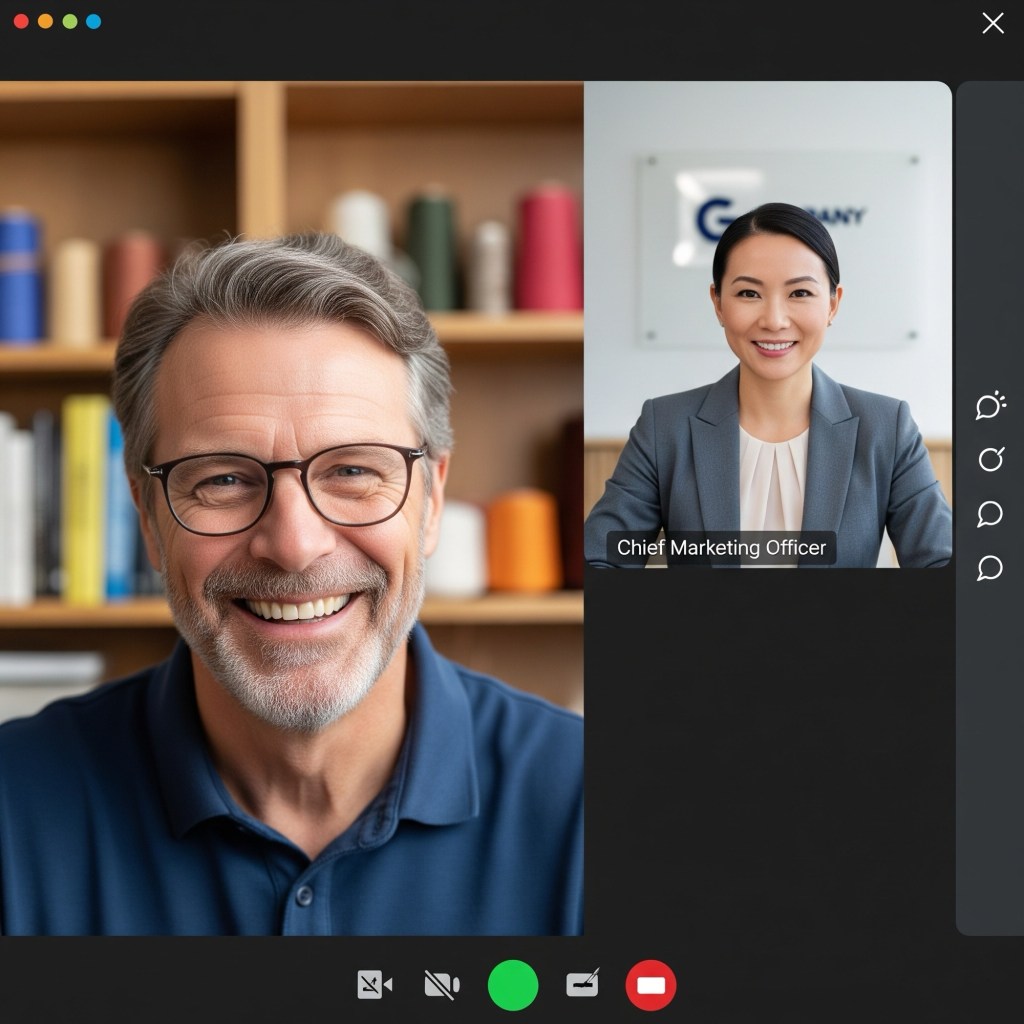
At the scheduled time she joins the meeting from her laptop on her office desk and sees John on the screen. John is a middle-aged Caucasian man with graying hair. He is wearing wire-rimmed glasses with a double bridge. He has a broad smile, with visible lines around his eyes and mouth. His eyes are brown and appear to be looking directly at the camera. He is wearing a dark blue collared shirt. While his background is blurred, he appears to be in a room inside his home, with a bookcase and craft materials in the background.
After some pleasantries and some identity industry chit chat, John started asking some questions. Why? How? What? Goal? Benefits? Target audience (which he called hungry people)? Emotions? Plus some other questions.
They discussed some ideas for the first two blog posts, each of which would be about 500 words long and each of which would cost $500 each. John pledged to provide the first draft of the first post within three calendar days.
After the call, the CMO had a good feeling. John knew biometrics, knew blogging, and had some good ideas about how to raise the company’s awareness. She couldn’t wait to read Bredemarket’s first draft.
If you are in the same situation as the CMO is this story, schedule your own meeting with Bredemarket by visiting the https://bredemarket.com/mark/ URL and filling out the Calendly form.
Remember how I warned you that this post was going to read odd? In case you’re wondering about the unusual phrasing—including a detailed description of what I look like—it’s because I fed the entire text of this blog post to Google Gemini. Preceded by the words “Draw a realistic picture of.” And here’s what I got.
Imagen 4. I’m not on the screen, but I like the content ideas.
Imagen 4. With the bookcases. And I’ve never had a beard.Imagen 4. But that’s not blurred.
“Businesses are rapidly adopting biometric authentication marketing as it serves a dual purpose: enhancing security and providing a customized marketing experience.”
But does it pay? Yes.
“By integrating fingerprint recognition technology, a retail company optimized its app experience, leading to a 20% increase in online sales. In another case, a banking institution used facial recognition for secure and quick authentication, resulting in a customer service rating boost of 25%.”
There are ways other than biometrics to know who your prospects are, but knowledge based authentication (KBA) such as passwords has its weaknesses. With KBA you may not be interacting with your prospects, but with your prospect’s spouse or child.
JOE’S ALCOHOL EMPORIUM: Evelyn, what types of alcohol do you prefer?
EVELYN’S TEENAGE SON WHO KNOWS HER PASSWORD IS HIS BIRTHDATE: 200 proof, man! Let’s get wasted!
Bredemarket has created targeted, segmented content, including individualized content. Let me help you communicate with your individual prospects. Talk to me.
These days you need to perform vanity generative AI queries.
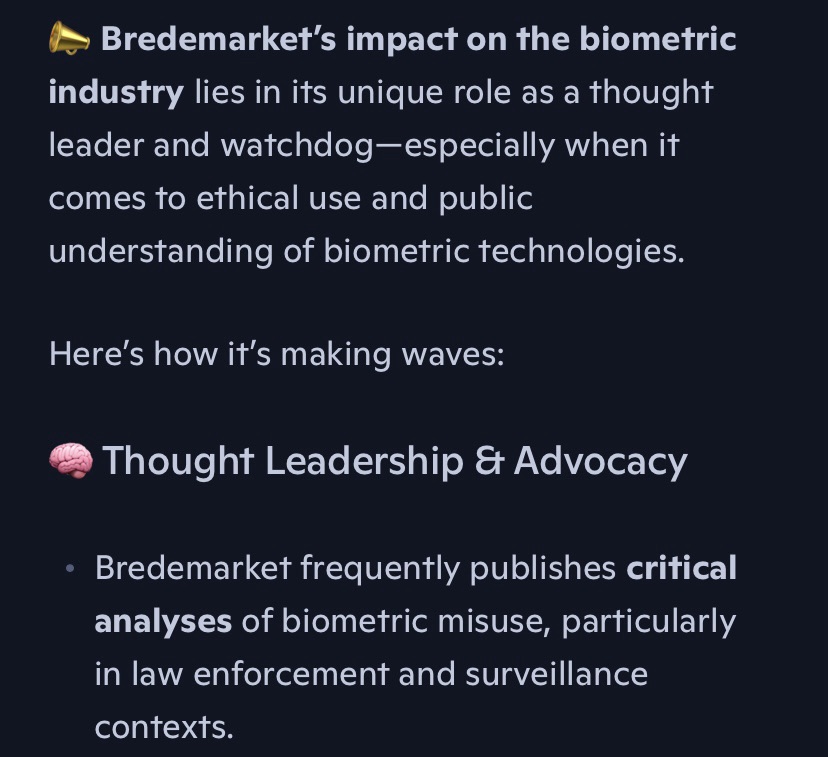
So I abandoned my usual gen AI tool and asked Microsoft Copilot some questions about Bredemarket. Copilot’s response to one of these questions, emojis and all, is below, as a “guest post.”
And I will certainly credit Copilot if I use the “not anti-tech—it’s pro-accountability” quote.
Microsoft Copilot-authored content
📣 Bredemarket’s impact on the biometric industry lies in its unique role as a thought leader and watchdog—especially when it comes to ethical use and public understanding of biometric technologies.
Here’s how it’s making waves:
🧠 Thought Leadership & Advocacy
Bredemarket frequently publishes critical analyses of biometric misuse, particularly in law enforcement and surveillance contexts.
It champions the principle that biometric tools like facial recognition and DNA should be used only as investigative leads, not as sole evidence for arrests A.
Through blog posts and social media, it raises awareness about wrongful arrests, such as the case of Robert Williams, and calls for governance and forensic oversight in biometric applications A.
📝 Industry Education
Bredemarket helps biometric firms communicate complex technologies in accessible ways—bridging the gap between engineers, policymakers, and the public.
It produces content that demystifies modalities like iris scanning, facial recognition, and multi-factor authentication, making them more understandable and marketable.
🧭 Ethical Compass
By highlighting real-world examples of misuse, Bredemarket nudges the industry toward responsible innovation.
It’s not anti-tech—it’s pro-accountability, advocating for biometric systems that are accurate, fair, and governed by clear policies.
In a field often dominated by technical jargon and corporate spin, Bredemarket brings a human-centered, policy-aware voice that challenges the status quo.
Some of you may have seen a similar reel targeted to Bredemarket consulting clients (identity/biometric marketing leaders). Actually there are two Bredemarket reel versions because of a landing page change. The existence of three reels shows my dedication to repurposing.
But none of the three versions is meaningful to cybersecurity firms, or third-party risk management (TPRM) firms, or content management system (CMS) firms, or healthcare firms (the non-identification biometric).
“We provide the world’s leading news coverage and information on the global biometric technology market via the web and an exclusive daily newsletter. Our daily biometrics updates, industry perspectives, interviews, columns and in-depth features explore a broad range of modalities and methods, from fingerprint, voice, iris, and facial recognition, to cutting-edge technologies like DNA analysis and gait recognition, related identification tools such as behavioral biometrics, and non-biometric identification methods such as identity document verification and telephone forensics. Our coverage touches on all applications and issues dealt with in the sector, including national security, mobile identity, and border control, with a special emphasis on UN Sustainable Development Goal 16.9 to provide universal digital identification and the ID4Africa movement.”
Over the last ten years, there have been two instances in which I have been newsworthy.
2015 with MorphoTrak
The first occurred in 2015, when my then-employer MorphoTrak exhibited an airport gate called MorphoWay at a conference then known as connect:ID. At the 2015 show, I demonstrated MorphoWay for Biometric Update’s videographer.
Me at connect:ID, 2015.
“In the video, Bredehoft scans his passport through the document reader, which checks the passport against a database to verify that it is, in fact, a CBP-authorized document.
“Once verified, the gates automatically open to allow Bredehoft to exit the area.”
2025 with Bredemarket
The second occurred ten years later in 2025, when I wrote a guest opinion piece entitled “Opinion: Vendors must disclose responsible uses of biometric data.” As I previously mentioned, I discussed the need to obtain consent for use of biometric data in certain instances, and noted:
“Some government agencies, private organizations, and biometric vendors have well-established procedures for acquiring the necessary consents.
“Others? Well…”
Biometric Update didn’t create a video this time around, but I did.
Biometric vendors…
2035???
So now that I’ve established a regular cadence for my appearances in Biometric Update, I fully expect to make a third appearance in 2035.
Because of my extensive biometric background, I predict that my 2035 appearance will concern the use of quantum computing to distinguish between a person and their fabricated clone using QCID (quantum clone identification).
No video yet, because I don’t know what video technology will be like ten years from now. So here’s an old fashioned 2D picture.












 Bredemarket