

Take care of the basics.
Category Archives: Uncategorized
Gemini Doesn’t Know Me
Vanity searches have been replaced by vanity LLM questions. And when I asked Google Gemini about myself, I found all sorts of errors.
A sampling:
He holds a Bachelor’s degree (and has mentioned graduate studies in public administration in professional contexts).
Having never studied public administration, I pressed Gemini on the issue.
Master of Business Administration (MBA): He earned his MBA from California State University, San Bernardino.
I pressed on that: I actually attended Cal State Fullerton. But that was nothing compared to this:
Undergraduate: He holds a Bachelor of Arts from Concordia University Chicago (formerly Concordia Teachers College).
That is actually my wife. I went to Reed College, which is NOT affiliated with the Lutheran Church Missouri Synod.

Whether you use Google Gemini, Wikipedia, or the Bredemarket blog, ALWAYS check your sources.
Surplus Labor

Therefore never send to know for whom the bell tolls; it tolls for thee.
On Newsletters

I’ve written newsletters for years, both as an employee (the third one here) and as a Bredemarket consultant. Some went to fewer than a dozen people, some to hundreds, and some to thousands.
Unlike a blog post, case study, or white paper, a newsletter does not provide a single focus. While the articles may be related, each stands on its own.
Sometimes literally. Individual newsletter articles may be repurposed as stand-alone blog and social media posts, extending their reach beyond the newsletter’s subscribers.
A powerful and flexible communication method.
Civil Registration and Vital Statistics (CRVS)

Today’s acronym is CRVS, and its importance in Africa.
But let’s define the acronym first: Civil Registration and Vital Statistics. From the World Health Organization:
“In most countries, a civil registration system is used to record statistics on vital events, such as births, deaths, marriages, divorces and fetal deaths. This government administrative system creates a permanent record of each event.”
Note the phrase “in most countries.” And even in some countries with CRVS systems, they may not be (in WHO’s words) “well-functioning.”
Which is why this year’s ID4Africa Annual Meeting (May 12-15) will spend significant time on CRVS as it pertains to legal identity. Here’s the first session in “Track 4,” moderated by UNICEF and the World Bank:
“This session launches the examination of CRVS–ID integration as both a critical governance reform and a strategic opportunity for African countries at all stages of identity system maturity. While civil registration and national ID systems are foundational to legal identity and effective service delivery, they have too often evolved in silos—resulting in fragmentation, inefficiencies, exclusion, and lost value from public investments. Drawing on country experiences from across the continent, the session explores why coherent CRVS–ID integration is essential, what integration pathways are available, and how institutional, legal, and technical choices shape outcomes. Part I features countries that have already undertaken top-down integration reforms, sharing lessons learned and benefits realized. Part II turns to countries still assessing policy options, examining the risks of continued fragmentation, the opportunities offered by integration, and the practical trade-offs involved in moving forward.”
Several additional sessions follow.
Identity has been an issue for years, as I described in a 2021 post about the European Union Digital COVID Certificate (EUDCC). Yeah, way back then.
“Assume for the moment that you have received an EU-authorized vaccine. This is only part of the battle, because the act of vaccination has to be tied to you as a person.
“And [Dr. Joseph] Atick notes one complicating factor in making that link:
“‘One of the biggest barriers to setting up these systems—and one that could greatly complicate digital health certificates – involves traceability, which for an official digital ID means documenting one’s birth event.
“‘In Africa, not everyone has a birth certificate, and many struggle to trace their identity to the birth event.’
“If you cannot prove to the satisfaction of the European Union (or whoever) that you were the actual person who received a vaccine, then you may face barriers to entering Europe (or wherever).”
This not only affects travel, but benefits, banking, and everything else that I in the United States take for granted.
The Wildebeest Speaks On Tactics vs. Strategy

So I finally wrote my new edition of my LinkedIn newsletter The Wildebeest Speaks—“On Types of Expertise”—on March 11.
And then found a spelling error on March 12.
Now if this had been client work, I would have quietly fixed it and went on my merry way.
But I’m more transparent when I’m writing for myself.
So rather than quietly correcting the error, I publicly did so.

In addition to preserving my transparency, the episode allowed me to illustrate the difference between tactics and strategy.
When a writer misspells the word “tactical” in an article and freely admits making the error, this is a tactic…not a strategy.
Call Centers and the United States
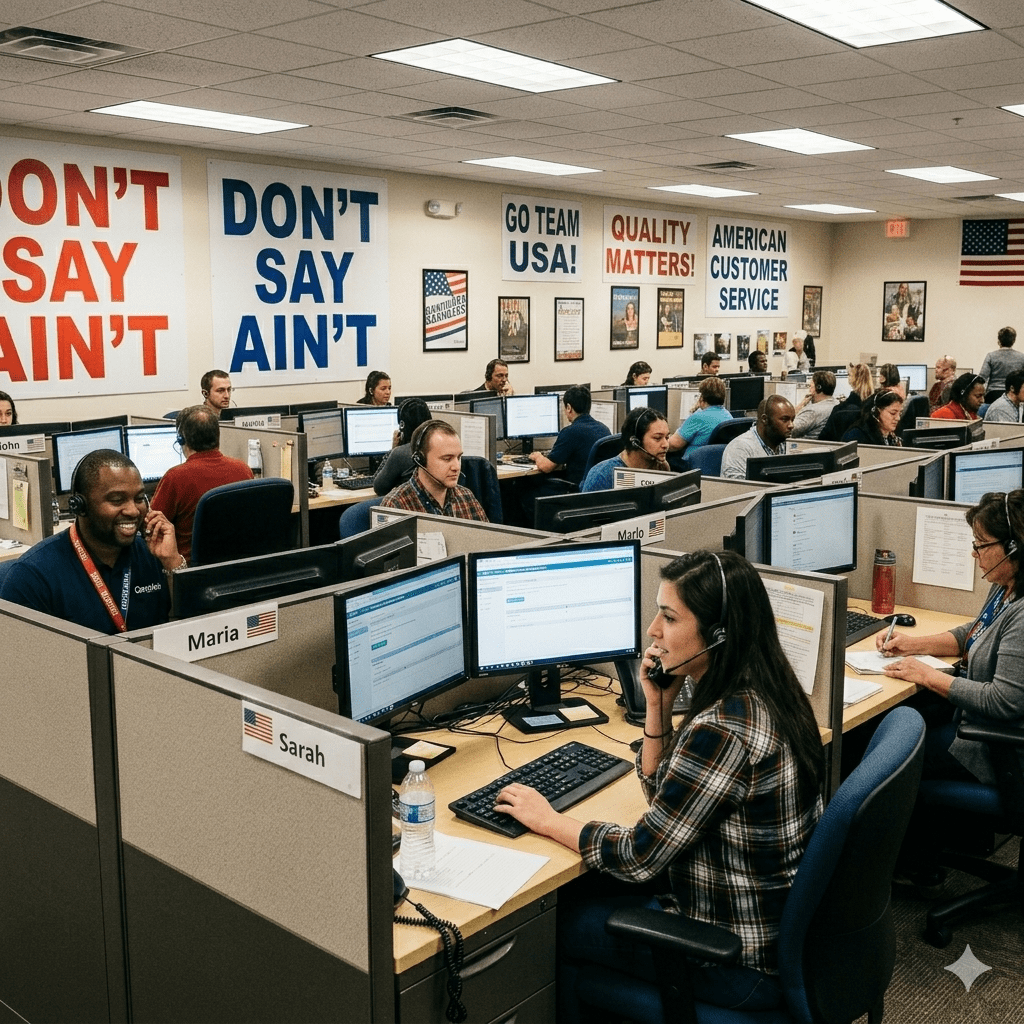
I belatedly learned about Federal Communications Commission Chair Brendan Carr’s proposals regarding call centers. But it’s important to note that there are three different proposals, each with different impacts.
- “First, the FCC will vote on reforms that can encourage businesses to bring call center jobs back the U.S.”
- “Second, the FCC will explore ways to improve customer service at existing call centers, including a proposal to require call takers to be proficient in American Standard English.”
- “Third, the FCC will address illegal robocalls that originate abroad by seeking comment on the targeted use of tariffs or bonds.”
Americans
Regarding those prized call center jobs that Americans hunger to fulfill so much, will the “reforms” include the abolition of the national $7.25 an hour minimum wage to make U.S.-based call center positions more attractive to employers? Well, employers in states that don’t have a higher minimum wage, anyway. Because call center jobs are a prime example of the jobs that Americans DON’T want to do. They’re worse than the data labeler jobs that require you to watch adult content.
English
Plus, many of these $7.25 an hour minimum wage states are in places where “American Standard English” is not widely spoken. Take Georgia and Oklahoma, each of which have a state minimum wage of $5.15, but that wage is overridden by the higher federal level.
Will the FCC consider Okie Talk as American Standard English?
Or will companies be required to import Yankees to make those calls? And offer unsweet tea options in the break room?
Robocalls
Which brings us to robocalls. Most people hate robocalls. (My secret: when someone from a random number calls me about my Google business listing, I immediately turn on call recording and the accompanying announcement. That shuts them up.)
But when thinking about possible ways to battle robocalls, the first answer that doesn’t come to mind is tariffs. That’s about as effective as…well, tariffs. Ask Jack Daniels and Jim Beam how tariffs have worked out for them.
Of course, both companies could solve their income problems by setting up call centers to call Americans, in American Standard English, and urge them to buy American…
…well, except that both Jack Daniels and Jim Beam are age restricted products, which makes calling somewhat difficult. I don’t think ANY company is pioneering age estimation by voice.
Passive Voice Liveness Detection
How do you detect a fake voice?
As with other biometrics, you can use either active or passive voice liveness detection.
Daon describes the latter:
“Unlike active liveness, which asks the user to complete an action (like…saying a phrase), passive liveness analyzes the content of a user’s…voice biometric input via AI neural networks that assess elements like…audio artifacts, and…the pitch, tone, and cadence of the user’s voice….”
Expertise is Everywhere

The Italian baseball players, fueled by espresso, defeated the U.S.
But who can help you defeat your competitors?
The strategic biometric product marketing expert, and…
…the tactical biometric product marketing writer.
Oh, wait…they’re the same person: John E. Bredehoft of Bredemarket.
Take the first step to biometric dominance. https://bredemarket.com/mark/
From Flip Phone to Smartphone to No Phone?
I remember the first time I saw someone talking to himself.
I was working in Motorola’s Anaheim office at the time. For those of you who remember the “triangle” office, I was walking down the hall from the factory floor to the lunchroom. And there was someone I didn’t recognize walking the other way down the hall, talking to himself.
Or at least it looked like it.
In reality, he had an earpiece in his ear which could also pick up his voice, and he was talking on his phone. The phone was presumably tucked away in a pocket and couldn’t be seen, so if you didn’t see the earpiece, you’d assume that he was talking to himself.
This was probably in the middle of my time at Motorola (2000-2009), and smartphones hadn’t really taken off yet. Perhaps the guy was using a smartphone, but my guess is that he had a good old flip phone.
If he had a smartphone, he’d be looking at it.
While I happen to be typing this post on a laptop, I just as easily could have typed it on my smartphone. Those devices are so prominent today.
But ZDNET asserts that smartphones will go away.
“Right now, mobile phones are the main hub of our personal device ecosystem. But as AI integrates into glasses, rings, headphones, and portable form factors, we could see our very own handsets step off center stage, and these wearable devices take their place.”
ZDNET’s assertion appears in article about Qualcomm, a leading manufacturer of the chips that drive these newer wearable devices. These new chips offer greater computing (seven times faster), less power demand, and therefore longer battery life (coupled with the ability to charge up to 50% in 10 minutes).
With these more powerful wearables, ZDNET anticipates that the wearables will become less of a smartphone accessory and more of a smartphone replacement.
But if the smartphones go away, then my future blog posts will be written as I walk down the hall.
Talking to myself.

 Bredemarket