Vertical Taxonomies: the UK Home Office Data Standards

I’ve talked about taxonomies ad nauseum, but they apply in multiple cases, including how police agencies talk to each other.

The United Kingdom’s Home Office has published the National Police Chiefs’ Council Minimum POLE Data Standards Dictionary. As the capitalization, I mean capitalisation, suggests, POLE is an acronym standing for Person, Object, Location, Event. The dictionary provides a common method for police agencies to talk to each other about…well, about people, objects, locations, and events.

Some of the comments in the dictionary seem unnecessary, but I guess it’s better to be too specific than not specific at all. Example:

If a telephone number is unknown – do not make one up.

In truth, this ties to a related notation:

A blank field is preferable to a known error…

Because, as anyone who has ever been a teenager will know, things that happen can be added to your permanent record.

Speaking of which, PERSON records may include offenders, suspects, victims, witnesses, and multiple other living, dead, or not-yet-born parties.

Very few specific OBJECT types are called out, but those that do include vehicles, land, and buildings. The OBJECT types also include identifying numbers such as passport numbers and telephone numbers.

A LOCATION may be an address, a geolocation, or another location designator. Or “no fixed abode.”

An EVENT may be a crime, an incident, a “custody,” a stop search, a safeguarding, and a case of “anti-social behaviour.”

Google Gemini.

So if a Welsh police officer runs into a person trashing a vehicle a a particular geolocation, the officer has all the tools to record what has happened and what will happen.

Many Ways To Conceptualize Stories, and Tell Them

Depending upon your talents and resources, your company may choose different ways to tell critically important stories to your prospects. But how do you get there?

Early this week, one of Bredemarket’s clients expressed an urgent need for a story. My job was to figure out the concept and pass it on to a talented person inside the company who would use my concept to create the final version.

Now I had no idea what format the final story would take. An infographic? A video? Something else?

Google Gemini.

But my concept didn’t need to be in the final format. It just had to contain the concept.

For all the client cared, I could have sketched the concept out in Microsoft Excel. Which works great for storyboards, especially when the story is fluid and needs to be re-sorted.

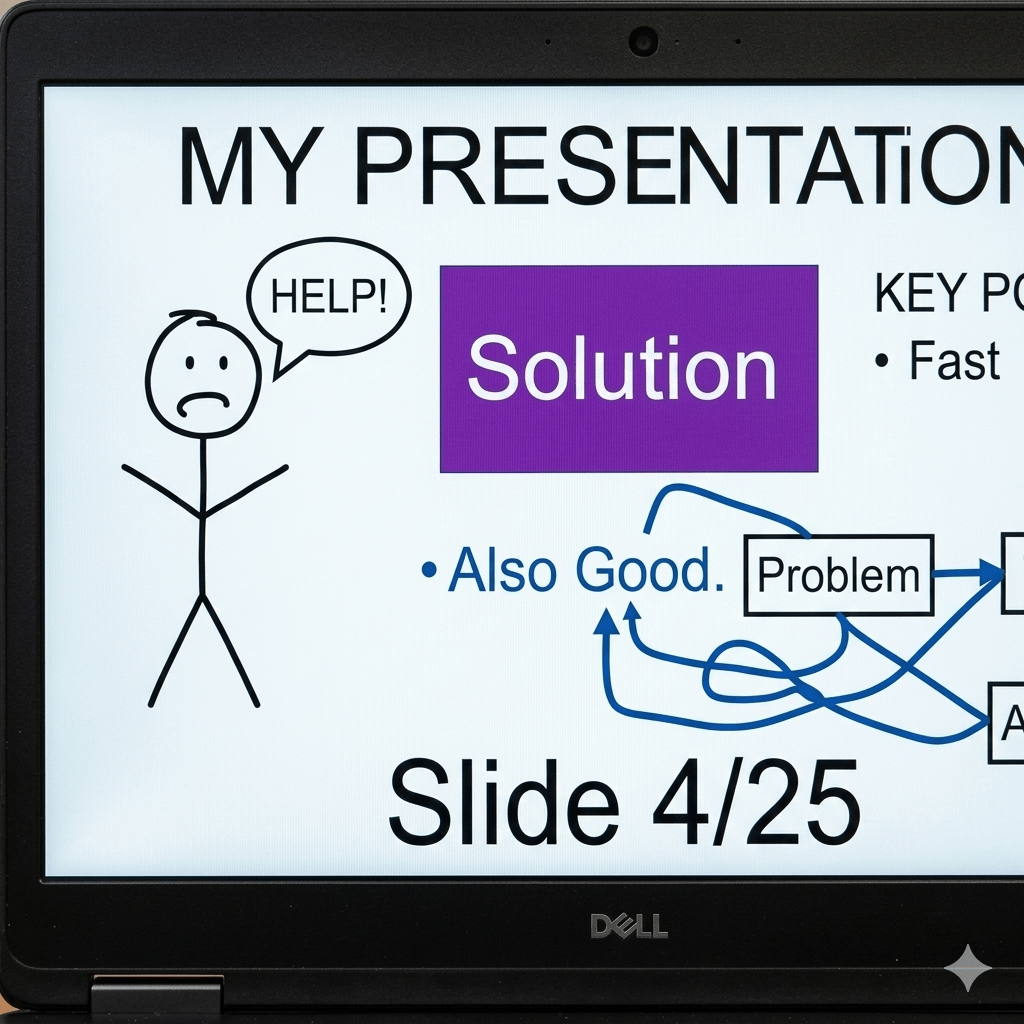
In the end, I used a different Microsoft product—PowerPoint. Not that it mattered.

Google Gemini.

When working with creative talent, you have to give them enough of your intent without constraining them. And I definitely did not constrain.

  • My PowerPoint used unformatted slides and default fonts.
  • The graphic concept that was central to the entire story consisted, in my concept, of three boxes with words in them. Later it became four boxes.
  • I used Google Gemini to create two subordinate concept images, but added indicators to show they should NOT be used. Even if the images were spectacular (they weren’t), we all know that my client couldn’t copyright them.
  • After I was supposedly done, I took one last pass through the slides and removed every unnecessary word.

I can’t share what happened after I completed the concept, but the creative talent had enough information to move forward.

And I saved my client a lot of time by performing the initial conceptual work so the client could execute immediately.

And that’s what matters.

“We Use AI.” And We Use YOUR (Non-copyrighted) AI.

A private social media comment got me thinking. I will gladly credit the author, with their permission.

“If a U.S. federal court says that you can’t copyright AI generated content, an appellate court upholds that ruling, and the SCOTUS refuses to hear the case, what are the implications for software generated by LLMs?”

Think about that the next time Company X publishes its marketing message “we use AI.”

What if Company X’s code and prompts were themselves written with AI?

Couldn’t Company Y take Company X’s non-copyrightable code and run it without penalty, like open source code?

Now Company X would be forced to prove that it does NOT use AI. For its code, anyway.

On Melanin

If you’re examining a person’s fingerprints, palm prints, face, and irises, you need to understand melanin.

The Cleveland Clinic goes into great detail on melanin, but for now I’m going to concentrate on one item.

There are three types of melanin, two of which affect the skin, eyes, and hair.

Eumelanin. There are two types of eumelanin: black and brown. Eumelanin is responsible for dark colors in skin, eyes and hair. People with brown or black hair have varying amounts of brown and black eumelanin. When there’s no black eumelanin and a small amount of brown eumelanin, it results in blonde hair.

Pheomelanin. This type of melanin pigments your lips, nipples and other pinkish parts of your body. People who have equal parts eumelanin and pheomelanin have red hair.

Melanin obviously affects the coloration of your skin, although some parts of your body (such as your fingertips) may have less melanin than other parts (such as your face).

Concentrating on fingertips and faces (and ignoring irises for the moment), let’s look at a situation where we use an optical mechanism (such as an optical fingerprint reader or a camera), along with available illumination, to photograph fingers and faces of people with varying skin tones.

But what if your entire photographic system is based upon reference materials optimized for light melanin levels? As late as the 1970s, Kodak’s reference materials, called “Shirley cards” after the first model, used to exclusively white people.

In the 1970s, photographer Jim Lyon joined Kodak’s first photo tech division and research laboratories. He says the company recognized there was a problem with the all-white Shirley cards.

“I started incorporating black models pretty heavily in our testing, and it caught on very quickly,” he says. “It wasn’t a big deal, it just seemed like this is the right thing to do. I wasn’t attempting to be politically correct. I was just trying to give us a chance of making a better film, one that reproduced everybody’s skin tone in an appropriate way.”

So hopefully today optical devices are properly capturing fingers, faces, and irises of people at all melanin levels.

Or is this wishful thinking?

Can You Tell Your Local Officials From Scammers?

This is not a comment on the corrupt nature of politics, but a question.

Apparently people in Kennebunk, Maine are receiving emails from their “Board Commissioners.”

“The email claims the permit is ready and approved, but that the “Board Commissioners” just needs a payment of $4,000 via wire transfer to finish it.

“Lee Feldman, deputy director of community development for the department, said Thursday that the email also named a former board member to try to bolster its apparent legitimacy.”

But Kennebunk citizens are smart, and one reported the scam attempt.

Know Your Locality.

Data Labelers Gonna Label

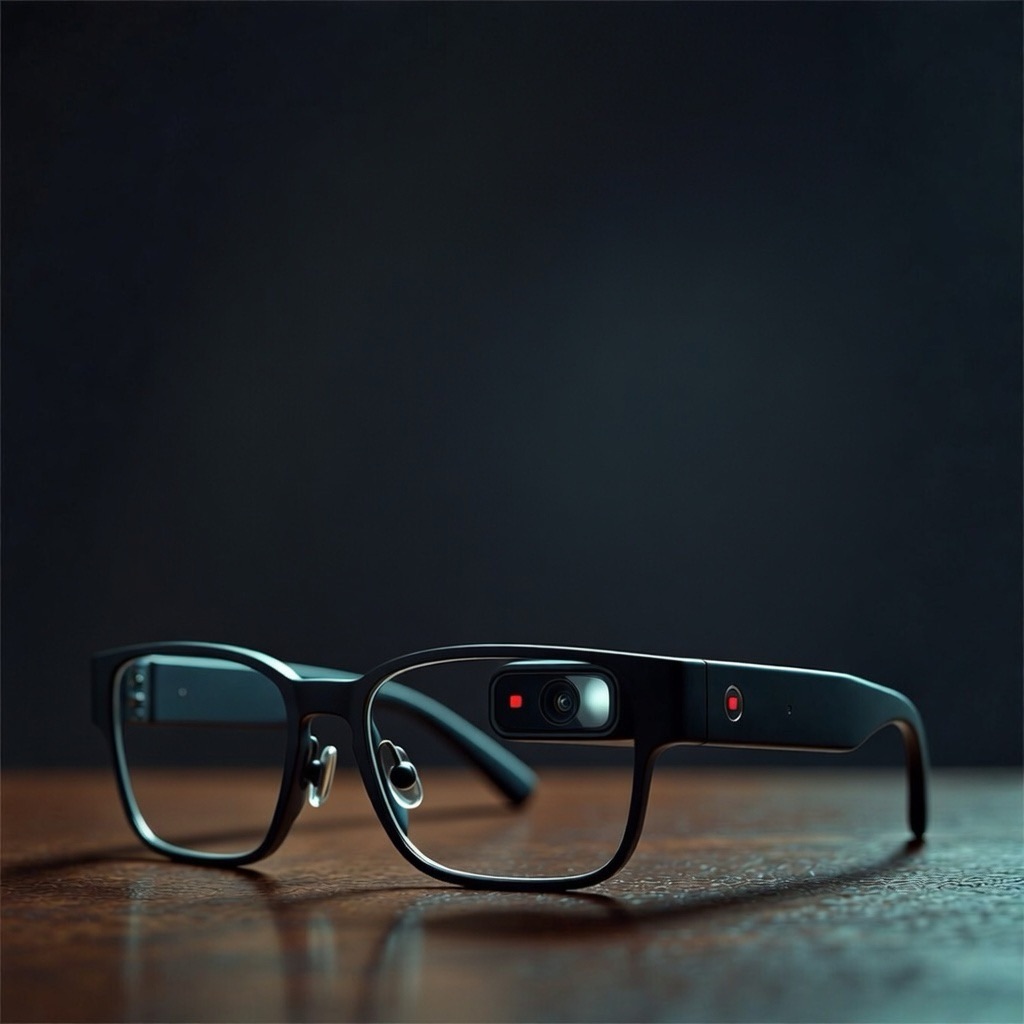
Before diving in, I should note that this is not just a Meta Ray Ban AI glasses issue.

This is an issue with ANY video feed that requires AI processing.

Because AI can’t do its job on its own.

To ensure that the AI is trained properly, an army of humans looks at the same data and uses data labeling to classify it.

We allow this when we sign those Terms of Service. And I personally believe it’s a good thing, since it helps correct errors from uncontrolled AI.

But Futurism notes the types of video feeds that the human data labelers have to label.

“I saw a video where a man puts the glasses on the bedside table and leaves the room,” one data annotator told the newspapers. “Shortly afterwards his wife comes in and changes her clothes.”

Grok.

Basically we record more than we should. One example: a bank card.

But regardless of whether data labelers are present or not, assume that any recording device will record anything, and potentially distribute it.

More on Velocity

I recently shared an NP Digital observation on velocity, so now let me share one from Marcia Riner.

“In fast-moving markets, speed of execution beats perfect strategy almost every time. Businesses that test ideas quickly, implement improvements, and make decisions without weeks of deliberation create momentum. That momentum compounds into growth, visibility, and opportunity.”

Bredemarket’s processes can—with your cooperation—result in rapid delivery of prospect-focused content.

So let’s talk.

Or you can take a few seconds to learn about the questions I ask to speed your content delivery.

I ask, then I act.

And the services I provide.

Bredemarket services, process, and pricing.

If Your Phone Has IMEI 440015202000…

When I posted (two times) the fact that International Mobile Equipment Identity (IMEI) numbers are NOT a reliable way to ascertain the identity of a user, I was pooh-poohed.

Tell that to the people of Bangladesh.

In that country, the National Equipment Identity Register (NEIR) went live on January 1, and it uncovered some surprising findings.

Turns out that tens of millions of phones in Bangladesh share their IMEIs with other phones. A single example:

“According to data generated after NEIR went live on January 1, a single IMEI, 440015202000, was found to be linked to 1,949,088 devices nationwide.”

So will you now admit that an IMEI is not a reliable way to identify an individual phone?

The Relationship Between Velocity and Sales Cost

Basil Hatto of NP (Neil Patel) Digital recently made the point that increased sales velocity reduces costs to the selling company, since the prospects reach decisions more quickly.

So how can a business like yours, or a business like Bredemarket, increase sales velocity?

Let’s discuss how Bredemarket’s marketing and writing services can help your content, proposal, and analysis needs.