If you’re not familiar with the complete history of the Eagles, you may not know that they began as practitioners of country rock. Their early songs were therefore softer than the ones from the Joe Walsh years.
One of those songs (actually later, but earlier in feel) was “Lyin’ Eyes.”
Glenn Frey and Don Henley could tell stories with the best country songwriters. And this was no exception, with a tale of a woman seeking solace outside of her marriage. Her life gets more scattered, until the singer turns judge and announces, “My, oh my, you sure know how to arrange things.”
But before that, when the singer is merely telling the story, the woman needs to seek solace.
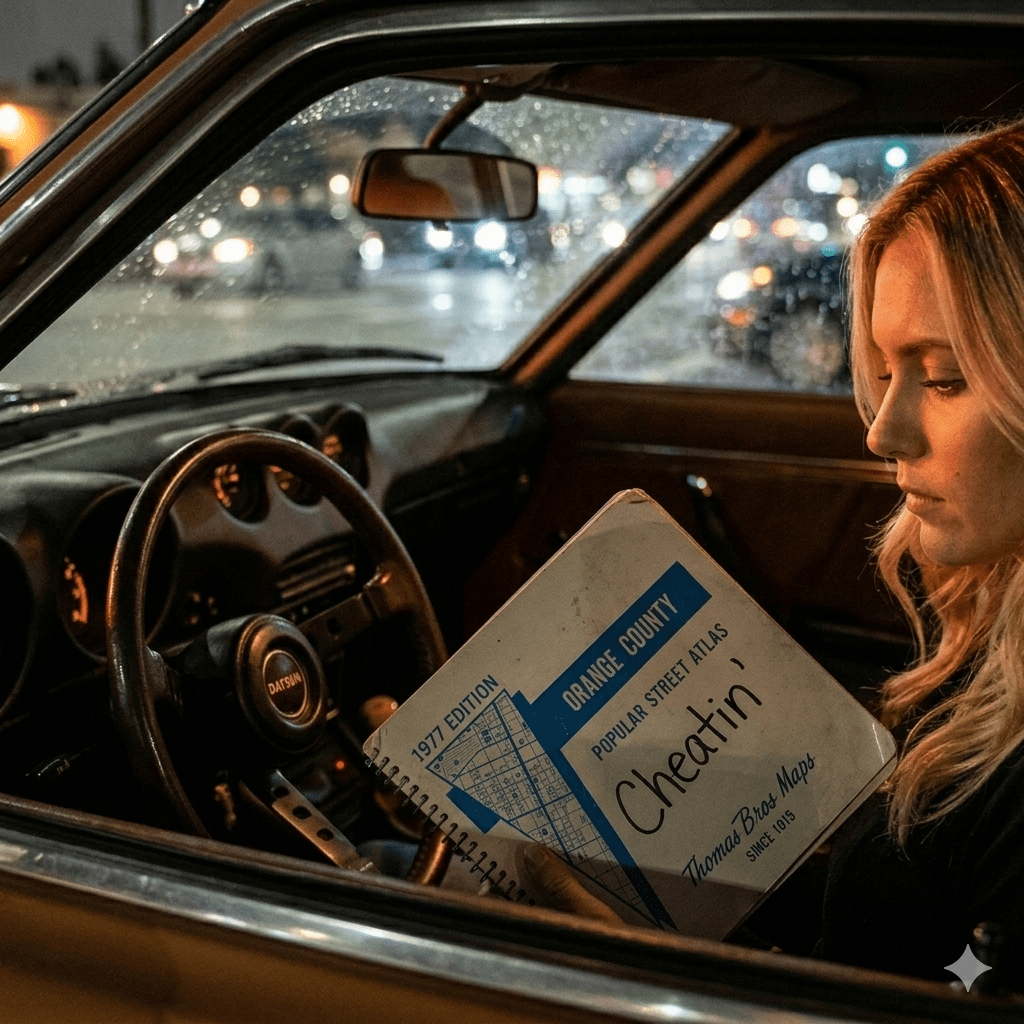
Google Gemini.
So the singer says what the woman is doing:
“She is headed toward the cheatin’ side of town”
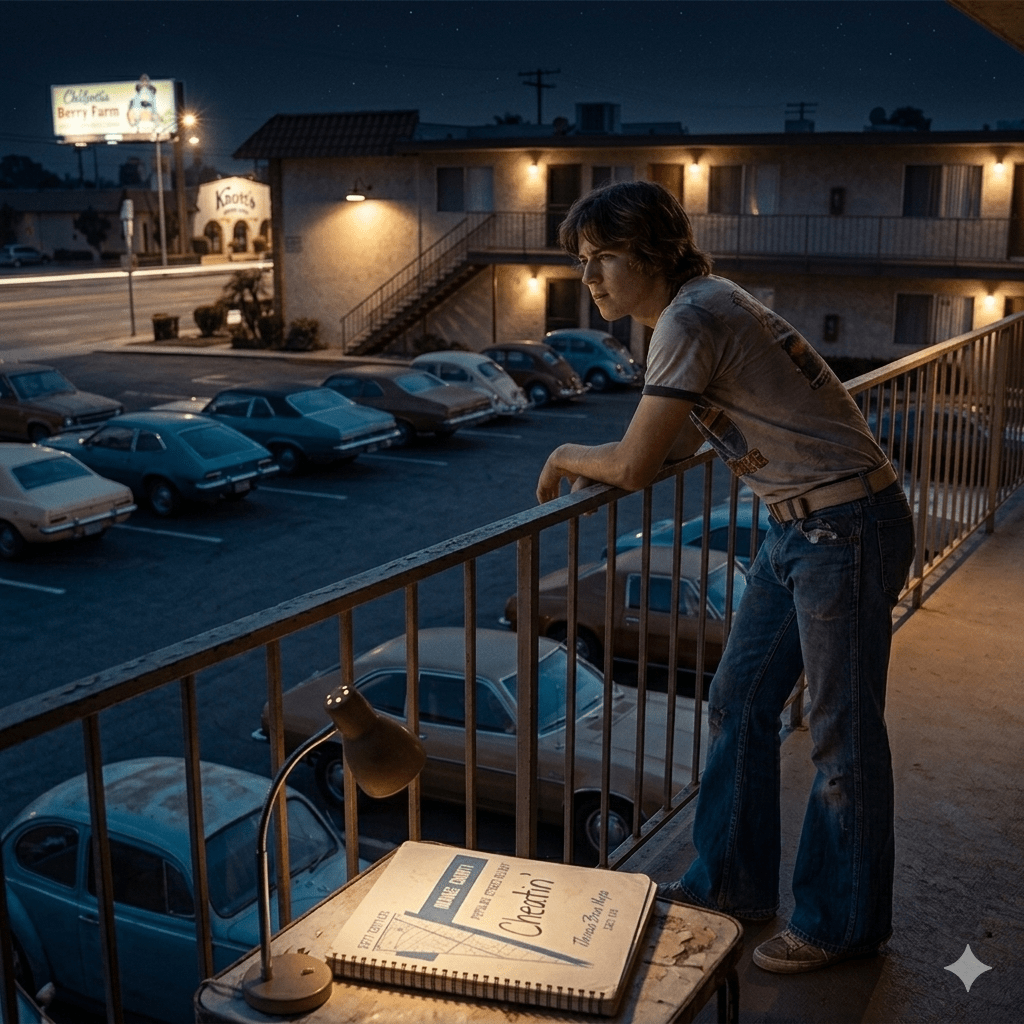
Now this is a lyrical fiction.
To my knowledge, no town in California or anywhere else enforces residential zoning regulations that segregate cheaters from non-cheaters. When “the boy” in the song rented his apartment (in Buena Park?), he didn’t need to indicate his receptiveness to desperate housewives. (Different decade, I know.)
Google Gemini.
So if the cheatin’ side of town is not a geolocation, is it perhaps tied to another factor of authentication?
After all, you could use non-identity biometrics such as respiration to discover the intent of a woman, whether she is driving
to comfort an old friend who’s feeling down, or
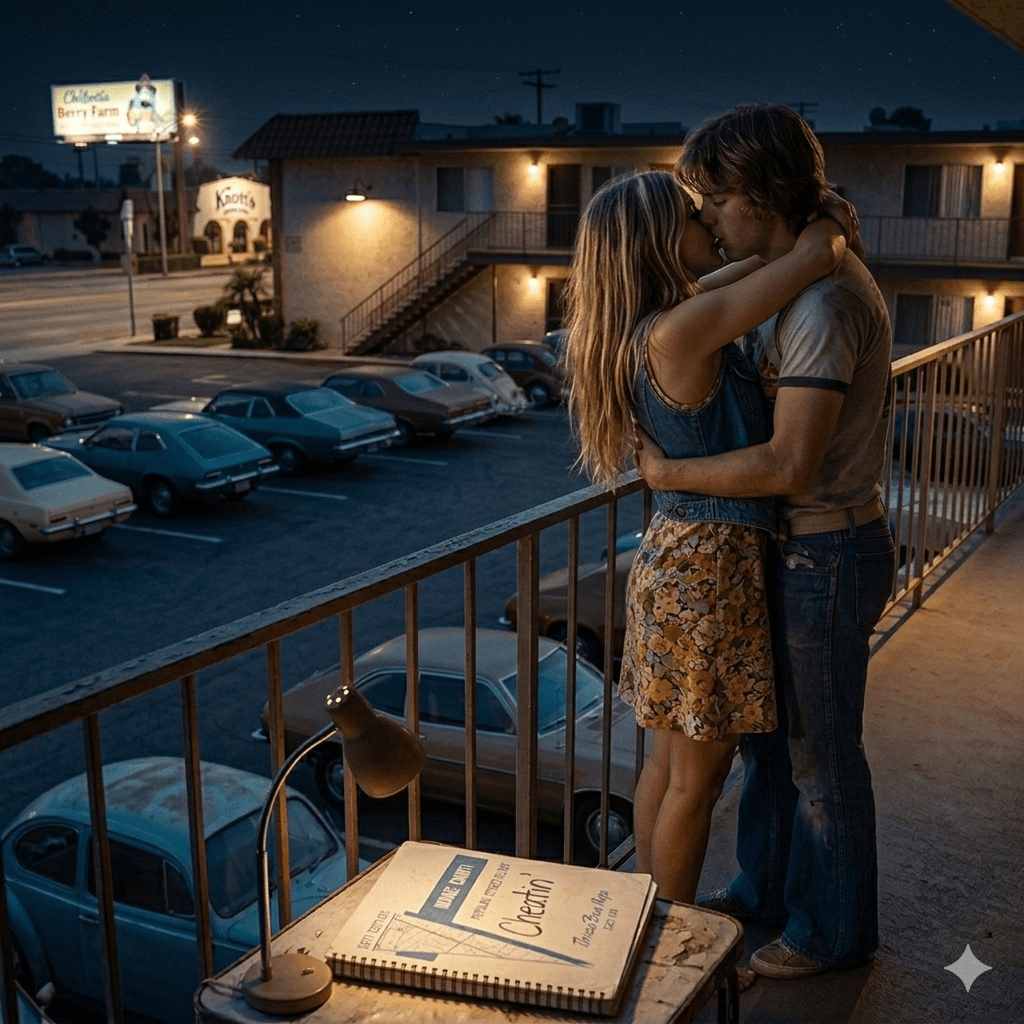
to rush into a man’s arms as they fall together.
Cheaterland is a state of mind. My, oh my.
Google Gemini.
And if I may interject an author’s note, I am VERY impressed with Google Gemini (Nano Banana 2) for knowing what a “Thomas Brothers Map” is. Except that I had to change my story setting from North Hollywood to Buena Park to match the images.
“Life in the Fast Lane,” of course, would need a Los Angeles County map.
Some of you knew these deepfake thoughts were coming. Might as well finish side one.
Elton.
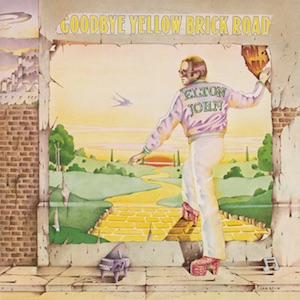
When we last met, I had discussed the othertwo tracks from side one of Elton John’s “Goodbye Yellow Brick Road.” Of course albums no longer have sides, but these three tracks/four songs give an idea of the breadth of Elton John’s first double album.
But this isn’t merely a music review. It also has to satisfy an Important Purpose. So this post about “Bennie and the Jets” will talk about…deepfakes.
Is it live?
After all the negativity that started the album, it was time for a little joy.
Bennie and the Jets.
A happy song about a band.
About fans who read things in magazines.
All topped off by Elton’s charged performance in front of a live, cheering audience.
Um…no.
While Elton John has given many live performances, the recording of “Bennie and the Jets” is not one of them.
“Elton’s producer Gus Dudgeon wanted a live feel on this recording, so he mixed in crowd noise from a show Elton played in 1972 at Royal Festival Hall. He also included a series of whistles from a live concert in Vancouver B.C., and added hand claps and various shouts.”
But in retrospect, I can’t imagine the song as a straight studio recording. Dudgeon was right: it HAD to sound live.
And that “live” performance yielded a bigger surprise…and Reginald Dwight was most surprised of all.
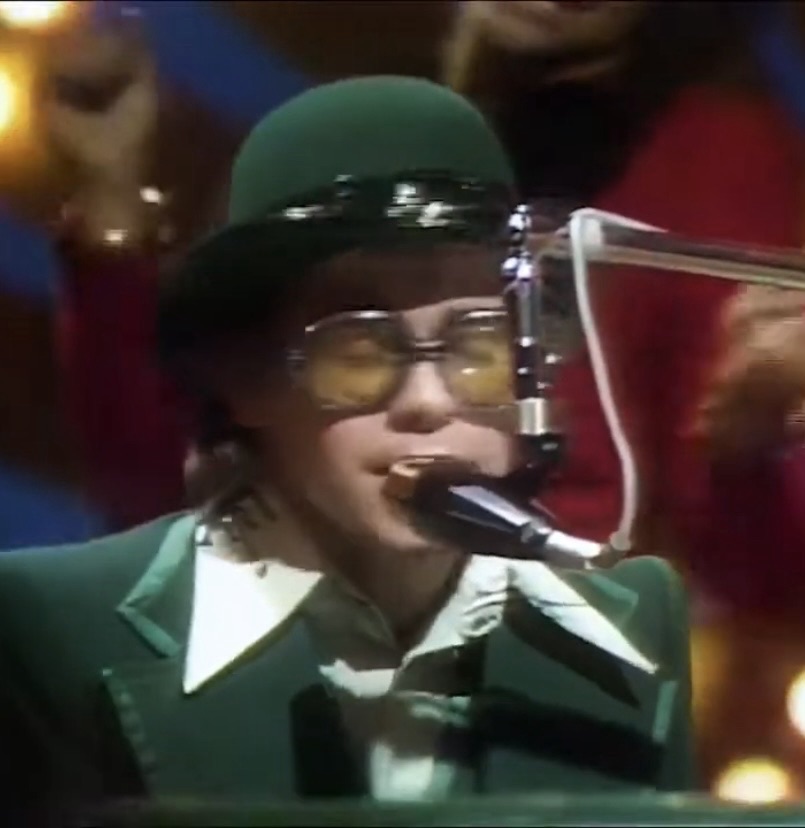
Reginald Dwight, soul god
For those who don’t know who Reginald Dwight is, he was born in 1947 in an English town. A shy boy whose parents divorced in his teens, the most notable aspect of his life was his piano talent. He obviously wasn’t going to become a banker as his father originally intended.
Oh, and one more thing. Dwight was Caucasian. And all of his reinventions, including his adoption of the stage name Elton John, wasn’t going to alter that.
But Elton was pretty fly for a white guy. Worked his way up to musical ladder until he achieved success on his own. First with some notable performances, then some hit albums, then some number ones.
“When Elton recorded “Bennie And The Jets,” MCA, his label, wanted to make the song a single. Elton disagreed vociferously. His pick was “Candle In The Wind”…”
What persuaded Elton to change his mind…at least in the North American market?
“But Elton was swayed when “Bennie And The Jets” started doing well on Detroit R&B radio.”
Yes, R&B. “Bennie and the Jets” reached #15 on Billboard’s R&B charts. Which both pleased and amused Elton.
“What am I going to do on my next American tour? Play the Apollo for a week, open with ‘Bennie,’ and then say, ‘Thanks, you can all go home now.'”
If only there were a forum where he could play a single song for a large black audience…
Don Cornelius was all too happy to provide the forum.
Soul Train.
Elton John wasn’t the first white artist to perform on Soul Train, but he was one of the few.
Technically this wasn’t a deepfake; Elton John didn’t pretend to be black. But he clearly absorbed some distinct musical influences: Little Richard, Ray Charles, Aretha Franklin, Fats Domino, Otis Redding, Nina Simone, Marvin Gaye, Wilson Pickett, James Brown, Stevie Wonder, The Temptations, Martha Reeves, Clyde McPhatter, and Sam Cooke. (Google Gemini helped me assemble this list.)
And he wasn’t a one hit wonder. Subsequent Philadelphia-influenced songs “Philadelphia Freedom” and “Mama Can’t Buy You Love” also made the R&B top 40.
Compare with Mick Jagger, who rarely made the R&B charts either as a Rolling Stone or as a solo artist. “Miss You” did, but Jagger’s highest placement was when he guested on the Jacksons’ “State of Shock.”
Because the phrase applied to so many troubled live fast die young types. Joplin’s own death was popularly linked with the deaths of Jimi Hendrix and Jim Morrison. And the phrase fit many others.
Including Norma Jeane Mortenson.
1973.
By the time lyricist Taupin was done with Mortenson, and his songwriting partner Elton John had added music to create “Candle in the Wind,” millions were convinced that Taupin was a Marilyn Monroe fanatic.
He wasn’t, but lines like “the young man in the 22nd row” certainly gave that impression.
But then came Farm Aid IV.
Ryan White
Farm Aid emerged from a desire to do for American farmers what prior efforts had done for people in Bangladesh and Ethiopia. And it wasn’t only for the Willie Nelsons, John Mellencamps, and Neil Youngs of the world. Elton John showed up by surprise at Farm Aid 4, with a special dedication.
“This one’s for Ryan.”
While Ryan White’s battle with AIDS was not haunted by demons like Monroe and the others, his death the next day was also untimely.
And one more repurposing
A few years later, for a grieving United Kingdom, Bernie Taupin altered the lyrics to the original song, and Elton John performed a tribute to his deceased friend Princess Diana.
1997.
And you thought “Funeral For A Friend”/“Love Lies Bleeding” was dark. “Candle in the Wind” is directly linked to four deaths—Janis Joplin, Marilyn Monroe, Ryan White, and Princess Diana—and indirectly linked to others.
Sometimes I write pieces that cover multiple topics, in this case both a technical analysis of digital asset taxonomies and classifications in a multi-faceted sense, and a musical analysis of the multi-faceted genres present in a single song. Whoops, two songs. (One track.)
Because the source picture used to generate the song is not exclusively biometric in nature.
Identity and non-identity technologies. Gemini.
If you look in the lower right corner of the picture you can see a reference to digital asset taxonomy, a reference to a Bredemarket client that specializes in Adobe Experience Manager implementations.
Which brings us to Spotify.
Building the perfect Spotify playlists
Every month without fail I build at least one Spotify playlist for my listening pleasure. Normally these are a mixture of different decades and genres, all thrown together.
Saturday (February 21) I thought I’d be more thematic and create multiple playlists sorted by genre. So far I’ve created four:
Dance, including the Andrea True Connection and Britney Spears.
Electronic, including Kraftwerk and Röyksopp.
Folk, including the Brothers Four and R.E.M.
Punk, including Public Image Ltd. and Hole.
I tried to stay away from traditional categories such as country and disco, and didn’t try to distinguish between punk and hardcore, or genre and NEO-genre.
And I recognize that artists can span multiple genres. Some Devo songs are in my electronic playlist, others are in my punk playlist, and when I get to “Disco Dancer” it won’t go in either.
Which brings us to Elton John.
Building the imperfect digital asset taxonomy
Elton John’s career has spanned multiple genres. The bespectacled piano player has covered simple love songs, energetic power trios (17-11-70), bombastic orchestral episodes, crocodile rock, an island girl, and everything else. And that’s just in his first decade, before he became Disney soundtrack guy.
However, in most cases Elton, Bernie Taupin, and his other collaborators would stick with a particular genre for an entire song. Because that’s what good product marketers do: stick to a single message. Bad product marketers like me tend toward multiple message overload…I seem to have strayed from my point. *** EDIT THIS LATER
But perhaps you noticed the music I incorporated here.
How do you taxonomize THIS digital asset?
1973 in music
Before I describe the problem, let me set the scene.
“Goodbye Yellow Brick Road” was the second of two albums that Elton John released in 1973. It was a sprawling double album.
Elton’s predecessor album, “Don’t Shoot Me I’m The Only Piano Player,” was a number one album with a number one single, the aforementioned “Crocodile Rock.” The album also included the popular song “Daniel” and a character piece (in the Randy Newman tradition) “Texan Love Song.” (Lyricist Bernie Taupin often courted controversy.)
But much was going on outside the pop star world that Elton John seemingly occupied. Progressive music was reaching its peak. While Elton’s first 1973 album rhapsodized on elderberry wine and backed away from the Paul Buckmaster arrangements, 1973 saw releases from Emerson Lake and Palmer, Genesis, Jethro Tull, King Crimson, and Yes. Oh, and an album by Pink Floyd entitled “Dark Side Of The Moon.” When I asked Google Gemini about 1973 progressive albums, it replied in part, “If you enjoy odd time signatures and 20-minute compositions, 1973 is your playground.”
However, music is governed by Newton’s Third Law of Motion, and some definitely anti-progressive works were just starting to appear. The New York Dolls released an album, and underground recordings were circulating of a band called The Modern Lovers.
A significant portion of American teenagers didn’t care about any of this. For them, the ONLY album of importance was Led Zeppelin’s “Houses of the Holy.”
Side one of four, track one, songs one and two
Which brings us to “Funeral For A Friend”/“Love Lies Bleeding.” Technically a two-song medley, but distributed (both physically and electronically) as a single asset.
Elton had tons of fans who were all too happy to rush out, slap $9.98 on the counter to buy “Goodbye Yellow Brick Road” upon its release, and plunk side one of the first record on their turntables.
Time to listen
I suspect that the “WTF” acronym was invented in November 1973.
WTF?
Because the listeners weren’t hearing “the only piano player.”
And they weren’t hearing a Paul Buckmaster-conducted orchestra.
You couldn’t hear a recognizable piano until the 1:40 mark of the song. Slowly you hear Dee, Nigel, and Davey, and the song slowly (but not completely) transitions away from the Hall of the Progressive Masterpiece in the Court of the Multi-Coloured Bespectacled Lunatic on the Top of the Charts. (And no, “lunatic” is not too strong here, since this song falls between Elton John’s known suicide attempts in 1968 and 1975.)
Then, after the band (augmented by Hentschel) brings “Funeral for a Friend” to an energetic conclusion, the piano player transitions to the second song at the 5:22 mark. And Elton, who has been silent all this time, finally sings.
And time to reflect
Let’s review, shall we?
Although the tone is dark with themes of breakup and demise, portions of this sound like a typical Elton John pop song.
But before that it begins with sounds that made American teenagers wondered if they had picked up a Yes album by mistake.
And while few portions of the songs are minimal like Mr. Richman, or include towering solos like Mr. Page, parts would have fit well into a New York studio performance three years earlier. And Elton at his best could outdress the Dolls.
That was fun. Now comes the challenge.
How do you classify THIS?
I’ve already implicitly noted that music classification is a tricky affair.
Take “MacArthur Park,” a song recorded by everyone from Richard Harris to Waylon Jennings to Donna Summer. There are over 200 versions of the song spanning multiple genres. And composer Jimmy Webb is challenging to classify.
Now look at Elton’s song and my four playlists.
The track isn’t folk, dance, or punk.
But is it electronic? Portions are decidedly NOT.
Multi-faceted
You could cheat and place it in two (or more) classifications. Heather Hedden addresses faceted classification:
“The idea of faceted classification as a superior alternative to traditional hierarchical classification, whereby an item (such as book or article) can be classified in multiple different ways instead of in just a single classification class/category, is not new. The first such faceted classification was developed and published by mathematician/librarian S.R. Ranganathan in 1933, as an alternative to the Dewey Decimal System for classifying books, called Colon Classification (since the colon punctuation was originally used to separate the multiple facets).”
A taxonomy, however, is different—ideally:
“[F]aceted taxonomies should…ideally be mutually exclusive, in contrast to the principle of faceted classification…”
My solution
Returning to my Spotify playlist problem:
I could simply place the song in multiple playlists: for example, an electronic playlist and some type of guitar/rock/whatever playlist.
Or I could create a single hyphenated playlist, such as an electronic-guitar playlist. (Many Depeche Mode songs, beginning with “Route 66,” would be ideal here.)
For now I followed neither option, but added “Funeral for a Friend”/“Love Lies Bleeding” into my existing electronic playlist (because it starts electronically) and nowhere else.
“Since launching the Gemini app, we’ve built tools to encourage creative expression through images and video. Today, we’re taking the next step: custom music generation. Lyria 3, Google DeepMind’s latest generative music model, is rolling out today in beta in the Gemini app.”
I used this prompt to generate a Lyria tune:
“Create music for a wildebeest using a laptop to compare a latent fingerprint to a tenprint fingerprint”
Google’s response:
“’I’ve created a unique atmospheric track for you that blends electronic data-processing sounds with the deep, resonant textures of a wildebeest’s world. You can play the music directly here in our chat!”
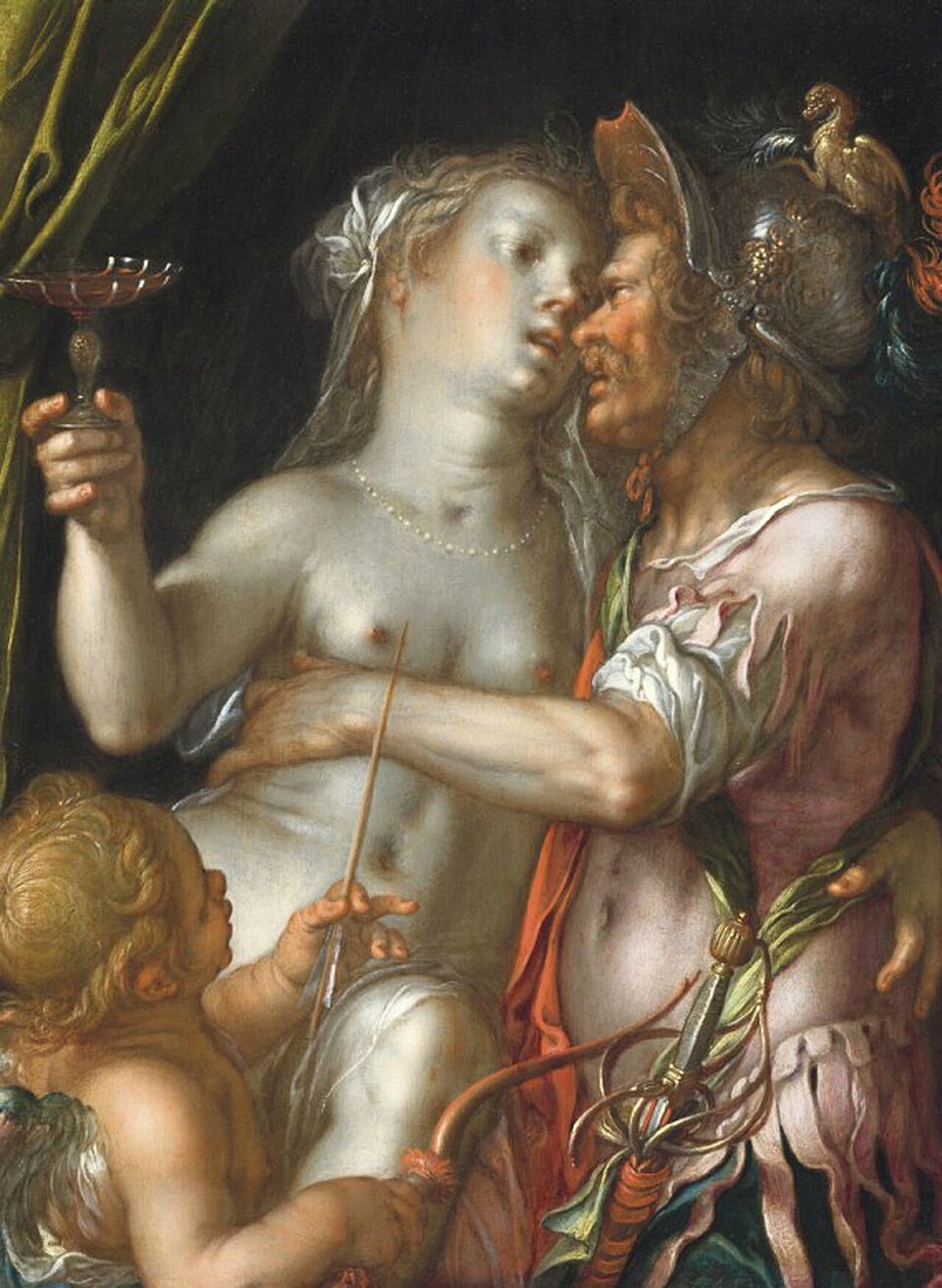
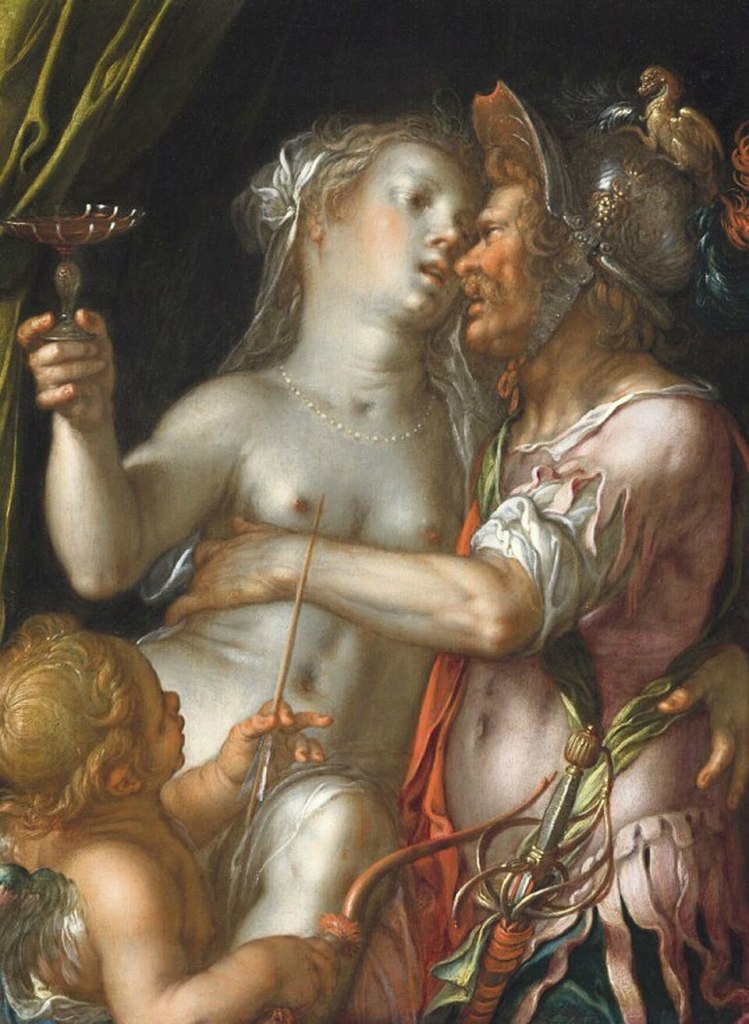
Considering his connection to erotic love, it’s no surprise that the parentage of Cupid (or Eros to the Greeks) is mysterious, but at least some sources consider Cupid to be the son of Venus (Aphrodite) and Mars (Ares).
By Joachim Wtewael – Scan from a magazine article by Marion Cornélie van Oudheusden: Joachim Wtewael: de lotgevallen van Venus en Mars, Oud-Utrecht 92, June 2019, 65-69, Public Domain, https://commons.wikimedia.org/w/index.php?curid=79575481.
Which of course makes me think of Paul McCartney and Wings.
But not the song that leads into a song about Jimmy Page.
I think of the reprise. The song that leads into a song about ancient…Egypt. (Hathor?)






 Bredemarket