What is “Know Your Business” (KYB)?

I run in circles that use the acronym KYB, or “Know Your Business.” But I realize that many of you don’t use this acronym every day, so I thought I would explain it.

Let’s say that you encounter a business such as ByteDance or HiveLLM or Lorem Ipsum and you want to know more about it.

There are good reasons to understand a business before engaging with it.

As financial institutions and other businesses have known for years, there are services such as “Know Your Customer” and “Know Your Business” that organizations can use. 

“KYC and KYB let companies make sure they’re dealing with real people, and that the business is legitimate and not a front for another company—or for a drug cartel or terrorist organization.”

Even if you’re not dealing with extremist terrorists, you may want to have a better understanding of where the business is and/or who runs the business. Remembering that the legal owner of the business may not be the one who is actually operating it. For example, the Mob Museum documents the original ownership of the late Tropicana Hotel in Las Vegas:

“Miami hotelier Ben Jaffe (part owner of the Fontainebleau in Miami Beach) owned the land on which the casino would sit, but Conquistador Inc. would build and operate the resort.

“It just so happened that Conquistador’s owner, “Dandy” Phil Kastel, had a long and fruitful partnership with Frank Costello, perhaps the nation’s most infamous gangster in the spring of 1957…. And it almost goes without saying that most ‘Miami hotel men’ who came to Las Vegas in this era were more than familiar with Meyer Lansky, another famous gangland name.”

Unfortunately for Costello, people soon knew HIS business:

“On May 2, 1957, while entering a New York apartment building, Costello was shot and wounded by Vincent “the Chin” Gigante on orders from rival Mafia boss Vito Genovese. Written on a piece of paper found by police inside Costello’s coat pocket was the exact gross win from the Tropicana as of April 27, 1957 — $651,284, less $153,745 in markers (loans to players), with the proceeds from slot machines at $62,844. The note mentioned $30,000 for “L” and $9,000 for “H,” likely money to be skimmed on behalf of Costello’s underworld partner Meyer Lansky and perhaps for Mob-connected Teamsters union boss James Hoffa. It was a big national news story.”

It’s best to know your business BEFORE it’s splashed all over the media.

OneTaste: Know Your (Convicted Forced Labor) Business

If I get my products from my vendor, why do I need to implement Know Your Business (KYB) or Third-Party Risk Management (TPRM)?

Perhaps Compliance Week has a good answer:

“About 27.6 million people around the globe are ensnared by modern slavery, which refers to people being forced to work and losing their freedom due to imprisonment, threats of violence, debt bondage, or retention of their identity papers, according to the United Nations’ International Labor Organization.”

Yeah, but who cares about Third World countries? 

Tell that to the former owners of OneTaste:

“As proven at trial, between 2006 and May 2018, [Nicole] Daedone and [Rachel] Cherwitz obtained the labor and services of multiple young women who had turned to OneTaste for healing and spirituality by coercing them to perform labor, including sexual labor, for the defendants’ benefit.”

Would you want to do business with THAT company?

Although it has undergone an ownership and name change:

“n 2017, Ms. Daedone sold OneTaste for $12 million, prosecutors said. The former OneTaste.us website now directs visitors to The Eros Platform, a community that still promotes it affiliation with Daedone, Cherwitz and and their Orgasmic Meditation practice. The Eros Coaching Collective still advertises a three-session OM training package for $525.”

When HiveLLM Pitches an Anti-Fraud Professional

I received a suspicious email from “Sara Romano,” a “scout” with HiveLLM who wanted me to bid on a biometric content calendar with a budget of “75000” (no currency specified).

HiveLLM has no corporate address, no LinkedIn presence, a website only a couple of months old, and an advertised business model in which you can ask a question for 10 cents.

Oh, and “Sara Romano” also cold emailed Danie Wylie, who also found the pitch sketchy: https://m.facebook.com/story.php?story_fbid=pfbid0nvmhyuLpn3jwMv8K8sbK5EXfS4kcpjfWHicgj4BJhdFLMme87P5fvPSYf9CwjRH7l&id=100001380243595&mibextid=wwXIfr

A clear case of the need for Know Your Business (KYB).

And as you can see, HiveLLM failed a rudimentary KYB check.

But let’s ask some questions anyway.

“Sara, to confirm that HiveLLM is not a fraudulent entity, please provide your corporate address, registration information, and the identities of your owner(s) and corporate officers.”

UPDATE. At midnight Pacific Time, “Sara” sent a long response. Buried toward the end: “I’m unable to provide corporate registration or ownership details.”

When Beneficial Ownership Diverges From Legal Ownership

I recently discussed some proposed changes to the way in which beneficial ownership information (BOI) is collected. However, even after the changes are made, FinCEN will still collect BOI for foreign firms.

Hungary, facial recognition, and geolocation

Biometric Update recently published a story about facial recognition in Hungary, and its use to identify people who display rainbows and dress in ways “that diverge from the gender they were assigned at birth.” I’m going to zero in on one portion of the story: the facial recognition provider involved.

The company FaceKom has been around under different names since 2010 but has seen significant growth during the past few years thanks to investments from the Central European Opportunity Private Equity Fund (CEOM). The fund has no direct links with [Prime Minister Orbán’s son-in-law, István] Tiborcz. However, it is registered on the same address in Budapest where several companies owned by Orbán ‘s son-in-law operate.

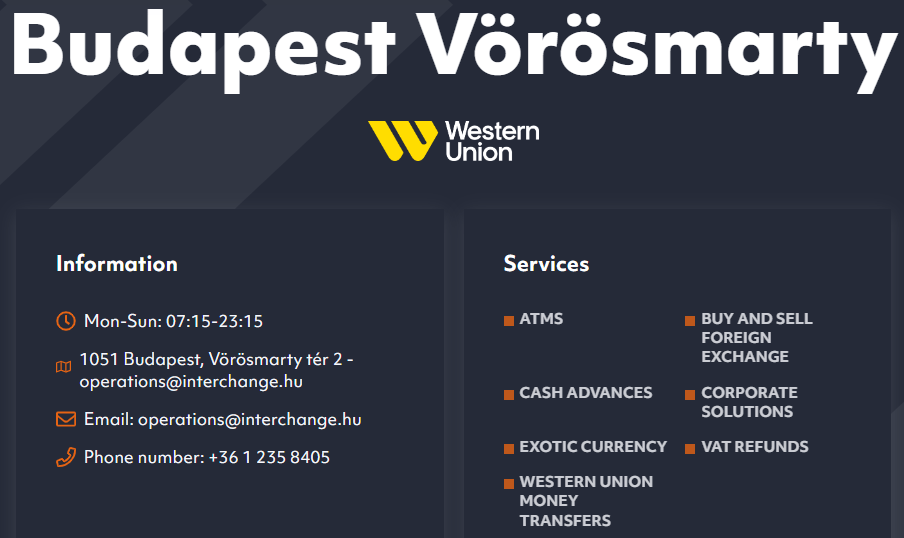
Ah, geolocation! The Chi Fu Investment Fund Management Zrt.’s address of record is 1051 Budapest, Vörösmarty tér 2.

And do you know what else is at that address?

A Western Union Currency Exchange.

Well, that’s enough to drive some conspiracy theorists crazy.

Beneficial ownership and legal ownership

So I didn’t find the smoking gun, but I do want to take this opportunity to point out what BENEFICIAL ownership is. Investopedia:

A beneficial owner is a person who enjoys the benefits of ownership even though the title to some form of property is in another name.

Using the Hungarian example (without the Western Union part), it’s not enough to say that CEOM and/or Chi Fu Investment Fund Management Zrt. (I don’t know enough Hungarian to confirm they are one and the same) does not list István Tiborcz (or Victor Orbán) as an official owner or co-owner.

As Unit21 points out, you don’t have to literally own (either on your own or through a trust) 25% of an entity to be a beneficial owner. Here’s another criterion of a beneficial owner:

Any individual that holds a significant ability to control, manage, or direct the legal entity

De facto control without de jure control could very well be wielded by a powerful politician, or his son-in-law.

(Imagen 3)

Don’t Know Your Business and Corporate Transparency Act Limited Enforcement (Oh BOI Again)

AuthenticID shared the following:

“In March, the U.S. Treasury Department announced it would no longer enforce the Corporate Transparency Act, the anti-money-laundering law that requires millions of businesses to disclose the identity of their real beneficial owners.”

Not entirely accurate as we will see, but the details are gated. But not at JD Supra:

“On March 26, 2025, FinCEN issued an interim final rule and request for comments, removing the requirement under the Corporate Transparency Act (CTA) for both U.S. companies and U.S. persons to report beneficial ownership information to FinCEN. The rule is effective March 26, 2025. Thus, subject to additional rule changes, U.S. companies and U.S. individuals no longer have to file an initial Beneficial Ownership Information Report (BOIR) or otherwise update or correct a previously filed BOIR.”

As the interim rule itself clarifies, foreign companies still have to report.

“On March 2, 2025, Treasury announced the suspension of enforcement of the CTA against U.S. citizens, domestic reporting companies, and their beneficial owners, and Treasury further announced its intent to engage in a rulemaking to narrow the Reporting Rule to foreign reporting companies only.”

The interim rule itself addresses the convoluted history (one, two, three) of FinCEN’s attempts to enforce anti-money laundering (AML) laws as court challenges persist.

I will let you judge whether this is welcome relief from bureaucracy for American companies, or a huge FinCEN loophole that facilitates AML financial identity evasion by simply letting companies represent themselves as domestic, allowing them to launder as much money as they please for terrorists, drug dealers, and others.

Not that I have an opinion on that.

(Business terrorist image Imagen 3/Google Gemini)

Jobseekers and Know Your (Fill in the Blank)

I’ve noticed that my LinkedIn posts on jobseeking perform much better than my LinkedIn posts on the technical intricacies of multifactor identity verification.

But maybe I can achieve both mass appeal and niche engagement.

Private Equity Talent Hunt and Emma Emily

A year ago I reposted something on LinkedIn about a firm called Private Equity Talent Hunt (among other names). As Shelly Jones originally explained, their business model is to approach a jobseeker about an opportunity, ask for a copy of the jobseeker’s resume, and then spring the bad news that the resume is not “ATS friendly” but can be fixed…for a fee.

The repost has garnered over 20,000 impressions and over 200 comments—high numbers for me. 

It looks like a lot of people are encountering Jennifer Cona, Elizabeth Vardaman, Sarah Williams, Jessica Raymond, Emily Newman, Emma Emily (really), and who knows how many other recruiters…

…who say they work at Private Equity Talent Hunt, Private Equity Recruiting Firm, Private Equity Talent Seek, and who knows how many other firms.

If only there were a way to know if you’re communicating with a real person, at a real business.

Actually, there is.

Know Your Customer and Business

As financial institutions and other businesses have known for years, there are services such as “Know Your Customer” and “Know Your Business” that organizations can use. 

KYC and KYB let companies make sure they’re dealing with real people, and that the business is legitimate and not a front for another company—or for a drug cartel or terrorist organization.

So if a company is approached by Emma Emily at Private Equity Talent Hunt, what do they need to do?

The first step is to determine whether Emma Emily is a real person and not a synthetic identity. You can use a captured facial image, analyzed by liveness detection, coupled with a valid government ID, and possibly supported by home ownership information, utility bills, and other documentation.

If there is no Emma Emily, you can stop there.

But if Emma Emily is a real person, you can check her credentials. Where is she employed today? Where was she employed before? What are her post secondary degrees? What does her LinkedIn profile say? If her previous job was as a jewelry designer and her Oxford degree was in nuclear engineering, Emma Emily sounds risky.

And you can also check the business itself, such as Private Equity Talent Hunt. Check their website, business license, LinkedIn profile, and everything else about the firm.

But I’m not a business!

OK, I admit there’s an issue here.

There are over 100 businesses that provide identity verification services, and many of them provide KYC and KYB.

To other businesses.

Very few people purchase KYC and KYB per se for personal use.

So you have to improvise.

Ask Emma Emily some tough questions.

Ask her about the track record of her employer.

And if Emma Emily claims to be a recruiter for a well-known company like Amazon, ask for her corporate email address.

(Image from Microsoft Copilot)

Where is ByteDance From?

Know Your Business!

Where is ByteDance From?

I am VERY familiar with questions regarding the nationality of a company. There are three questions:

  • Where is it incorporated?
  • Where is it headquartered?
  • Who owns it?

IDEMIA

For my former employer IDEMIA, the answers are France, France, and primarily a U.S. investor (Advent International).

(So depending upon your needs, you can argue that IDEMIA is a French company or a U.S. company.)

ByteDance

For ByteDance, the answers are the Cayman Islands, China (Beijing), and primarily global investors (Blackrock, General Atlantic, Susquehanna International Group, etc.).

(So depending upon your needs, you can argue that ByteDance is a Chinese company, a mostly American company, or a British company off the coast of Cuba.)

Your company

Not that I create TikTok videos (at least not for paying clients), but I provide other services.

More information on Bredemarket’s Content-Proposal-Analysis marketing and writing services:

CPA
Bredemarket’s “CPA.”

A3ML: When Regular AML is Not Good Enough

As some of you know, AML stands for Anti-Money Laundering. It ensures that money given to Johnny Angel doesn’t end up in the hands of Vladimir Putin. This impacts financial institutions:

“Banks had to follow government regulations (know your customer, anti-money laundering, know your business), even in the midst of a worldwide pandemic.”

But AML goes far beyond banks because of its national security implications. Which means the military has to get involved.

Therefore DARPA has entered the picture, with its Program Announcement (posted on SAM as DARPA-SN-25-23) for something DARPA calls “Anticipatory and Adaptive Anti-Money Laundering,” or A3ML.

Uh, what? GovTribe explains:

“The program seeks to develop sophisticated algorithmic methods that can analyze financial transaction graphs and detect suspicious patterns more effectively than existing manual processes. This initiative represents a significant shift towards proactive and predictive financial crime detection methodologies.”

Of course, the introduction of the word “predictive” raises alarm bells, based upon activities outside of banking. At best, police potentially waste a lot of time investigating every single broken tail light. At worst, Muslim lawyer Brandon Mayfield becomes a suspect for a crime he didn’t commit.

Hopefully the people pursuing A3ML can minimize bias.