“In Jordan, the apparel sector relies heavily on a large migrant workforce, many of whom lack access to bank accounts and remain unbanked. Wage payments have traditionally been cash-based…”
To facilitate cash payments to unbanked apparel workers in Jordan, IrisGuard stepped in with its EyePay product.
“Cairo Amman Bank (CAB) Jordan…has launched a national-scale biometric cash salary payment network for unbanked workers.
“With just a simple iris scan, employees can securely access their wages instantly, without the need for a bank account, PIN, or physical ID.”
I don’t think this is tied to an iris-based time and attendance system, but that is the obvious next step.
“M5 provides an even faster, smoother, and more responsive experience for Apple Vision Pro users, while introducing new opportunities for developers to create more advanced spatial and immersive experiences. Built using third-generation 3-nanometer technology, M5 on Vision Pro features an advanced 10-core CPU that delivers higher multithreaded performance, resulting in faster experiences throughout the system, including faster load times for apps and widgets and more responsive web browsing.”
Source: Apple.
“The Dual Knit Band delivers an even more comfortable fit for users. It features upper and lower straps that are 3D-knitted as a single piece to create a unique dual-rib structure that provides cushioning, breathability, and stretch. The lower strap features flexible fabric ribs embedded with tungsten inserts that provide a counterweight for additional comfort, balance, and stability. And the intuitive dual-function Fit Dial allows users to make fine-tuned adjustments to achieve their ideal fit. The new Dual Knit Band comes in small, medium, and large sizes; is available to purchase separately; and is compatible with the previous-generation Apple Vision Pro.”
I had to read the fine print in the press release, and this is what it says about Apple.
“Apple revolutionized personal technology with the introduction of the Macintosh in 1984. Today, Apple leads the world in innovation with iPhone, iPad, Mac, AirPods, Apple Watch, and Apple Vision Pro. Apple’s six software platforms — iOS, iPadOS, macOS, watchOS, visionOS, and tvOS — provide seamless experiences across all Apple devices and empower people with breakthrough services including the App Store, Apple Music, Apple Pay, iCloud, and Apple TV. Apple’s more than 150,000 employees are dedicated to making the best products on earth and to leaving the world better than we found it.”
All right and fine, but Apple (then Apple Computer) existed before 1984. And while the Macintosh changed everything, including the non-Apple computer that I’m typing on today, there never would have been a Macintosh if it hadn’t been for the Apple II. Remember the Apple II, Tim? Woz does.
And another thing
Reminder to marketing leaders: if you need Bredemarket’s content-proposal-analysis help, book a meeting at https://bredemarket.com/mark/
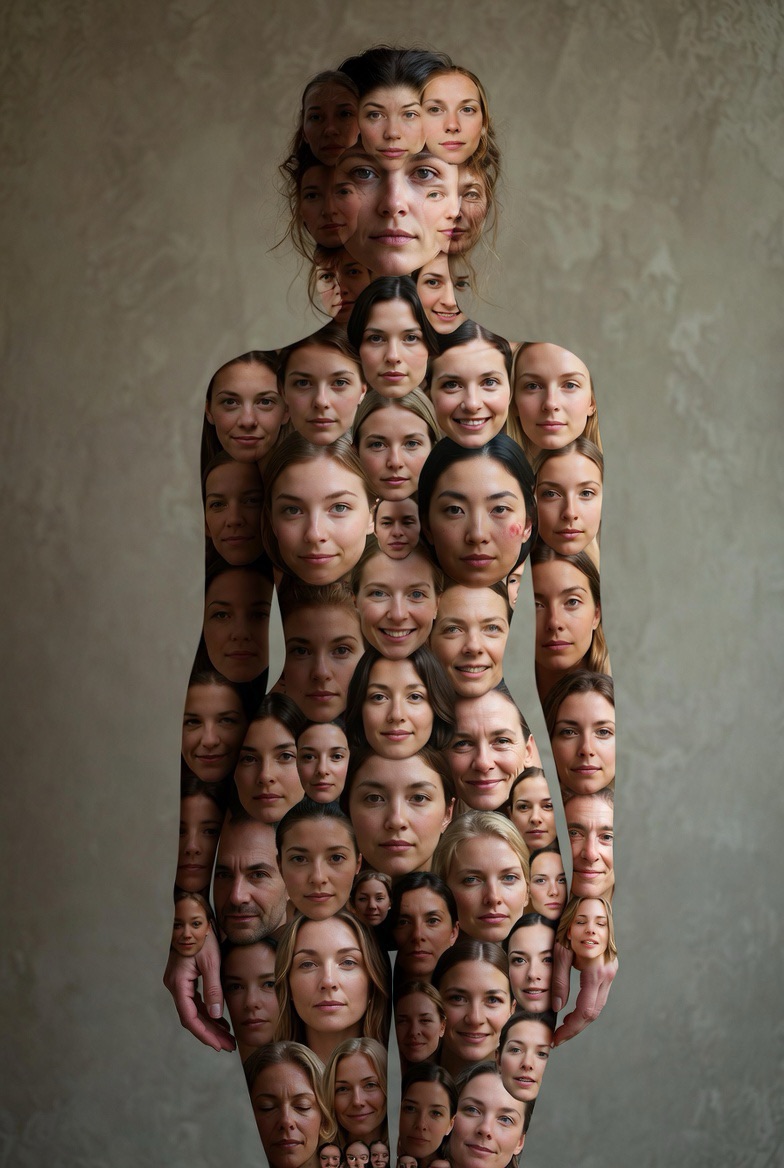
Whether you are a human or a non-person entity (NPE) with facial recognition capability, you rely on visual cues to positively identify or authenticate a person. Let’s face it; many people resemble each other, but specific facial expressions or emotions are not always shared by people who otherwise look alike.
All pictures Google Gemini.
But in one of those oddities that fill the biometric world, you can have TOO MUCH expression. Part 3 of International Civil Aviation Organization (ICAO) Document 9303, which governs machine readable travel documents, mandates that faces on travel documents must maintain a neutral expression without smiling. At the time (2003) it was believed that the facial recognition algorithms would work best if the subject were expressionless. I don’t know if that holds true today.
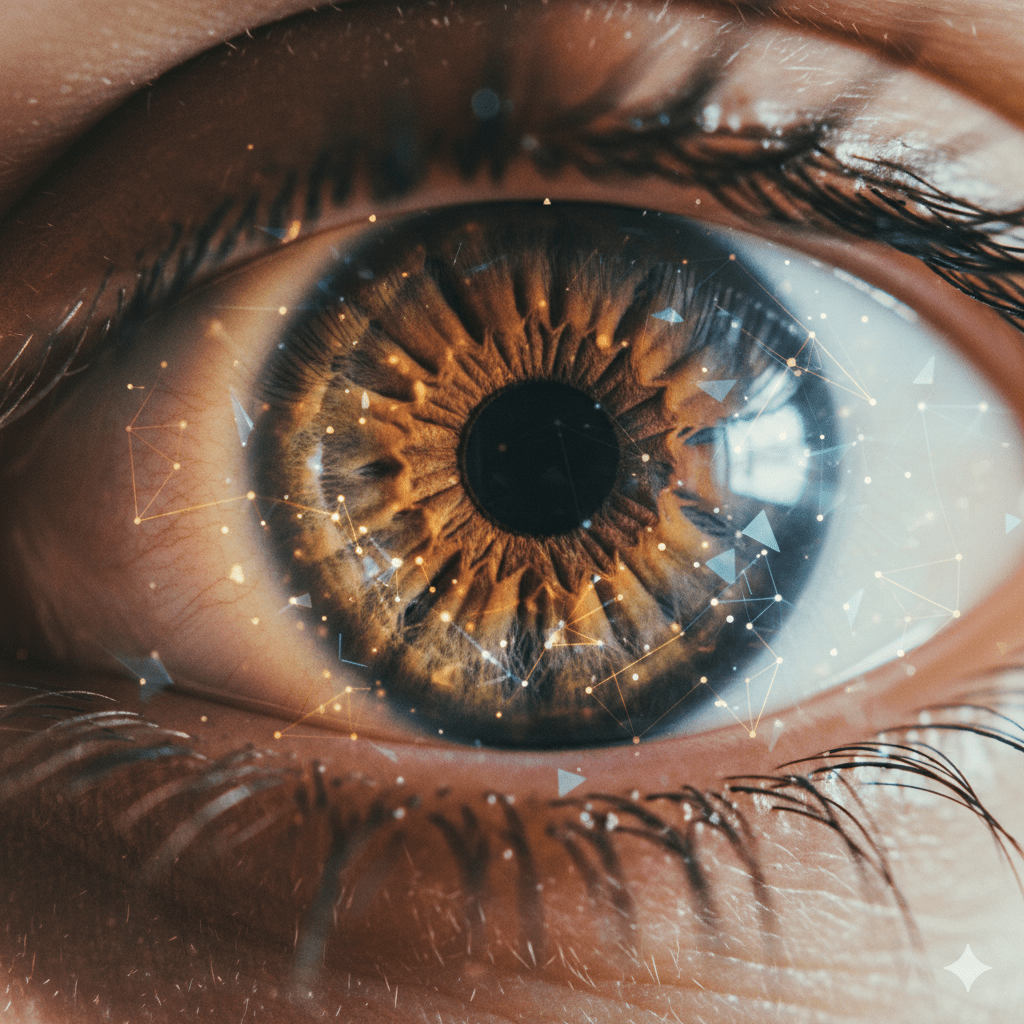
But once the smile is erased, any other removal of expression or emotion degrades identification capability significantly. For example, closing the eyes not only degrades facial recognition, but is obviously fatal to iris recognition.
And if you remove the landmarks upon which facial recognition depends, identification is impossible.
While expression or lack thereof does not invalidate the assumption of permanence of the biometric authentication factor, it does govern the ability of people and machines to perform identification or authentication.
Biometric marketing leaders, do your firm’s product marketing publications require the words of authority?
John E. Bredehoft of Bredemarket, the biometric product marketing expert.
Can John E. Bredehoft of Bredemarket—the biometric product marketing expert—contribute words of authority to your content, proposal, and analysis materials?
I offer:
30 years of biometric experience, 10 years of product marketing expertise, and complementary proposal and product management talents.
Success with numerous biometric firms, including Incode, IDEMIA, MorphoTrak, Motorola, Printrak, and over a dozen biometric consulting clients.
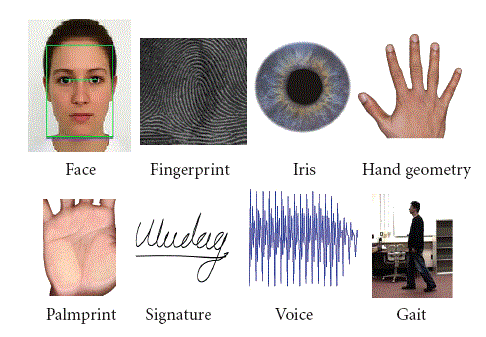
I wanted to write a list of the biometric modalities for which I provide experience.
So I started my usual list from memory: fingerprint, face, iris, voice, and DNA.
Then I stopped myself.
My experience with skin goes way beyond fingerprints, since I’ve spent over two decades working with palm prints.
(Can you say “Cambridgeshire method”? I knew you could. It was a 1990s method to use the 10 standard rolled fingerprint boxes to input palm prints into an automated fingerprint identification system. Because Cambridgeshire had a bias to action and didn’t want to wait for the standards folks to figure out how to enter palm prints. But I digress.)
So instead of saying fingerprints, I thought about saying friction ridges.
But there are two problems with this.
First, many people don’t know what “friction ridges” are. They’re the ridges that form on a person’s fingers, palms, toes, and feet, all of which can conceivably identify individuals.
But there’s a second problem. The word “friction” has two meanings: the one mentioned above, and a meaning that describes how biometric data is captured.
No, there is not a friction method to capture faces. Squishing
If you have to do something to provide your biometric data, such as press your fingers against a platen, that’s friction.
If you don’t have to do anything other than wave your fingers, hold your fingers in the air, or show your face as you stand near or walk by a camera, that’s frictionless.
More and more people capture friction ridges with frictionless methods. I did this years ago using MorphoWAVE at MorphoTrak facilities, and I did it today at Whole Foods Market.
So I could list my biometric modalities as friction ridge (fingerprint and palm print via both friction and frictionless capture methods), face, iris, voice, and DNA.
But I won’t.
Anyway, if you need content, proposal, or analysis assistance with any of these modalities, Bredemarket can help you. Book a meeting at https://bredemarket.com/cpa/
“Apple Inc. may have ceased production of its first-generation Vision Pro headset after the product, which came to market in 2024, turned out to be a massive flop for the company.”