As you know, I’ve been spending more and more time concentrating on identity issues when a person is not present. This is what the attribute-based access control folks refer to as “non-person entities” (NPEs).
In the article, CyberArk’s Scott Carter makes the following points:
Today there are many more machine identities than human ones.
They may have a short shelf life. Unlike humans, who usually access your systems for months or years if not decades, machine identities may be “created and discarded dynamically in minutes.” (Incidentally, I just wrote a LinkedIn article that delves into this in more detail.)
These identities are being breached. “Half of the surveyed organizations experienced security breaches tied to compromised machine identities within the past year.”
What does this mean?
Well, for CyberArk, it means that it endorses technologies such as automating certificate lifecycle management. And by the strangest coincidence, CyberArk offers a solution…
But for us, it means that we don’t only need automation, but we also need governing processes to ensure that ALL the people and NPEs that are accessing our systems are properly managed, quickly commissioned, and quickly decommissioned.
(Image from Imagen 3. Yes, I’m falling into the habit of reusing images for multiple use cases. It’s easier that way.)
I’m admittedly fascinated by the parallels between people and non-person entities (NPEs), to the point where I asked at one point whether NPEs can use the factors of authentication. (All six. Long story.)
When I got to the “something you are” factor, which corresponds to biometrics in humans, here is what I wrote:
Something you are. For simplicity’s sake, I’ll stick to physical objects here, ranging from pocket calculators to hand-made ceramic plates. The major reason that we like to use “something you are” as a factor is the promise of uniqueness. We believe that fingerprints are unique (well, most of us), and that irises are unique, and that DNA is unique except for identical twins. But is a pocket calculator truly unique, given that the same assembly line manufactures many pocket calculators? Perhaps ceramic plates exhibit uniqueness, perhaps not.
But I missed one thing in that discussion, so I wanted to revisit it.
Understanding IMEI Numbers
Now this doesn’t apply to ceramic plates or pocket calculators, but there are some NPEs that assert uniqueness.
Our smartphones, each of which has an International Mobile Equipment Identity (IMEI) number.
IMEI stands for International Mobile Equipment Identity. It’s a unique identifier for mobile devices, much like a fingerprint for your phone’s IMEI number.
Now some of you who are familiar with biometrics are saying, “Hold it right there.”
Can someone assert that there has NEVER been two people with the same fingerprint in all of human history?
But let’s stick to phones, Johnny.
Each IMEI number is a 15-digit code that’s assigned to every mobile phone during its production. This number helps in uniquely identifying a device regardless of the SIM card used.
This is an important point here. Even Americans understand that SIM cards are transient and can move from one phone to another, and therefore are not valid to uniquely identify phones.
What about IMEIs?
Are IMEIs unique?
I won’t go into the specifics of the 15-digit IMEI number format, which you can read about here. Suffice it to say that the format dictates that the number incorporate the make and model, a serial number, and a check digit.
Therefore smartphones with different makes and models cannot have the same IMEI number by definition.
And even within the make and model, by definition no two phones can have the same serial number.
Why not? Because everyone says so.
It’s even part of the law.
Changing an IMEI number is illegal in many countries due to the potential misuse, such as using a stolen phone. Tampering with the IMEI can lead to severe legal consequences, including fines and imprisonment. This regulation helps in maintaining the integrity of mobile device tracking and discourages the theft and illegal resale of devices.
IMEIs in India
To all of the evidence above about the uniqueness of IMEI numbers, I only have two words:
So what?
A dedicated person can create or modify multiple smartphones to have the exact same IMEI number if desired. Here’s a recent example:
The Indore Police Crime Branch has dismantled two major digital arrest fraud rackets operating in different parts of the country, seizing a massive database containing private details of 20,000 pensioners in Indore….
A dark room in the flat functioned as the nerve centre of the cyber fraud operation, which had been active since 2019. The group specialised in IMEI cloning and used thousands of SIM cards from select mobile networks.
IMEIs in Canada
“Oh, but that’s India,” you say. “That couldn’t happen in a First World country.”
A Calgary senior is warning others after he was scammed out of $1,000 after buying what he thought was a new iPhone 15 Pro Max.
“I didn’t have any doubt that it was real,” Boyd told Global News….
The seller even provided him with the “original” receipt showing the phone had been purchased down east back in October 2023. Boyd said he also checked the phone’s serial number and the International Mobile Equipment Identity (IMEI). All checked out fine.
Boyd said the first sign of a problem was when he tried to update the phone with his own information and it wouldn’t update. It was only after he took it to a representative at a local Apple retailer, that he realized he had been duped.
IMEIs in general
Even IMEICheck.net, which notes that the threat of stealing one’s phone information is overrated, admits that it is possible (albeit difficult) to clone an IMEI number.
In theory, hackers can clone a phone using its IMEI, but this requires significant effort. They need physical access to the device or SIM card to extract data, typically using specialized tools.
The cloning process involves copying the IMEI and other credentials necessary to create a functional duplicate of the phone. However, IMEI number security features in modern devices are designed to prevent unauthorized cloning. Even if cloning is successful, hackers cannot access personal data such as apps, messages, photos, or passwords. Cloning usually only affects network-related functions, such as making calls or sending messages from the cloned device.
Again, NOTHING provides 100.00000% security. Not even an IMEI number.
What this means for IMEI uniqueness claims
So if you are claiming uniqueness of your smartphone’s IMEI, be aware that there are proven examples to the contrary.
Perhaps the shortcomings of IMEI uniqueness don’t matter in your case, and using IMEIs for individualization is “good enough.”
(Imagen 3 image. Oddly enough, Google Gemini was unable, or unwilling, to generate an image of three smartphones displaying the exact same 15-digit string of numbers, or even a 2-digit string. I guess Google thought I was a fraudster.)
An announcement from Paravision says its biometric age estimation technology has achieved Level 3 certification from the Age Check Certification Scheme (ACCS), the leading independent certification body for age estimation. The results make it one of only six companies globally to receive ACCS’s highest-level designation for compliance.
San Francisco-based Paravision’s age estimation tech posted 100 percent precision in Challenge 25 compliance, with 0 subjects falsely identified as over 25 years old. It also scored a 0 percent Failure to Acquire Rate, meaning that every image submitted for analysis returned a result. Mean Absolute Error (MAE) was 1.37 years, with Standard Deviation of 1.17.
Now this is an impressive achievement, and Paravision is a quality company, and Joey Pritikin is a quality biometric executive, but…well, let me share the other story first, involving a Yoti customer (not Yoti).
Fenix responded that it set a challenge threshold at 23 years of age. Any user estimated to be that age or younger based on their face biometrics is required to use a secondary method for age verification.
Fenix had set OnlyFans challenge age, it turns out, at 20 years old. A correction to 23 years old was carried out on January 16, and then Fenix changed it again three days later, to 21 years old, Ofcom says.
Now Biometric Update was very clear that “Yoti provides the tech, but does not set the threshold.”
Challenge ages and legal ages
But do challenge thresholds have any meaning? I addressed that issue back in May 2024.
Many of the tests used a “Challenge-T” policy, such as “Challenge 25.” In other words, the test doesn’t estimate whether a person IS a particular age, but whether a person is WELL ABOVE a particular age….
So if you have to be 21 to access a good or service, the algorithm doesn’t estimate if you are over 21. Instead, it estimates whether you are over 25. If the algorithm thinks you’re over 25, you’re good to go. If it thinks you’re 24, pull out your ID card.
And if you want to be more accurate, raise the challenge age from 25 to 28.
NIST admits that this procedure results in a “tradeoff between protecting young people and inconveniencing older subjects” (where “older” is someone who is above the legal age but below the challenge age).
You may be asking why the algorithms have to set a challenge age above the lawful age, thus inconveniencing people above the lawful age but below the challenge age.
The reason is simple.
Age estimation is not all that accurate.
I mean, it’s accurate enough if I (a person well above the age of 21 years) must indicate whether I’m old enough to drink, but it’s not sufficiently accurate for a drinker on their 21st birthday (in the U.S.), or a 13 year old getting their first social media account (where lawful).
Not an official document.
If you have a government issued ID, age verification based upon that ID is a much better (albeit less convenient) solution.
But perhaps you would prefer to hear from someone who knows what they’re talking about.
On a webcast this morning, C. Maxine Most of The Prism Project reminded us that the “Biometric Digital Identity Deepfake and Synthetic Identity Prism Report” is scheduled for publication in May 2025, just a little over a month from now.
As with all other Prism Project publications, I expect a report that details the identity industry’s solutions to battle deepfakes and synthetic identities, and the vendors who provide them.
And the report is coming from one of the few industry researchers who knows the industry. Max doesn’t write synthetic identity reports one week and refrigerator reports the next, if you know what I mean.
At this point The Prism Project is soliciting sponsorships. Quality work doesn’t come for free, you know. If your company is interested in sponsoring the report, visit this link.
While waiting for Max, here are the Five Tops
And while you’re waiting for Max’s authoritative report on deepfakes and synthetic identity, you may want to take a look at Min’s (my) views, such as they are. Here are my current “five tops” posts on deepfakes and synthetic identity.
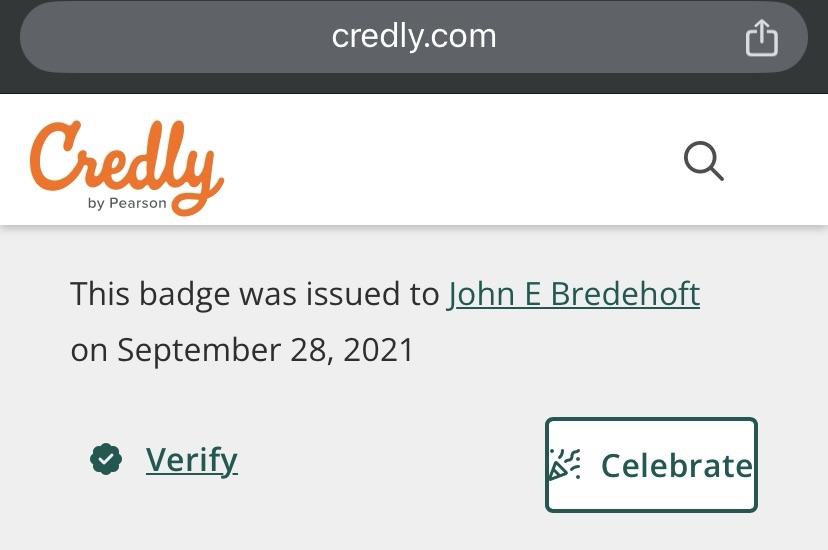
Now if you click on that link, you will see a “Verify” link at the top left.
From Credly.
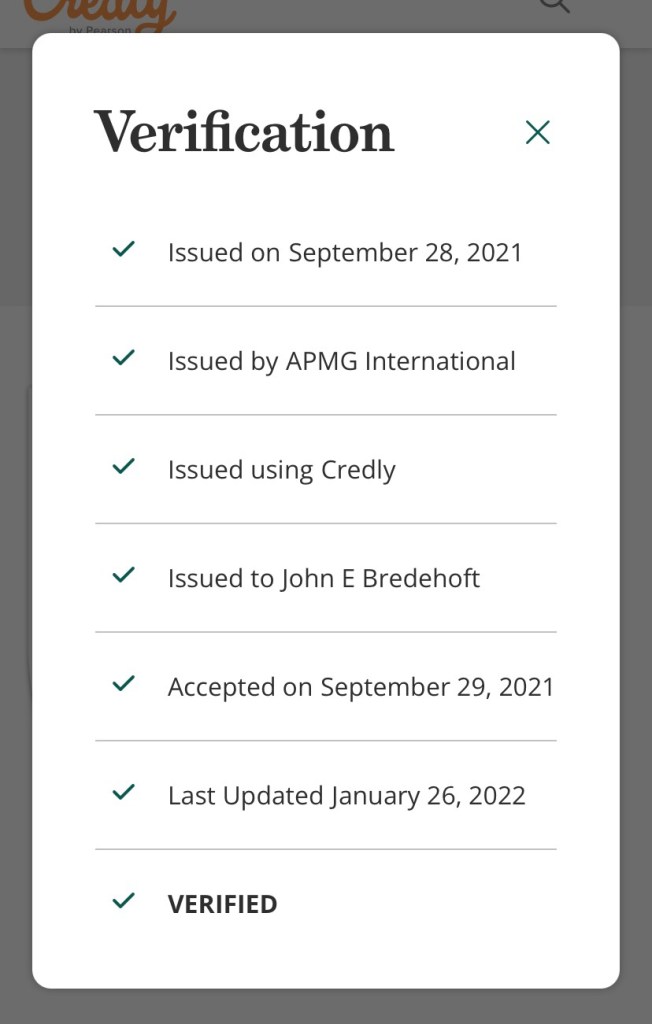
And if you click on that”Verify,” this is what you get.
The verification.
So I have verified that I am allowed to call myself John E. Bredehoft, CF APMP. It’s allowed:
In the same manner, those who have achieved one of the APMP certifications can append the appropriate certification. In the case of APMP Foundation certification, that means that I can style myself as “John E. Bredehoft, CF APMP.” (Or “John E. Bredehoft, MBA, CF APMP, RSBC” if I want to be thorough. But I probably won’t, since “RSBC” stands for “Radio Shack Battery Club.”)
But have I REALLY verified that I have achieved this accomplishment? (Not the battery club one, the proposal one. Although it would be good to know whether I really have that MBA educational accomplishment.)
The identity problem
You see, despite how impressive that Credly link is, it doesn’t prove nothing.
Sure, somebody who claimed to be John E. Bredehoft sat down in 2021 and took an online exam.
But was that person truly John E. Bredehoft?
And even if he was, am I the same John E. Bredehoft who received the certification?
Maybe there were fraudsters along the way. Maybe someone else took the test and pretended to be Bredehoft. Or maybe I’m not Bredehoft.
Sure, at one point I whipped out a credit card with Bredehoft’s name on it. But that doesn’t prove identity.
You probably know the things that prove identity. A biometric modality, including the liveness of that modality. A government-issued identity document that matches the biometric. A sensible location (was the test taker in Ontario, California as expected?).
Now perhaps this is overkill for authenticating a proposal writer, but it may not be if you need a certified plumber.
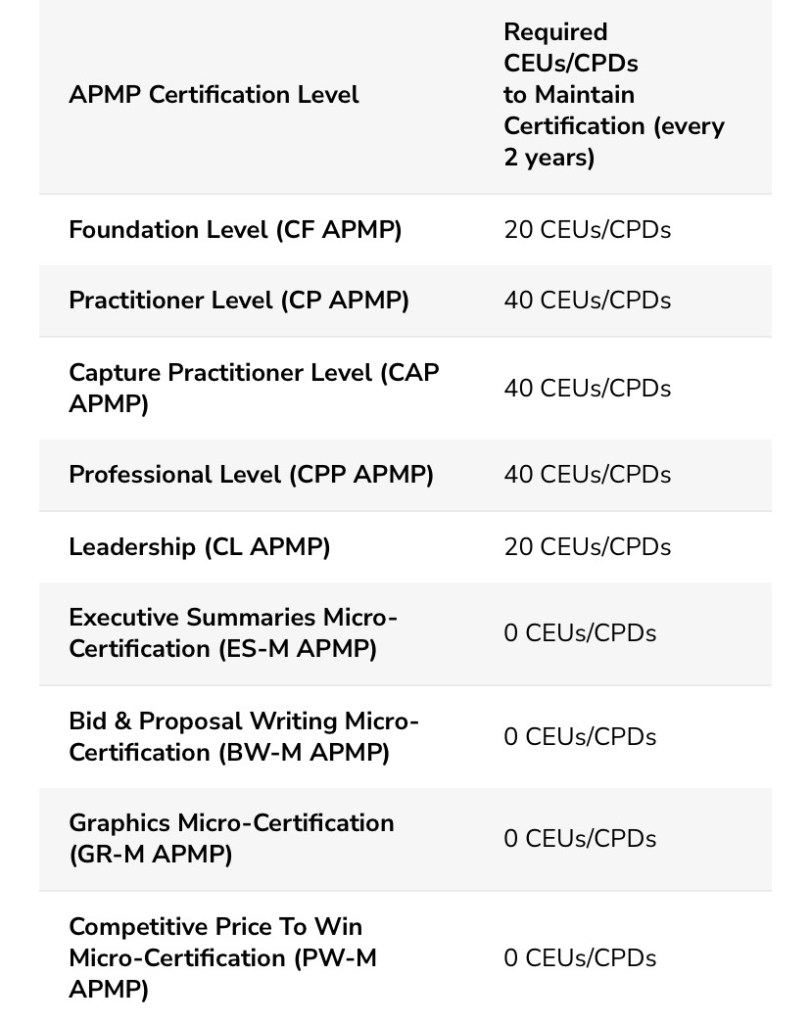
And because I truly am me, I know I didn’t meet the CEU/CPD requirement by September 2023. I don’t know how many I did achieve; the APMP was changing its CEU/CPD tracking system in early 2022, and then I joined Incode and theoretically wasn’t writing proposals any more. Theoretically.
So in truth, my shiny badge only represents a dated accomplishment. John E. Bredehoft can no longer use the CF APMP designation.
Unless I add “Emeritus” or something.
And as for those cases in which the certifications and identities truly matter…
My own post referenced the Auriemma Group estimate of a $6 billion cost to U.S. lenders.
McKinsey preferred to use a percentage estimate of “10–15% of charge offs in a typical unsecured lending portfolio.” However, this may not be restricted to synthetic identity fraud, but may include other types of fraud.
Thomson Reuters quoted Socure’s Johnny Ayers, who estimated that “20% of credit losses stem from synthetic identity fraud.”
Oh, and a later post that I wrote quoted a $20 billion figure for synthetic identity fraud losses in 2020. Plus this is where I learned the cool acronym “SIF” to refer to synthetic identity fraud. As far as I know, there is no government agency with the acronym SIF, which would of course cause confusion. (There was a Social Innovation Fund, but that may no longer exist in 2025.)
Never Search Alone, not National Security Agency. AI image from Imagen 3.
Back to synthetic identity fraud, which reportedly resulted in between $6 billion and $20 billion in losses in 2020.
The financial toll of AI-driven fraud is staggering, with projected global losses reaching $40 billion by 2027 up from US12.3 billion in 2023 (CAGR 32%)., driven by sophisticated fraud techniques and automation, such as synthetic identities created with AI tools.
Again this includes non-synthetic fraud, but it’s a good number for the high end. While my FTC fraud post didn’t break out synthetic identity fraud figures, Plaid cited a 2023 $1.8 billion figure for the auto industry alone, and Mastercard cited a $5 billion figure.
But everyone agrees on a figure of billions and billions.
The real Carl Sagan.
The deepfake Carl Sagan.
(I had to stop writing this post for a minute because I received a phone call from “JP Morgan Chase,” but the person didn’t know who they were talking to, merely asking for the owner of the phone number. Back to fraud.)
Reducing SIF in 2025
In a 2023 post, I cataloged four ways to fight synthetic identity fraud:
Private databases.
Government documents.
Government databases.
A “who you are” test with facial recognition and liveness detection (presentation attack detection).
Ideally an identity verification solution should use multiple methods, and not just one. It doesn’t do you any good to forge a driver’s license if AAMVA doesn’t know about the license in any state or provincial database.
Well, Anthony Kimery of Biometric Update provided a…well, update. According to Thomas Shedd, who heads the GSA’s Technology Transformation Services (the organization in which the former 18F resided), we have nothing to worry about:
“‘“I can assure you that Login.gov’s work carries forward as a critical part of government-wide efforts to promote efficiency and fight fraud,’ Shedd wrote in a Monday email. ‘To that end we are working to accelerate Login’s roadmap. More to come on that soon.’”
As I mentioned earlier, I don’t know if Login.gov is affected by the abrupt shutdown of GSA’s 18F. Was 18F still maintaining Login.gov code, or had the Login.gov folks established their own code maintenance, independent of the now-deprecated 18F?
Perhaps we will find out Monday.
But what if 18F were still responsible for Login.gov, which therefore is nearly impossible to update or maintain?
No, Mark Cuban, DOGE will not contract with the ex-18F workers. DOGE doesn’t need them. Look at what they’ve already done with verifying identities.
IDV via SMS
For example, at the private sector company X, you cannot get a paid X Premium subscription unless you have a confirmed phone number. Because everybody knows that confirming identities via an SMS text message is a foolproof method.
“According to information provided by Google, the decision to move away from SMS verification stems from numerous security vulnerabilities associated with text message codes. These include susceptibility to phishing attacks, where users might inadvertently share codes with malicious actors, and dependence on phone carriers’ security practices, which can vary widely in effectiveness.”
“X will provide a voluntary ID verification option for certain X features to increase the overall integrity and trust on our platform. We collect this data when X Premium subscribers optionally choose to apply for an ID verified badge by verifying their identity using a government-issued ID. Once confirmed, a verified label is added to the user’s profile for transparency and potentially unlocking additional benefits associated with specific X features in the future.”
But the public sector needs IDV
Identity verification isn’t mandatory on X because some people plain do not want it. Not because they’re crooks, but because they don’t want to hand their PII over to anyone if they don’t have to.
Of course, the Internal Revenue Service, the Social Security Administration, and many other government agencies HAVE to implement identity verification from Login.gov, ID.me, or some other provider.
“For over 11 years, 18F has been proudly serving you to make government technology work better. We are non-partisan civil servants. 18F has worked on hundreds of projects, all designed to make government technology not just efficient but effective, and to save money for American taxpayers.
“However, all employees at 18F – a group that the Trump Administration GSA Technology Transformation Services Director called “the gold standard” of civic tech – were terminated today at midnight ET.”
If you are a government agency who uses Login.gov, or if you are a U.S. citizen who has a Login.gov account, I’m not sure about the future of the service.
Back in November 2023, I wrote a post that included the three letters “18F.” Specifically:
Obviously there are a number of private companies (over 80 last I counted) that provide secure access to information, but Login.gov is provided by the government itself—specifically by the General Services Administration’s Technology Transformation Services. Agencies at the federal, state, and local level can work with the GSA TTS’ “18F” organization to implement solutions such as Login.gov.
Now perhaps I’m, um, biased, but I happen to think that identity verification, whether performed by a public entity, is kinda sorta important.
This is from the executive director of the 18F, the digital services agency within the General Services Administration (GSA) that develops open-source tools to improve digital services across the federal government.
“I am the Executive Director of 18F and 18F’s longest running employee- I have been at 18F for 10 years. You may not have heard of us, but last night proved that we are powerful. The way the administration ran to get rid of us under the cover of night and shut us down without warning proves that they were scared. They are too afraid to even speak to us.”
The General Services Administration has eliminated its 18F program, an internal team of tech consultants and engineers that develops open-source tools to improve digital services across the federal government.
The announcement, which came overnight, is the latest in the Trump administration’s ongoing efforts to slash the federal workforce. It was foreshadowed weeks ago when Elon Musk, who’s become a highly influential and controversial voice in the White House, tweeted that the decade-old program had been “deleted.”
At this point I am not sure how this affects future updates to Login.gov. As far as I know the service itself remains operational.







 Bredemarket