Evading State Taxes: Non-Person Automotive Entities and Geolocation

When a person is born in the United States, they obtain identifiers such as a name and a Social Security Number.

When a non-person entity is “born,” it gets identifiers also. For automobiles, the two most common ones are a Vehicle Identification Number (VIN) and a license plate number. (There is also title, which I’ve discussed before, but that’s not really an identifier.)

In my country license plates and the associated vehicle registrations, like driver’s licenses, are issued at the state level. Montana, for example, has 2.3 million registered vehicles…which is odd, because the state only has 879,000 licensed drivers.

How can this be? Jalopnik explains:

“All that wealthy car owners have to do is spend around $1,000 to open an LLC in Montana, then use the LLC to purchase a car with no sales tax — and said car is not subject to vehicle inspections or emissions testing.”

That explains things. The Montana LLCs need multiple cars for all their LLC-related travel between Billings, Bozeman, and Butte. That’s a ton of miles on the Montana highways.

Um…no.

“According to Bloomberg, former Montana revenue director Dan Bucks said there are likely more than 600,000 vehicles registered in Montana but operated in other states.”

Like California. Where people don’t want to pay the fees associated with vehicle registration here, so they say their vehicles are Montana vehicles. Only problem is, license plate readers on California freeways can identify the movements of a car with Montana plates. And if that “Montana” car is moving in California, expect a visit from the tax authority.

But it’s not just the money hungry loony liberal Commies in California. Jalopnik reports that the money hungry loony liberal Commies in…um…Utah are mad also.

“This is really an abuse of our tax system,” said Utah tax commissioner John Valentine. “They pay nothing to support our state, just a small fee to Montana for the opportunity to evade taxes in Utah.”

Because in the end it doesn’t matter if you’re blue or red. What matters is the green. And the geolocation.

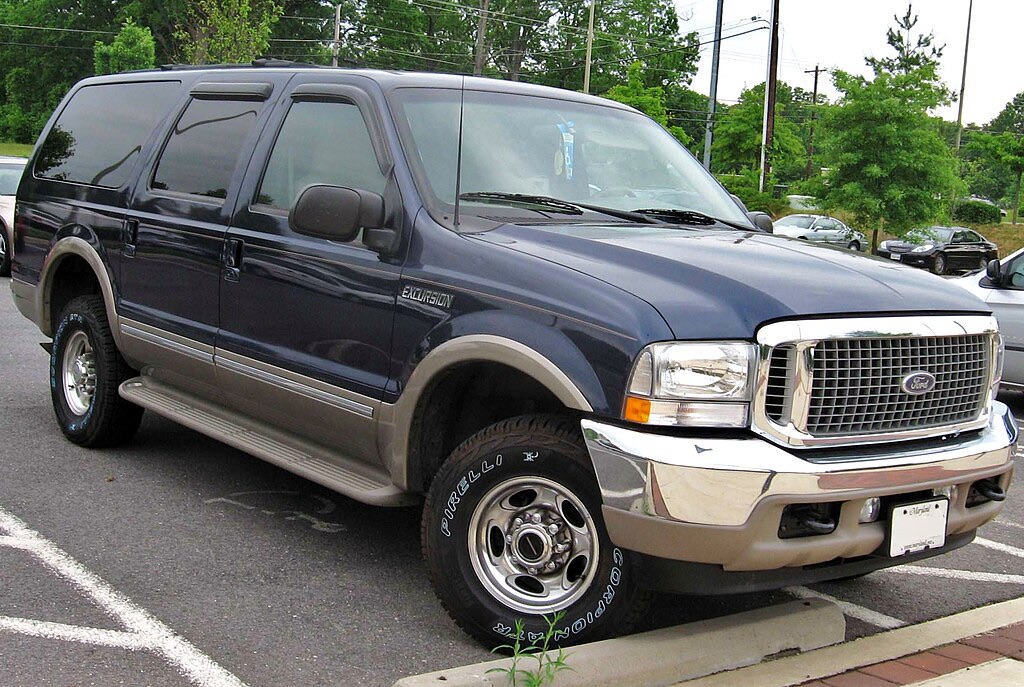
(2002 Ford Excursion image public domain)

Enrolling in the Amazon One Palm System via Smartphone

I think I’ve already mentioned that the Amazon Fresh in Upland, California is holding its grand opening in about an hour.

So I figured I should pre-investigate what was necessary to enroll in the Amazon One palm vein system once I arrived at the store.

My first discovery was that Amazon One has its own app, separate from the Amazon app. I don’t know how many apps Amazon has, but if Amazon and Meta ever merge (Amameta?), I will need a separate phone just for its apps.

So I downloaded Amazon One, linked it to my Amazon account, and waited for the instructions on how to enroll my palm at an Amazon location…

…only to find that Amazon One wanted to take pictures of both my palms, right there on my smartphone. Just like any contactless fingerprint app.

Enrolled in Amazon One.

So I am now enrolled, and I have confirmed that my local Amazon Fresh accepts Amazon Go.

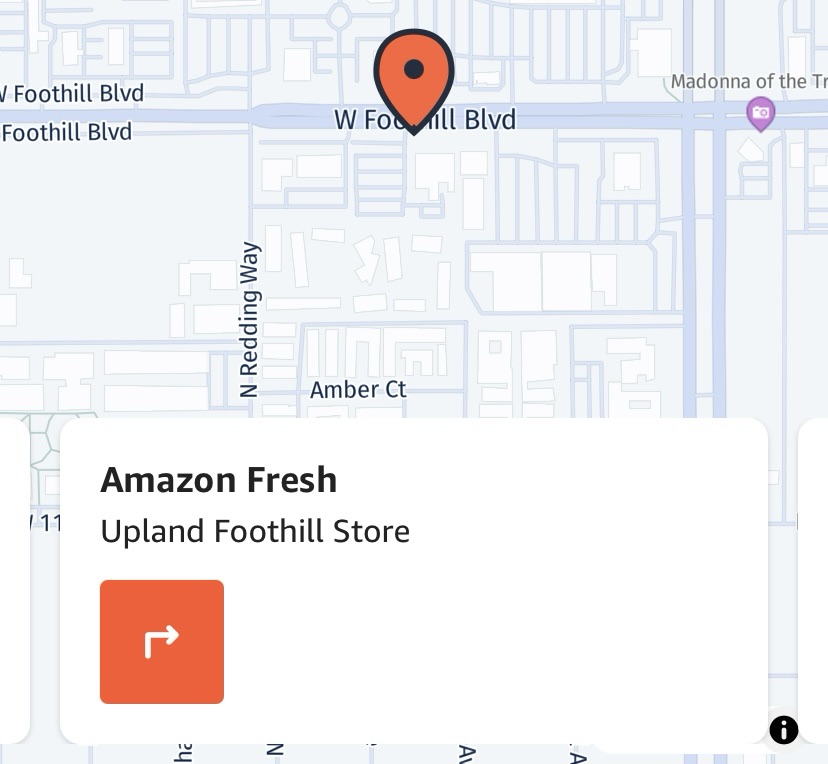
Um…that is not East Foothill.

However, as even non-locals will realize, this is NOT 235 East Foothill, but WEST Foothill. So much for geolocation. (And the location of the Madonna of the Trail statue is wrong also, but I digress.)

Now let’s see if it all works.

When Beneficial Ownership Diverges From Legal Ownership

I recently discussed some proposed changes to the way in which beneficial ownership information (BOI) is collected. However, even after the changes are made, FinCEN will still collect BOI for foreign firms.

Hungary, facial recognition, and geolocation

Biometric Update recently published a story about facial recognition in Hungary, and its use to identify people who display rainbows and dress in ways “that diverge from the gender they were assigned at birth.” I’m going to zero in on one portion of the story: the facial recognition provider involved.

The company FaceKom has been around under different names since 2010 but has seen significant growth during the past few years thanks to investments from the Central European Opportunity Private Equity Fund (CEOM). The fund has no direct links with [Prime Minister Orbán’s son-in-law, István] Tiborcz. However, it is registered on the same address in Budapest where several companies owned by Orbán ‘s son-in-law operate.

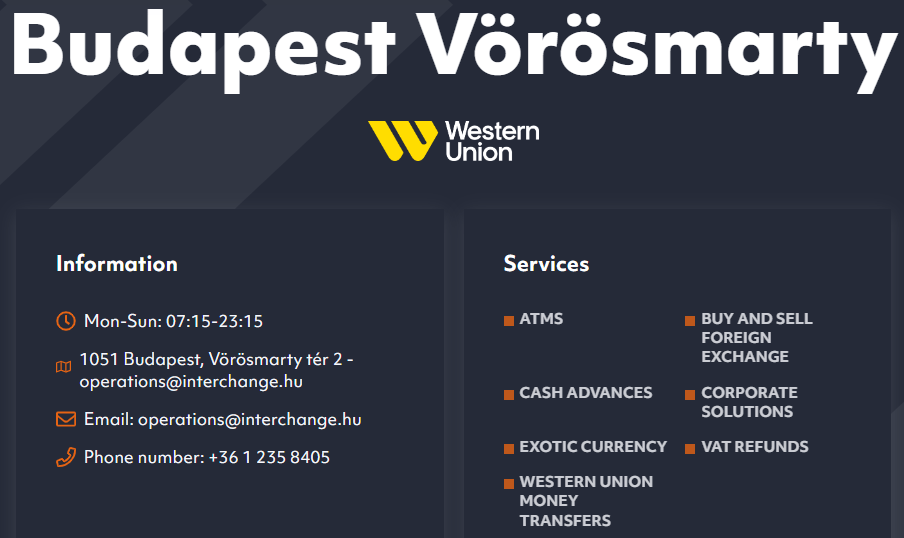
Ah, geolocation! The Chi Fu Investment Fund Management Zrt.’s address of record is 1051 Budapest, Vörösmarty tér 2.

And do you know what else is at that address?

A Western Union Currency Exchange.

Well, that’s enough to drive some conspiracy theorists crazy.

Beneficial ownership and legal ownership

So I didn’t find the smoking gun, but I do want to take this opportunity to point out what BENEFICIAL ownership is. Investopedia:

A beneficial owner is a person who enjoys the benefits of ownership even though the title to some form of property is in another name.

Using the Hungarian example (without the Western Union part), it’s not enough to say that CEOM and/or Chi Fu Investment Fund Management Zrt. (I don’t know enough Hungarian to confirm they are one and the same) does not list István Tiborcz (or Victor Orbán) as an official owner or co-owner.

As Unit21 points out, you don’t have to literally own (either on your own or through a trust) 25% of an entity to be a beneficial owner. Here’s another criterion of a beneficial owner:

Any individual that holds a significant ability to control, manage, or direct the legal entity

De facto control without de jure control could very well be wielded by a powerful politician, or his son-in-law.

(Imagen 3)

FinCEN, Cartels, and Geolocation

Who says that geolocation isn’t a critical factor for persons and non-person entities alike?

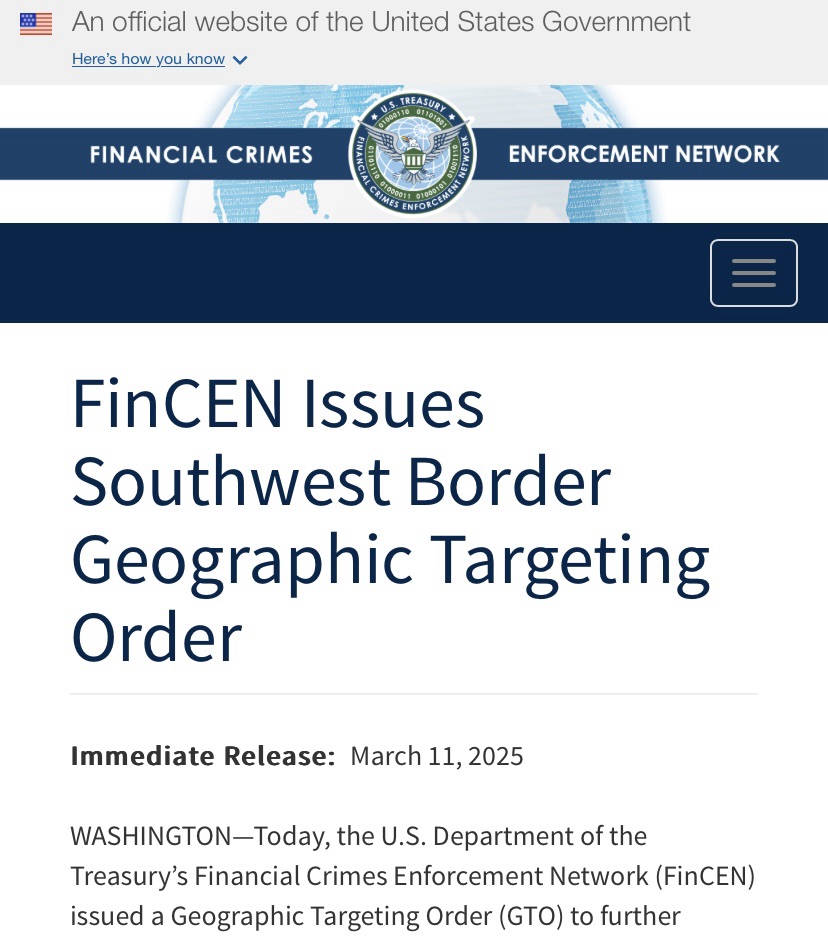
ComplyAdvantage alerted me to a Geographic Targeting Order from FinCEN.

“The GTO requires all money services businesses (MSBs) located in 30 ZIP codes across California and Texas near the southwest border to file Currency Transaction Reports (CTRs) with FinCEN at a $200 threshold, in connection with cash transactions.”

Of course, the targeted “cartels, drug traffickers, and other criminal actors along the Southwest border” can easily evade the reporting requirements by going a little north, east, or west. After all, there are more than 40,000 ZIP codes….

Delivery Packages and Geolocation in Residential Neighborhoods

Today’s musings concern delivery packages and geolocation, and may be pertinent if you receive a residential delivery this month. You know, maybe a present or something.

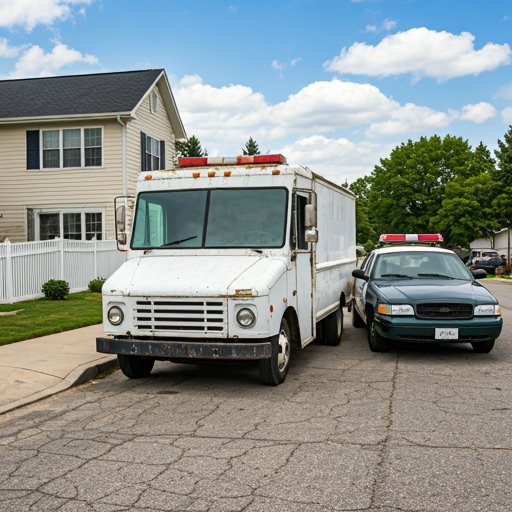
Let’s say you receive a package at your house, the delivery driver takes a picture of your package on your porch as proof of delivery…and the package is subsequently stolen by a porch pirate before you get it.

“Hey, you’re out of luck,” the company may say. “The package was delivered.”

How long will it be until security professionals advise you to NEVER EVER EVER HAVE RETAILERS DELIVER PACKAGES TO YOUR HOME? Use a locker or a staffed business address, but treat residential delivery as EVIL…just like public wi-fi.

Or perhaps expensive packages could be equipped with geotagging…like your luggage. I know that delivery companies hate geolocation as much as airlines do…but it’s a thought.

(Thanks to the anonymous victim of a porch pirate who inspired this. AI-generated image by Google Gemini.)

Don’t Miss the Boat

Bredemarket helps identity/biometric firms.

  • Finger, face, iris, voice, DNA, ID documents, geolocation, and even knowledge.
  • Content-Proposal-Analysis. (Bredemarket’s “CPA.”)

Don’t miss the boat.

Augment your team with Bredemarket.

Find out more.

Don’t miss the boat.

Do All 5 Identity Factors Apply to Non-Human Identities?

I’ve talked ad nauseam about the five factors of identity verification and authentication. In case you’ve forgotten, these factors are:

  • Something you know.
  • Something you have.
  • Something you are.
  • Something you do.
  • Somewhere you are.

I’ll leave “somewhat you why” out of the discussion for now, but perhaps I’ll bring it back later.

These five (or six) factors are traditionally used to identify people.

Identifying “Non-Person Entities”

But what happens when the entity you want to identify is not a person? I’ll give two examples:

Kwebbelkop AI? https://www.youtube.com/watch?v=3l4KCbTyXQ4.
  • Kwebbelkop AI, discussed in “Human Cloning Via Artificial Intelligence: It’s Starting,” is not a human. But is there a way to identify the “real” Kwebbelkop AI from a “fake” one?
  • In “On Attribute-Based Access Control,” I noted that NIST defined a subject as “a human user or NPE (Non-Person Entity), such as a device that issues access requests to perform operations on objects.” Again, there’s a need to determine that the NPE has the right attributes, and is not a fake, deep or shallow.

There’s clearly a need to identify non-person entities. If I work for IBM and have a computer issued by IBM, the internal network needs to know that this is my computer, and not the computer of a North Korean hacker.

But I was curious. Can the five (or six) factors identify non-person entities?

Let’s consider factor applicability, going from the easiest to the hardest.

The easy factors

  • Somewhere you are. Not only is this extremely applicable to non-person entities, but in truth this factor doesn’t identify persons, but non-person entities. Think about it: a standard geolocation application doesn’t identify where YOU are. It identities where YOUR SMARTPHONE is. Unless you have a chip implant, there is nothing on your body that can identify your location. So obviously “somewhere you are” applies to NPEs.
  • Something you have. Another no brainer. If a person has “something,” that something is by definition an NPE. So “something you have” applies to NPEs.
  • Something you do. NPEs can do things. My favorite example is Kraftwerk’s pocket calculator. You will recall that “by pressing down this special key it plays a little melody.” I actually had a Casio pocket calculator that did exactly that, playing a tune that is associated with Casio. Later, Brian Eno composed a startup sound for Windows 95. So “something you do” applies to NPEs. (Although I’m forced to admit that an illegal clone computer and operating system could reproduce the Eno sound.)
Something you do, 1980s version. Advance to 1:49 to hear the little melody. https://www.youtube.com/watch?v=6ozWOe9WEU8.
Something you do, 1990s version. https://www.youtube.com/watch?v=miZHa7ZC6Z0.

Those three were easy. Now it gets harder.

The hard factors

Something you know. This one is a conceptual challenge. What does an NPE “know”? For artificial intelligence creations such as Kwebbelkop AI, you can look at the training data used to create it and maintain it. For a German musician’s (or an Oregon college student’s) pocket calculator, you can look at the code used in the device, from the little melody itself to the action to take when the user enters a 1, a plus sign, and another 1. But is this knowledge? I lean toward saying yes—I can teach a bot my mother’s maiden name just as easily as I can teach myself my maiden name. But perhaps some would disagree.

Something you are. For simplicity’s sake, I’ll stick to physical objects here, ranging from pocket calculators to hand-made ceramic plates. The major reason that we like to use “something you are” as a factor is the promise of uniqueness. We believe that fingerprints are unique (well, most of us), and that irises are unique, and that DNA is unique except for identical twins. But is a pocket calculator truly unique, given that the same assembly line manufactures many pocket calculators? Perhaps ceramic plates exhibit uniqueness, perhaps not.

That’s all five factors, right?

Well, let’s look at the sixth one.

Somewhat you why

You know that I like the “why” question, and some time ago I tried to apply it to identity.

  • Why is a person using a credit card at a McDonald’s in Atlantic City? (Link) Or, was the credit card stolen, or was it being used legitimately?
  • Why is a person boarding a bus? (Link) Or, was the bus pass stolen, or was it being used legitimately?
  • Why is a person standing outside a corporate office with a laptop and monitor? (Link) Or, is there a legitimate reason for an ex-employee to gain access to the corporate office?

The first example is fundamental from an identity standpoint. It’s taken from real life, because I had never used any credit card in Atlantic City before. However, there was data that indicated that someone with my name (but not my REAL ID; they didn’t exist yet) flew to Atlantic City, so a reasonable person (or identity verification system) could conclude that I might want to eat while I was there.

But can you measure intent for an NPE?

  • Does Kwebbelkop AI have a reason to perform a particular activity?
  • Does my pocket calculator have a reason to tell me that 1 plus 1 equals 3?
  • Does my ceramic plate have a reason to stay intact when I drop it ten meters?

I’m not sure.

By Bundesarchiv, Bild 102-13018 / CC-BY-SA 3.0, CC BY-SA 3.0 de, https://commons.wikimedia.org/w/index.php?curid=5480820.

Positioning, Messaging, and Your Facial Recognition Product Marketing

(Part of the biometric product marketing expert series)

By Original: Jack Ver at Dutch Wikipedia Vector: Ponor – Own work based on: Plaatsvector.png by Jack Ver at Dutch Wikipedia, CC BY-SA 4.0, https://commons.wikimedia.org/w/index.php?curid=95477901.

When marketing your facial recognition product (or any product), you need to pay attention to your positioning and messaging. This includes developing the answers to why, how, and what questions. But your positioning and your resulting messaging are deeply influenced by the characteristics of your product.

If facial recognition is your only modality

There are hundreds of facial recognition products on the market that are used for identity verification, authentication, crime solving (but ONLY as an investigative lead), and other purposes.

Some of these solutions ONLY use face as a biometric modality. Others use additional biometric modalities.

From Sandeep Kumar, A. Sony, Rahul Hooda, Yashpal Singh, in Journal of Advances and Scholarly Researches in Allied Education | Multidisciplinary Academic Research, “Multimodal Biometric Authentication System for Automatic Certificate Generation.”

Your positioning depends upon whether your solution only uses face, or uses other factors such as voice.

Of course, if you initially only offer a face solution and then offer a second biometric, you’ll have to rewrite all your material. “You know how we said that face is great? Well, face and gait are even greater!”

If biometrics is your only factor

It’s no secret that I am NOT a fan of the “passwords are dead” movement.

Too many of the tombstones are labeled “12345.” By GreatBernard – Own work, CC0, https://commons.wikimedia.org/w/index.php?curid=116933238.

It seems that many of the people that are waiting the long-delayed death of the password think that biometrics is the magic solution that will completely replace passwords.

For this reason, your company might have decided to use biometrics as your sole factor of identity verification and authentication.

Or perhaps your company took a different approach, and believes that multiple factors—perhaps all five factors—are required to truly verify and/or authenticate an individual. Use some combination of biometrics, secure documents such as driver’s licenses, geolocation, “something you do” such as a particular swiping pattern, and even (horrors!) knowledge-based authentication such as passwords or PINs.

This naturally shapes your positioning and messaging.

  • The single factor companies will argue that their approach is very fast, very secure, and completely frictionless. (Sound familiar?) No need to drag out your passport or your key fob, or to turn off your VPN to accurately indicate your location. Biometrics does it all!
  • The multiple factor companies will argue that ANY single factor can be spoofed, but that it is much, much harder to spoof multiple factors at once. (Sound familiar?)

So position yourself however you need to position yourself. Again, be prepared to change if your single factor solution adopts a second factor.

A final thought

Every company has its own way of approaching a problem, and your company is no different. As you prepare to market your products, survey your product, your customers, and your prospects and choose the correct positioning (and messaging) for your own circumstances.

And if you need help with biometric positioning and messaging, feel free to contact the biometric product marketing expert, John E. Bredehoft. (Full-time employment opportunities via LinkedIn, consulting opportunities via Bredemarket.)

In the meantime, take care of yourself, and each other.

Jerry Springer. By Justin Hoch, CC BY 2.0, https://commons.wikimedia.org/w/index.php?curid=16673259.

Geolocation Identifies People (Who Don’t Want To Be Identified)

From https://nextdoor.com/p/ks5wW5n_csJB?utm_source=share&extras=NDk4MjIxOTI%3D

A person in Upland, California posted this on the local NextDoor. While anecdotal and not statistical, in this case the geolocation capabilities of a device (in this case AirPods) identified someone in possession of a stolen vehicle.

https://nextdoor.com/p/ks5wW5n_csJB?utm_source=share&extras=NDk4MjIxOTI%3D

The Secret to Beating Half of All Fortune 500 Marketers and Growing Your Business

(Updated blog post count 10/23/2023)

Always take advantage of your competitors’ weaknesses.

This post describes an easy way to take advantage of your competitors. If they’re not blogging, make sure your firm is blogging. And the post provides hard numbers that demonstrate why your firm should be blogging.

Who uses blogging?

According to an infographic using 2017 data, 50% of the top 200 Fortune 500 companies had a public corporate blog.

Which means that half of those companies don’t have a public corporate blog.

The same infographic also revealed the following:

  • 86% of B2B companies are blogging. (Or, 14% are not.)
  • 68% of social media marketers use blogs in their social media strategy. (Or, 32% don’t.)
  • 45% of marketers saying blogging is the #1 most important piece of their content strategy.
  • Small businesses under 10 employees allocate 42% of their marketing budget to content marketing.

So obviously some firms believe blogging is important, while others don’t.

What difference does this make for your firm?

What results do blogging companies receive?

In my view, the figures above are way too low. 100% of all Fortune 500 companies, 100% of B2B companies should be blogging, and 100% of social media marketers should incorporate blogging.

Why? Because blogging produces tangible results.

Blogging produces awareness

Blogging is an ideal way to promote awareness of your firm and its offerings. From the same infographic:

  • 77% of internet users read blogs.
  • Internet users in the US spend 3x more time on blogs than they do on email.
  • Companies who blog receive 97% more links to their websites.
  • 70% of consumers learn about a company through articles rather than ads.
  • The average company that blogs generates 55% more website visitors.

Blogging produces leads

Awareness is nice, but does awareness convert into leads?

  • Small businesses that blog get 126% more lead growth than those who don’t.
  • B2B marketers that use blogs get 67% more leads than those who do not.

Blogging produces conversions

From https://www.youtube.com/watch?v=B8EnslW6Uao

Getting leads from blogging is nice, but show me the money! What about conversions?

  • Marketers who have prioritized blogging are 13x more likely to enjoy positive ROI.
  • 92% of companies who blog multiple times per day have acquired a customer from their blog.

Take a look at those last two bullets related to conversion again. Blogging is correlated with positive ROI (I won’t claim causation, but anecdotally I believe it), and blogging helps firms acquire customers. So if your firm wants to make money, get blogging.

What should YOUR company do?

With numbers like this, shouldn’t all companies be blogging?

But don’t share these facts with your competitors. Keep them to yourself so that you gain a competitive advantage over them.

Now you just need to write those blog posts.

How can I help?

And if you need help with the actual writing, I, John E Bredehoft of Bredemarket, can help.

From Sandeep Kumar, A. Sony, Rahul Hooda, Yashpal Singh, in Journal of Advances and Scholarly Researches in Allied Education | Multidisciplinary Academic Research, “Multimodal Biometric Authentication System for Automatic Certificate Generation.”
By Unknown author – postcard, Public Domain, https://commons.wikimedia.org/w/index.php?curid=7691878

In most cases, I can provide your blog post via my standard package, the Bredemarket 400 Short Writing Service. I offer other packages and options if you have special needs.

Authorize Bredemarket, Ontario California’s content marketing expert, to help your firm produce words that return results.

Bredemarket logo