Secretly Using WOMBAT for Positive Impact

We create things for maximum impact. But is the impact positive or negative?

Move fast and break things

In 2019, Hemant Taneja wrote the following in a Harvard Business Review article, “The Era of ‘Move Fast and Break Things’ Is Over”:

“The technologies of tomorrow—genomics, blockchain, drones, AR/VR, 3D printing—will impact lives to an extent that will dwarf that of the technologies of the past ten years.”

Although not mentioned in the sentence above, Taneja subsequently references artificial intelligence—not as a technology, but as an underpinning of the others.

And the overall theme of the piece is a questioning of what all these things DO—and that it may not be good to break things. Destroying society may have an impact, but it’s a negative one. Can anyone think of any recent examples?

Which leads to keeping processes secret. But not all of them.

Bredemarket’s not-so-secret process

If you’ve ever read my CPA page, you may have noticed the phrase “before I write a word.”

Perhaps that’s the point where some people stopped reading the page. After all, Bredemarket provides writing services. Write stuff! Don’t wait.

And I do write stuff, creating a draft 0.5, sleeping on it, and only then creating a draft 1.

But there’s something that I do even before my draft 0.5.

“Before I write a word, I work with you to make sure that I understand your needs. I start by asking seven important questions. This ensures the best possible deliverable.”

In case you’re curious about those seven questions, you can read about them here. These questions certainly aren’t so secret, since I’ve talked about them for a long time. (There used to be six.)

But there’s something I’ve learned not to talk about.

Bredemarket’s secret process

I don’t want to reveal Bredemarket’s secret process, so I’m just going to call it WOMBAT. Not that WOMBAT is unique to Bredemarket; far from it. Many companies use WOMBAT.

And many companies don’t use WOMBAT. In fact, they abhor WOMBAT and call it stifling. (Emotion words. Geddit?)

But I’ve found over the years that if you don’t use WOMBAT, there’s a very good chance that you’ll break things.

And who catches hell? The consultant. “Why did you do what we asked you to do? Now look at the mess you made!”

So out of a sense of fear and self-preservation (geddit?), there are times that I’ve secretly used WOMBAT and not told my clients I’m doing it.

Because it helps my clients make an impact.

A positive one.

(Imagen 3)

Over Archetyping Your Brand

You’ve probably seen the joke posts in which someone details a stupid accomplishment, but for the LinkedIn audience.

The same holds true for brand archetypes. Whether your company is a sage, maverick, hero, or something else, you can easily go overboard in aligning with the archetype.

I asked generative AI to rewrite a piece of text for the sage archetype. After reading the result, I am now convinced that you should not only prohibit generative AI from writing the first draft, but you should also prevent it from writing the second. 

Seriously.

“The wisdom of the Sage tells us that true strength lies in knowledge, not just its acquisition, but its unwavering protection.”

Um, no. I’m not going to sell security software like that.

Over Sage.

But the exercise was not a complete failure. As I reviewed the non-person entity output, I found one word that I liked.

One word.

Which is better than no words at all.

But if you want words for human beings, let me know.

CPA

(Images from Imagen 3)

Keith’s “Why”

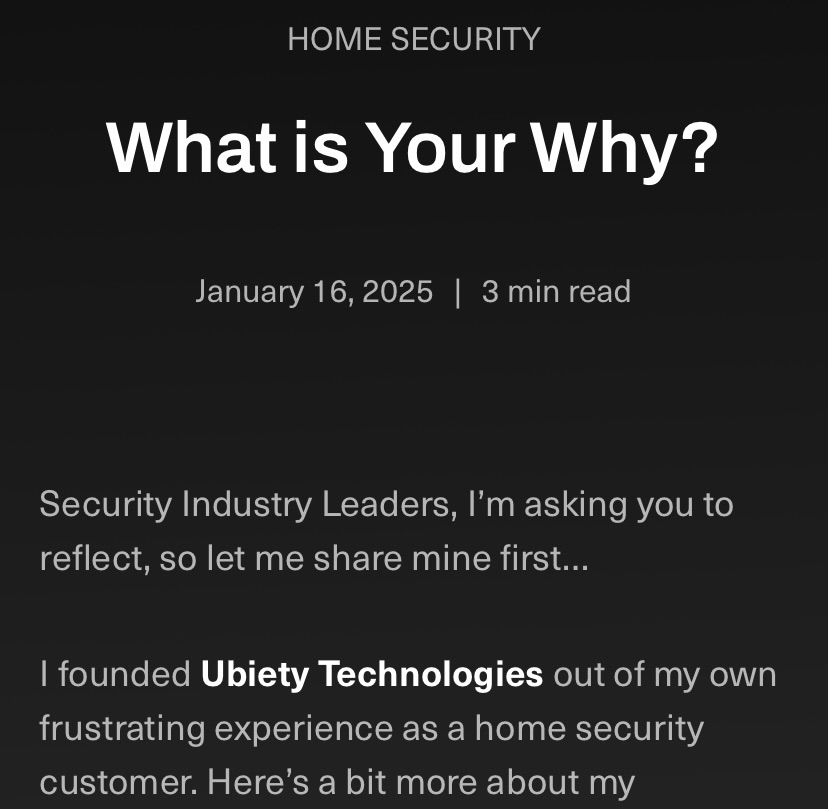
One of the best “why” stories I’ve seen in some time was written by Keith Puckett of Ubiety Technologies

He had purchased a feature-rich home security system and received an alarm while he was traveling. That’s all—an alarm, with no context.

“The security company then asked me, ‘Should we dispatch the police?’ At that moment, the reality hit: I was expected to make a decision that could impact my family’s safety, and I had no information to base that decision on. It was a gut-wrenching experience. The very reason I invested in security—peace of mind—had failed me.”

From Ubiety Technologies, “What is Your Why?”

https://ubiety.io/what-is-your-why

Puckett then started his company so others wouldn’t face the same emotions of fear and helplessness that he faced.

Why ask why?

Why is a “why” story so powerful? 

Because a story like this grabs a prospect’s attention a million times better than some boring technical feature list with optimum camera angles.

Make it personal. Many prospects have their own challenges that you can solve. 

Make sure you have the answers to their questions. That’s why Bredemarket asks questions before creating content…so your prospects don’t have to.

After all, “why ask why?” is more than an old beer commercial slogan.

And one more thing

For those like me who noted Ubiety Technologies’ Illinois location—you know, BIPAland—here is the company approach to privacy.

Face Your Emotions

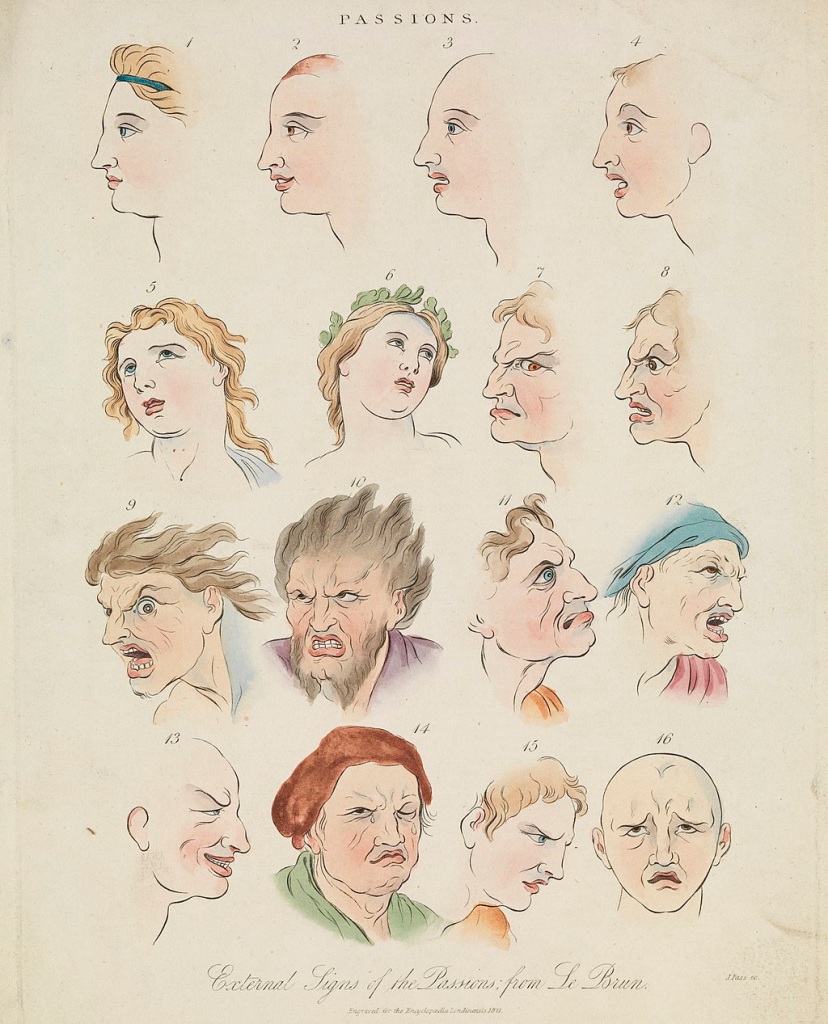
Sixteen faces expressing the human passions. Coloured engraving by J. Pass, 1821, after C. Le Brun. CC BY 4.0. https://commons.wikimedia.org/wiki/File:Sixteen_faces_expressing_the_human_passions.Wellcome_L0068375(cropped).jpg

How should you react to my content marketing? And why?

I was contemplating (in a sage-like manner) the emotions I may want people to feel after they read a piece of my content.

The problem statement should inspire one or more negative emotions.

Perhaps FEAR.

Perhaps ANGER.

Likewise, the solution and/or the results statements should inspire one or more positive emotions.

Perhaps COMFORT.

Perhaps EMPOWERMENT.

Then I realized that the four words I selected formed the acronym “face.”

I think I can remember that.

Now I just need acronyms I can apply to the other six questions.

Those will empower ME.

Are You ConTENT? Balance Your Critical List With Your Prospects’ Critical Lists

Designed by Imgflip.

Normally I talk about CONtent, but today I’m talking about conTENT. (OK, a little bit about CONtent also.)

There are many prospects that may be CRITICALLY IMPORTANT (the highest of my three levels of importance) to your firm—perhaps too many. You can reduce your firm’s list of critically important prospects without losing them altogether. The extra time you receive benefits your firm and your TRUE critically important prospects. And eventually the other prospects may come around anyway.

Let them

You may pursue a prospect because you perceive they have a need. For example, there are identity/biometric companies that have not blogged in over a year, and these companies obviously have a need to increase their visibility with their own prospects by blogging.

But what if the identity/biometric prospects are not HUNGRY to satisfy that need? (Hungry people = true target audience.) Addressing the need may even be “important” to the prospects—but not CRITICALLY important.

  • Now I can create (and have created) content addressing this need and how to fill it. If a prospect searches for this content, they will find it.
  • I can even proactively initiate direct contact with these prospects, and maybe even contact them a second time.

But in most cases a prospect may respond with a “not interested” message—if the prospect even responds at all.

Mel Robbins has a response to this.

Let them.”

When you “Let Them” do whatever it is that they want to do, it creates more control and emotional peace for you and a better relationship with the people in your life.

From https://www.melrobbins.com/podcasts/episode-70.

If the prospect is not hungry for your services at this time, let them.

And at the same time move the prospect from your “critically important” category down to your “important” category. Focus on the critically important prospects, and be content (conTENT) with them rather than stressing out over the uncontrollable prospects.

But don’t eliminate the merely important prospects entirely, because some day they may become hungry for your services. Continue creating content (CONtent) such as your own blogs, plus social media without messaging the merely important people directly. When they DO get hungry, they will emerge from your trust funnel and contact YOU, asking for your services.

Becoming conTENT

What happens when you, in the words of Mel Robbins, “let them”?

You’re focused, your true critically important prospects are happy that you’re paying attention to them, your merely important prospects are happy that you’re no longer pestering them…

…and everyone is conTENT.

What is Your Tone of Voice?

We relate to firms as entities with personalities…and particular tones of voice. Could you imagine Procter & Gamble speaking in Apple’s tone of voice, or vice versa?

And one more thing…Charmin. Now in black.

(Thunderous applause and royal adoration with no indifference whatsoever.)

Designed by Freepik.

When you contract with a writer

Firms take care to speak in a particular tone of voice. Which means that the people writing their copy have to speak in that same tone of voice.

I have spent time thinking about Bredemarket’s own tone of voice, most recently when I delved into the “royalty” aspects of the Bredemarket family of archetypes. In that family “Sage” is most dominant, but there are also other elements.

Bredemarket’s top archetypes: sage, explorer, royalty, and entertainer.

In Bredemarket’s case, my sage/explorer/royalty/entertainer tone of voice is visible in Bredemarket’s writing. At least in Bredemarket’s SELF-promotional writing.

But MY tone of voice makes no difference to my clients, all of whom are focused on their OWN tones of voice. And Bredemarket has to adjust to EACH CLIENT’S tone of voice.

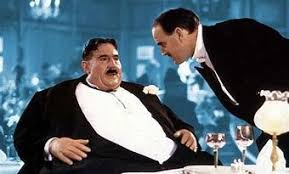
  • If I’m writing for a toilet paper manufacturer, I will NOT delve into details of how the product is used. Then again, maybe I will. Times have changed since Mr. Whipple.
  • If I’m writing for a cool consumer electronics firm, I definitely WILL delve into product use…if it’s cool.
  • If I’m writing for a technologist, I’m not going to throw a lot of music references into the technologist’s writing. I will emphasize the technologist’s expertise.
  • If I’m writing for a firm dedicated to advancement, I’m not going to throw ancient references into the firm’s writing. I will emphasize the newness of the firm’s approach, using the firm’s own key words.

My hope is that if you see two pieces of ghostwritten (work-for-hire) Bredemarket work for two different clients, you WON’T be able to tell that they were both written by me.

When your writer dons your mask

I’ve addressed the topic of adaptation before, where people don masks to portray characters that they are not.

By JamesHarrison – Own work, Public Domain, https://commons.wikimedia.org/w/index.php?curid=4873863

At the time I said the following:

So when Bredemarket or another content marketing expert starts to write something for you, should you fret and fuss over what your archetype is?

If you feel like it. But it’s not essential.

What is essential is that you have some concept of the tone of voice that you want to use in your communication.

From https://bredemarket.com/2022/10/30/donning-archetypes/

I then led into…well, something that is long outdated. But the gist of what I said at the time is that you need to determine what your firm’s tone of voice is, so that your writers can consistently write in that tone of voice.

Creating content with your tone of voice

So if Bredemarket works with you to create your content, how will I know your desired tone of voice? By one of two ways.

  1. You tell me.
  2. I ask you.
Bredemarket’s first seven questions, the October 30, 2023 version.

As we work through the seven questions that will shape your content, I ensure that I understand the tone of voice that you want to adopt in your content.

And with the review cycles interspersed through the content creation process, you can confirm that the tone is correct, and I can make adjustments as needed.

Unless you absolutely insist that I use a hackneyed phrase like “best of breed.” That requires a significant extra charge.

Do you want to drive content results in your own tone of voice with Bredemarket’s help?

Here’s how.

Brand Archetypes: I Am Royalty, But I Am Not Royalty

When I investigated Bredemarket’s archetypes back in 2021, the Kaye Putnam quiz that I took identified my primary archetype (sage) and three sub-archetypes (explorer, royalty, and entertainer).

Of my four top archetypes, the one that I haven’t really, um, explored is the “Royalty” brand archetype. This archetype was a surprise to me, and upon researching it further it fits me…and it doesn’t fit me.

I am Royalty

By United Kingdom Government – Illustrated magazine, 13 December 1952, p. 14. Copyright label: “CROWN COPYRIGHT RESERVED” (no other labels or attributions)., Public Domain, https://commons.wikimedia.org/w/index.php?curid=64590096

Using Kaye Putnam’s description of the Royalty brand archetype, I found some elements that spoke to me personally.

Whether you resonate with being a boss, aristocrat, king, queen, politician, or manager, your brand possesses the incredible power to evoke feelings of awe, admiration, and the promise of shared success in those who encounter it.

From https://www.kayeputnam.com/brand-archetype-royalty/

Let’s face it: I am the strong-willed person who self-brands as the temperamental writer, often moved to take charge of a situation, and frankly craving admiration and protesting indifference.

For example, for the last several weeks I’ve been tracking both impression and (more importantly) engagement statistics for my personal LinkedIn account and the Bredemarket website. What does engagement mean? In its most basic terms, it can be expressed as (in Sally Field’s words) “you like me.”

From https://www.youtube.com/watch?v=rl_NpdAy3WY

I am not Royalty

The “King” and the “Duke.” By Twain, Mark, 1835-1910 – Adventures of Huckleberry Finn.djvu, Public Domain, https://commons.wikimedia.org/w/index.php?curid=44881563

So those behaviors align with the Royalty archetype. But others do not.

Your brand exudes a sense of impeccable taste, inspiring others to aspire to your level of refinement.

From https://www.kayeputnam.com/brand-archetype-royalty/

I don’t think anyone would use the words “impeccable taste” and “level of refinement” to describe me. Even when I do wear a tie.

John E. Bredehoft at Bredemarket worldwide headquarters in Ontario, California, September 6, 2023.

So maybe I’m not elegant Royalty, just Royalty with an attitude.

Lorde, Reign O’er Me

Ever since I conceived the idea for this blog post, I wanted to work the Lorde song “Royals” into it if possible. But the song doesn’t really fit, since it’s really about established musical royalty who resist young upstarts like Lorde.

(Young but not young. Even a decade ago when the song was released, I was amused at the world-weariness expressed by a teenager. But I digress.)

And as Marc Bodnik notes, the song is contradictory:

The great irony of the lyrics is that “we’ll never be royals” but she keeps talking about becoming Queen and talks about “ruling.”…Will Lorde’s new rule be any better than the current regime? Who knows.

From https://www.huffpost.com/entry/what-does-the-song-royals_b_4310438

In an Abbott and Costello way, “Who” DID know.

The same lyricist who hoped to die before he got old (spoiler: he didn’t) subsequently wrote the lyric

Meet the new boss

Same as the old boss

From https://genius.com/The-who-wont-get-fooled-again-lyrics

Despite my employment background, I’m not a royal with revolutionary tendencies.

But I can don masks, which does matter.

To be continued…

Do You Know the “Three Levels of Importance” (TLOI)?

“Your call is important to us.” Oh, really? Will the CEO answer my call in the next ten seconds?

By Jonathan Mauer – Own work, CC BY-SA 4.0, https://commons.wikimedia.org/w/index.php?curid=50534668

All things are NOT equally important. In fact, there are THREE levels of importance (TLOI):

  1. IMPORTANT.
  2. VERY IMPORTANT.
  3. CRITICALLY IMPORTANT.

Maybe you use different words (perhaps “life-or-death important” or “DEFCON 1”), but the basic point remains. Some things are more important than others.

Make sure that everyone has a common understanding of how important a task is. If you think something is “important” but your partner thinks it is “very important,” your partner may think you are indifferent and have hurt emotions.

Enough theory; let’s apply this. Are you interested in an application of TLOI that answers the following questions?

  1. How is the Eisenhower Matrix flawed by its use of only a SINGLE level of importance?
  2. How does the correction of the Eisenhower Matrix with TLOI affect whether or not you will select Bredemarket as your content marketing expert?

The second question may not have ANY importance to you, but it’s critically important to me.

For the answers to these two questions, read “The Eisenhower Matrix is Flawed” at https://bredemarket.com/2023/10/25/the-eisenhower-matrix-is-flawed/.

#contentmarketing #contentmarketingexpert #eisenhowermatrix #importance #important #indifference

Image by Jonathan Mauer – Own work, CC BY-SA 4.0.

Nothing Bad Will Happen if You Don’t Update Your Content…Right?

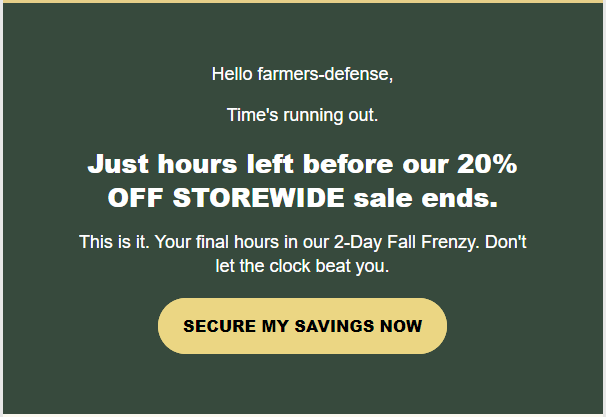
Before you rush to click https://corporate.walmart.com/news/2022/11/01/for-two-days-only-annual-walmart-membership-is-half-price, this half price deal was for 2022, not 2023. You missed out!

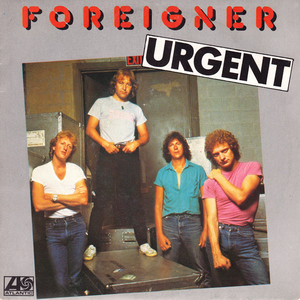
The marketing experts insist that calls to action must emphasize urgency.

The cover art can be obtained from the record label., Fair use, https://en.wikipedia.org/w/index.php?curid=2404116

If you want a prospect to do something, stir up the necessary emotions: fear, fear of missing out (FOMO), anger, whatever. The call to action should emphasize that they act NOW. TV Tropes provides a few examples of these calls to action:

“If you call before midnight tonight, we’ll give you a special bonus!”

“Call in the next 5 minutes for a special bonus!”

“Call quickly because we’re only giving this offer to the first 100 callers.”

From https://tvtropes.org/pmwiki/pmwiki.php/Main/IfYouCallBeforeMidnightTonight

Of course, you don’t need to advertise on television to use these lines. It’s just as easy to use these messages online, as in the Walmart example above, or in this example.

A lot of marketers (and for that matter, a lot of scam artists) listen to the advice of marketing experts. As a result, we are bombarded with “act now” advertising.

In fact, we are bombarded with so much of this junk that we end up tuning it out.

Designed by Freepik.

In the end, NOTHING is urgent.

Or is it?

Is a task important?

Urgency is one thing, but importance is another. Which is why the Eisenhower matrix distinguishes between the two.

For example, your firm’s website may be in urgent need of an upgrade. Perhaps the information on the website is out of date or completely incorrect. (Maybe you DON’T support Windows XP any more.)

But is that important?

  • If an issue is urgent and important, you would have updated your website already to avoid being fired.
  • If an issue is urgent but not important, then it’s something that you could delegate to a content marketing expert. (Ahem. We’ll revisit this later.)

Incidentally, I have some thoughts about the use of “importance” in the Eisenhower matrix, but I’ll save those for another post.

Is a task urgent?

Of course, this assumes that the issue is urgent. Perhaps it’s not urgent at all. As I said before, a lot of sellers like to create a false sense of urgency.

As a consultant, I often find prospects and clients who believe that a particular issue is NOT urgent. You can easily get that Walmart+ membership a few days later, at a minimally higher price. And you can easily wait on updating your online content.

If something is not urgent, then you have two choices depending upon the issue’s importance.

  1. If an issue is not urgent and not important, then why bother taking care of it at all? Let it slide.
  2. If an issue is not urgent but is important, then you had better do it…but there’s no rush. You don’t have to take care of it before midnight tonight. Next week will do…or the week after that.
Designed by Freepik.

Compounding the issue is that if you DO update your website, you’re NOT going to see an immediate return on investment.

It takes longer than three days for content marketing to yield results. One source estimates four to five months. Another source says six to twelve months. Joe Pulizzi (quoted by Neil Patel) estimates 15 to 17 months. And all the sources say that their estimates may not apply to your particular case.

From https://bredemarket.com/2023/08/26/on-trust-funnels/

So if a content marketing update isn’t going to yield immediate results, what’s the rush? Spending time making the updates, or even spending the time managing someone else to make the updates, takes away from tasks that yield financial results NOW.

Designed by Freepik.

If it’s not urgent but is important…

If your outdated content is not urgent but is important, then there’s no rush to take care of the issue.

You can delay it for weeks or even for months, and you’re NEVER going to have a problem.

Until…

By hughepaul from London, UK – Children trying to steal some more bikes from Evans Chalk Farm, CC BY 2.0, https://commons.wikimedia.org/w/index.php?curid=16042615

…a competitor with up-to-date and accurate content swoops in and loots your prospects AND your existing customers away from you.

(Are you worried?)

Why would old content cause you to lose a customer? Because your outdated information demonstrates that you don’t care about your customers. After all, you’re not focused on your customers’ need for up-to-date information on your products and services.

(Are you angry?)

And if you lose enough prospects and customers to result in a revenue drop, then you may lose your job. Then you won’t have to worry about the company’s outdated content any more. Problem solved!

(Are you scared?)

By El mundo de Laura from Puebla, Mexico – Resanadita… pero a nuestra economía!, CC BY 2.0, https://commons.wikimedia.org/w/index.php?curid=7744198

But if it’s urgent but is not important…

Of course, there’s the other alternative that I discussed earlier in this post, in which your content issues are urgent, but they’re not important enough to devote your own resources to them.

In that case, you can contract the work out to someone who will perform the majority of the work in updating your content.

(While retaining a say in your content. That should make you happy.)

And I know where you can contract that work. Bredemarket.

Bredemarket can help you create content that converts prospects and drives content results. Why?

If you’re sold on using Bredemarket to create customer-focused messaging, there are three ways to move forward with your content project. Or you can just join the Bredemarket mailing list to stay informed.

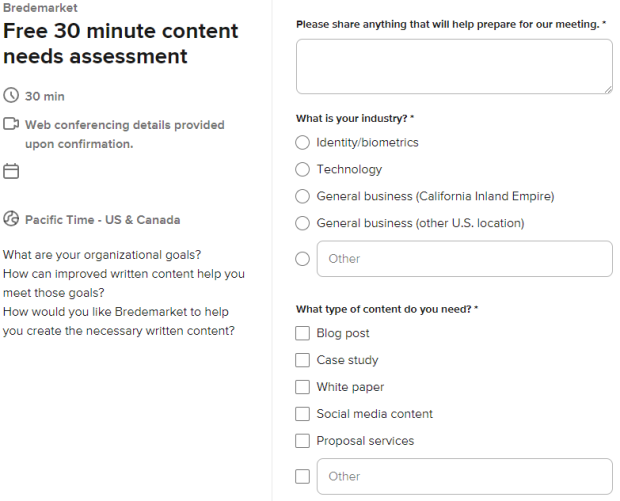
  • Book a meeting with me at calendly.com/bredemarket. Be sure to fill out the information form so I can best help you.

Seven Questions Your Content Creator Should Ask You: the e-book version

No, this is not déjà vu all over again.

If you’re familiar with Bredemarket’s “six questions your content creator should ask you”…I came up with a seventh question because I feared the six questions were not enough, and I wanted to provide you with better confidence that Bredemarket-authored content will achieve your goals.

To no one’s surprise, I’ll tell you WHY and HOW I added a seventh question.

If you want to skip to the meat, go to the WHAT section where you can download the new e-book.

Why?

Early Sunday morning I wrote something on LinkedIn and Facebook that dealt with three “e” words: entertainment, emotion, and engagement, and how the first and second words affect the third. The content was very long, and I don’t know if the content itself was engaging. But I figured that this wasn’t the end of the story:

I know THIS content won’t receive 250 engagements, and certainly won’t receive 25,000 impressions, but maybe I can repurpose the thoughts in some future content. (#Repurposing is good.)

From LinkedIn.

But what to repurpose?

Rather than delving into my content with over 25,000 impressions but less than 250 engagements, and rather than delving into the social media group I discussed, and rather than delving into the Four Tops and the Sons of the Pioneers (not as a single supergroup), I decided that I needed to delve into a single word: indifference, and how to prevent content indifference.

Because if your prospects are indifferent to your content, nothing else matters. And indifference saddens me.

By Mark Marathon – Own work, CC BY-SA 4.0, https://commons.wikimedia.org/w/index.php?curid=72257785

How?

Eventually I decided that I needed to revise an old piece of content from 2022.

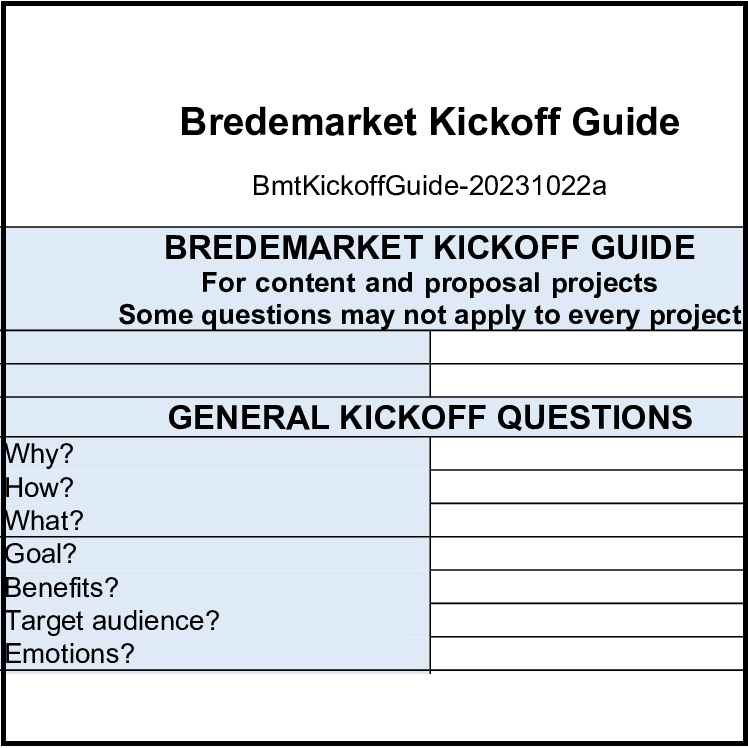
The first questions in the Bredemarket Kickoff Guide, BmtKickoffGuide-20231022a. No, you can’t have the guide; it’s proprietary.

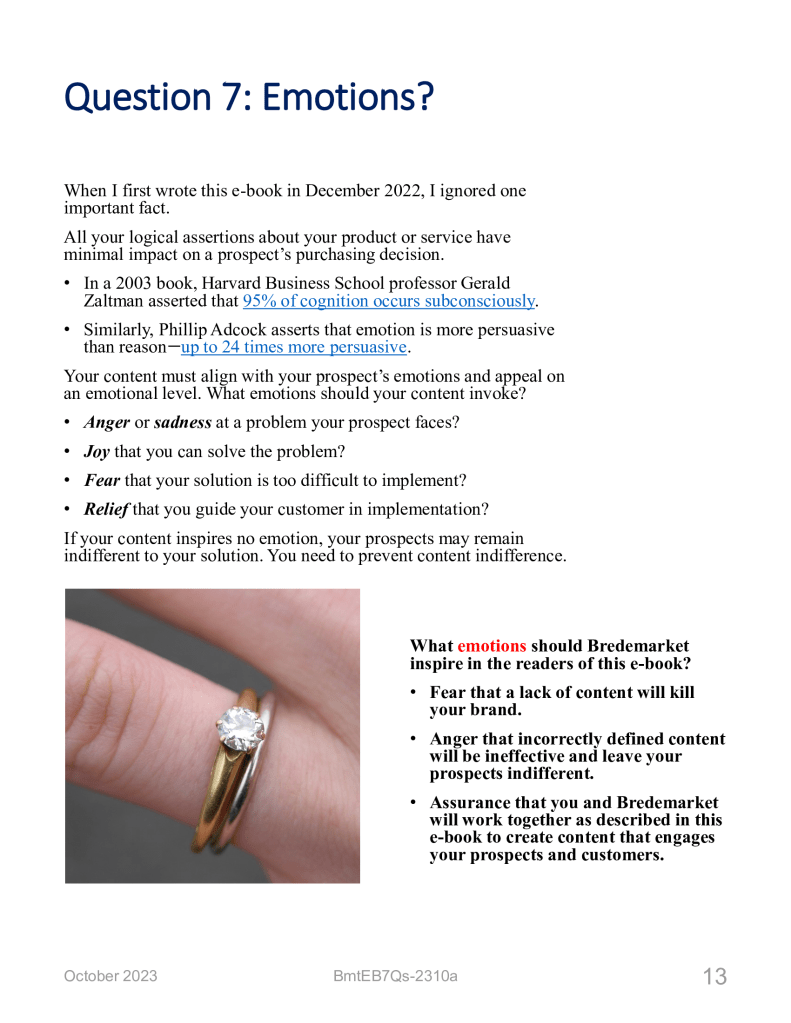
I decided that I needed to update my process, as well as that e-book, and add a seventh question, “Emotions?”

What?

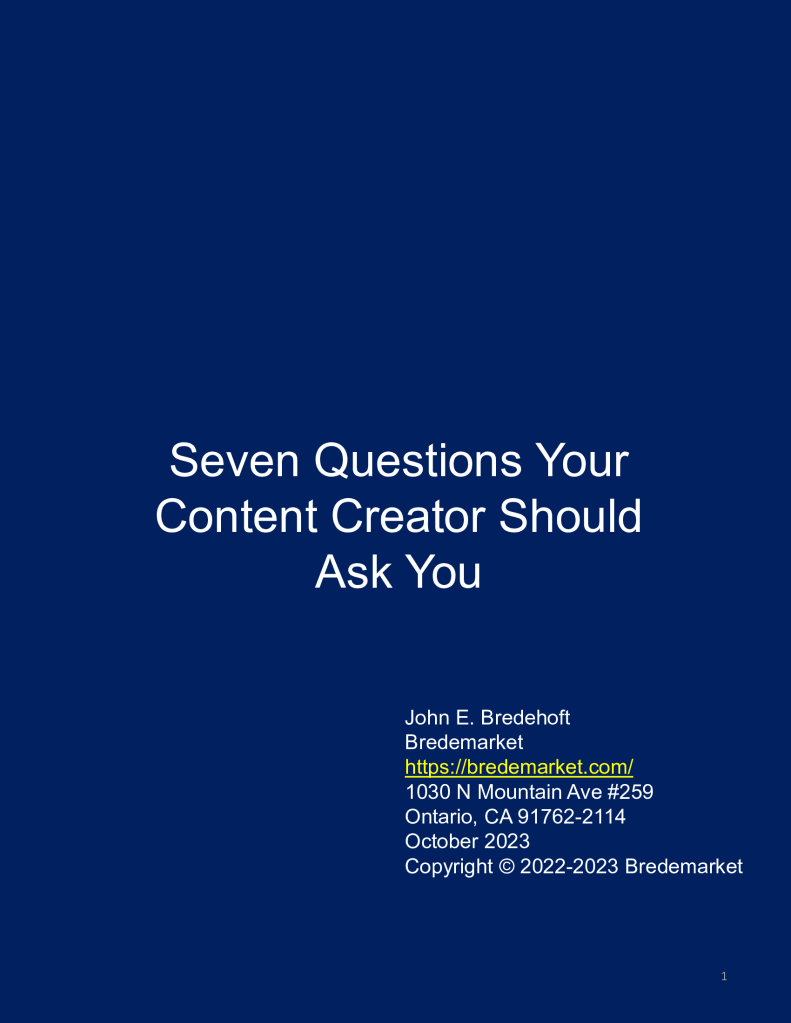
For those who have raced ahead to this section, Bredemarket has a new downloadable e-book (revised from an earlier version) entitled “Seven Questions Your Content Creator Should Ask You.” It includes a new page, “Emotions,” as well as minor revisions to the other pages. You can download it below.

Goal, Benefits, Target Audience, and Emotions

You’ll have to download the e-book to find the answers to the remaining four questions.