California Voter Proof of Identity AND Citizenship: How?

(Imagen 4)

This post provides an update on election integrity, which I haven’t discussed since March.

The update? Assemblymember Carl DeMaio wants to put a proposition on the 2026 California ballot that achieves three purposes:

  • “[R]equire the state to verify proof of citizenship when a person registers to vote.”
  • Require voters to “provide identifications at the polls.”
  • “Those who vote through mail-in ballots would have to give the last four digits of a government-issued ID such as a Social Security number.”

Let’s go through these…backwards.

Mail-in ballots

The third proposal about authenticating mail-in ballots is silly. 

The mere fact that someone knows the last four digits of a Social Security Number does NOT prove that the person is the valid holder of the Social Security Number in question. 

Frankly, I’m surprised that DHS released Leonardo Garcia Venegas just because he knew a Social Security Number. Of course, I’m also surprised that they determined his REAL ID was fake.

In-person ballots

Which brings us to the second proposal about requiring a government ID for in-person voting. 

I’ve already addressed why this is silly. The short version? Election precinct workers have neither the equipment nor the training to tell whether a government ID is real or fake.

Not an official government-issued ID. From https://www.al.com/news/2022/10/alabama-gop-chairman-made-the-photo-id-he-used-to-vote.html.

Voter registration…and re-registration

That only leaves the first one, proving citizenship at voter registration. This one is technically feasible; the feds do it all the time. The California Secretary of State could merely adapt the federal I-9 process to the state level; I’m sure Janice Kephart and her company ZipID would love to help the state with that.

Especially since the requirement for election integrity dictates that all of California’s existing voters would need to re-register to prove their citizenship.

All 22+ million of them.

Because if you DO NOT require all California voters to re-register, the whole exercise is pointless.

You Can START the REAL ID Application Process Online

The Federal Trade Commission sort of got it wrong.

“If you want to use your driver’s license to fly, you’ll need a REAL ID. If you don’t have one yet, your state’s Department of Motor Vehicles (DMV) is the place to go, and they’re only taking in-person appointments.”

The FTC is attempting to warn against scammers who claim to offer REAL ID services and then defraud you.

But at least in California, you can START the REAL ID application process online. At the California DMV website, of course.

“During the online REAL ID application process, you will be prompted to upload documents that prove identity (e.g., valid passport or birth certificate) and residency (e.g., utility bill, bank statement).”

But you can’t do EVERYTHING online.

“Uploading images of these documents online will save you time when you visit the DMV office to complete your application so don’t skip this step. Bring the original documents submitted online to your REAL ID appointment.”

But whatever you do, don’t upload your documents to “the-real-id dot cn.”

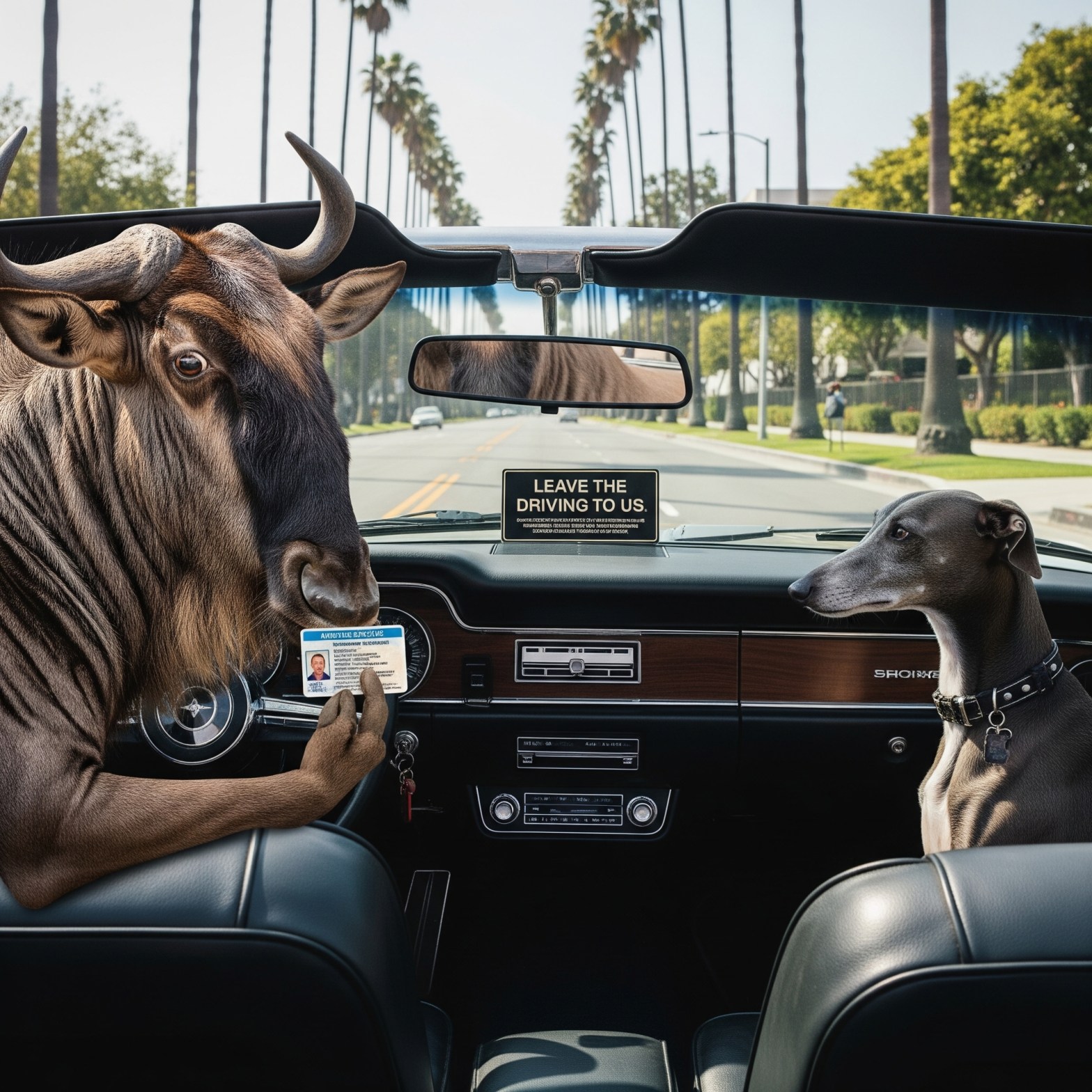
When Robocars Eliminate Identity

From the Department of Unintended Consequences: different countries approach identity proofing in different ways. But what happens when the underlying assumptions disappear and make some identity proofing methods obsolete?

Identity proofing in the United States

In the United States, the primary public identity document for citizens and non-citizens is the driver’s license. These government identity documents, issued by individual states and territories, satisfy a variety of uses, including driving, buying alcohol, boarding a plane or entering a federal facility (eventually), or purchasing something.

There are two other common identity documents in the United States:

  • The passport. But not everybody has one.
  • The Social Security card. But this is like your underwear; you don’t show it to everybody.

So our de facto identity card in this country is the driver’s license, or an equivalent ID document issued by a motor vehicle agency. Even though driver’s licenses are used for a ton of purposes that have nothing to do with driving, the entire ecosystem for these IDs is driven by the needs of drivers.

Which is a smart idea, because just about everybody needs a driver’s license.

Right?

What I’m reading

I read a number of WordPress blogs, and one of the ones that I read has the title “The Last Driver License Holder…

The abstract for the blog completes the sentence and clarifies it.

…is already born. How Waymo, Tesla, Zoox & Co will change our automotive society and make mobility safer, more affordable and accessible in urban as well as rural areas.

It’s certainly a provocative statement, especially if you’re a recent college graduate who just joined the California DMV and thought you were set for life. You’re not.

Even if the author’s conclusion is a complete exaggeration, we need to entertain the possibility that driverless automobiles may eventually improve so much that people won’t even need a driver’s license, except for the cranky few that want them.

Assume that the majority of people own driverless cars at some point in the future, and that these support complete automation with no driver intervention. Imagine the ripple effects:

  • The government motor vehicle agencies, who will be more than busy certifying the road worthiness of new automobiles, will start wondering why they are spending so much time issuing these IDs that no one uses.
  • Other agencies at the state and federal level, eager to expand their operations and budgets, will start asking why the motor vehicle agencies are the ones in charge of IDs, and why they should be providing IDs instead.
  • While the agencies fight this out, private companies that provide adult services such as alcohol, prostitution, pornography, and buying gardening implements will have to figure out how to ensure their customers are old enough for these services. Perhaps they will be forced to turn to age estimation because the person at the counter never bothered to get a driver’s license.

So now half the people don’t bother to get IDs, yet they still need IDs.

Now what?

Will There Be FEWER States with Mobile Driver’s Licenses in the Future?

(Imagen 3)

Normally when states adopt a new technology, one state will first adopt it, followed by other states, until eventually all states adopt it. (Take REAL ID.)

It’s rare that a state adopts an emerging technology and then trashes it.

Last year

But that’s exactly what happened in Florida last summer, when the state withdrew support for its Thales mobile driver’s license (mDL) pending the creation of a new mDL from a new vendor.

Update as of June 2025…there isn’t one.

“The Florida Smart ID applications will be updated and improved by a new vendor. At this time, the Florida Department of Highway Safety and Motor Vehicles is removing the current Florida Smart ID application from the app store. Please email FloridaSmartID@flhsmv.gov to receive notification of future availability.”

This year

But hey, I’m sure Florida is working behind the scenes to develop a new mDL. After all, digital identity remains a federal priority.

Um…check Biometric Update.

“At the forefront of the Trump administration’s cybersecurity shift is the categorical removal of Biden-era digital identity initiatives which had encouraged federal agencies to accept digital identity documents to access public benefit programs and promoted federal grants to help states develop secure mobile driver’s licenses.”

Biometric Update is specifically referring to President Donald Trump’s Executive Order issued last Friday, which affects cybersecurity efforts in general. Lots of use of the Q word.

Next year?

But if states aren’t receiving federal funding to develop mDLs, and if states decide that only physical driver’s licenses are in their interest, then will mDL adoption slow?

Or may other states follow Florida’s lead and let their contracts with mDL vendors expire?

SWOT analysis advocates…this is a threat.

Oh, and by the way…don’t forget that moving from mDLs back to physical driver’s licenses leads to a certain loss of privacy

Privacy.

Enhanced Driver’s License (EDL) vs. REAL ID

Unlike a REAL ID, which merely proves lawful presence in the United States, an Enhanced Driver’s License (EDL) also proves citizenship.

The catch? Only certain states bordering Canada offer them.

Originally developed for both U.S. and Canadian use as part of the Western Hemisphere Travel Initiative, as of May 2025 EDLs are only offered by the states of Michigan, Minnesota, New York, Vermont, and Washington. California considered issuing EDLs, but rejected the idea because of privacy concerns surrounding the underlying RFID technology.

No Canadian province offers EDLs any more. The last province, Manitoba, discontinued them in 2022.

Leonardo Garcia Venegas is a U.S. Citizen…but REAL ID Holders Don’t Have to Be

The Parnas Perspective offered its take on Garcia’s story. From Parnas’ post:

“Authorities allegedly dismissed the ID as fake and used force to detain him, with bystanders shouting that he was a citizen.”

Also listen to the accompanying video (which states that Garcia was born in Florida), and see my prior post.

Non-citizen REAL IDs? Sure.

One important clarification: non-citizens CAN obtain a REAL ID…provided that they are lawfully in the country and hold certain documents.

Here are California’s non-citizen REAL ID requirements, which are federally acceptable:

“This includes all U.S. citizens, permanent residents who are not U.S. citizens (Green Card holders), and those with temporary legal status, such as recipients of Deferred Action for Childhood Arrivals (DACA) or Temporary Protected Status (TPS) and holders of a valid student or employment visa. For Californians with temporary legal status, their REAL ID DL/ID card will expire on the same date as their U.S. legal presence document, and they can receive a new card with a documented extension of their legal status.”

(Imagen 4)

Leonardo Don’t Lose That Number

You know that I’ve railed against solely relying on knowledge-based authentication: for example, by relying on a person’s knowledge of a name and a birthdate to gain access to protected health information.

What when knowledge-based authentication receives HIGHER trust than other proofs of identity?

There is a story about Leonardo Garcia Venegas, who was working in Foley, Alabama. Apparently he was caught up in an immigration raid. So Garcia, who is a U.S. citizen, did the intelligent thing: he brought out his REAL ID, a document that can only be issued to someone after they prove they are a U.S. citizen.

Except…

“Garcia told Noticias Telemundo that authorities took his ID from his wallet and told him it was fake before handcuffing him.”

So how did he finally get released?

“Garcia said he was released from the vehicle where he was held after he gave the arresting officials his Social Security number, which showed he is a U.S. citizen.”

So apparently having a REAL ID counts for nothing, while being able to rattle off a Social Security Number counts as proof?

Frequent fliers and voters take note.

(Imagen 4)

Evading State Taxes: Non-Person Automotive Entities and Geolocation

When a person is born in the United States, they obtain identifiers such as a name and a Social Security Number.

When a non-person entity is “born,” it gets identifiers also. For automobiles, the two most common ones are a Vehicle Identification Number (VIN) and a license plate number. (There is also title, which I’ve discussed before, but that’s not really an identifier.)

In my country license plates and the associated vehicle registrations, like driver’s licenses, are issued at the state level. Montana, for example, has 2.3 million registered vehicles…which is odd, because the state only has 879,000 licensed drivers.

How can this be? Jalopnik explains:

“All that wealthy car owners have to do is spend around $1,000 to open an LLC in Montana, then use the LLC to purchase a car with no sales tax — and said car is not subject to vehicle inspections or emissions testing.”

That explains things. The Montana LLCs need multiple cars for all their LLC-related travel between Billings, Bozeman, and Butte. That’s a ton of miles on the Montana highways.

Um…no.

“According to Bloomberg, former Montana revenue director Dan Bucks said there are likely more than 600,000 vehicles registered in Montana but operated in other states.”

Like California. Where people don’t want to pay the fees associated with vehicle registration here, so they say their vehicles are Montana vehicles. Only problem is, license plate readers on California freeways can identify the movements of a car with Montana plates. And if that “Montana” car is moving in California, expect a visit from the tax authority.

But it’s not just the money hungry loony liberal Commies in California. Jalopnik reports that the money hungry loony liberal Commies in…um…Utah are mad also.

“This is really an abuse of our tax system,” said Utah tax commissioner John Valentine. “They pay nothing to support our state, just a small fee to Montana for the opportunity to evade taxes in Utah.”

Because in the end it doesn’t matter if you’re blue or red. What matters is the green. And the geolocation.

(2002 Ford Excursion image public domain)

Proposals and “Weasel Words”

Have you ever used the phrase “weasel word”? Here’s how Merriam-Webster defines it:

“a word used in order to evade or retreat from a direct or forthright statement or position”

I don’t know how weasels became the subject of a negative phrase like this, but here we are.

I learned the phrase “weasel word” when I started working in proposals. I’ve been writing proposals for nearly 15 years, and I’ve run into many cases where I don’t comply with the written word of a mandatory requirement, and I end up having to…evade or retreat.

I’ve adopted my share of favorite weasel words over the years. I’m not going to give away any of my secrets in this public forum, but you’ve probably heard me rant about the government weasel wording regarding REAL ID “enforcement”:

“This rule ensures that Federal agencies have appropriate flexibility to implement the card-based enforcement provisions of the REAL ID regulations after the May 7, 2025, enforcement deadline by explicitly permitting agencies to implement these provisions in phases….The rule also requires agencies to coordinate their plans with DHS, make the plans publicly available, and achieve full enforcement by May 5, 2027.”

As I have ranted repeatedly, the REAL ID enforcement DEADLINE is May 7, 2025, but FULL enforcement will be achieved by May 5, 2027. There are enough weasel words to distract from the fact that full enforcement is not taking place on May 7, 2025.

“Flexibility,” “implement in phases”…I’m taking notes. The next time I respond to a DHS RFI, I may use some of these.

Because Bredemarket does respond to Requests for Information, Requests for Proposal, and similar documents. One of Bredemarket’s clients recently received an award, with possible lucrative add-on work in the future.

Does your identity/biometric or technology conpany want the government to give you money? I can help. Talk to me: https://bredemarket.com/cpa/

Bredemarket’s “CPA.” The P stands for Proposal.

(Weasel picture Keven Law • CC BY-SA 2.0; https://commons.wikimedia.org/wiki/File:Mustela_nivalis_-British_Wildlife_Centre-4.jpg)

This is What REAL ID “Enforcement” Looks Like: Not Compelling at All

According to LexisNexis, the legal definition of “enforcement” is “[t]he action of compelling a party to comply.”

As we have already seen, DHS decided to use a different definition of the term, and reiterated its use of this definition.

What does enforcement mean at JFK, LaGuardia, and Newark as of May 8?

“Passengers presenting identification that does not conform to Real ID standards ‘are being notified of their non-compliance,’ [Transportation Security Administration spokesperson Lisa] Farbstein said. They are then escorted away from the security line and asked to leave the airport or they will be arrested and sent to Gitmo as terrorists and waterboarded.”

Whoops, I appear to have made a typo and misquoted North Jersey. Here is what is ACTUALLY happening:

“Passengers presenting identification that does not conform to Real ID standards ‘are being notified of their non-compliance,’ [Transportation Security Administration spokesperson Lisa] Farbstein said. They may then be directed to a separate area for additional screening.”

That ain’t “compelling” at all. And the non-compliant people will probably get a cookie and fruit juice so they feel better.

Also note the use of the word “may,” which indicates that non-compliant travelers may NOT go to a separate area and undergo additional screening. They may just get waved on through without robust identity confirmation. And still get the cookie and fruit juice.

I will admit that this is probably unavoidable. You could tell people for years that they needed a REAL ID to fly and they would still…oh wait, we did that.

My guess is that we will continue the “you are naughty, but come on through anyway” non-enforcement until the REAL enforcement date of May 5, 2027.

Subject to extension….again.

Unless someone without a REAL ID slips through and does bad things. Then the flying public will complain that the government is ineffective.

But I have an even bigger question: what does enforcement look like at YOUR company?

(Imagen 3)