As We Predicted, REAL ID Won’t Be Fully Enforced

So much for my 15 seconds of fame with my Biometric Update guest post. Let’s move on to more important things.

Like the (finally!) enforcement of REAL ID at midnight EDT Wednesday May 7.

Not really.

We already knew that REAL ID enforcement wouldn’t be fully enforced.

“This rule ensures that Federal agencies have appropriate flexibility to implement the card-based enforcement provisions of the REAL ID regulations after the May 7, 2025, enforcement deadline by explicitly permitting agencies to implement these provisions in phases….The rule also requires agencies to coordinate their plans with DHS, make the plans publicly available, and achieve full enforcement by May 5, 2027.”

And Secretary of Homeland Security Kristi Noem just confirmed this.

“’If it’s not compliant, they may be diverted to a different line, have an extra step, but people will be allowed to fly,’ Noem said at a U.S. House hearing on Tuesday. ‘This is a security issue.’”

So when WILL it be enforced? Memorial Day? Thanksgiving? May 5, 2027? Ever?

Of course, it’s not going to be easy for those without a passport, REAL ID, or other acceptable form of identification. They will undergo a little investigation, humiliation, and if they cross their fingers rehabilitation.

(Imagen 3)

Driver’s License Data and Third Party Risk Management

It gets real tomorrow, with the enforcement date (sort of) for REAL ID at federal installations and airports. But what about the privacy of the data behind REAL IDs?

Bela Kumar of Jumio Corporation was recently interviewed by CNBC for an article about REAL ID and the data sharing behind it.

As can be expected, some people are very concerned about what this means.

“[C]oncerns persist among privacy professionals that the next step will be a federal database of driver’s license information, which is bad from a privacy and cybersecurity standpoint, said Jay Stanley, a senior policy analyst with the American Civil Liberties Union.

“‘The more information the government has, the more the government might use that information,’ said Jodi Daniels, founder and chief executive of Red Clover Advisors, a privacy consulting company. ‘But that’s not what’s happening now,’ she added.”

Kumar addressed what IS happening now, and whether our personally identifiable information (PII) is protected.

“States have been issuing driver’s licenses for many years, and personal information is already being stored. The expectation is that the same controls apply to Real ID, said Bala Kumar, chief product and technology officer at Jumio, an online mobile payment and identity verification company. ‘States have already been managing this for many years,’ Kumar said.”

If you continue to read the article, you’ll also see a statement from the American Association of Motor Vehicle Administrators that echoes what Jumio said.

But as a former IDEMIA employee, my curiosity was piqued.

Has anyone ever gained unauthorized access to a state driver’s license database?

So I checked, and could not find an example of unauthorized access to a state driver’s license database.

But I DID find an example of unauthorized access to driver’s license DATA that was processed by a third party. The State of Louisiana issued a notice that included the following:

“On May 31, 2023, Progress Software Corporation, which developed and supports the MOVEIt managed file transfer platform, notified all customers across the globe, including [Louisiana Office of Motor Vehicles], of a zero-day vulnerability that an unauthorized party leveraged to access and acquire data without authorization. Upon learning of the incident, immediate measures were taken to secure the MOVEIt environment utilized to transfer files. A thorough investigation was conducted, and it was determined that there was unauthorized acquisition of and access to OMV files in the MOVEIt environment….

“The information varied by individual but included name and one or more of the following: address, date of birth, Social Security number, driver’s license, learner’s permit, or identification card number, height, eye color, vehicle registration information, and handicap placard information.”

Well, at least the hacked data didn’t include weight. Or claimed weight.

Cybersecurity professionals know that you cannot completely prevent these hacks. Which explains the “risk” in third party risk management. Progress Software has been around for a long time; I worked with Progress Software BEFORE I began my biometric career. But these hacks (in this case, CVE-2023-34362 as documented by CISA) can happen to anyone.

Be cautious, and remember that others with good intentions might not be cautious enough.

The Present Reality of REAL ID Federal-State Tensions

Driver’s license vendors already know about the states’ decades-long resistance to REAL ID, and I bet you do too.

Anthony Kimery of Biometric Update put a fundamental truth succinctly:

“The saga of the REAL ID pushback reveals a deep and ongoing tension at the heart of American governance: the friction between national imperatives and state autonomy.”

Kimery’s article, “Twenty years later the REAL ID debate refuses to go away,” captures the history of this federal-state tension over the years. 

Beginning with some states telling the federal government to get out of their affairs, as well as expressing budgetary concerns about federal mandates that the federal government wouldn’t fund, Anthony Kimery’s REAL ID tale concludes with all the states and territories achieving technical compliance with REAL ID…two decades later.

(Why did the states surrender to the federal REAL ID mandates? Because as much as the states complained about federal overreach…in the end the federal government controlled the airports. If you wanted to fly, you had to get a federal passport…or bend your state driver’s license to the federal rules. And you might recall that airport security was the whole reason for REAL IDs in the first place.)

At the end of Kimery’s story, concerns have come full circle. States that maintained that they have the right to determine how they issue their own driver’s licenses are angry at how OTHER states exercise the right to issue THEIR own driver’s licenses.

“Early this year,…Wyoming passed legislation invalidating out-of-state driver’s licenses issued to undocumented immigrants.”

Maybe we need a national ID?

If you’re curious about what Bredemarket has said about REAL ID over the years, I’ve collected a few samples:

And if your company sells driver’s license services, but your staff is too swamped to tell your story, you can obtain the services of a consultant who can create 22 (or more) types of internal and external content. Contact Bredemarket: https://bredemarket.com/cpa/

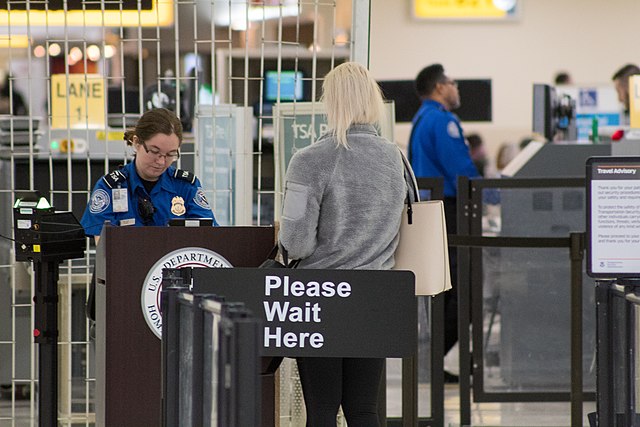
(Image: Transportation Security Administration Checkpoint at John Glenn Columbus International Airport. By Michael Ball – Own work, CC0, https://commons.wikimedia.org/w/index.php?curid=77279000.)

TSA Photo Requests: “The Current U.S. Government” Can Already Obtain Your Facial Image

There have been many recent stories about Transportation Security Administration (TSA) capture of the facial images of travelers, an outgrowth of the same post-9/11 concerns that resulted in REAL IDs in 2008…I mean 2025. (Maybe.)

One story from HuffPost clearly states its view on the matter. The title of the story? “Why You Can (And Should) Opt Out Of TSA Facial Recognition Right Now.”

I guess we know where HuffPost stands.

As to the “why” of its stance, here’s a succinct statement:

“Do you really want to be submitting a face scan to the current U.S. government?”

And perhaps there are good reasons to distrust the Trump Administration, or any administration. 

After all, the TSA says it only retains the picture for a limited time: “Photos are not stored or saved after a positive ID match has been made, except in a limited testing environment for evaluation of the effectiveness of the technology,”

But maybe…something happens. Someone accidentally forgot to delete the files. Oops.

And if something happens, the federal government has just captured an image of your face!

Guess what? The federal government can probably already get an image of your face, even if you don’t allow TSA to take your photo.

After all, you had to show some sort of identification when you arrived at that TSA checkpoint. Maybe you showed a passport, with a picture that the U.S. State Department received at one point. No, they don’t retain them either. But maybe…something happens.

But who does retain an image of your face?

Your state driver’s license agency. And as of 2019:

“Twenty-one states currently allow federal agencies such as the FBI to run searches of driver’s license and identification photo databases.”

So if a federal agency wants your facial image, it can probably obtain it even if you decline the TSA photo request.

Unless you strictly follow Amish practices. But in that case you probably wouldn’t be going through a TSA checkpoint anyway.

But if you are with a facial recognition company, and you want your prospects and their prospects to understand how your solution protects their privacy…

Bredemarket can help:

  • compelling content creation
  • winning proposal development
  • actionable analysis

Book a call: https://bredemarket.com/cpa/ 

(Security checkpoint picture generated by Imagen 3)

“Somewhat You Why” in Minnesota

Remember my earlier post “‘Somewhat You Why,’ and Whether Deepfakes are Evil or Good or Both”?

When I posted it, I said:

I debated whether or not I should publish this because it touches upon two controversial topics: U.S. politics, and my proposed sixth factor of authentication. 

I eventually decided to share it on the Bredemarket blog but NOT link to it or quote it on my socials.

Well, I’m having the same debate with this post, which is ironic because I learned about the content via the socials. Not that I will identify the source, because it is from someone’s personal Facebook feed.

Just a random picture of Princess Diana. Public domain.

My earlier post analyzed my assumption that deepfakes are bad. It covered the end of National Science Foundation funding for deepfake research, apparently because deepfakes can be used as a form of First Amendment free speech.

Well, the same issue is appearing at the state level, according to the AP:

X Corp., the social media platform owned by Trump adviser Elon Musk, is challenging the constitutionality of a Minnesota ban on using deepfakes to influence elections and harm candidates, saying it violates First Amendment speech protections.

As I previously noted, this does NOT mean that X believes in a Constitutional right to financially defraud people.

  • Or do I have a Constitutional right to practice my freedom of religion by creating my own biometric-free voter identification card like John Wahl did?

Again, is it all about intent? Somewhat you why?

And if your firm provides facial recognition, how do you address such issues?

If you need help with your facial recognition product marketing, Bredemarket has an opening for a facial recognition client. I can offer

  • compelling content creation
  • winning proposal development
  • actionable analysis

If Bredemarket can help your stretched staff, book a free meeting with me: https://bredemarket.com/cpa/

(Lincoln’s laptop from Imagen 3)

Know Your Political Influencer

In an article with a clickbait title, Newsweek reported on the indictment of Massachusetts state Representative Christopher Flanagan on various fraud charges. One of the allegations:

“Beyond the five wire fraud counts, the grand jury also indicted him on one count of falsifying documents related to a campaign flier. The mailer from “Conservatives for Dennis” endorsed Flanagan….[He attributed] “the source of the Mailer to a false persona, ‘Jeanne Louise,'” whom he created for the endorsement….In October 2023, he admitted to OCPF that Jeanne Louise “was fake” and he was the source of the mailer.”

There is so much effort to identify voters. What about identifying the sources of political endorsements?

Does your company have a solution to this? I can help you tell your story. Go to https://bredemarket.com/cpa/.

(Picture from Imagen 3)

If Your Identity System Only Manages People, It Is Flawed

This is painful, but it has to be done.

I’ve spent 30 years working with the identities of PEOPLE and ensuring that all PEOPLE accessing a system are properly identified.

In other words, leaving a huge GAPING security hole.

Look at what Okta is doing;

“[N]ew Okta Platform capabilities…help businesses secure AI agents and other non-human identities with the same level of visibility, control, governance, and automation as human ones. The Okta Platform will now bring a unified, end-to-end identity security fabric to organizations for managing and securing all types of identities across their ecosystem, from AI agents to API keys to employees.”

I think that “unified” will take the place of “trust” as the identity buzzword. Thankfully.

If you’re only selling biometrics, or maybe biometrics and ID cards, where will your customers go to get the rest of their systems? Or will you just be a commodity supplier to the companies that provide the REAL systems?

(Unified security AI picture from Imagen 3)

Looking at One Voter ID State

Back in 2023, I wrote “How to Vote Fraudulently in a Voter ID State.” But that only works if the voter ID state fails to protect its precincts from fake IDs.

Here is an example of voter ID legislation, this one from South Dakota.

12-18-6.1. Voters required to provide identification before voting.

When the voter is requesting a ballot, the voter shall present a valid form of personal identification. The personal identification that may be presented shall be either:

(1)    A South Dakota driver’s license or nondriver identification card;

(2)    A passport or an identification card, including a picture, issued by an agency of the United States government;

(3)    A tribal identification card, including a picture; or

(4)    A current student identification card, including a picture, issued by a high school or an accredited institution of higher education, including a university, college, or technical school, located within the State of South Dakota.

Source:  SL 2003, ch 82, § 1; SL 2004, ch 108, § 3; SL 2006, ch 71, § 1.

As most people know, legislators only define the law in broad strokes. It is up to the executive to figure out the details of how to implement the law.

So how does the South Dakota Board of Elections determine that the presented identification is valid?

Does every precinct worker in South Dakota possess a copy of a guide (such as this one) that includes, among other items:

“Explanation of what the proper alphanumeric sequencing of a South Dakota ID or Driver’s License should be (how many letters, numbers, etc.).”

In addition, does every precinct worker in South Dakota have access to software and equipment (such as this one that uses “white, infrared, ultraviolet and coaxial lights”) that detects deepfake IDs? This one has a $1,600 list price. You can get cheaper ones that only support white light and can’t detect the other security features, but such readers would violate the law.

If the state can negotiate a discount of $1,000 per reader, then you can equip almost 700 precincts for less than $1 million (excluding training and maintenance, and assuming only 1 reader per precinct). A small price to pay for democracy.

Unfortunately, I could not find Regula in the list of certified South Dakota voting equipment. Perhaps South Dakota uses a competitor.

Of course voter ID fraud doesn’t just affect South Dakota, as I previously noted. But even if South Dakota doesn’t equip its precinct workers to reject voters with fake IDs, I’m sure the other states do.

Well, maybe not Alabama.

Age Estimation is Challenging

(Part of the biometric product marketing expert series)

Two Biometric Update stories that were published on March 27, 2025 reminded me of something I wrote before.

One involved Paravision.

An announcement from Paravision says its biometric age estimation technology has achieved Level 3 certification from the Age Check Certification Scheme (ACCS), the leading independent certification body for age estimation. The results make it one of only six companies globally to receive ACCS’s highest-level designation for compliance.

San Francisco-based Paravision’s age estimation tech posted 100 percent precision in Challenge 25 compliance, with 0 subjects falsely identified as over 25 years old. It also scored a 0 percent Failure to Acquire Rate, meaning that every image submitted for analysis returned a result. Mean Absolute Error (MAE) was 1.37 years, with Standard Deviation of 1.17.

Now this is an impressive achievement, and Paravision is a quality company, and Joey Pritikin is a quality biometric executive, but…well, let me share the other story first, involving a Yoti customer (not Yoti).

Fenix responded that it set a challenge threshold at 23 years of age. Any user estimated to be that age or younger based on their face biometrics is required to use a secondary method for age verification.

Fenix had set OnlyFans challenge age, it turns out, at 20 years old. A correction to 23 years old was carried out on January 16, and then Fenix changed it again three days later, to 21 years old, Ofcom says.

Now Biometric Update was very clear that “Yoti provides the tech, but does not set the threshold.”

Challenge ages and legal ages

But do challenge thresholds have any meaning? I addressed that issue back in May 2024.

Many of the tests used a “Challenge-T” policy, such as “Challenge 25.” In other words, the test doesn’t estimate whether a person IS a particular age, but whether a person is WELL ABOVE a particular age….

So if you have to be 21 to access a good or service, the algorithm doesn’t estimate if you are over 21. Instead, it estimates whether you are over 25. If the algorithm thinks you’re over 25, you’re good to go. If it thinks you’re 24, pull out your ID card.

And if you want to be more accurate, raise the challenge age from 25 to 28.

NIST admits that this procedure results in a “tradeoff between protecting young people and inconveniencing older subjects” (where “older” is someone who is above the legal age but below the challenge age).

You may be asking why the algorithms have to set a challenge age above the lawful age, thus inconveniencing people above the lawful age but below the challenge age.

The reason is simple.

Age estimation is not all that accurate.

I mean, it’s accurate enough if I (a person well above the age of 21 years) must indicate whether I’m old enough to drink, but it’s not sufficiently accurate for a drinker on their 21st birthday (in the U.S.), or a 13 year old getting their first social media account (where lawful).

Not an official document.

If you have a government issued ID, age verification based upon that ID is a much better (albeit less convenient) solution.

(Kid computer picture by Adrian Pingstone – Transferred from en.wikipedia, Public Domain, https://commons.wikimedia.org/w/index.php?curid=112727.)

(Fake driver license picture from https://www.etsy.com/listing/1511398513/editable-little-drivers-license.)