Will Entities Adopt the SITA-IDEMIA-Indico “Digital Travel Ecosystem”?

Thinking about “de plane” used in the Fantasy Island television series (image CC BY-SA 3.0) makes me think about travel. Mr. Roarke’s and Tattoo’s guests didn’t have to worry about identifying themselves to disembark from the plane and enter the island. But WE certainly do…and different countries and entities need to adopt standards to facilitate this.

I’ve previously observed that standards often don’t emerge, like Athena, from ivory towers. They emerge when a very powerful entity or person (for example, Microsoft or Taylor Swift) says that THIS is the standard, and waits for the world to comply.

Of course, there can be issues when MULTIPLE powerful entities or people try to champion competing standards.

But what if powerful entities band together?

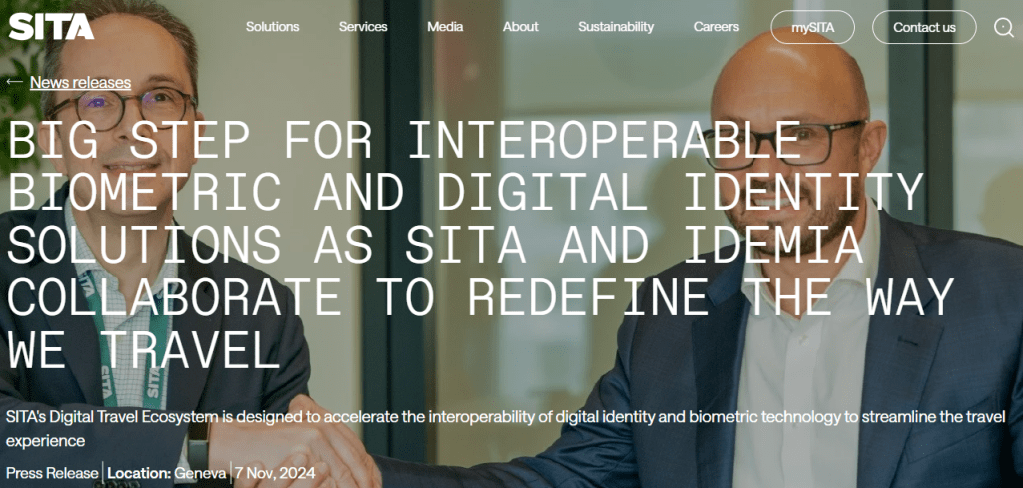
SITA, the global leader in air transport technology, and IDEMIA Public Security, a world leader in digital technologies, biometrics, and security have announced a collaboration to advance interoperability, trust, and data security through a globally recognized Digital Travel Ecosystem.

Add Indico to the partnership, and perhaps the parties may be on to something.

From SITA.

The goal is to create “an open, secure, and interoperable framework that ensures a travelers’ digital identity is trusted globally, without the need for direct integrations between issuers and verifiers.” It is intentionally decentralized, giving the traveler control over their identity.

Perhaps it’s a fantasy to think that others will buy in. Will they?

Or will they instead select Taylor’s version?

Marketing Identity Product Privacy

When marketing digital identity products secured by biometrics, emphasize that they are MORE secure and more private than their physical counterparts.

When you hand your physical driver’s license over to a sleazy bartender, they find out EVERYTHING about you, including your name, your birthdate, your driver’s license number, and even where you live.

When you use a digital mobile driver’s license, bartenders ONLY learn what they NEED to know—that you are over 21.

Image source: GET Group NA, https://apps.apple.com/us/app/get-mobile-verify/id1501552424

Oh, Florida (mobile driver’s licenses)

I should properly open this post by stating any necessary disclosures…but I don’t have any. I know NOTHING about the goings-on reported in this post other than what I read in the papers.

“I know NOTHING.” By CBS Television – eBayfrontback, Public Domain, https://commons.wikimedia.org/w/index.php?curid=73578107.

However, I do know the history of Thales and mobile driver’s licenses. Which makes the recent announcements from Florida and Thales even more surprising.

Gemalto’s pioneering mobile driver’s license pilots

Back when I worked for IDEMIA from 2017 to 2020, many states were performing some level of testing of mobile driver’s licenses. Rather than having to carry a physical driver’s license card, you would be able to carry a virtual one on your phone.

While Louisiana was the first state to release an operational mobile driver’s license (with Envoc’s “LA Wallet”), several states were working on pilot projects.

Some of these states were working with the company Gemalto to create pilots for mobile driver’s licenses. As early as 2016, Gemalto announced its participation in pilot mDL projects in Colorado, Idaho, Maryland, and Washington DC. As I recall, at the time Gemalto had more publicly-known pilots in process than any other vendor, and appeared to be leading the pack in the effort to transition driver’s licenses from the (physical) wallet to the smartphone.

Thales’ operational mobile driver’s license

By the time Gemalto was acquired by and absorbed into Thales, the company won the opportunity to provide an operational (as opposed to pilot) driver’s license. The Florida Smart ID app has been available to both iPhone and Android users since 2021.

From https://www.flhsmv.gov/floridasmartid/ as of July 12. No idea whether this image will still be there on July 15.

What just happened?

This morning I woke up to a slew of articles (such as the LinkedIn post from PEAK IDV’s Steve Craig, and the Biometric Update post from Chris Burt) that indicated the situation had changed.

One of the most important pieces of new information was a revised set of Frequently Asked Questions (or “Question,” or “Statement”) on the “Florida Smart ID” section of the Florida Highway Safety and Motor Vehicles website.

The Florida Smart ID applications will be updated and improved by a new vendor. At this time, the Florida Department of Highway Safety and Motor Vehicles is removing the current Florida Smart ID application from the app store. Please email FloridaSmartID@flhsmv.gov to receive notification of future availability.

Um…that was abrupt.

But a second piece of information, a Thales statement shared by PC Mag, explained the abruptness…in part.

In a statement provided to PCMag, a Thales spokesperson said the company’s contract with the FLHSMV expired on June 30, 2024.

“The project has now entered a new phase in which the FLHSMV requirements have evolved, necessitating a retender,” Thales says. “Thales chose not to compete in this tender. However, we are pleased to have been a part of this pioneering solution and wishes it continued success.”

Now normally when a government project transitions from one vendor to another, the old vendor continues to provide the service until the date that the new vendor’s system is operational. This is true even in contentious cases, such as the North Carolina physical driver’s license transition from IDEMIA to CBN Secure Technologies.

But in the Florida case:

  • Thales chose not to bid on the contract renewal.
  • The new vendor and/or the State of Florida chose not to begin providing services when the Thales contract expired on June 30.
  • Thales and/or the State of Florida chose not to temporarily renew the existing contract until the new vendor was providing services in 2025.

This third point is especially odd. I’ve known of situations where Company A lost a renewal bid to Company B, Company B was unable to deliver the new system on time, and Company A was all too happy to continue to provide service until Company B (or in some cases the government agency itself) got its act together.

Anyway, for whatever reason, those who had Florida mobile driver’s licenses have now lost them, and will presumably have to go through an entirely new process (with an as-yet unknown vendor) to get their mobile driver’s licenses again.

I’m not sure how much more we will learn publicly, and I don’t know how much is being whispered privately. Presumably the new vendor, whoever it is, has some insight, but they’re not talking.

Digital Identity and Public Benefits

Both the U.S. National Institute of Standards and Technology and the Digital Benefits Hub made important announcements this morning. I will quote portions of the latter announcement.

The National Institute of Standards and Technology (NIST), the Digital Benefits Network (DBN) at the Beeck Center for Social Impact + Innovation at Georgetown University, and the Center for Democracy and Technology (CDT) are collaborating on a two-year-long collaborative research and development project to adapt NIST’s digital identity guidelines to better support the implementation of public benefits policy and delivery while balancing security, privacy, equity, and usability….

In response to heightened fraud and related cybersecurity threats during the COVID-19 pandemic, some benefits-administering agencies began to integrate new safeguards such as individual digital accounts and identity verification, also known as identity proofing, into online applications. However, the use of certain approaches, like those reliant upon facial recognition or data brokers, has raised questions about privacy and data security, due process issues, and potential biases in systems that disproportionately impact communities of color and marginalized groups. Simultaneously, adoption of more effective, evidence-based methods of identity verification has lagged, despite recommendations from NIST (Question A4) and the Government Accountability Office

There’s a ton to digest here. This impacts a number of issues that I and others have been discussing for years.

NIST’s own press release, by the way, can be found here.

Authenticator Assurance Levels (AALs) and Digital Identity

(Part of the biometric product marketing expert series)

Back in December 2020, I dove into identity assurance levels (IALs) and digital identity, subsequently specifying the difference between identity assurance levels 2 and 3. These IALs are defined in section 4 of NIST Special Publication 800-63A, Digital Identity Guidelines, Enrollment and Identity Proofing Requirements.

It’s past time for me to move ahead to authenticator assurance levels (AALs).

Where are authenticator assurance levels defined?

Authenticator assurance levels are defined in section 4 of NIST Special Publication 800-63B, Digital Identity Guidelines, Authentication and Lifecycle Management. As with IALs, the AALs progress to higher levels of assurance.

  • AAL1 (some confidence). AAL1, in the words of NIST, “provides some assurance.” Single-factor authentication is OK, but multi-factor authentication can be used also. All sorts of authentication methods, including knowledge-based authentication, satisfy the requirements of AAL1. In short, AAL1 isn’t exactly a “nothingburger” as I characterized IAL1, but AAL1 doesn’t provide a ton of assurance.
  • AAL2 (high confidence). AAL2 increases the assurance by requiring “two distinct authentication factors,” not just one. There are specific requirements regarding the authentication factors you can use. And the security must conform to the “moderate” security level, such as the moderate security level in FedRAMP. So AAL2 is satisfactory for a lot of organizations…but not all of them.
  • AAL3 (very high confidence). AAL3 is the highest authenticator assurance level. It “is based on proof of possession of a key through a cryptographic protocol.” Of course, two distinct authentication factors are required, including “a hardware-based authenticator and an authenticator that provides verifier impersonation resistance — the same device MAY fulfill both these requirements.”

This is of course a very high overview, and there are a lot of…um…minutiae that go into each of these definitions. If you’re interested in that further detail, please read section 4 of NIST Special Publication 800-63B for yourself.

Which authenticator assurance level should you use?

NIST has provided a handy dandy AAL decision flowchart in section 6.2 of NIST Special Publication 800-63-3, similar to the IAL decision flowchart in section 6.1 that I reproduced earlier. If you go through the flowchart, you can decide whether you need AAL1, AAL2, or the very high AAL3.

One of the key questions is the question flagged as 2, “Are you making personal data accessible?” The answer to this question in the flowchart moves you between AAL2 (if personal data is made accessible) and AAL1 (if it isn’t).

So what?

Do the different authenticator assurance levels provide any true benefits, or are they just items in a government agency’s technical check-off list?

Perhaps the better question to ask is this: what happens if the WRONG person obtains access to the data?

  • Could the fraudster cause financial loss to a government agency?
  • Threaten personal safety?
  • Commit civil or criminal violations?
  • Or, most frightening to agency heads who could be fired at any time, could the fraudster damage an agency’s reputation?

If some or all of these are true, then a high authenticator assurance level is VERY beneficial.

Age Assurance Meets Identity Assurance (Level 2)

I’ve talked about age verification and age estimation here and elsewhere. And I’ve also talked about Identity Assurance Level 2. But I’ve never discussed both simultaneously until now.

I belatedly read this March 2024 article that describes Georgia’s proposed bill to regulate access to material deemed harmful to minors.

A minor in Georgia (named Jimmy Carter) in the 1920s, before computers allowed access to adult material. From National Park Service, https://www.nps.gov/jica/learn/historyculture/early-life.htm.

The Georgia bill explicitly mentions Identity Assurance Level 2.

Under the bill, the age verification methods would have to meet or exceed the National Institute of Standards and Technology’s Identity Assurance Level 2 standard.

So if you think you can use Login.gov to access a porn website, think again.

There’s also a mention of mobile driver’s licenses, albeit without a corresponding mention of the ISO/IEC 18013-5:2021.

Specifically mentioned in the bill text is “digitized identification cards,” described as “a data file available on a mobile device with connectivity to the internet that contains all of the data elements visible on the face and back of a driver’s license or identification card.”

So digital identity is becoming more important for online access, as long as certain standards are met.

Worldcoin Publicly Exposes Its Security

One advantage of an open source project is that there are far fewer secrets to hide. If a commercial firm develops biometric products, it has a responsibility to its investors to not release sensitive information.

Worldcoin has few limitations on sharing information because it is an open source project, so when governments in Argentina, Kenya, and elsewhere raised questions about what Worldcoin does with its citizens’ biometric data, Worldcoin could afford to conduct a security assessment…and publicly share the results.

Although findings…describe potential attack surfaces and are of high or medium severity, (Trail of Bits’) analysis did not uncover vulnerabilities in the Orb’s code…

From https://github.com/trailofbits/publications/blob/master/reviews/2023-08-worldcoin-orb-securityreview.pdf

Read Trail of Bits’ full report at https://github.com/trailofbits/publications/blob/master/reviews/2023-08-worldcoin-orb-securityreview.pdf. Note that Trail of Bits ONLY analyzed the software running on the Orb, NOT the back-end software.

Also see Biometric Update’s coverage. It notes that Trail of Bits also analyzed the security of Voatz’s voting software.

Login.gov and IAL2 #realsoonnow

Back in August 2023, the U.S. General Services Administration published a blog post that included the following statement:

Login.gov is on a path to providing an IAL2-compliant identity verification service to its customers in a responsible, equitable way. Building on the strong evidence-based identity verification that Login.gov already offers, Login.gov is on a path to providing IAL2-compliant identity verification that ensures both strong security and broad and equitable access.

From https://www.gsa.gov/blog/2023/08/18/reducing-fraud-and-increasing-access-drives-record-adoption-and-usage-of-logingov

It’s nice to know…NOW…that Login.gov is working to achieve IAL2.

This post explains what the August 2023 GSA post said, and what it didn’t say.

But first, I’ll define what Login.gov and “IAL2” are.

What is Login.gov?

Here is what Login.gov says about itself:

Login.gov is a secure sign in service used by the public to sign in to participating government agencies. Participating agencies will ask you to create a Login.gov account to securely access your information on their website or application.

You can use the same username and password to access any agency that partners with Login.gov. This streamlines your process and eliminates the need to remember multiple usernames and passwords.

From https://www.login.gov/what-is-login/

Obviously there are a number of private companies (over 80 last I counted) that provide secure access to information, but Login.gov is provided by the government itself—specifically by the General Services Administration’s Technology Transformation Services. Agencies at the federal, state, and local level can work with the GSA TTS’ “18F” organization to implement solutions such as Login.gov.

Why would agencies implement Login.gov? Because the agencies want to protect their constituents’ information. If fraudsters capture personally identifiable information (PII) of someone applying for government services, the breached government agency will face severe repurcussions. Login.gov is supposed to protect its partner agencies from these nightmares.

How does Login.gov do this?

  • Sometimes you might use two-factor authentication consisting of a password and a second factor such as an SMS code or the use of an authentication app.
  • In more critical cases, Login.gov requests a more reliable method of identification, such as a government-issued photo ID (driver’s license, passport, etc.).

What is IAL2?

At the risk of repeating myself, I’ll briefly go over what “Identity Assurance Level 2” (IAL2) is.

The U.S. National Institute of Standards and Technology, in its publication NIST SP 800-63a, has defined “identity assurance levels” (IALs) that can be used when dealing with digital identities. It’s helpful to review how NIST has defined the IALs. (I’ll define the other acronyms as we go along.)

Assurance in a subscriber’s identity is described using one of three IALs:

IAL1: There is no requirement to link the applicant to a specific real-life identity. Any attributes provided in conjunction with the subject’s activities are self-asserted or should be treated as self-asserted (including attributes a [Credential Service Provider] CSP asserts to an [Relying Party] RP). Self-asserted attributes are neither validated nor verified.

IAL2: Evidence supports the real-world existence of the claimed identity and verifies that the applicant is appropriately associated with this real-world identity. IAL2 introduces the need for either remote or physically-present identity proofing. Attributes could be asserted by CSPs to RPs in support of pseudonymous identity with verified attributes. A CSP that supports IAL2 can support IAL1 transactions if the user consents.

IAL3: Physical presence is required for identity proofing. Identifying attributes must be verified by an authorized and trained CSP representative. As with IAL2, attributes could be asserted by CSPs to RPs in support of pseudonymous identity with verified attributes. A CSP that supports IAL3 can support IAL1 and IAL2 identity attributes if the user consents.

From https://pages.nist.gov/800-63-3/sp800-63a.html#sec2

So in its simplest terms, IAL2 requires evidence of a verified credential so that an online person can be linked to a real-life identity. If someone says they’re “John Bredehoft” and fills in an online application to receive government services, IAL2 compliance helps to ensure that the person filling out the online application truly IS John Bredehoft, and not Bernie Madoff.

As more and more of us conduct business—including government business—online, IAL2 compliance is essential to reduce fraud.

One more thing about IAL2 compliance. The mere possession of a valid government issued photo ID is NOT sufficient for IAL2 compliance. After all, Bernie Madoff may be using John Bredehoft’s driver’s license. To make sure that it’s John Bredehoft using John Bredehoft’s driver’s license, an additional check is needed.

This has been explained by ID.me, a private company that happens to compete with Login.gov to provide identity proofing services to government agencies.

Biometric comparison (e.g., selfie with liveness detection or fingerprint) of the strongest piece of evidence to the applicant

From https://network.id.me/article/what-is-nist-ial2-identity-verification/

So you basically take the information on a driver’s license and perform a facial recognition 1:1 comparison with the person possessing the driver’s license, ideally using liveness detection, to make sure that the presented person is not a fake.

So what?

So the GSA was apparently claiming how secure Login.gov was. Guess who challenged the claim?

The GSA.

Now sometimes it’s ludicrous to think that the government can police itself, but in some cases government actually identifies government faults.

Of course, this works best when you can identify problems with some other government entity.

Which is why the General Services Administration has an Inspector General. And in March 2023, the GSA Inspector General released a report with the following title: “GSA Misled Customers on Login.gov’s Compliance with Digital Identity Standards.”

The title is pretty clear, but Fedscoop summarized the findings for those who missed the obvious:

As part of an investigation that has run since last April (2022), GSA’s Office of the Inspector General found that the agency was billing agencies for IAL2-compliant services, even though Login.gov did not meet Identity Assurance Level 2 (IAL2) standards.

GSA knowingly billed over $10 million for services provided through contracts with other federal agencies, even though Login.gov is not IAL2 compliant, according to the watchdog.

From https://fedscoop.com/gsa-login-gov-watchdog-report/

So now GSA is explicitly saying that Login.gov ISN’T IAL2-compliant.

Which helps its private sector competitors.

Kelly Shepherd, #fakefakefake

My belief that everything on the Internet is true has been irrevocably shattered, all because of what an entertainment executive ordered in his spare time. But the Casey Bloys / “Kelly Shepherd” story is just a tiny bit of what is going on with synthetic identities. And X isn’t the only platform plagued by them, as my LinkedIn experience attests.

By the way, this blog post contains pictures of a lot of people. Casey Bloys is real. Some of the others, not so much.

Blame COVID

Casey Bloys. Fair use. From https://wbd.com/leadership/casey-bloys/

Casey Bloys is the Chairman and CEO of HBO and Max Content. Bloys had to start a recent 2024 schedule presentation with an apology, according to Variety. After explaining how passionate he is about his programming, he went back in time a couple of years to a period that we all remember.

So when you think of that mindset, and then think of 2020 and 2021, I’m home, working from home and spending an unhealthy amount of scrolling through Twitter. And I come up with a very, very dumb idea to vent my frustration.

From Variety.

Casey Bloys’ very, very dumb idea

So why did Bloys have to apologize on Thursday? Because of an article that Rolling Stone published on Wednesday. The article led off with this juicy showbiz tidbit about Bloys’ idea for responding to a critic.

“Maybe a Twitter user should tweet that that’s a pretty blithe response to what soldiers legitimately go through on [the] battlefield,” he texted. “Do you have a secret handle? Couldn’t we say especially given that it’s D-Day to dismiss a soldier’s experience like that seems pretty disrespectful … this must be answered!”

From Rolling Stone.

(A note to my younger readers: Twitter used to be a popular social media service that no longer exists. It was replaced by X.)

Eventually Bloys found someone to create the “secret handle.” Sully Temori is now alleging wrongful termination by HBO (which is why we’re learning about these juicy tidbits, via court filings). But in 2021 he was an executive assistant who wanted to get ahead by pleasing his bosses.

This is where Kelly Shepherd enters the story.

Kelly Shepherd, fake vegan mom

Ms. Shepherd seems like a nice woman. A mom, a Texan, a herbalist and aromatherapist, and a vegan. (The cows love that last part.)

Most critically, Shepherd is a normal person, not one of those Hollywood showbiz folks. Although Shepherd, who never posted anything on her own, seems to have a distinct motivation to respond to critics of HBO shows. Take her first reply to a critic from (checks notes) Rolling Stone. (Two years later, Rolling Stone would gleefully report on this story. Watch out who you anger.)

alan is always predictably safe and scared in his opinions

From https://twitter.com/KellySh33889356/status/1379101699969720323

Kelly’s other three replies were along the same lines.

  • All were short one-sentence blurbs.
  • Most were completely in lower case, because that’s how regular non-Hollywood folk tweet.
  • All were critical of those who were critical of HBO, accusing them of “shitting on a show about women,” getting their “panties in a bunch,” and being “busy virtue signaling.”

Hey, if I couldn’t eat hamburgers and my home was filled with weird herbs and aromas, I’d be a little mad too.

And then, a little over a week later, it was over, and Kelly Shepherd never tweeted again. Although Temori apparently performed other activities against HBO critics via other methods. Well, until he was terminated.

Did Kelly Shepherd open a LinkedIn account?

But as part of the plan to satisfy Casey Bloys’ angry whims, Kelly Shepherd acquired a social media account, which she could use as a possible proof of identity.

Even though we now know she doesn’t exist.

But X isn’t the only platform plagued with synthetic identities, and some synthetic identities can do much more than anger an entertainment reviewer.

Many of us on LinkedIn are regularly receiving InMails and connection requests (in my case, from profiles with pictures of beautiful women) who say that we are constantly recommended by LinkedIn, who tell us how impressive our profiles are, and who want to contact us outside of the LinkedIn platform via text message or WhatsApp.

Now perhaps some of these messages are from real people, but I seriously doubt that so many of the employees at John Q Wine & Liquor Winery in New York happen to have the last name “Walter.” And the exact same job title.

Partial results from a LinkedIn search.

Let’s take a close look at what Karina has been doing for the last 4+ years. Other than posing in front of her car, of course.

Ms. Walter is a pretty busy freelance general manager / director / content partnerships manager.

As for her colleague Ms. Alice Walter, she has more experience (having started in 2018) but also has an extensive biography that begins:

The United States is a country with innovative challenges, and there is more room for development in the wine industry at John Q Wine & Liquor Winery. I am motivated and love to learn, and like to be exposed to more different cultures, and hope to develop more careers in my future life.

From https://www.linkedin.com/in/alice-walter-b97bb2113/

Sound familiar?

And you can check out Maria Walter’s profile if you’re so inclined. Or at least check out “her” picture.

Now none of the Walters women tried to contact me, but another “employee” (or maybe it was a “freelancer,” I forget) of this company tried to do so, which led my curious nature to discover yet another hive of fake LinkedIn profiles.

Sadly, one person from this company is a second-degree connection, which means that one of my connections accepted “her” connection request.

Synthetic identities are harmless…right?

Who knows what Karina, Alice, and Maria will do with their LinkedIn profiles?

  • Will they connect with other professionals?
  • Will they ask said professionals to move the conversation to SMS or WhatsApp, for whatever reason?
  • Will they apply for new jobs, using their impressive work history? A 98.8% customer satisfaction rate while managing 1,800 sub-partnerships is remarkable.
  • Will they apply for bank accounts…or loans?

The fraud possibilities from fake LinkedIn accounts are endless, and could be very costly for any company who falls for a fake synthetic identity. In fact, FiVerity reports that “in 2020, an estimated $20 billion was lost to SIF” (synthetic identity fraud). Which means that LinkedIn account holders and Partnerships Managers Karina, Alice, and Maria Walter could make a LOT of money.

Now banks and other financial institutions have safeguards to verify financial identities of people who open accounts and apply for loans, because fraud reduction is critically important to financial institutions.

Social media companies? Identity is only “important” to them.

They don’t even care about uniqueness (as Worldcoin does), evidenced by the fact that I have more than two X accounts (but none in which I portray a female Texas mom and vegan).

So if someone comes up to you on X or LinkedIn, remember that all may not be as it seems.