Remember Hygiene?

When I first worked with (then) MorphoTrak’s MorphoWave in the mid-2010s, speed and convenience were the selling points.

A few years later, hygiene was all the rage for (now) IDEMIA and other companies.

As COVID recedes (for now), speed and convenience take center stage again.

Grok.

Reminder to marketing leaders: if you need Bredemarket’s content-proposal-analysis help, book a meeting at https://bredemarket.com/mark/

As Digital “Health Certifications” Advance (sort of), Paper Health Certifications Recede

Back in June I wrote about the Global Digital Health Certification Network (GDHCN), a post-COVID way to digitally exchange information about a person’s vaccination status—not just for COVID, but for any future pandemic.

This effort is being pioneered by WHO.

It seems to me they give these vaccine certificates now-a-days very peculiar names. By Public Domain – Snapshot Image – https://archive.org/details/ClassicComedyTeams, Public Domain, https://commons.wikimedia.org/w/index.php?curid=25914575

But as we continue to advance digital health identities, the United States is no longer producing a well-known physical identity document.

It’s the end of an era for a once-critical pandemic document: The ubiquitous white COVID-19 vaccination cards are being phased out.

Now that COVID-19 vaccines are not being distributed by the federal government, the U.S. Centers for Disease Control and Prevention has stopped printing new cards.

From https://apnews.com/article/covid-vaccine-cdc-medical-record-a70eb7f3f32b961eae1a7bf69175ad11

This doesn’t affect the validity of current cards. It just means that if you get a COVID vaccine, or any future vaccine, and you need to prove you obtained it, you will have to contact the medical facility who administered it.

Or, in selected states (because in the U.S. health is generally a state and not a federal responsibility), you can access the state’s digital health information. For example, the state of Washington offers MyIRmobile, as do the states of Arizona, Louisiana, Maryland, Mississippi, North Dakota, and West Virginia.

Sign up for MyIR Mobile by going to myirmobile.com and follow the registration instructions. Your registration information will be used to match your records with the state immunization registry. You will be sent a verification code on your phone to finalize the process. Once registration is complete, you’ll be able to view your immunization records, Certificate of Immunization Status (CIS) and access your COVID-19 vaccination certificate.

From https://doh.wa.gov/you-and-your-family/immunization/access-your-familys-immunization-information

I have no idea if MyIR Mobile conforms to GDHCN; neither the phrase nor the acronym is mentioned on the MyIR Mobile website.

My own state of California has its own digital vaccine record, but frankly it’s kind of clunky. Again, I don’t know if California conforms to GDHCN.

So maybe digital health certifications are not advancing.

How Remote Work Preserves Your Brain

I remember the day that my car skidded down Monterey Pass Road in Monterey Park, California, upside down, my seatbelt saving my brain from…um…very bad things. (I promised myself that I’d make this post NON-gory.)

Monterey Pass Road and South Fremont Avenue, Monterey Park, California. https://www.google.com/maps/@34.0586679,-118.1445677,19z?entry=ttu

I was returning from lunch to my employer farther south on Monterey Pass Road when a car hit me from the side, flipping my car over so that it skidded down Monterey Pass Road, upside down. Only my seat belt saved my from certain death.

(Mini-call to action: wear seat belts.)

By The cover art can be obtained from Liberty Records., Fair use, https://en.wikipedia.org/w/index.php?curid=25328218

Now some of you who know me are asking, “John, you’ve lived in Ontario and Upland for the past several decades. Why were you 30 miles away, in Monterey Park?”

Well, back in 1991, after working for Rancho Cucamonga companies for several years, I ended up commuting to a company in Monterey Park, California, at least an hour’s drive one way from my home. Driving toward downtown Los Angeles in the morning, and away from downtown Los Angeles in the afternoon. If you know, you know.

After I left the Monterey Park company, I consulted or worked for companies in Pomona, Brea, Anaheim, Irvine, and other cities. But for most of the next three decades, I was still driving at least an hour one-way every day to get from home to work.

And it’s not just a problem in Southern California. By B137 – Own work, CC BY-SA 4.0, https://commons.wikimedia.org/w/index.php?curid=48998674

As I’ll note later in this post, some people are still commuting today. And for all I know I may commute again also.

I learn the acronym WFH

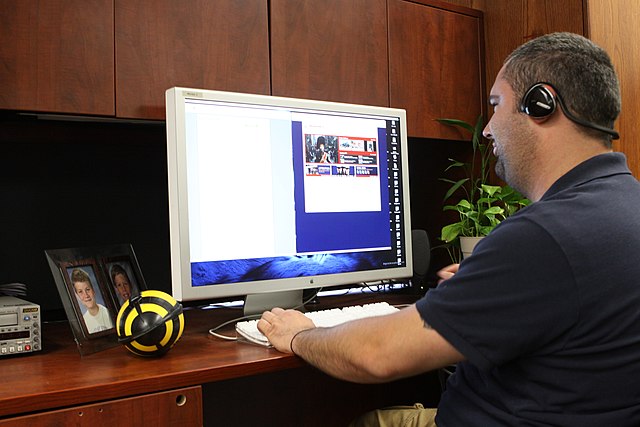
That all stopped in March 2020 when a worldwide pandemic sent all non-essential personnel at IDEMIA’s Anaheim office to work from home (WFH). Now there were some IDEMIA employees, such as salespeople, who had been working from home for years, but this was the first time that a whole bunch of us were doing it.

Some of us had to upgrade our home equipment: mesh networks, special face illumination lighting, and other things. And now, instead of having a couple of people participating in meetings remotely, ALL of us were doing so. (Before 2020, the two words “Zoom background” would be incomprehensible to me. After 2020, I understood those words intimately.)

This new work practice continued after I left IDEMIA, as I started Bredemarket, joined Incode Technologies for a little over a year, and returned (for now) to Bredemarket again.

The U.S. Marine Corps supported WFH (for certain positions) in 2010, long before COVID. This image was released by the United States Marine Corps with the ID 100324-M-6847A-001 (next). This tag does not indicate the copyright status of the attached work. A normal copyright tag is still required. See Commons:Licensing.العربية ∙ বাংলা ∙ Deutsch ∙ Deutsch (Sie-Form) ∙ English ∙ español ∙ euskara ∙ فارسی ∙ français ∙ italiano ∙ 日本語 ∙ 한국어 ∙ македонски ∙ മലയാളം ∙ Plattdüütsch ∙ Nederlands ∙ polski ∙ پښتو ∙ português ∙ slovenščina ∙ svenska ∙ Türkçe ∙ українська ∙ 简体中文 ∙ 繁體中文 ∙ +/−, Public Domain, https://commons.wikimedia.org/w/index.php?curid=23181833

WFH benefits

There are two benefits to working from home:

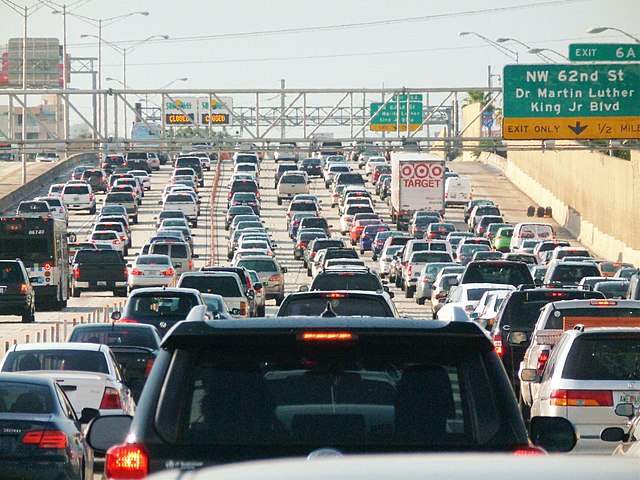
  • First, it preserves your brain. Not just from the horrible results of a commuting automobile accident. For the last three-plus years, I’ve gotten more rest and sleep since I’m not waking up before 6am and getting home after 6pm. And I’m not sitting in traffic on the 57, waiting for an accident to clear.
  • Second, it provides the best talent to your employer. Why? Because it can hire you. I just spent over a year working for a company headquartered in San Francisco, and I didn’t have to move to San Francisco to do it. In fact, when my product marketing team reached its apex, we had two people in Southern California, one in England, and one in Sweden. None of us had to move to San Francisco to work there, and my company was not restricted to hiring people who could get to San Francisco every day.

But that doesn’t stop some companies from insisting on office work

In-office presence controversy predates COVID (remember Marissa Mayer and Yahoo?), and now that COVID has receded, the “return to office” drumbeat has gotten louder.

Laith Masarweh shared the story of a woman who, like me, is tiring of the L.A. freeway grind.

So she asked her boss for help–

And he told her to change her mindset.

“That’s just life,“ he said. “Everyone has to commute.”…

All she asked for was some flexibility, and he shut her down.

So he’s going to lose her.

Laith Masarweh, LinkedIn. (link)

Now I’m not saying I’ll never work on-site again. Maybe someday I’ll even accept an on-site position in Monterey Park.

But I’m not that thrilled about going down Monterey Pass Road again.

In the meantime…

…since I’m NOT full-time employed, and since my home office is well equipped (I have Nespresso!), I have the time to make YOUR company’s messaging better.

If you can use Bredemarket’s expertise for your biometric, identity, technology, or general blog posts, case studies, white papers, or other written content, contact me.

From https://open.spotify.com/track/2BPEPkeifa5LoOg2Cq9bkx

From EUDCC to GDHCN: The Evolution of Vaccine Certificates

Back in 2021, it seemed that I was commenting on the EU Digital COVID Certificate (EUDCC) ad nauseum. The EUDCC is the “vaccine passport” that was developed to allow people in member EU countries to prove their COVID vaccination status in another EU country.

From the EC site.

My most recent post on the EUDCC was written on August 30, 2021, and discussed the International Air Transport Association (IATA) endorsement of the EUDCC as a global standard. But did it matter? I took a look at how global standards are adopted (hint: brute force):

If a lot of people like something, it’s a standard.

If a trillion dollar company likes something, and I like something different, then the thing that the trillion dollar company likes is a standard.

If two trillion dollar companies like two different things…it can get messy.

From https://bredemarket.com/2021/08/30/iata-endorses-the-eudcc-but-will-it-matter/

August 2021 was the last time that I wrote about the EUDCC in the Bredemarket blog. Until now.

Enter…WHO?

You know how standards are adopted by brute force from big players? Well, one big player has forced itself into the discussion. That player is the World Health Organization, commonly known as WHO.

It seems to me they give these vaccine certificates now-a-days very peculiar names. By Public Domain – Snapshot Image – https://archive.org/details/ClassicComedyTeams, Public Domain, https://commons.wikimedia.org/w/index.php?curid=25914575

But according to Masha Borak at Biometric Update, the WHO is just recognizing that the “EU” Digital COVID Certificate has expanded far beyond the EU.

Stella Kyriakides, the European commissioner for health and food safety (announced) that the voluntary certificate program has already been taken up by almost 80 countries.

From https://www.biometricupdate.com/202306/united-nations-taking-over-eu-covid-certificate-program-july-1

Last I checked there were not 80 countries in the EU. So this health standards thing took off after the initial hiccups. Although the Wikipedia list of non-EU adopting countries does not include two big players—the United States and China (the same two countries I cited in my August 2021 post).

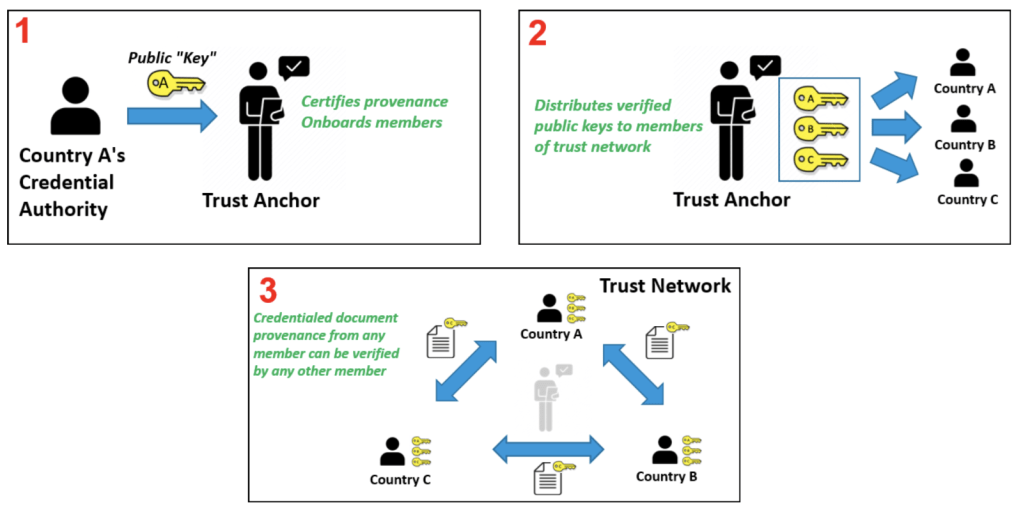
Therefore, it made sense for WHO to get in on the act with its Global Digital Health Certification Network, allowing worldwide responses to post-COVID issues.

WHO’s Global Digital Health Certification Network is an open-source platform, built on robust & transparent standards that establishes the first building block of digital public health infrastructure for developing a wide range of digital products for strengthening pandemic preparedness and to deliver better health for all….

The GDHCN is builds (sic) upon the experience of regional networks for COVID-19 Certificates and takes up the infrastructure and experiences with the digital European Union Digital COVID Certificate (EU DCC) system, which has seen adoption across all Member States of the EU as well as 51 non-EU countries and territories. The GDHCN has been designed to be interoperable with other existing regional networks (e.g., ICAO VSD-NC, DIVOC, LACPass, SMART Health Cards) specifications. 

From https://www.who.int/initiatives/global-digital-health-certification-network

On the surface it sounds great, but we’ll see what happens when it goes live (Borak states that the go-live date is July 1).

And we’ll see how it expands:

To facilitate the uptake of the EU DCC by WHO and contribute to its operation and further development, WHO and the European Commission have agreed to partner in digital health.

This partnership will work to technically develop the WHO system with a staged approach to cover additional use cases, which may include, for example, the digitisation of the International Certificate of Vaccination or Prophylaxis. Expanding such digital solutions will be essential to deliver better health for citizens across the globe.

From https://www.who.int/news/item/05-06-2023-the-european-commission-and-who-launch-landmark-digital-health-initiative-to-strengthen-global-health-security

And most importantly, we’ll see which countries participate—and which countries don’t.

Technological rapidity and #COVID19 #Omicron responses

So I took almost a week off from “bredemarketing,” but it’s not like anything happened.

Well, except for a new COVID-19 variant and the attending travel shutdowns and other changes.

And now people are wondering when Omicron will hit the United States. Frankly, it’s probably already here.

But as we become more familiar with things, and as our technology improves, our responses are quicker.

Take this Thermo Fisher Scientific press release.

Thermo Fisher Scientific Inc. (NYSE:TMO)…today confirmed that its polymerase chain reaction (PCR) TaqPath COVID-19 Combo Kit*, and TaqPath COVID-19 CE-IVD RT-PCR Kit*, which test for the presence of SARS-CoV-2, are not impacted by the emerging B.1.1.529, or Omicron variant, enabling accurate test results.

https://thermofisher.mediaroom.com/2021-11-29-Thermo-Fisher-Scientific-Confirms-Detection-of-SARS-CoV-2-in-Samples-Containing-the-Omicron-Variant-with-its-TaqPath-COVID-19-Tests

That’s quick.

But test results are one thing; minimization of harm is another.

Moderna is already at work on a treatment to address the Omicron variant. Within the next few weeks, he said the company will know whether the new strain will require an altogether new vaccine, a specially formulated booster, or simply a higher dose of vaccines currently available.

From https://www.newsweek.com/moderna-estimates-weeks-before-omicron-vaccine-resistance-understood-variant-spreads-1653983

Considering how long it took to develop the first vaccines (which were already developed at a breakneck pace), that’s quick also.

IATA endorses the EUDCC. But will it matter?

In a Bredemarket blog post in February 2021, I quoted something that I wrote in 2013 in one of my personal blogs, Empoprise-BI.

I’m sure that many people imagine that standards are developed by a group of reasonable people, sitting in a room, who are pursuing things for the good of the world.

You can stop laughing now.

As I noted back in 2013, and again in February, there are many instances in which standards do not evolve from a well-designed process. In reality, standards emerge via that process that I referred to in February as “brute force.”

By イーストプレス – 「ゴング格闘技」=1951年のブラジル地元新聞からの転載, Public Domain, https://commons.wikimedia.org/w/index.php?curid=13320163

For those who are not familiar with the “brute force” process, I’ll provide two illustrations.

  • If a lot of people like something, it’s a standard.
  • If a trillion dollar company likes something, and I like something different, then the thing that the trillion dollar company likes is a standard.

If two trillion dollar companies like two different things…it can get messy.

Back in February, I was just beginning to talk about something that I called “health passports” at the time. Later, I personally decided that “health passports” is a poor choice of words, and have instead gravitated to using the phrase “vaccine certificate.”

Regardless, my concern back in February was that there were all sorts of these things floating around. Even back then, Clear had its own solution, IATA had one, IBM had one, iProov had one, Daon had one, and there were many, many more.

So what happens if I have a Clear vaccine certificate but the airline or building that I’m approaching supports the iProov certificate? Can the iProov certificate read the Clear certificate? Or do I have to get multiple certificates?

This post looks at a new development in the vaccine certificate brouhaha. I’m not talking about what vaccines are honored by the vaccine certificate, but about acceptability of the vaccine certificates themselves. In particular, I’m talking about acceptance of one certificate, the EU Digital COVID Certificate (EUDCC).

Because one big player is getting behind it.

How do international air transport folks feel about the EUDCC?

While the EUDCC can conceivably be used for a number of use cases, such as entering a private business like a restaurant, one of the most popular use cases for the EUDCC is to board an airplane that is crossing an international border.

So if there was an organization that was dedicated to the business of flying airplanes across international borders, and if that organization thought that the EUDCC was pretty cool, then that endorsement would have as much pull as Google (and Facebook) endorsing a web image format.

Enter the (drumroll) International Air Transport Association, which issued a press release on 26 August.

The title?

“IATA Backs European Digital Covid Certificate as Global Standard.”

Now those who read my February post will recall that IATA was one of those groups that was already developing its own vaccination certificate. So how does the EUDCC compare with the the IATA Travel Pass?

The DCC…is fully supported by IATA Travel Pass.

But in addition to mere self-interest, there is another reason why IATA is endorsing the EUDCC: it’s supported by a lot of countries inside the EU, and other countries are looking at the EUDCC as a model.

The EU DCC is implemented in the 27 EU Member states and a number of reciprocal agreements have been agreed with other states’ own vaccination certificates, including Switzerland, Turkey, and Ukraine. In the absence of a single global standard for digital vaccination certificates, up to 60 other countries are looking to use the DCC specification for their own certification. 

Oh no, I’m just looking

However, it’s one thing to be “looking” at something, and another thing entirely to actually “do” something.

Before assuming that the EUDCC will become the de facto DCC, consider how two countries in particular will approach it.

This image or media was taken or created by Matt H. Wade. To see his entire portfolio, click here. @thatmattwade This image is protected by copyright! If you would like to use it, please read this first. – Own work, CC BY-SA 3.0, https://commons.wikimedia.org/w/index.php?curid=5004719

One of those countries is my own, the United States of America. While one can argue whether or not the U.S. enjoys the same level of power that it enjoyed immediately after the end of the Cold War, it is still a major player in world economic and travel affairs. And regardless of who the President of the United States is at any given time, the U.S. has often decided to go its own way. Couple this with the power of individual U.S. states in my country’s federal system, and it’s quite possible that even if the U.S. goes along with IATA, and some form of the EUDCC is adopted by our Transportation Security Administration, that does not necessarily mean that the same certificate can be used as it is in Europe to grant access to museums, sporting events, and concerts.

The other country that may have an issue with the EUDCC is China. If the United States is potentially a waning world power, China is potentially a gaining world power. The relationship between China and the rest of the world varies from time to time and from issue to issue. China may decide that it’s not in its best interest to adhere to an international standard for certifications of COVID vaccination, testing, or contraction. And if it’s not in China’s best interest, China won’t do it.

So before declaring that IATA endorsement of the EUDCC settles the issue…we’ll see.

Update on Covishield and the EUDCC, as long as you can prove you were born

It’s been a while since I looked at issues regarding the European Union Digital COVID Certificate (EUDCC).

And there are a ton of ramifications and unintended consequences.

Covishield and the EUDCC

When I last looked at the EUDCC, I examined its effect on travel from people outside of the European Union. The question at the time was what would happen to people who were vaccinated with something other than the European Medicines Agency-approved vaccines, thus rendering them ineligible for the EUDCC.

In particular, people who were vaccinated with the Covishield vaccine were not eligible for the EUDCC. Depending upon whom you asked, Covishield is either just the same as the EMA-approved AstraZeneca vaccine (now referred to as “Vaxzervria” in EU-speak), or it has a radically different manufacturing process that disqualifies it from automatic acceptance.

This non-recognition of Covishield has a great impact on African nations, because that vaccine is popular there. However, EUDCC disapproval has been offset by the actions of several individual countries to recognize Covishield as a vaccine. For example, Greece recognizes ten vaccines (including Covishield) as opposed to the EU’s four. Of course, you have to go through additional paperwork to get authorization to enter a specific country.

But Joseph Atick notes that there’s another issue that adversely impacts the ability of Africans to enter Europe.

Linking a vaccination to a person

Assume for the moment that you have received an EU-authorized vaccine. This is only part of the battle, because the act of vaccination has to be tied to you as a person.

Dr. Joseph Atick of ID4Africa. From https://id4africa.com/the-general-secretariat/

And Atick notes one complicating factor in making that link:

One of the biggest barriers to setting up these systems—and one that could greatly complicate digital health certificates – involves traceability, which for an official digital ID means documenting one’s birth event.

In Africa, not everyone has a birth certificate, and many struggle to trace their identity to the birth event.

If you cannot prove to the satisfaction of the European Union (or whoever) that you were the actual person who received a vaccine, then you may face barriers to entering Europe (or wherever).

And what are the ramifications of this?

A digital health certificate has appeal as an efficient and effective way to manage COVID-19 risks. But if we don’t pause now to consider the implications of getting it wrong and look for ways to get it right, these marvellous digital innovations could also be supremely effective at creating a binary world of those who can prove their COVID-19 risk status and those who cannot.

The requirement for a digital identity

Oh, and there’s another issue that Atick didn’t address, but which bears noting.

All of the health vaccination solutions listed above assume as a given that people will be the owners of a unique, government-authorized digital identity.

As I’ve noted elsewhere, there are people who are fervently opposed to this.

In my country, both some people on the left and some people on the right believe that “governmental digital identity” naturally equates to “governmental digital surveillance,” and that governments shouldn’t be abusing the data that they can obtain from all the vaccinations you get, all the places you travel, all the things you buy, and all the other things that you do.

(Well, except for voting. Some on the right fervently believe that government identities are essential to voting, even if they’re not essential to any other activity.)

But are people truly banned from travel?

So where does this leave the people who cannot prove that they were vaccinated with an authorized vaccine, or perhaps were never vaccinated at all?

In many cases travel for the unvaccinated is not banned, but they have to go through additional hoops to travel. Using one example, unvaccinated U.S. citizens can travel to Austria if they “have recovered from COVID-19 in the past 180 days; or present a negative COVID-19 PCR or antigen test result procured within 72 or 48 hours of travel.” For more country-by-country specifics as of August 13, click here.

But how will the unvaccinated get to Europe, or anywhere else?

But on the other hand, a vaccination in and of itself is not a guarantee that you can travel. Norway has a long list of requirements that an incoming person must satisfy, vaccination or not. This isn’t the time for an American to go on a sightseeing tour to Oslo.

Or Pyongyang.

So a binary division into the “travels” and “travel nots” may not become a reality. Instead, it will be a gradation of travel allowances and non-allowances, based upon a variety of factors.

The EUDCC and Covishield

Well, that was unexpected, at least by me.

I figured that discussion of the European Union Digital COVID Certificate (EUDCC) would focus on use of the certificate by residents of the EU.

However, the big debate right now is about how citizens of countries outside of the EU are affected. While the EUDCC is primarily designed for EU citizens, the EU has an interest in getting people from outside of the EU to travel to Europe and spend lots of euros and make everyone happy.

By Avij (talk · contribs) – Own work, Public Domain, https://commons.wikimedia.org/w/index.php?curid=30112364

However, some of the regulations that govern the EUDCC and the EU’s COVID response are actually hampering travel from outsiders.

And when words like “equitable” are being bandied about, people are going to take notice.

Let’s start by examining the list of vaccines that are approved in the European Union.

Four vaccines are currently approved for use in the EU: Pfizer/BioNTech, Moderna, AstraZeneca and Johnson & Johnson. Another four are under “rolling review” for possible approval: Russia’s Sputnik, China’s Sinovac, Germany’s CureVac and Novavax of the United States.

So if you received one of the first four vaccines, this can be listed on your EUDCC and you can go about your merry way.

But African governmental entities believe that a fifth vaccine, one that happens to be available in Africa, should be added to the list.

[W]hile the goal is for EU Member States to issue vaccination certificates regardless of the COVID-19 vaccine type used, the granting of a “green pass” applies, only to vaccines that have received EU-wide marketing authorisation. Thus, while the AstraZeneca vaccine (ChAdOx1_nCoV-19) produced and authorized in Europe (Vaxzervria) is included, the same formation of the vaccine (Covishield) produced under license by the Serum Institute of India (SII), is excluded.

The TL;DR version: since Covishield is equivalent to Vaxzervria/AstraZeneca, people who received Covishield should get EU travel privileges.

Why does the same vaccine formulation have two different names? Because a special effort was mounted to provide vaccines to the Third World without endangering First World profits.

Covishield is the Indian counterpart of AstraZeneca-Oxford developed Vaxzervria and is identical to the one made in Europe. It has been widely distributed in many low and middle-income countries through the EU-supported COVAX programme. However the vaccine has not been included on the EUDCC because it is not approved by the European Medicines Agency (EMA). 

The European Medicines Agency counters that Covishield is NOT the same as the European version of AstraZeneca, despite an identical formulation:

“Even though it may use an analogous production technology to Vaxzevria (AstraZeneca’s vaccine), Covishield as such is not currently approved under EU rules,” the European Medicines Agency (EMA) said in a statement to AFP. “This is because vaccines are biological products. Even tiny differences in the manufacturing conditions can result in differences in the final product, and EU law therefore requires the manufacturing sites and production process to be assessed and approved as part of the authorisation process.”

So that’s where things stand as of now. And they may remain this way unless there’s pressure on the EMA to revise its decision.

Now I’m wondering how many Nigerians…and how many Indians…and how many Chinese and Russians (remember that Sputnik and Sinovac aren’t approved either)…are choosing to forgo a European holiday this summer.

How 6 CFR 37 (REAL IDs) exhibits…federalism

The United States, like some other countries, reserves some responsibilities to lower subdivisions of the country, in this case the states. This concept is enshrined in the 10th Amendment to the Constitution:

The powers not delegated to the United States by the Constitution, nor prohibited by it to the States, are reserved to the States respectively, or to the people.

The 10th Amendment basically means that unless the Constitution explicitly speaks on a matter, the states can do whatever they want. However, the Federal government still has ways of making the states obey its will.

States are NOT mandated to issue REAL IDs

If you look at the Code of Federal Regulations, Title 6, Volume 1, Chapter I, Part 37 (one online source here), you will see the official laws that govern the issuance of REAL ID Driver’s Licenses and Identification Cards. Part 37 is divided into several subparts:

  • General.
  • Minimum Documentation, Verification, and Card Issuance Requirements.
  • Other Requirements.
  • Security at DMVs and Driver’s License and Identification Card Production Facilities.
  • Procedures for Determining State Compliance.
  • Driver’s Licenses and Identification Cards Issued Under section 202(d)(11) of the REAL ID Act.

A pretty comprehensive list here. But that very first section, “General,” begins with the following:

Subparts A through E of this part apply to States and U.S. territories that choose to issue driver’s licenses and identification cards that can be accepted by Federal agencies for official purposes.

Note the word “choose,” and the phrase “accepted by Federal agencies for official purposes.” In essence, it is incorrect to say that states are MANDATED by law to issue REAL IDs. States have the power to choose NOT to issue REAL IDs, and the Federal government has no Constitutional power to force them to do so.

So many states DIDN’T issue REAL IDs

And for many years, many states of various political persuasions adopted that view. Whether “red” or “blue,” many states held to the belief that REAL ID was an unconscionable imposition on state sovereignty, and that Bush or Obama or Trump didn’t have the power to tell states what to do with their state driver’s licenses.

I ran into this personally in my proposal work. There was a brief period of time in which MorphoTrak was bidding on driver’s license opportunities (thus competing with our sister company MorphoTrust), and I remember reviewing a Request for Proposal (RFP) issued by one of the states. I won’t reveal the state, but the opening section of its RFP made very clear that the state was NOT asking vendors to implement Federal REAL ID regulations, or asking vendors to help the state issue REAL IDs.

So some states declined to participate in REAL ID efforts for years…and years.

And the Federal government couldn’t dictate that states issue REAL IDs.

So the Federal government said that states don’t HAVE to issue REAL IDs, but…

But the Federal government COULD dictate which IDs could be “accepted by Federal agencies for official purposes.”

  • Accepted IDs included passports, Federal government-issued identification cards, various other national IDs…and REAL IDs issued by the states. Other IDs issued by the states were not acceptable.
  • Official purposes included visiting a military base (Federal control, not state control), visiting your Congressperson’s office (Federal control, not state control)…and the big one, entering the secure areas of an airport (again, Federal control, not state control).
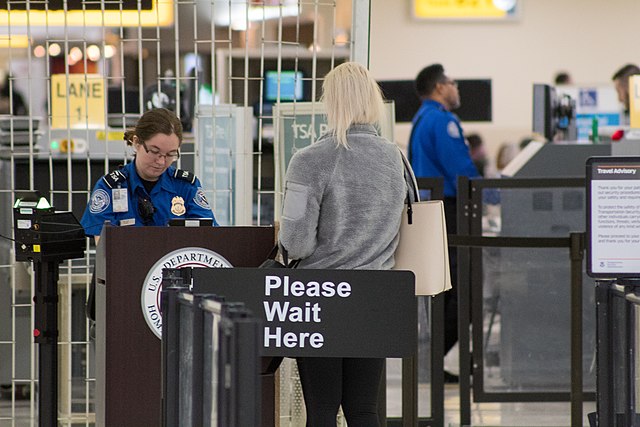
Transportation Security Administration Checkpoint at John Glenn Columbus International Airport. By Michael Ball – Own work, CC0, https://commons.wikimedia.org/w/index.php?curid=77279000

So it’s pretty simple. If you want to get on a plane, even for a domestic flight, you have to pay $100 or so to get a passport. Well, unless your state happens to be one of the states that issues REAL IDs.

(Now large states with multiple major cities such as California and Texas could conceivably try to get around this by setting up a whole system of intrastate airports that only flew within the state, but that would be costly.)

Even with this, the REAL ID implementation date has been delayed several times (most recently due to COVID), but as of today, all 50 states and most U.S. territories are finally issuing REAL IDs, including the unnamed state (and others) that refused to even consider issuing REAL IDs a decade ago.

And that, my friends, is how the Federal government gets what it wants.

COVID is no longer profitable (for a few, anyway)

In the spring of 2000, the COVID-19 crisis brought vast changes to economies throughout the world. Some businesses completely ground to a halt, such as sporting events, while a number of new businesses sprang up.

Now that COVID is (hopefully) receding, some of those newer businesses are fading away.

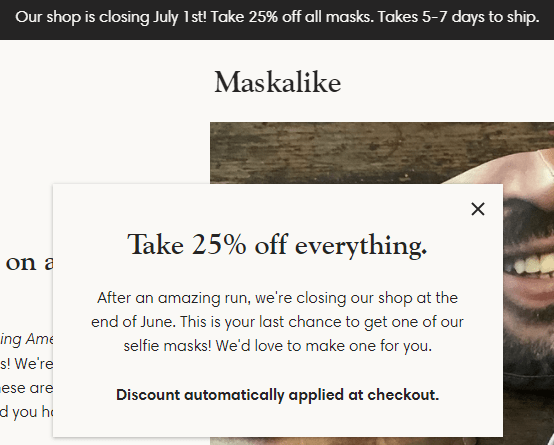
Take Maskalike – please!

https://maskalike.com/ as of June 29, 2021.

Before COVID hit, you generally only saw people wearing masks in operating rooms, unless you visited Disneyland and saw Asian visitors walking around with masks. All of a sudden EVERYONE was wearing masks, and you had people getting creative in their design. Maskalike’s gimmick was to create masks that looked just like the portion of your face that was being covered by the mask.

But Maskalike is closing down in a few short days.

It’s been an amazing run bringing thousands of smiles to people, but this project was always supposed to be temporary and we’re getting busy with new ideas. If you have any questions, or want to acquire this company, get in touch. Otherwise, get your order in!

Let’s face it: people aren’t going to be buying a lot of masks any more. In fact, I’m sure that some people never want to see a face mask ever again.

Perhaps some novelty company will buy Maskalike and include it in its catalog, along with other gimmicky things.

If not, it was good while it lasted.

And I’m still keeping my Rodrigo’s mask that I won on Instagram, even though I have no idea where I’m going to wear it.