I’ve written newsletters for years, both as an employee (the third one here) and as a Bredemarket consultant. Some went to fewer than a dozen people, some to hundreds, and some to thousands.
Unlike a blog post, case study, or white paper, a newsletter does not provide a single focus. While the articles may be related, each stands on its own.
Sometimes literally. Individual newsletter articles may be repurposed as stand-alone blog and social media posts, extending their reach beyond the newsletter’s subscribers.
Your company probably spends a lot of money exhibiting and presenting at trade shows and conferences. And you probably email your prospects and customers about your participation in these events.
But what about the people not on your mailing list?
You can do what the Biometrics Institute has done and create an events page on your website. As I write this, the Biometrics Institute’s events page lists upcoming appearances from March to June, including both in-person events and (for those of us nowhere near Sydney) online events.
How many Biometrics Institute members (and non-members) have their own events pages? One major identity firm (I won’t name it) has an events page…with no events.
But even if you don’t have a web page per se, you can email your prospects and customers as mentioned above. Another identity firm just sent me an email listing several future events, their dates, their locations, and why I would want to go to any of these events.
Do your prospects know about your upcoming events? Bredemarket can help you create a blog post, social media post, email, or even some web page content so that your prospects can see you. Let’s talk.
By the way, here are all the services Bredemarket provides.
Do you want your company’s message to appear in your blog…someday?
If it’s acceptable to your company to get a message out within 90 days, then don’t even bother to read the rest of this post. It’s going to sound ridiculous to you, and probably pretty scary, and frankly it will seem rather rushed.
But could you put me in contact with your competitors? Because while you’re delaying, your competitors are acting.
And can get messages out within 14 days.
(Day 1) Your competitor and its writer decide on the topic, goal, benefits, and target audience (and, if necessary, outline, section sub-goals, relevant examples, and relevant key words/hashtags, and interim and final due dates).
(Days 2-4) Then the writer puts a draft together for your competitor’s review, ideally within three calendar days.
(Days 5-7) The competitor reviews it, ideally within three calendar days. (Yes, I know that such projects sometimes end up on a company’s back burner and aren’t reviewed until a month later, but what if your competitor is motivated?)
(Days 8-10) The writer makes some final changes, again within three days.
(Days 11-13) The competitor approves the final changes, again within three days.
(Day 14) The competitor loads the text into its blog software, adds any necessary images, creates promotional posts on social media (often the original writer can draft those when they draft the blog post itself)…and THE BLOG POST IS LIVE.
So while you’re deciding when you will decide whether you want to say something, your competitor has already said it.
A good chunk of her email was devoted to her statements on how much content should cost. It turns out that my rates are in the ballpark that she described.
Bredemarket’s services, process…and pricing.
But that’s not the most important part of the email. The key observation comes at the end.
“If you want to create high-quality blog posts, engaging videos, or targeted social media campaigns, you will need to pay for skilled writers, designers, videographers, and social media experts.
“No, it doesn’t come cheap. But remember that for every dollar spent on content marketing, you get 3 in return, and that content marketing brings 6x the ROI of other marketing tactics.”
Some of you have heard of Dave Winer, who started Scripting News…when?
“Scripting News was started in 1997, by me, Dave Winer.
“Or 1994 or 1996 or whenever you think it actually started.
“I wrote my first blog posts in 1994, that’s for sure.”
Because of his early interest in immediate and direct sharing of information without intermediaries, Winer is considered as one of the first bloggers. And he has undeniable longevity, still publishing today.
But there is a blogger that preceded Winer, Justin Hall, Jorn Barger, Peter Merholz, and others.
Going off on a tangent
And me.
For the record, I didn’t write my first blog post until October 14, 2003.
“Why did synthetica start with fake bluegrass sounds? Why not? This is the Ontario Empoblog, or the blog for Ontario Emperor, which has nothing and everything to do with Canada, New Mexico, and Texas, but also California, which is a location in California. It exists in cyberspace, which is also synthetic.
“The Ontario Empoblog may or may not touch on a variety of subjects, including music, poetry, poker, the supposed familial relationship between Brian Eno and Slim Whitman, the number of licks it takes to get to the center of a Tootsie Pop (1,121 – I checked), various comments about frogs, and the nature of nature.”
So back then I discussed synthetic music and frogs. Today I discuss synthetic identities and wildebeests. Not much has changed.
What were we talking about?
Back to the first blogger
Oh yeah, the first blogger, predating everyone else by decades.
And blogging on a physical medium, seven inch wide circles of vinyl.
Because I maintain that the first blogger was John Lennon.
Although he didn’t start out that way.
Early Lennon couldn’t “blog”
When Lennon and his band signed a recording contract with a subsidiary of EMI in 1962, the four of them became cogs in a monstrous machine.
They had to report to EMI’s studio, record for an EMI producer, and were almost forced to record someone else’s songs. After they recorded multiple takes (some with a session drummer), their first EMI recording was processed through the EMI sausage system and released in the UK. (EMI’s U.S. subsidiary didn’t want it.)
The September 4, 1962 recording of “Love Me Do” (with Ringo Starr drumming) was released as a single about a month later, on October 5, 1962.
September 4 version. Andy White would come later.
(Most subsequent releases of the song used the September 11 version with Andy White drumming.)
Of course, some later Beatles releases took longer than a month to travel from the studio to the record shops. For example, “When I’m Sixty-Four” was recorded on December 6, 20, and 21, 1966, but was not released on record until May 26, 1967 (in the U.K.; June 2 in the U.S.).
But the times, they were a’changing.
Later Lennon “blogging”
Within the year, the Beatles would have their own record label. Apple was still distributed by EMI, but the Beatles now had more control over the process, especially for their solo releases.
And John Lennon had things he wanted to say…now.
His first chance to practice immediacy was on a song formally credited to The Beatles, but actually recorded by Lennon with Paul McCartney’s help on piano, bass, and drums. Lennon and Yoko Ono married in March 1969. Lennon (with McCartney) recorded “The Ballad of John and Yoko” on April 14, and Apple released it on May 30. Quickly.
“In his biography, McCartney states that Lennon had a sudden inspiration for the song and had suggested that the two of them should record it immediately, without waiting for the other Beatles to return.”
Then Lennon turned to his solo career, which up to this point had consisted of two solo albums with Yoko Ono. Now Lennon started releasing singles.
On June 1, 1969, Lennon recorded “Give Peace a Chance” in Montreal and released it in the U.K. on July 4.
“Cold Turkey” was recorded September 30 and released October 20.
“Instant Karma!” lived up to its name: recorded January 27, 1970 and released February 6. Even with Phil Spector producing.
A mostly-mimed “Top of the Pops” performance.
Lennon subsequently re-focused on albums rather than singles and didn’t release songs as quickly. But those four singles achieved Lennon’s goal of getting something out quickly.
Like a blogger.
Google Gemini. This is not real.
Lennon died before technology allowed musicians (or pirates) to post music files directly on the World Wide Web for immediate download. You can, um, imagine what Lennon could have done if those capabilities had existed in 1969.
Or in 1962.
June 1962, when Ringo Starr was still playing at Butlins with Rory Storm.
Another SoCal Tech Forum presentation on Saturday, this one on banking technology from Carey Ransom of BankTech Ventures.
FoundrSpace.
Only a small reference to financial identity, but excellent nonetheless. While I live-posted the event here on my personal LinkedIn account, I wanted to summarize my three main takeaways from Bredemarket’s perspective.
One: Differentiate
Yes, community banks need to differentiate. Perhaps back in the 1980s before the advent of national banks, community banks could offer a standard suite of services for their communities. But now they’re competing against national banks that do business in their prospects’ communities, and in their prospects’ phones. (We will get to phones in a minute.)
One example Ransom gave: why do community banks offer credit cards? Are their credit cards better than the credit cards from the Really Big (Banking) Bunch? Probably not.
But unlike the Capital Ones and Chimes of the world, community banks know their communities. And they know what local businesses need, and are ideally suited to deliver this. (We will get to services in two minutes.)
Yes, I know that Bank of America may have someone attending and sponsoring your local events, but that person is not Brian Moynihan. And if you don’t know who Moynihan is, your prospects don’t know him either.
But John, you may be saying to yourself, you can’t bank on a phone. How do you deposit checks? And how do you get cash?
Well, let’s look at this:
Bredemarket hasn’t received a check in over three years, but when one of my clients was paying me by check, I would use my phone to take a picture of it and deposit it.
And as for cash, this is needed less and less, especially since many merchants take Apple Pay and Google Pay.
In fact, bank branches are so irrelevant to today’s—and tomorrow’s—bank prospects and customers that Ransom referred to a $3 million dollar bank branch as a really expensive billboard. Probably none of the people who are reading this post WANT to go into a bank branch.
And those that do? Here’s a little secret: if the average age of the people who bank at your bank is in their 70s, they will…um…not be long-term bank customers. The 18 year olds that will bank for decades? They’re opening accounts on their phones. Can they use a phone to open an account at your bank? And why would they do so? (See the differentiation discussion above.)
Three: Supplement
One way a bank can differentiate is via the services they offer.
At the most basic level, a bank can make money by loaning the funds they receive from deposits.
But they can offer many more services to 21st century clients, thanks to legislation such as the Gramm-Leach-Billey Act that allow financial holding companies to own financial or complementary firms.
And not just investments and wealth management.
Ransom provided an illustrative example: cybersecurity.
Banks need to have expertise in cybersecurity to stay alive, and to comply with Know Your Customer and other financial regulations.
So why not offer cybersecurity services to their customers?
This not only gives the banks another revenue stream, but also reduces the risk that their own customers will experience fraud from hacks.
Four: Market
I know I said there were three takeaways. I lied.
Ransom also noted that CapitalOne spends 20% on marketing, including everything from TV ads to cafes. Your typical community bank spends much less, maybe 1%.
How are your prospects going to know what differentiates your bank if they don’t have awareness of those differentiators?
Or perhaps you need proposal or analysis services.
Bredemarket, a provider of content, proposal, and analysis services to technology (and identity) firms, can work with you to create the words you need. Learn about my offerings and book a free meeting here.
This post includes an unprecedented level of name-dropping. As can be expected in a post on the positive effects of a blogging cadence, I mention Robert Scoble and Shel Israel. But I also mention Loren Feldman, Neil Patel, me, Bredebot, Roland Fournier, and Dean Nicolls.
So let’s begin.
Ever read the book Naked Conversations?
I never have, but I imagined that it went something like this.
Robert: I’m naked.
Shel: I’m naked too.
Robert: Let’s talk.
(An aside for those who are fans of repurposing content: the dialog itself was adapted from a comment of mine on a Loren Feldman short.)
Actually, the book isn’t like that, the famous (and patented) shower picture to the contrary.
From Magic Leap US Patent Application No. 2016/0109789 A1.
“According to experts Robert Scoble and Shel Israel, blogs offer businesses something that has long been lacking in their communication with customers — meaningful dialogue. Devoid of corporate-speak and empty promises, business blogs can humanize communication, bringing companies and their constituencies together in a way that improves both image and bottom line.”
Of course, the book was written in 2006. And therefore we know it’s no longer valid in 2025, and that blogging is dead.
Or is it?
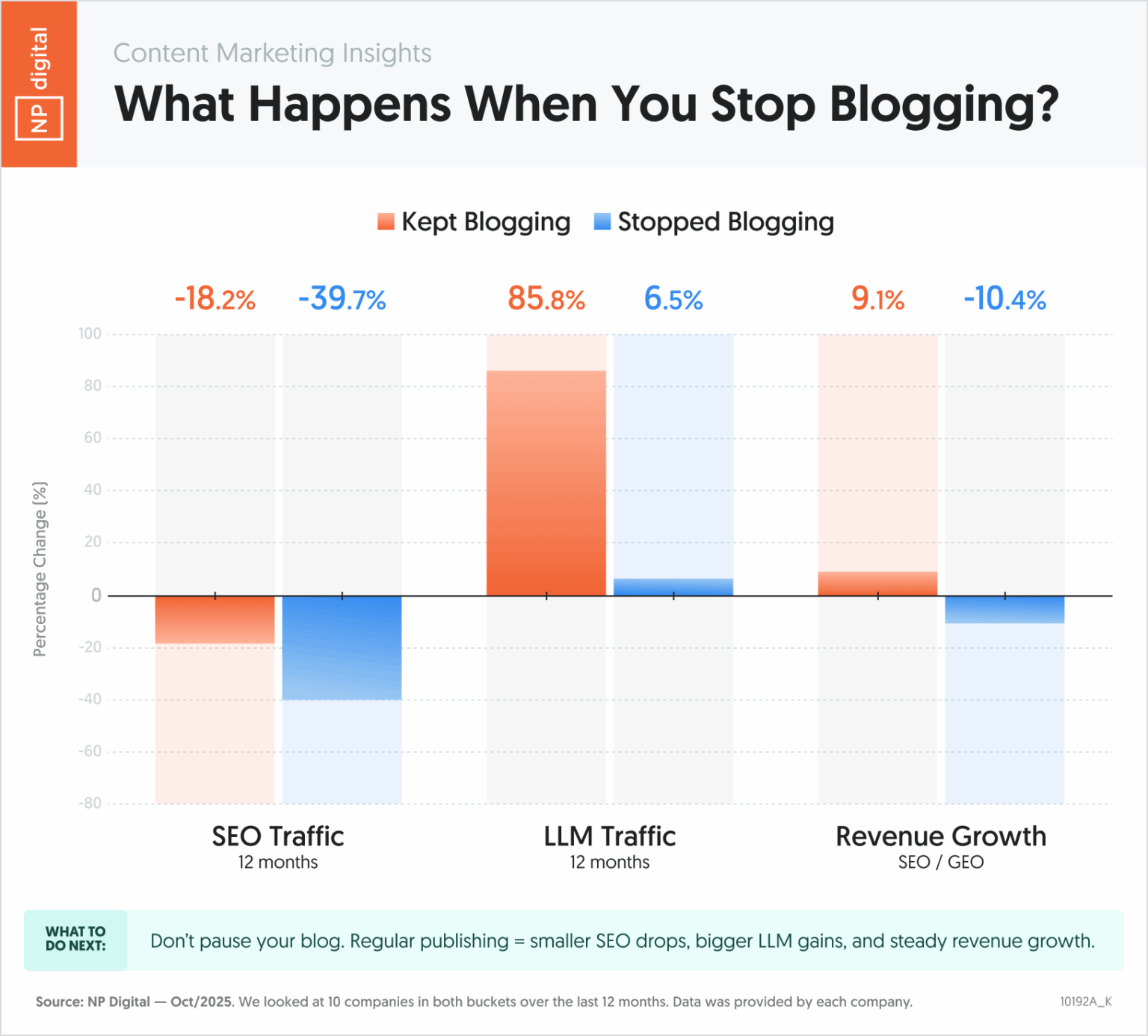
Neil Patel on blogging effects on SEO, LLM visibility, and revenue
And the companies that blog saw an 18.2% decline over 12 months in SEO traffic.
But the companies that don’t blog saw a 39.7% decline in SEO traffic over that same period.
So while SEO traffic is declining, blogging helps mitigate the decline.
Not that you care about SEO. That’s old school. LLM traffic is what you want to optimize these days. And the companies that don’t blog saw a 12-month increase of 6.5% in LLM traffic.
But…the companies that do blog saw an 85.8% LLM traffic increase.
But why is blogging so beneficial to SEO traffic, and LLM traffic, and revenue?
“The stark contrast in outcomes suggests that search engines and AI systems are increasingly prioritizing recently updated, actively maintained content sources over static websites….
“The 85.8% increase in LLM traffic correlates with AI systems preferring sources that demonstrate ongoing expertise and current knowledge, not just historical authority.”
Bredemarket’s blogging cadence
Bredemarket (well, with Bredebot’s help) has successfully maintained a daily blogging cadence for the last several months now. Since late March, as a matter of fact.
Bredemarket posting frequency (in various shades of blue), March 24-October 29, 2025.
Along with nearly-daily cadences on many of Bredemarket’s social channels, this has increased Bredemarket’s SEO and LLM presence.
Google Gemini answer as of October 29, 2025. And I’ve worked with Roland Fournier and know Dean Nicolls.
And it may yield comparable revenue impacts.
Increase your blogging cadence for visibility and revenue
Especially from those companies that haven’t blogged in months or years, and are just now beginning to realize how this hurts them.
And how Bredemarket can help.
Talk to me if you want to kick your blogging into high gear and attract prospects. After all, Bredemarket creates content.









 Bredemarket