From the Department of Unintended Consequences: different countries approach identity proofing in different ways. But what happens when the underlying assumptions disappear and make some identity proofing methods obsolete?
Identity proofing in the United States
In the United States, the primary public identity document for citizens and non-citizens is the driver’s license. These government identity documents, issued by individual states and territories, satisfy a variety of uses, including driving, buying alcohol, boarding a plane or entering a federal facility (eventually), or purchasing something.
There are two other common identity documents in the United States:
The passport. But not everybody has one.
The Social Security card. But this is like your underwear; you don’t show it to everybody.
So our de facto identity card in this country is the driver’s license, or an equivalent ID document issued by a motor vehicle agency. Even though driver’s licenses are used for a ton of purposes that have nothing to do with driving, the entire ecosystem for these IDs is driven by the needs of drivers.
Which is a smart idea, because just about everybody needs a driver’s license.
The abstract for the blog completes the sentence and clarifies it.
“…is already born. How Waymo, Tesla, Zoox & Co will change our automotive society and make mobility safer, more affordable and accessible in urban as well as rural areas.”
It’s certainly a provocative statement, especially if you’re a recent college graduate who just joined the California DMV and thought you were set for life. You’re not.
Even if the author’s conclusion is a complete exaggeration, we need to entertain the possibility that driverless automobiles may eventually improve so much that people won’t even need a driver’s license, except for the cranky few that want them.
Assume that the majority of people own driverless cars at some point in the future, and that these support complete automation with no driver intervention. Imagine the ripple effects:
The government motor vehicle agencies, who will be more than busy certifying the road worthiness of new automobiles, will start wondering why they are spending so much time issuing these IDs that no one uses.
Other agencies at the state and federal level, eager to expand their operations and budgets, will start asking why the motor vehicle agencies are the ones in charge of IDs, and why they should be providing IDs instead.
While the agencies fight this out, private companies that provide adult services such as alcohol, prostitution, pornography, and buying gardening implements will have to figure out how to ensure their customers are old enough for these services. Perhaps they will be forced to turn to age estimation because the person at the counter never bothered to get a driver’s license.
So now half the people don’t bother to get IDs, yet they still need IDs.
There is a lot of discussion about identity verification for people working in certain jobs: police officers, teachers, financial professionals, and the like.
With one exception.
One job that isn’t frequently discussed in the identity verification world is that of a sex worker. Primarily because sex workers usually don’t undergo identity verification for employment, but identity checks for criminal proceedings.
Applicants are fingerprinted and are also required to submit a recent photo.
Applicants must provide their birth name and all subsequent “names or aliases used.”
Three years of residence addresses and employment information.
The applicant criminal record “except minor traffic violations.”
“A waiver of release of medical information,” since the nature of the work involves the possibility of transmission of communicable diseases. And you thought being a nuclear power plant worker was dangerous!
Presumably the fingerprints are searched against law enforcement databases, just like the fingerprints of school teachers and the other newer professions.
Why?
“The chief of police shall investigate, through all available means, the accuracy of all information supplied by the prostitute on the registration form.”
Included in the investigation:
Controlled substance criminal convictions.
Felony convictions.
Embezzlement, theft, or shoplifting convictions.
Age verification; you have to be 21.
As you can see, the identity verification requirements for sex workers are adapted to meet the needs of that particular position.
But…it takes two to tango.
Brothel clients need to be at least 18 years old.
But I don’t know if Nevada requires client age verification, or if age estimation is acceptable.
Why do we have both age verification and age estimation? And how do we overcome the restrictions that force us to choose one over the other?
Why age verification?
As I’ve mentioned before, there are certain products and services that are ONLY provided to people who have attained a certain age. These include alcohol, tobacco, firearms, cannabis, driver’s licenses, gambling, “mature” adult content, and car rentals.
There’s also social media access, which I’ll get to in a minute.
So how do you know that someone purchasing one of these controlled products or services has attained the required age?
One way is to ask the purchaser to provide their government identification (driver’s license, passport, whatever) with their birthdate to prove their age.
This is known as age verification. Provided that the ID was issued by a legitimate government authority, and provided that the ID is not fraudulent, this ID provides ironclad assurance that you are 18 years old or 21 years old or whatever the requirement is.
But let’s return to social media.
Why age estimation?
If you’re Australian, sit down for a moment before I share the following fact.
There are jurisdictions in the world that allow kids as young as 13 years old to access social media.
However, these wild uncontrolled jurisdictions face a problem when trying to determine the ages of their social media users. As I noted almost two years ago:
How many 13 year olds do you know that have driver’s licenses? Probably none.
How many 13 year olds do you know that have government-issued REAL IDs? Probably very few.
How many 13 year olds do you know that have passports? Maybe a few more (especially after 9/11), but not that many.
So how can you figure out whether Bobby or Julie is old enough to open that social media account?
One way to do so is by using a technique called age estimation, which looks at facial features and classifies people by their estimated ages.
The only problem is that while age verification is accurate (assuming the ID is legitimate), age estimation is not:
So if a minor does not have a government ID, and the social media firm has to use age estimation to determine a minor’s age for purposes of the New York Child Data Protection Act, the following two scenarios are possible:
An 11 year old may be incorrectly allowed to give informed consent for purposes of the Act.
A 14 year old may be incorrectly denied the ability to give informed consent for purposes of the Act.
“OK,” you may say, “but so what? Anybody can print a card that says anything they want, like Alabama’s John Wahl did. Why should anyone accept the CitizenCard?”
CitizenCard is the only non-profit, UK-wide issuer of police-approved proof of age & ID cards….
CitizenCard was founded in 1999 and is governed by representatives from the National Lottery operator Allwyn, the Co-op, Ladbrokes & Coral owner Entain and the TMA.
CitizenCard…is the longest-established and the largest issuer of Home Office-endorsed PASS-hologram ID cards in the UK with more than 2.5 million issued.
[CitizenCard] is audited by members of the Age Check Certification Scheme on behalf of PASS to ensure that the highest standards of UK data protection, privacy and security are upheld and rigorous identity verification is carried out.
So one could argue that you don’t need age estimation in the UK, because there is a well-established way to VERIFY ages in the UK.
However, there are other benefits to age estimation, including the fact that estimation is frictionless and doesn’t require you to pull out a card (or a smartphone) at all.
I was encouraged to check out k-ID, a firm that tracks age compliance laws on a global basis. It also lets companies ensure that their users comply with these laws.
“Age assurance refers to a range of methods and technologies used to estimate, verify or confirm someone’s age. Different countries allow different methods, but here are a few commonly used by k-ID…”
The following methods are then listed:
Face Scan: Your age is estimated by completing a video selfie
ID Scan: Your age is confirmed by scanning a government-issued ID
Credit Card: Confirm you’re an adult by using a valid credit card
Note that k-ID’s age assurance methods include age estimation (via your face), age verification (via your government ID), and age who-knows-what (IMHO, possession of a credit card proves nothing, especially if it’s someone else’s).
But if k-ID truly applies the appropriate laws to age assurance, it’s a step in the right direction. Because keeping track of laws in hundreds of thousands of jurisdictions can be a…um…challenge.
An announcement from Paravision says its biometric age estimation technology has achieved Level 3 certification from the Age Check Certification Scheme (ACCS), the leading independent certification body for age estimation. The results make it one of only six companies globally to receive ACCS’s highest-level designation for compliance.
San Francisco-based Paravision’s age estimation tech posted 100 percent precision in Challenge 25 compliance, with 0 subjects falsely identified as over 25 years old. It also scored a 0 percent Failure to Acquire Rate, meaning that every image submitted for analysis returned a result. Mean Absolute Error (MAE) was 1.37 years, with Standard Deviation of 1.17.
Now this is an impressive achievement, and Paravision is a quality company, and Joey Pritikin is a quality biometric executive, but…well, let me share the other story first, involving a Yoti customer (not Yoti).
Fenix responded that it set a challenge threshold at 23 years of age. Any user estimated to be that age or younger based on their face biometrics is required to use a secondary method for age verification.
Fenix had set OnlyFans challenge age, it turns out, at 20 years old. A correction to 23 years old was carried out on January 16, and then Fenix changed it again three days later, to 21 years old, Ofcom says.
Now Biometric Update was very clear that “Yoti provides the tech, but does not set the threshold.”
Challenge ages and legal ages
But do challenge thresholds have any meaning? I addressed that issue back in May 2024.
Many of the tests used a “Challenge-T” policy, such as “Challenge 25.” In other words, the test doesn’t estimate whether a person IS a particular age, but whether a person is WELL ABOVE a particular age….
So if you have to be 21 to access a good or service, the algorithm doesn’t estimate if you are over 21. Instead, it estimates whether you are over 25. If the algorithm thinks you’re over 25, you’re good to go. If it thinks you’re 24, pull out your ID card.
And if you want to be more accurate, raise the challenge age from 25 to 28.
NIST admits that this procedure results in a “tradeoff between protecting young people and inconveniencing older subjects” (where “older” is someone who is above the legal age but below the challenge age).
You may be asking why the algorithms have to set a challenge age above the lawful age, thus inconveniencing people above the lawful age but below the challenge age.
The reason is simple.
Age estimation is not all that accurate.
I mean, it’s accurate enough if I (a person well above the age of 21 years) must indicate whether I’m old enough to drink, but it’s not sufficiently accurate for a drinker on their 21st birthday (in the U.S.), or a 13 year old getting their first social media account (where lawful).
Not an official document.
If you have a government issued ID, age verification based upon that ID is a much better (albeit less convenient) solution.
« L’internaute doit simplement effectuer 3 mouvements de la main et l’avant-bras devant la caméra de son écran (ordinateur, tablette, smartphone). En quelques secondes, il/elle vérifie son âge sans dévoiler son identité. »
Help me, Google Translate; you’re my only hope.
“The Internet user simply has to make 3 movements of the hand and forearm in front of the camera on their screen (computer, tablet, smartphone). In a few seconds, he/she verifies his/her age without revealing his/her identity.”
The method is derived from a 1994 scientific paper entitled “Rapid aimed limb movements: Age differences and practice effects in component submovements.” The abstract of the paper reads as follows:
“Two experiments are reported in which younger and older adults practiced rapid aimed limb movements toward a visible target region. Ss were instructed to make the movements as rapidly and as accurately as possible. Kinematic details of the movements were examined to assess the differences in component submovements between the 2 groups and to identify changes in the movements due to practice. The results revealed that older Ss produced initial ballistic submovements that had the same duration but traveled less far than those of younger Ss. Additionally, older Ss produced corrective secondary submovements that were longer in both duration and distance than those of the younger subjects. With practice, younger Ss modified their submovements, but older Ss did not modify theirs even after extensive practice on the task. The results show that the mechanisms underlying movements of older adults are qualitatively different from those in younger adults.”
So what does this mean? Needemand has a separate BorderAge website—thankfully in English—that illustrates the first part of the user instructions.
I don’t know what happens after that, but the process definitely has an “active liveness” vibe, except instead of proving you’re real, you’re proving you’re old, or old enough.
Now I’m not sure if the original 1994 study results were ever confirmed across worldwide populations. But it wouldn’t be the first scheme that is unproven. Do we KNOW that fingerprints are unique?
Another question I have regards the granularity of the age estimation solution. Depending upon your use case and jurisdiction, you may have to show that your age is 13, 16, 18, 21, or 25. Not sure if BorderAge gets this granular.
But if you want a way to estimate age and preserve anonymity (the solution blocks faces and has too low of a resolution to capture friction ridges), BorderAge may fit the bill.
“So depending upon your needs, you can argue that”
This frame was followed by three differing answers to the “Where is ByteDance From?” question.
But isn’t there only one answer to the question? How can there be three?
It all depends upon your needs.
Who is the best age estimation vendor?
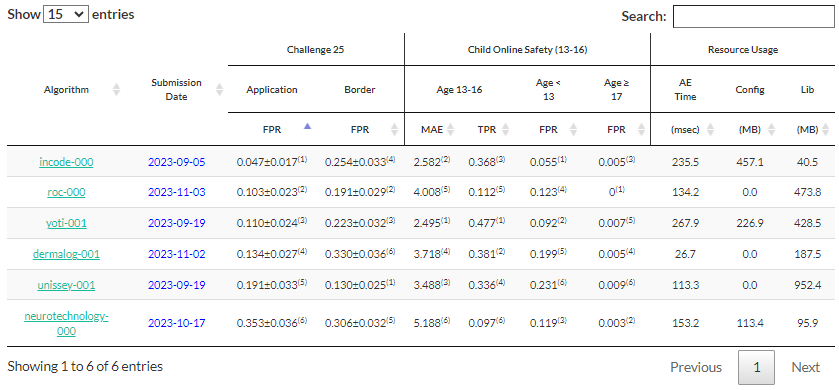
I shared an illustrative example of this last year. When the National Institute of Standards and Technology (NIST) tested its first six age estimation algorithms, it published the results for everyone to see.
“Because NIST conducts so many different tests, a vendor can turn to any single test in which it placed first and declare it is the best vendor.
“So depending upon the test, the best age estimation vendor (based upon accuracy and or resource usage) may be Dermalog, or Incode, or ROC (formerly Rank One Computing), or Unissey, or Yoti. Just look for that “(1)” superscript….
“Out of the 6 vendors, 5 are the best. And if you massage the data enough you can probably argue that Neurotechnology is the best also.
“So if I were writing for one of these vendors, I’d argue that the vendor placed first in Subtest X, Subtest X is obviously the most important one in the entire test, and all the other ones are meaningless.”
Are you the best? Only if I’m writing for you
I will let you in on a little secret.
When I wrote things for IDEMIA, I always said that IDEMIA was the best.
When I wrote things for Incode, I always said that Incode was the best.
And when I write things for each of my Bredemarket clients, I always say that my client is the best.
I recently had to remind a prospect of this fact. This particular prospect has a very strong differentiator from its competitors. When the prospect asked for past writing samples, I included this caveat:
“I have never written about (TOPIC 1) or (TOPIC 2) from (PROSPECT’S) perspective, but here are some examples of my writing on both topics.”
I then shared four writing samples, including something I wrote for my former employer Incode about two years ago. I did this knowing that my prospect would disagree with my assertions that Incode’s product is so great…and greater than the prospect’s product.
If this loses me the business, I can accept that. Anyone with any product marketing experience in the identity industry is guaranteed to have said SOMETHING offensive to most of the 80+ companies in the industry.
How do I write for YOU?
But let’s say that you’re an identity firm and you decide to contract with Bredemarket anyway, even though I’ve said nice things about your competitors in the past.
How do we work together to ensure that I say nice things about you?
By the time we’re done, we have hopefully painted a hero picture of your company, describing why you are the preferred solution for your customers—better than IDEMIA, Incode, or anyone else.
(Unless of course IDEMIA or Incode contracts with Bredemarket, in which case I will edit the sentence above just a bit.)
So let’s talk
If you would like to work with Bredemarket for differentiated content, proposal, or analysis work, book a free meeting on my “CPA” page.
As I’ve mentioned before, when the National Institute of Standards and Technology (NIST) tests biometric modalities such as finger and face, they conduct each test in a bunch of different ways.
But NIST doesn’t do this just to make the vendors happy. NIST does this because biometrics are used in many, many ways.
Let’s look at recent age estimation testing, which currently tests 15 algorithms rather than the original 6.
Governments and private entities can estimate ages for people at the pub, people buying weed, or people gambling. And then there’s the use case that is getting a lot of attention these days—people accessing social media.
Child Online Safety, Ages 13-16 (in my country anyway)
When NIST conceived the age estimation tests, the social media providers generaly required their users to be 13 years of age or older. For this reason, one of NIST’s age estimation tests focused upon whether age estimation algorithms could reliably identify those who were 13 years old vs. those who were not.
Age 8-12 – False Positive Rates (FPR) are proportions of subjects aged 8 to 12 but whose age is estimated from 13 to 16 (below 17).
This covers the case in which a social media provider requires people to be 13 years old or older, someone between 8 and 12 tries to sign up for the social media service anyway…AND SUCCESSFULLY DOES SO.
You want the “false positive rate” to be as low as possible in this case, so that’s what NIST measures.
As of December 10, the best performing algorithm of the 15 tested had a false positive rate (FPR) of 0.0467. The second was close at 0.0542, with the third at 0.0828.
The 15th was a distant last at 0.2929.
But the worst-tested algorithm is much better on other tests
But before you conclude that the 15th algorithm in the “8-12” test is a dud, take a look at how that same algorithm performed on some of the OTHER age estimation tests.
For the age 17-22 test (“False Positive Rates (FPR) are proportions of subjects aged 17 to 22 but whose age is estimated from 13 to 16 (below 17)”), this algorithm was the second MOST accurate.
And the algorithm is pretty good at correctly classifying 13-16 year olds.
It also performs well in the “challenge 25” tests (addressing some of the use cases I mentioned above such as alcohol purchases).
So it looks like this particular algorithm doesn’t (currently) do well with kids, but it does VERY well with adults.
So before you use the NIST tests as a starting point to determine if an algorithm is good for you, make sure you evaluate the CORRECT test, including the CORRECT data.
Basically, the difference between “recognition” and “analysis” in this context is that recognition identifies an individual, while analysis identifies a characteristic of an individual….The age of a person is another example of analysis. In and of itself an age cannot identify an individual, since around 385,000 people are born every day. Even with lower birth rates when YOU were born, there are tens or hundreds of thousands of people who share your birthday.
Normal people look forward to the latest album or movie. A biometric product marketing expert instead looks forward to an inaugural test report from the National Institute of Standards and Technology (NIST) on age estimation and verification using faces.
I’ve been waiting for this report for months now (since I initially mentioned it in July 2023), and in April NIST announced it would be available in the next few weeks.
NIST news release
Yesterday I learned of the report’s public availability via a NIST news release.
A new study from the National Institute of Standards and Technology (NIST) evaluates the performance of software that estimates a person’s age based on the physical characteristics evident in a photo of their face. Such age estimation and verification (AEV) software might be used as a gatekeeper for activities that have an age restriction, such as purchasing alcohol or accessing mature content online….
The new study is NIST’s first foray into AEV evaluation in a decade and kicks off a new, long-term effort by the agency to perform frequent, regular tests of the technology. NIST last evaluated AEV software in 2014….
(The new test) asked the algorithms to specify whether the person in the photo was over the age of 21.
Well, sort of. We’ll get to that later.
Current AEV results
I was in the middle of a client project on Thursday and didn’t have time to read the detailed report, but I did have a second to look at the current results. Like other ongoing tests, NIST will update the age estimation and verification (AEV) results as these six vendors (and others) submit new algorithms.
Why does NIST test age estmation, or anything else?
The Information Technology Laboratory and its Information Access Division
NIST campus, Gaithersburg MD. From https://www.nist.gov/ofpm/historic-preservation-nist/gaithersburg-campus. I visited it once, when Safran’s acquisition of Motorola’s biometric business was awaiting government approval. I may or may not have spoken to a Sagem Morpho employee at this meeting, even though I wasn’t supposed to in case the deal fell through.
One of NIST’s six research laboratories is its Information Technology Laboratory (ITL), charged “to cultivate trust in information technology (IT) and metrology.” Since NIST is part of the U.S. Department of Commerce, Americans (and others) who rely on information technology need an unbiased source on the accuracy and validity of this technology. NIST cultivates trust by a myriad of independent tests.
Some of those tests are carried out by one of ITL’s six divisions, the Information Access Division (IAD). This division focuses on “human action, behavior, characteristics and communication.”
The difference between FRTE and FATE
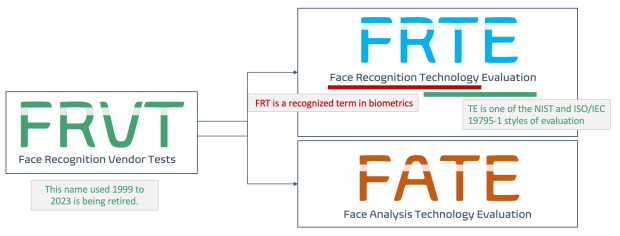
While there is a lot of IAD “characteristics” work that excites biometric folks, including ANSI/NIST standard work, contactless fingerprint capture, the Fingerprint Vendor Technology Evaluation (ugh), and other topics, we’re going to focus on our new favorite acronyms, FRTE (Face Recognition Technology Evaluation) and FATE (Face Analysis Technology Evaluation). If these acronyms are new to you, I talked about them last August (and the deprecation of the old FRVT acronym).
Basically, the difference between “recognition” and “analysis” in this context is that recognition identifies an individual, while analysis identifies a characteristic of an individual. So the infamous “Gender Shades” study, which tested the performance of three algorithms in identifying people’s sex and race, is an example of analysis.
Age analysis
The age of a person is another example of analysis. In and of itself an age cannot identify an individual, since around 385,000 people are born every day. Even with lower birth rates when YOU were born, there are tens or hundreds of thousands of people who share your birthday.
They say it’s your birthday. It’s my birthday too, yeah. From https://www.youtube.com/watch?v=fkZ9sT-z13I. Paul’s original band never filmed a promotional video for this song.
And your age matters in the situations I mentioned above. Even when marijuana is legal in your state, you can’t sell it to a four year old. And that four year old can’t (or shouldn’t) sign up for Facebook either.
You can check a person’s ID, but that takes time and only works when a person has an ID. The only IDs that a four year old has are their passport (for the few who have one) and their birth certificate (which is non-standard from county to county and thus difficult to verify). And not even all adults have IDs, especially in third world countries.
Self-testing
So companies like Yoti developed age estimation solutions that didn’t rely on government-issued identity documents. The companies tested their performance and accuracy themselves (see the PDF of Yoti’s March 2023 white paper here). However, there are two drawbacks to this:
While I am certain that Yoti wouldn’t pull any shenanigans, results from a self-test always engender doubt. Is the tester truly honest about its testing? Does it (intentionally or unintentionally) gloss over things that should be tested? After all, the purpose of a white paper is for a vendor to present facts that lead a prospect to buy a vendor’s solution.
Even with Yoti’s self tests, it did not have the ability (or the legal permission) to test the accuracy of its age estimation competitors.
How NIST tests age estimation
Enter NIST, where the scientists took a break from meterological testing or whatever to conduct an independent test. NIST asked vendors to participate in a test in which NIST personnel would run the test on NIST’s computers, using NIST’s data. This prevented the vendors from skewing the results; they handed their algorithms to NIST and waited several months for NIST to tell them how they did.
I won’t go into it here, but it’s worth noting that a NIST test is just a test, and test results may not be the same when you implement a vendor’s age estimation solution on CUSTOMER computers with CUSTOMER data.
The NIST internal report I awaited
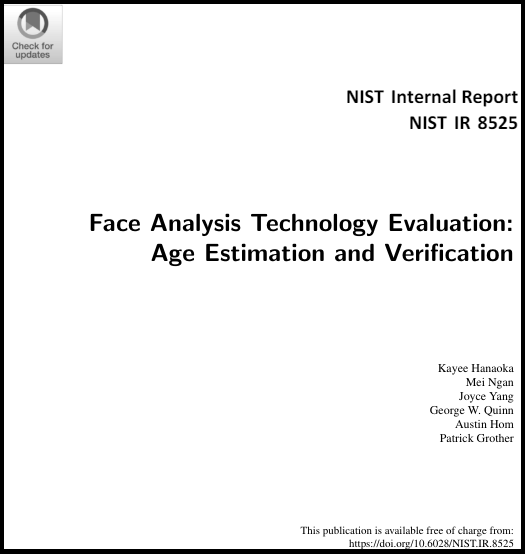
NOW let’s turn to the actual report, NIST IR 8525 “Face Analysis Technology Evaluation: Age Estimation and Verification.”
NIST needed a set of common data to test the vendor algorithms, so it used “around eleven million photos drawn from four operational repositories: immigration visas, arrest mugshots, border crossings, and immigration office photos.” (These were provided by the U.S. Departments of Homeland Security and Justice.) All of these photos include the actual ages of the persons (although mugshots only include the year of birth, not the date of birth), and some include sex and country-of-birth information.
For each algorithm and each dataset, NIST recorded the mean absolute error (MAE), which is the mean number of years between the algorithm’s estimate age and the actual age. NIST also recorded other error measurements, and for certain tests (such as a test of whether or not a person is 17 years old) the false positive rate (FPR).
The challenge with the methodology
Many of the tests used a “Challenge-T” policy, such as “Challenge 25.” In other words, the test doesn’t estimate whether a person IS a particular age, but whether a person is WELL ABOVE a particular age. Here’s how NIST describes it:
For restricted-age applications such as alcohol purchase, a Challenge-T policy accepts people with age estimated at or above T but requires additional age assurance checks on anyone assessed to have age below T.
So if you have to be 21 to access a good or service, the algorithm doesn’t estimate if you are over 21. Instead, it estimates whether you are over 25. If the algorithm thinks you’re over 25, you’re good to go. If it thinks you’re 24, pull out your ID card.
And if you want to be more accurate, raise the challenge age from 25 to 28.
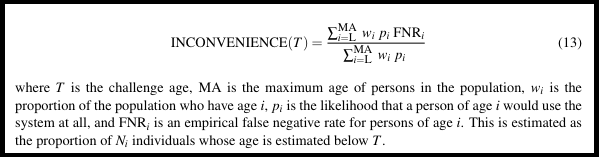
NIST admits that this procedure results in a “tradeoff between protecting young people and inconveniencing older subjects” (where “older” is someone who is above the legal age but below the challenge age).
NIST also performed a variety of demographic tests that I won’t go into here.
What the NIST age estimation test says
OK, forget about all that. Let’s dig into the results.
So depending upon the test, the best age estimation vendor (based upon accuracy and or resource usage) may be Dermalog, or Incode, or ROC (formerly Rank One Computing), or Unissey, or Yoti. Just look for that “(1)” superscript.
You read that right. Out of the 6 vendors, 5 are the best. And if you massage the data enough you can probably argue that Neurotechnology is the best also.
So if I were writing for one of these vendors, I’d argue that the vendor placed first in Subtest X, Subtest X is obviously the most important one in the entire test, and all the other ones are meaningless.
But the truth is what NIST said in its news release: there is no single standout algorithm. Different algorithms perform better based upon the sex or national origin of the people. Again, you can read the report for detailed results here.
What the report didn’t measure
NIST always clarifies what it did and didn’t test. In addition to the aforementioned caveat that this was a test environment that will differ from your operational environment, NIST provided some other comments.
The report excludes performance measured in interactive sessions, in which a person can cooperatively present and re-present to a camera. It does not measure accuracy effects related to disguises, cosmetics, or other presentation attacks. It does not address policy nor recommend AV thresholds as these differ across applications and jurisdictions.
Of course NIST is just starting this study, and could address some of these things in later studies. For example, its ongoing facial recognition accuracy tests never looked at the use case of people wearing masks until after COVID arrived and that test suddenly became important.
What about 22 year olds?
As noted above, the test used a Challenge 25 or Challenge 28 model which measured whether a person who needed to be 21 appeared to be 25 or 28 years old. This makes sense when current age estimation technology measures MAE in years, not days. NIST calculated the “inconvenience” to 21-25 (or 28) year olds affected by this method.
While a lot of attention is paid to the use cases for 21 year olds (buying booze) and 18 year olds (viewing porn), states and localities have also paid a lot of attention to the use cases for 13 year olds (signing up for social media). In fact, some legislators are less concerned about a 20 year old buying a beer than a 12 year old receiving text messages from a Meta user.
NIST tests for these in the “child online safety” tests, particularly these two:
Age < 13 – False Positive Rates (FPR) are proportions of subjects aged below 13 but whose age is estimated from 13 to 16 (below 17).
Age ≥ 17 – False Positive Rates (FPR) are proportions of subjects aged 17 or older but whose age is estimated from 13 to 16.
However, the visa database is the only one that includes data of individuals with actual ages below age 13. The youngest ages in the other datasets are 14, or 18, or even 21, rendering them useless for the child online safety tests.
Why NIST researchers are great researchers
The mark of a great researcher is their ability to continue to get funding for their research, which is why so many scientific papers conclude with the statement “further study is needed.”
Here’s how NIST stated it:
Future work: The FATE AEV evaluation remains open, so we will continue to evaluate and report on newly submitted prototypes. In future reports we will: evaluate performance of implementations that can exploit having a prior known-age reference photo of a subject (see our API); consider whether video clips afford improved accuracy over still photographs; and extend demographic and quality analyses.
Translation: if Congress doesn’t continue to give NIST money, then high school students will get drunk or high, young teens will view porn, and kids will encounter fraudsters on Facebook. It’s up to you, Congress.











 Bredemarket