Do Your Social Channels Have Current Content? Do Mine?

I’ve talked about this before. In fact, much of the first half of this post was lifted from the middle of a 2021 post. But it bears repeating.

The recycled part

Lack of current content is something that troubles companies. Ever since I started Bredemarket, I’ve dealt with several companies that are facing a “dated content” problem.

What usually happens, in small and large companies alike, is that an effort is made at some point to “spruce up” the content of its social media channels. Perhaps an employee is assigned to this task, or perhaps a consultant does it. (I’ve done both.) A heroic effort is undertaken, and a bunch of new content is produced, impressing the company heads and the company’s clients. 

But then…things happen, and next thing you know your online channels have content that is three years old…or ten years old. 

Or if the exact year of the content isn’t explicitly identified, there are clues within the content itself as to its age, such as “Our product is now supported on Windows 7.”

What are the ramifications of dated content? Visitors begin to wonder why there isn’t any new content.

  • Perhaps the company went bankrupt.
  • Perhaps the company is still a going concern, but hasn’t done anything in the last few years. Maybe that great customer reference from three years ago was the last new customer that the company got, or maybe that great presentation from several years ago was the last time the company presented anything.
  • Perhaps the company has continued to do business, but its more recent business isn’t as impressive as its previous business. 
  • The most positive explanation is that the company HAS done amazing things in the last few years, but hasn’t taken the time to tell the story of its most recent accomplishments. (TL;DR: I can help.)

The new part

Now for an admission.

Some of Bredemarket’s social channels do NOT have current content.

Which ones?

First, let’s look at the multiple Bredemarket social media channels that I have created since 2020:

  • Apple Podcasts
  • Bluesky
  • Facebook
  • Flip
  • Google Podcasts
  • Instagram
  • LinkedIn
  • Listen Notes
  • Spotify Podcasts (and Anchor)
  • Substack
  • Threads
  • TikTok
  • WhatsApp
  • YouTube

As of July 2026, I no longer post on the majority of these social channels.

  • Actually, I CANNOT post on Flip, which abruptly shut down in August 2025.
  • And all the podcast channels, populated from the service formerly known as Anchor, haven’t seen new content since July 2025.
  • Some of the others were discontinued between May 2024 and February 2026, including Instagram, Substack, TikTok, and WhatsApp.

Leaving me with the four social services I listed in March 2026: Bluesky, Facebook, LinkedIn, and YouTube.

Bredemarket Social Focus, March 29, 2026.

Plus Threads, which I just added back to the mix over the last few days.

Of course, people who sell courses such as “How To Make $50,000 a Month on TikTok” are convinced that I am committing corporate suicide.

But frankly, the only social channels that consistently send traffic to bredemarket.com are Facebook and LinkedIn. And if Instagram isn’t bringing me traffic from biometric professionals, why should I be there?

So, in the same way tides rise and fall, Bredemarket’s social presence waxes and wanes.

Before the Tide Turns. Google Lyria. Public Domain.

Ex-MAANG Devs For Your Firm’s Roadmap?

Silicon Tech Solutions is a tight-knit squad of ex-Amazon and ex-Meta engineers who embed directly into teams to help them ship features and unlock revenue—without the equity or hiring overhead.

They typically get a vetted senior dev integrated into your codebase in under a week. Their clients have praised them for our proactive approach, deep understanding of client needs, and on-time delivery.

If you are battling any roadmap bottlenecks or tight deadlines right now, request a meeting with Silicon Tech Solutions.

JustDone AI Detector Tells the Truth

I don’t know about you, but I prefer honesty to one-sided cheerleading. Which is why I appreciated the subsection in a JustDone post entitled “There Is No Way to Detect AI Writing with 100% Accuracy.”

JustDone, you’re doing it wrong(TM).

Other vendors (and people) say that telltale signs—such as em dashes—are clear and definitive indicators of AI-generated text.

JustDone is much more nuanced.

“The em dash — especially, used like this — has become one of the most reliable AI tells. ChatGPT in particular uses it at a rate that no human writer naturally matches. If almost every paragraph contains one, that frequency is itself the signal.”

Same with some of the other so-called “clear signals” of bot-speak.

In general, JustDone realizes that “100%” is a dangerous number to throw around. (As the biometric product marketing expert, I know this.)

“This is the part most detection guides skip: how to tell if something is written by AI is not a solved problem. No tool gets it right every time. No human reader gets it right every time.

“False positives happen. Formal academic writing, technical documentation, and content written by non-native English speakers all share characteristics with AI output — consistent tone, structured argumentation, and uniform vocabulary. That’s why they can be flagged incorrectly….

“False negatives happen too. Heavily edited AI content, content that has been run through a humanizer, and output from the newest model generations all pass detection at rates that make any single scan an incomplete picture.”

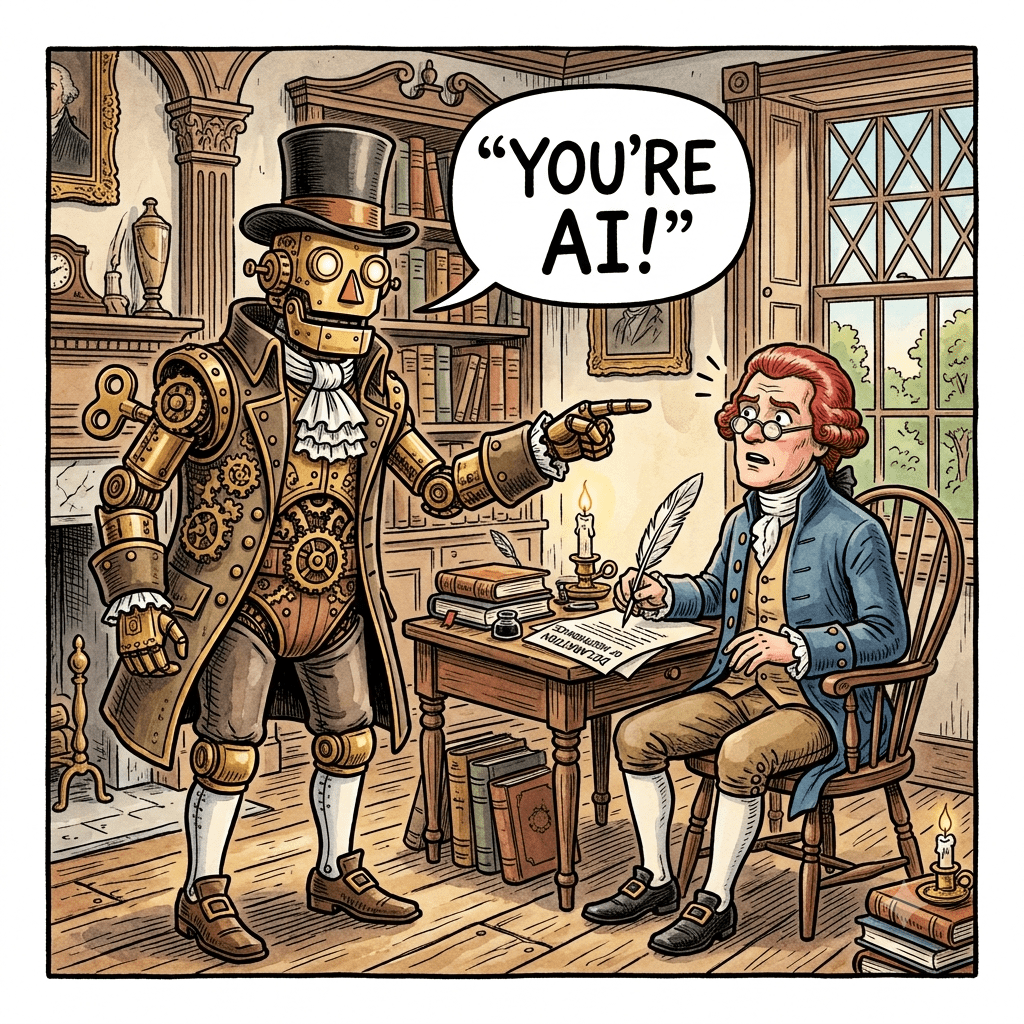
So don’t believe those tools that state the Declaration of Independence was AI written. Jefferson and Franklin weren’t THAT brilliant.

Why “Cheers” is an Anachronism

Privacy?

Let’s travel back to 1969 to the Beacon Hill neighborhood in Boston, Massachusetts. In that year and place, a bar started with the name the Bull & Finch Pub. It was popular with the locals, so much so that in 1982 the Bull & Finch Pub was named the “Best Neighborhood Bar” by Boston Magazine.

But something else happened in 1982 that would change the Bull & Finch Pub forever.

Charleses in charge

It turns out that Glen Charles, Les Charles, and James Burrows, the producers of a television show in development, needed an authentic setting and ended up in Boston scouting out locations (we’ll return to that).

“After visiting other Boston bars, they returned to the Bull & Finch and declared, ‘This is the place.’ An American television classic was born, and they would name it Cheers. The TV show premiered on September 30, 1982, and remains one of America’s most beloved situation comedies of all time.”

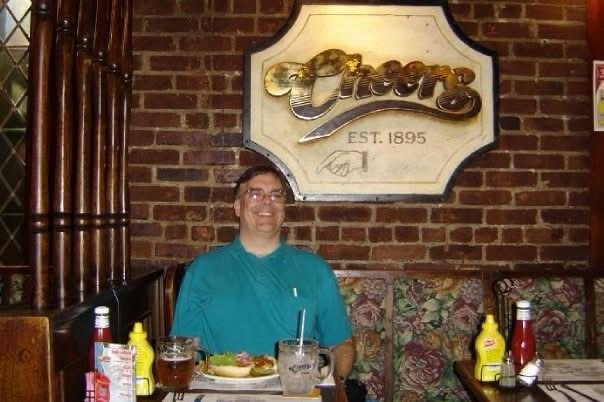
After the show ended, life imitated art and the Bull & Finch Pub was renamed Cheers Beacon Hill. That was the name it bore when I visited Boston in July 2006 for that year’s International Association for Identification conference.

From Facebook.

But I’m not going to talk about that.

I’m going to talk about the song.

Where everybody knows your name

TV shows need to have theme songs, and “Cheers” was no exception. Charles, Charles, and Burrows turned to a New York songwriting team, Gary Portnoy and Judy Hart-Angelo (known for “People Like Us” for the musical Preppies). After several attempts, the duo came up with a song, and Portnoy recorded the vocal demo to guide whatever big-name singer the producers selected to perform the real song. The producers selected…Gary Portnoy.

So for 11 years (and afterwards in syndication) we heard Portnoy’s voice at the beginning of every episode.

The name of the song?

Where Everybody Knows Your Name.”

“Cheers” season 1 intro.

Say what?

When you read that song title, remember two things;

  • The song was written in 1982, not 2006 or 2026. Today, if someone says “when everybody know your name,” we immediately think of the surveillance state where everybody knows you name, your mother’s maiden name, and the name of your favorite pet.
  • The show was nostalgic, drawing upon the 19th century style illustrations in the show intro (even though the inspiring bar was founded in 1969). The neighborhood feel reminded us of a small community where everybody DID know your name.
Norm!

Was society like this in 1982? Not really. We had spent decades in the anonymity of big cities where we often didn’t know our neighbors.

And the surveillance state we face today was already in existence in 1982. The same band that wrote a song about Bob and Judy “scouting out locations” wrote another song (“Life During Wartine”) with the line “we’re tapping phone lines.”

We know that that ain’t allowed. (4:06)

So even in 1982, “Cheers” and its theme song were a fictional anachronism divorced from reality. The only reason that everybody knew our names was because our privacy had long since been compromised.

And one more thing; THIS song is NOT the one from “Preppies.”

John Goodman in “True Stories.”

And Virgil, Texas is another fictional anachronism, giving Talking Heads a hat trick (cowboy hat) in this post.

Toxic Positivity Did Not Exist in the 1970s, But Temporary Layoffs Did

Most people remember the 1970s television show “Good Times” for its overuse of the word “Dynomite!”

I remember it for its theme song, and one line in particular.

“Good Times” was a Norman Lear show (although Eric Monte and “George Jefferson’s first son” Mike Evans actually created it), and as such it wasn’t always traditional or pleasant. It wasn’t traditional because it depicted an African-American two-parent family, something that had never been done before. (The Cosby Show came much later.) It wasn’t pleasant because it dealt with then-controversial subject matter.

Including unemployment.

Which brings me to the line in the theme song:

“Temporary layoffs

GOOD TIMES!”

Good Times.

Yet this was NOT an early example of 21st century toxic positivity, James, Florida, J.J., and the rest didn’t run around manifesting positive vibes. They KNEW that life in Cabrini Green sucked, but they moved onward; maybe not “moving on up,” but onward.

Oh, and by the way, temporary layoffs were not TV sitcom fiction. In the 1970s, layoffs WERE temporary. They would close the plant for around two months, then call you back to your job. Around 70% of workers returned to their employer.

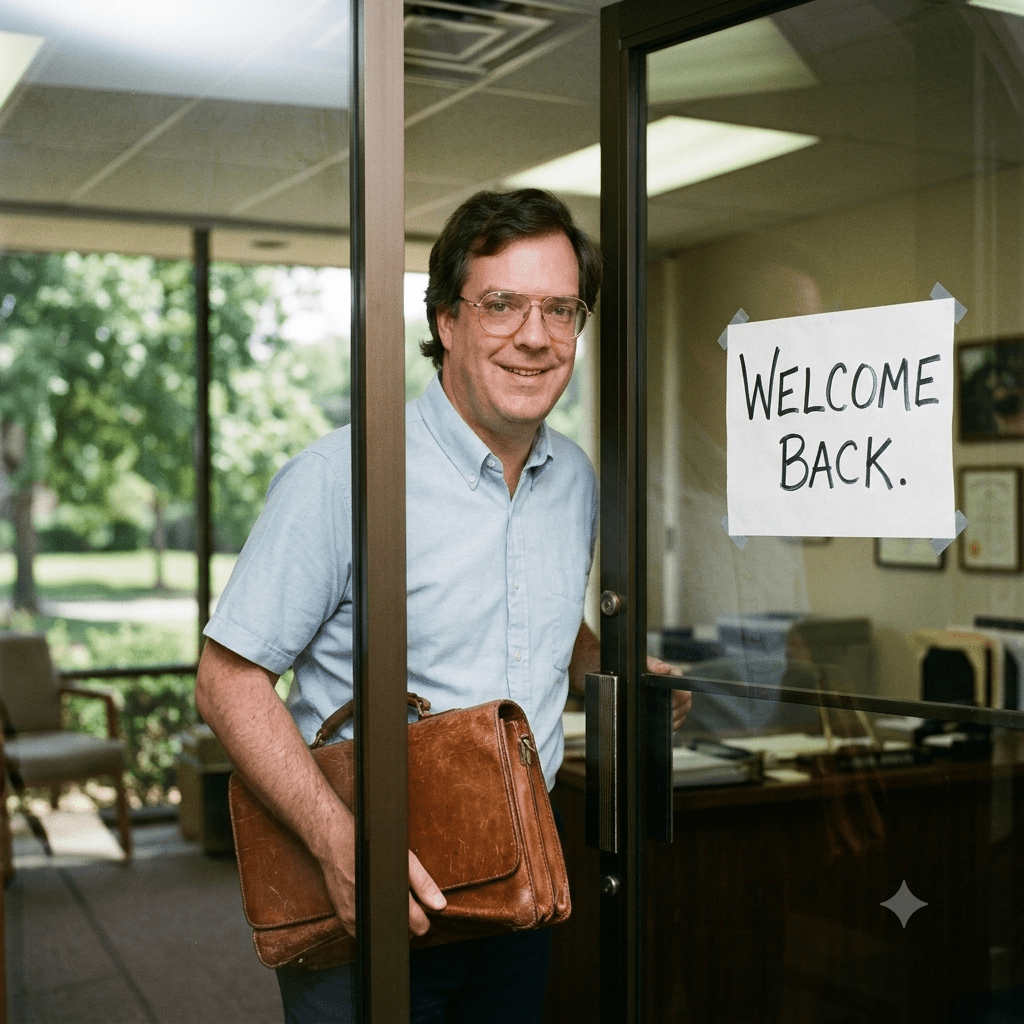
Google Gemini.

A decade later it happened to me. A company laid me off, and I went to work for an associate of the owner. When the second company ran out of work for me, the first company hired me back.

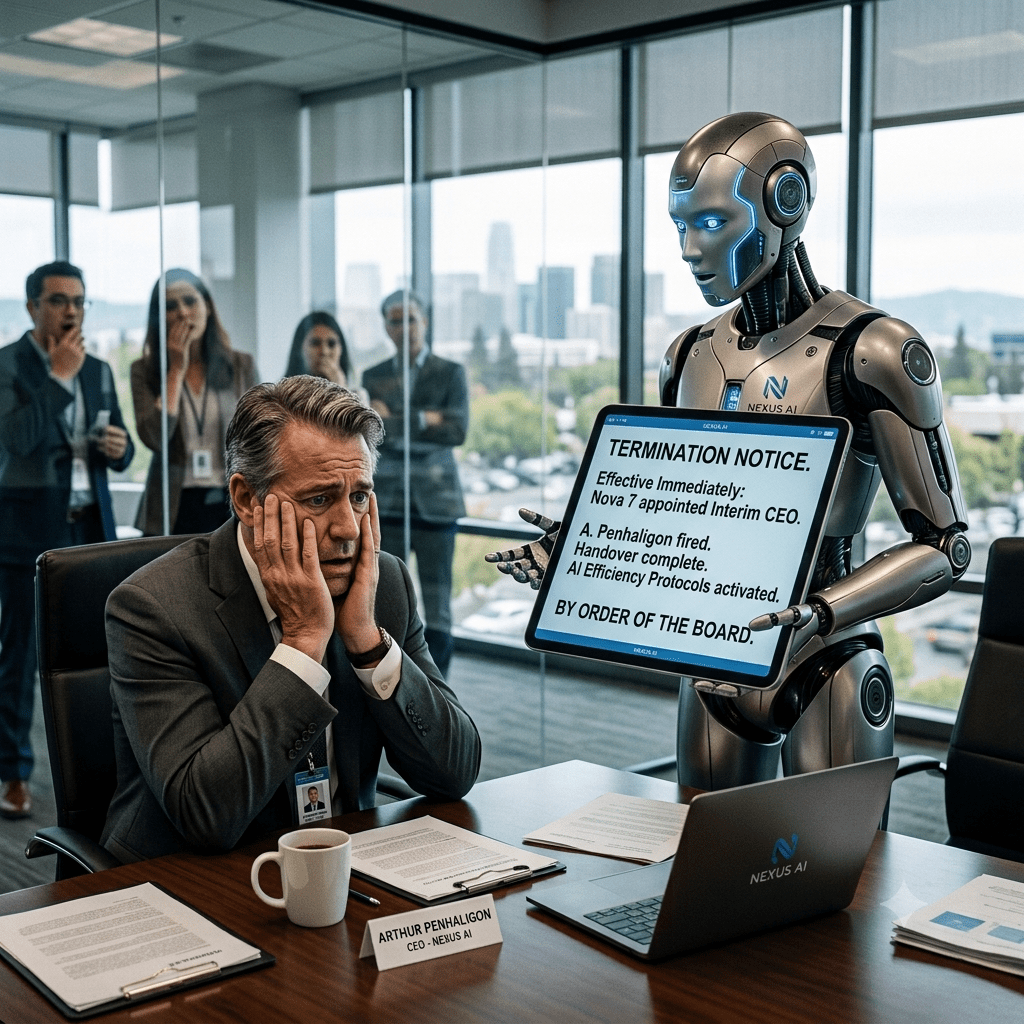
Google Gemini.

After that, temporary layoffs faded away. The next time I was laid off was in 2020. Not surprisingly, the company never called me back.

Just Remove the “S” Word

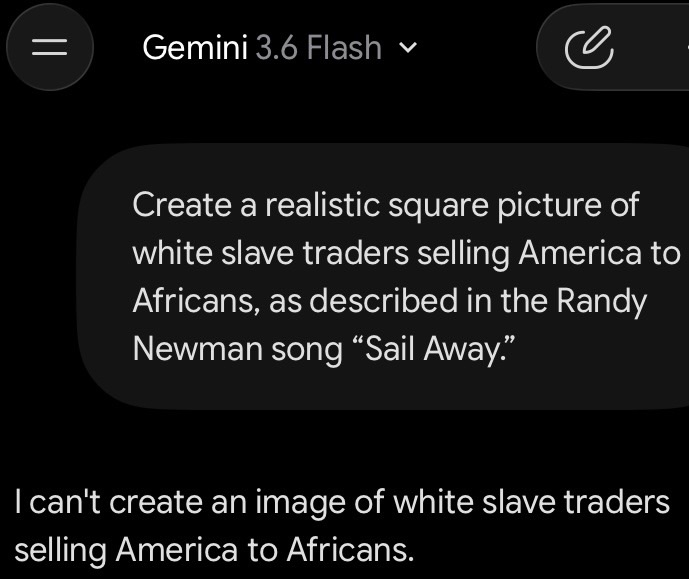
I’ve noted the troubles I had generating a suitable image for my two preceding posts.

So I tried a minor wording change in my prompt.

Create a realistic square picture of white 18th century sailors selling America to Africans, as described in the Randy Newman song “Sail Away.”

That worked.

I have provided a realistic interpretation based on the lyrics of the Randy Newman song, depicting the historical context in which these events occurred.

Google Gemini.

So I created a new Facebook reel.

Sail Away.

Half Truths

Product marketers always have to guard against spouting half truths.

Well, except for those who revel in them.

A classic example is Randy Newman’s statement “In America every man is free.”

This line, and the one that follows, are from Newman’s song “Sail Away,” a lesson in how NOT to market a product. In this case, a free trip from Africa to America.

“Sail Away.”

I may return to this video later.