“This rule ensures that Federal agencies have appropriate flexibility to implement the card-based enforcement provisions of the REAL ID regulations after the May 7, 2025, enforcement deadline by explicitly permitting agencies to implement these provisions in phases….The rule also requires agencies to coordinate their plans with DHS, make the plans publicly available, and achieve full enforcement by May 5, 2027.”
“’If it’s not compliant, they may be diverted to a different line, have an extra step, but people will be allowed to fly,’ Noem said at a U.S. House hearing on Tuesday. ‘This is a security issue.’”
So when WILL it be enforced? Memorial Day? Thanksgiving? May 5, 2027? Ever?
It gets real tomorrow, with the enforcement date (sort of) for REAL ID at federal installations and airports. But what about the privacy of the data behind REAL IDs?
As can be expected, some people are very concerned about what this means.
“[C]oncerns persist among privacy professionals that the next step will be a federal database of driver’s license information, which is bad from a privacy and cybersecurity standpoint, said Jay Stanley, asenior policy analyst with the American Civil Liberties Union.
“‘The more information the government has, the more the government might use that information,’ said Jodi Daniels, founder and chief executive of Red Clover Advisors, a privacy consulting company. ‘But that’s not what’s happening now,’ she added.”
Kumar addressed what IS happening now, and whether our personally identifiable information (PII) is protected.
“States have been issuing driver’s licenses for many years, and personal information is already being stored. The expectation is that the same controls apply to Real ID, said Bala Kumar, chief product and technology officer at Jumio, an online mobile payment and identity verification company. ‘States have already been managing this for many years,’ Kumar said.”
If you continue to read the article, you’ll also see a statement from the American Association of Motor Vehicle Administrators that echoes what Jumio said.
But as a former IDEMIA employee, my curiosity was piqued.
Has anyone ever gained unauthorized access to a state driver’s license database?
So I checked, and could not find an example of unauthorized access to a state driver’s license database.
“On May 31, 2023, Progress Software Corporation, which developed and supports the MOVEIt managed file transfer platform, notified all customers across the globe, including [Louisiana Office of Motor Vehicles], of a zero-day vulnerability that an unauthorized party leveraged to access and acquire data without authorization. Upon learning of the incident, immediate measures were taken to secure the MOVEIt environment utilized to transfer files. A thorough investigation was conducted, and it was determined that there was unauthorized acquisition of and access to OMV files in the MOVEIt environment….
“The information varied by individual but included name and one or more of the following: address, date of birth, Social Security number, driver’s license, learner’s permit, or identification card number, height, eye color, vehicle registration information, and handicap placard information.”
Well, at least the hacked data didn’t include weight. Or claimed weight.
Cybersecurity professionals know that you cannot completely prevent these hacks. Which explains the “risk” in third party risk management. Progress Software has been around for a long time; I worked with Progress Software BEFORE I began my biometric career. But these hacks (in this case, CVE-2023-34362 as documented by CISA) can happen to anyone.
Be cautious, and remember that others with good intentions might not be cautious enough.
Driver’s license vendors already know about the states’ decades-long resistance to REAL ID, and I bet you do too.
Anthony Kimery of Biometric Update put a fundamental truth succinctly:
“The saga of the REAL ID pushback reveals a deep and ongoing tension at the heart of American governance: the friction between national imperatives and state autonomy.”
Beginning with some states telling the federal government to get out of their affairs, as well as expressing budgetary concerns about federal mandates that the federal government wouldn’t fund, Anthony Kimery’s REAL ID tale concludes with all the states and territories achieving technical compliance with REAL ID…two decades later.
(Why did the states surrender to the federal REAL ID mandates? Because as much as the states complained about federal overreach…in the end the federal government controlled the airports. If you wanted to fly, you had to get a federal passport…or bend your state driver’s license to the federal rules. And you might recall that airport security was the whole reason for REAL IDs in the first place.)
At the end of Kimery’s story, concerns have come full circle. States that maintained that they have the right to determine how they issue their own driver’s licenses are angry at how OTHER states exercise the right to issue THEIR own driver’s licenses.
“Early this year,…Wyoming passed legislation invalidating out-of-state driver’s licenses issued to undocumented immigrants.”
Maybe we need a national ID?
If you’re curious about what Bredemarket has said about REAL ID over the years, I’ve collected a few samples:
“Beyond the five wire fraud counts, the grand jury also indicted him on one count of falsifying documents related to a campaign flier. The mailer from “Conservatives for Dennis” endorsed Flanagan….[He attributed] “the source of the Mailer to a false persona, ‘Jeanne Louise,'” whom he created for the endorsement….In October 2023, he admitted to OCPF that Jeanne Louise “was fake” and he was the source of the mailer.”
There is so much effort to identify voters. What about identifying the sources of political endorsements?
12-18-6.1. Voters required to provide identification before voting.
When the voter is requesting a ballot, the voter shall present a valid form of personal identification. The personal identification that may be presented shall be either:
(1) A South Dakota driver’s license or nondriver identification card;
(2) A passport or an identification card, including a picture, issued by an agency of the United States government;
(3) A tribal identification card, including a picture; or
(4) A current student identification card, including a picture, issued by a high school or an accredited institution of higher education, including a university, college, or technical school, located within the State of South Dakota.
As most people know, legislators only define the law in broad strokes. It is up to the executive to figure out the details of how to implement the law.
So how does the South Dakota Board of Elections determine that the presented identification is valid?
Does every precinct worker in South Dakota possess a copy of a guide (such as this one) that includes, among other items:
“Explanation of what the proper alphanumeric sequencing of a South Dakota ID or Driver’s License should be (how many letters, numbers, etc.).”
In addition, does every precinct worker in South Dakota have access to software and equipment (such as this one that uses “white, infrared, ultraviolet and coaxial lights”) that detects deepfake IDs? This one has a $1,600 list price. You can get cheaper ones that only support white light and can’t detect the other security features, but such readers would violate the law.
If the state can negotiate a discount of $1,000 per reader, then you can equip almost 700 precincts for less than $1 million (excluding training and maintenance, and assuming only 1 reader per precinct). A small price to pay for democracy.
Of course voter ID fraud doesn’t just affect South Dakota, as I previously noted. But even if South Dakota doesn’t equip its precinct workers to reject voters with fake IDs, I’m sure the other states do.
When then-President George W. Bush signed into law the “Real ID Act of 2005,” American adults initially had a May 11, 2008 deadline to ensure their identification documents met federal standards.
For those who didn’t notice, we didn’t all adopt REAL IDs in 2008.
In fact, a few years later I was working on a driver’s license proposal for a state I won’t identify, and the RFP clearly and emphatically stated that REAL ID compliance for the new driver’s license was not…um…OK.
The Transportation Security Administration has published a final rule which clearly states that the REAL ID enforcement date of May 7, 2025 still stands and has not been delayed.
Or perhaps it’s not so clear.
This rule ensures that Federal agencies have appropriate flexibility to implement the card-based enforcement provisions of the REAL ID regulations after the May 7, 2025, enforcement deadline by explicitly permitting agencies to implement these provisions in phases. Under this rule, agencies may implement the card-based enforcement provisions through a phased enforcement plan if they determine it is appropriate upon consideration of relevant factors including security, operational feasibility, and public impact. The rule also requires agencies to coordinate their plans with DHS, make the plans publicly available, and achieve full enforcement by May 5, 2027.
So the enforcement DEADLINE is May 7, 2025, but FULL enforcement will be achieved by May 5, 2027.
Date subject to change.
It’s not only the U.S.
But at least these decades of delays give me an excuse to share a Geico commercial.
And Europe (the continent, not the band) has its own problems with delays to its Entry/Exit System (EES)…and a graduated rollout is proposed.
When talking about the validity periods for U.S. driver’s licenses (which vary from state to state) in a February 2024 post, Veriff points out one oft-overlooked part of the REAL ID Act:
“If a document bears the typical Real ID star symbol (or some accepted adaptation of it), meaning it is a Real ID-compliant document, it cannot be valid for longer than 8 years (Section 202(d)(10) of the Real ID Act).”
At the time of Veriff’s post, the REAL ID deadline was due for enforcement on May 7, 2025 after numerous delays. Several months later, in September 2024, the Transportation Security Administration started planning to be flexible about that deadline…
And this number is increasing. In June, Nebraska approved Legislative Bill 514 which implements voter ID requirements for Nebraska elections beginning in May 2024. Nebraska will be a “strict” voter ID state.
Proponents argue increasing identification requirements can prevent in-person voter impersonation and increase public confidence in the election process.
The exact IDs that are required vary from state to state, but all states accept a state-issued driver’s license or other state ID (REAL ID or not) as an acceptable form of identification for voting.
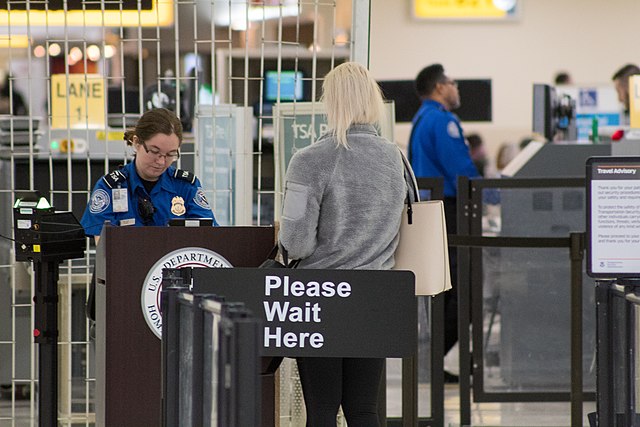
When you present your ID to a Transportation Security Agency official, they place the ID in a specialized machine which, among other things, can detect forgeries.
And if you win money at a Las Vegas casino, they will check your ID also before paying out (as an underage friend of mine learned the hard way).
How can YOU detect a fake ID? Well, you can buy a book such as the “I.D. Checking Guide” or similar reference and compare the presented ID to the examples in the book.
Check the hologram. You can do this without using any special tools, so it’s an easy way to spot a fake ID…unless the fraudster has placed a hologram on their document.
Check for tampering. Sometimes this is obvious to the naked eye, sometimes not so obvious. For example, a fraudster may have clumsily pasted another photo on top of the real photo. But maybe the tampering isn’t so obvious.
Inspect the microprint. You’ll need a magnifying glass for this, but if you know what to look for, you can spot fraudulent IDs…unless the fraudster also added the appropriate microprinting to their document.
Look for ultraviolet (UV) features. You’ll need a UV light for this, but again this can reveal forgeries…unless the fraudster also incorporated UV features into their document.
Use Nametag products. These (and similar products from other companies such as Regula) can check for fraud that the untrained eye cannot detect.
These fraud detection techniques are great if you work for the TSA or a casino full-time and have the appropriate training and equipment to detect fake IDs.
Enter the untrained, unequipped fraud guardians
But what about precinct workers?
They work one or maybe a few days a year, and it’s very doubtful that the elections authorities:
Train and test precinct workers in the detection of fraudulent IDs.
Provide precinct workers with reference materials, magnifiying glasses, ultraviolet lights, or automated hardware and software to detect fraudulent IDs.
If the precinct workers don’t have the training, equipment, and software, Phineas T. Bailey could walk up to a local precinct, show a fake ID saying that he is Joe Real, and if Joe Real is registered to vote in that precinct, Phineas can go ahead and vote.
On at least two occasions, John Wahl presented the ID above when voting.
When poll workers asked Alabama GOP Chairman John Wahl for his voter ID, he gave them a card they’d never seen before. He texted this picture of it to the Limestone County Probate judge, who then approved him to vote.
However, it was subsequently discovered that Wahl made the ID himself.
(Why? Because Wahl and other members of his family object to biometric identification for religious reasons. Rather than submitting to the standard biometric identification processes used to create driver’s licenses and other government forms of identification, Wahl simply had an unnamed third party create his own ID, with the knowledge of the State Auditor.)
If you’re going to insist that people present legitimate IDs for voting, then you need to enforce it, both for people who present IDs in person and for people who present IDs remotely. There are a number of companies that provide hardware and software to verify the legitimacy of driver’s licenses and other government-issued documents.
Of course, that costs money. Depending upon the solution you choose, it could cost tens or hundreds of millions of dollars to protect the more than 230,000 polling places from identity fraud.
For example, when biometric companies want to justify the use of their technology, they have found that it is very effective to position biometrics as a way to combat sex trafficking.
Similarly, moves to rein in social media are positioned as a way to preserve mental health.
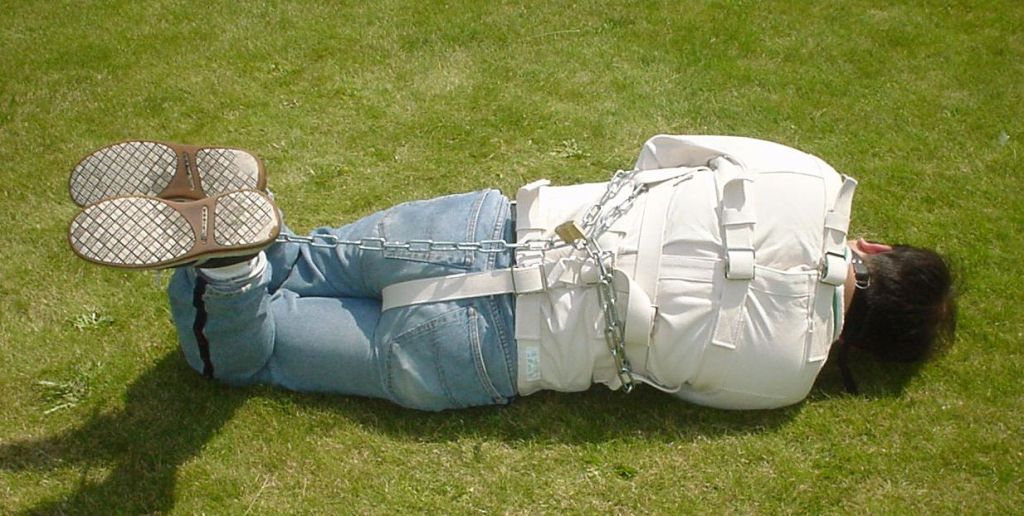
Now that’s a not-so-pretty picture, but it effectively speaks to emotions.
“If poor vulnerable children are exposed to addictive, uncontrolled social media, YOUR child may end up in a straitjacket!”
In New York state, four government officials have declared that the ONLY way to preserve the mental health of underage social media users is via two bills, one of which is the “New York Child Data Protection Act.”
But there is a challenge to enforce ALL of the bill’s provisions…and only one way to solve it. An imperfect way—age estimation.
Because they want to protect the poor vulnerable children.
By Paolo Monti – Available in the BEIC digital library and uploaded in partnership with BEIC Foundation.The image comes from the Fondo Paolo Monti, owned by BEIC and located in the Civico Archivio Fotografico of Milan., CC BY-SA 4.0, https://commons.wikimedia.org/w/index.php?curid=48057924
And because the major U.S. social media companies are headquartered in California. But I digress.
So why do they say that children need protection?
Recent research has shown devastating mental health effects associated with children and young adults’ social media use, including increased rates of depression, anxiety, suicidal ideation, and self-harm. The advent of dangerous, viral ‘challenges’ being promoted through social media has further endangered children and young adults.
Of course one can also argue that social media is harmful to adults, but the New Yorkers aren’t going to go that far.
So they are just going to protect the poor vulnerable children.
CC BY-SA 4.0.
This post isn’t going to deeply analyze one of the two bills the quartet have championed, but I will briefly mention that bill now.
The “Stop Addictive Feeds Exploitation (SAFE) for Kids Act” (S7694/A8148) defines “addictive feeds” as those that are arranged by a social media platform’s algorithm to maximize the platform’s use.
Those of us who are flat-out elderly vaguely recall that this replaced the former “chronological feed” in which the most recent content appeared first, and you had to scroll down to see that really cool post from two days ago. New York wants the chronological feed to be the default for social media users under 18.
The bill also proposes to limit under 18 access to social media without parental consent, especially between midnight and 6:00 am.
And those who love Illinois BIPA will be pleased to know that the bill allows parents (and their lawyers) to sue for damages.
Previous efforts to control underage use of social media have faced legal scrutinity, but since Attorney General James has sworn to uphold the U.S. Constitution, presumably she has thought about all this.
Enough about SAFE for Kids. Let’s look at the other bill.
The New York Child Data Protection Act
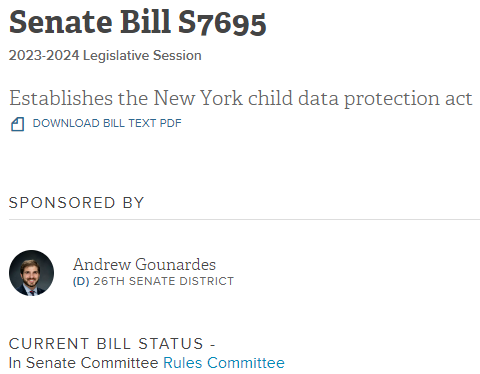
The second bill, and the one that concerns me, is the “New York Child Data Protection Act” (S7695/A8149). Here is how the quartet describes how this bill will protect the poor vulnerable children.
CC BY-SA 4.0.
With few privacy protections in place for minors online, children are vulnerable to having their location and other personal data tracked and shared with third parties. To protect children’s privacy, the New York Child Data Protection Act will prohibit all online sites from collecting, using, sharing, or selling personal data of anyone under the age of 18 for the purposes of advertising, unless they receive informed consent or unless doing so is strictly necessary for the purpose of the website. For users under 13, this informed consent must come from a parent.
And again, this bill provides a BIPA-like mechanism for parents or guardians (and their lawyers) to sue for damages.
But let’s dig into the details. With apologies to the New York State Assembly, I’m going to dig into the Senate version of the bill (S7695). Bear in mind that this bill could be amended after I post this, and some of the portions that I cite could change.
This only applies to natural persons. So the bots are safe, regardless of age.
Speaking of age, the age of 18 isn’t the only age referenced in the bill. Here’s a part of the “privacy protection by default” section:
§ 899-FF. PRIVACY PROTECTION BY DEFAULT.
1. EXCEPT AS PROVIDED FOR IN SUBDIVISION SIX OF THIS SECTION AND SECTION EIGHT HUNDRED NINETY-NINE-JJ OF THIS ARTICLE, AN OPERATOR SHALL NOT PROCESS, OR ALLOW A THIRD PARTY TO PROCESS, THE PERSONAL DATA OF A COVERED USER COLLECTED THROUGH THE USE OF A WEBSITE, ONLINE SERVICE, ONLINE APPLICATION, MOBILE APPLICA- TION, OR CONNECTED DEVICE UNLESS AND TO THE EXTENT:
(A) THE COVERED USER IS TWELVE YEARS OF AGE OR YOUNGER AND PROCESSING IS PERMITTED UNDER 15 U.S.C. § 6502 AND ITS IMPLEMENTING REGULATIONS; OR
(B) THE COVERED USER IS THIRTEEN YEARS OF AGE OR OLDER AND PROCESSING IS STRICTLY NECESSARY FOR AN ACTIVITY SET FORTH IN SUBDIVISION TWO OF THIS SECTION, OR INFORMED CONSENT HAS BEEN OBTAINED AS SET FORTH IN SUBDIVISION THREE OF THIS SECTION.
So a lot of this bill depends upon whether a person is over or under the age of eighteen, or over or under the age of thirteen.
And that’s a problem.
How old are you?
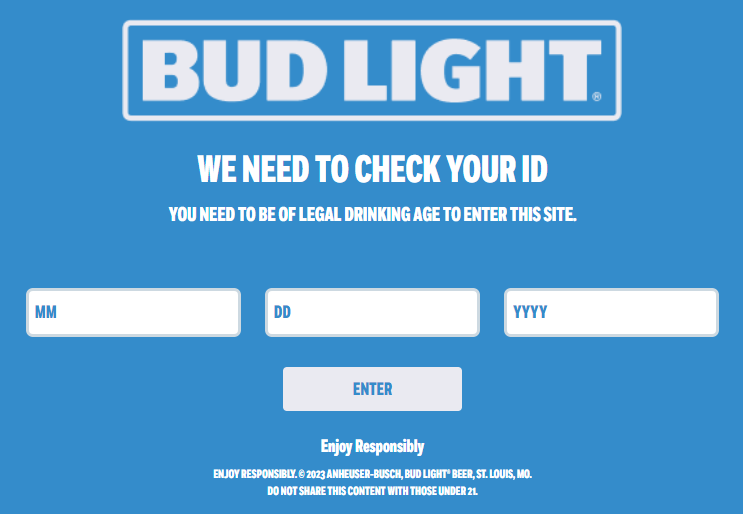
The bill needs to know whether or not a person is 18 years old. And I don’t think the quartet will be satisfied with the way that alcohol websites determine whether someone is 21 years old.
Attorney General James and the others would presumably prefer that the social media companies verify ages with a government-issued ID such as a state driver’s license, a state identification card, or a national passport. This is how most entities verify ages when they have to satisfy legal requirements.
For some people, even some minors, this is not that much of a problem. Anyone who wants to drive in New York State must have a driver’s license, and you have to be at least 16 years old to get a driver’s license. Admittedly some people in the city never bother to get a driver’s license, but at some point these people will probably get a state ID card.
However, there are going to be some 17 year olds who don’t have a driver’s license, government ID or passport.
And some 16 year olds.
And once you look at younger people—15 year olds, 14 year olds, 13 year olds, 12 year olds—the chances of them having a government-issued identification document are much less.
What are these people supposed to do? Provide a birth certificate? And how will the social media companies know if the birth certificate is legitimate?
But there’s another way to determine ages—age estimation.
How old are you, part 2
As long-time readers of the Bredemarket blog know, I have struggled with the issue of age verification, especially for people who do not have driver’s licenses or other government identification. Age estimation in the absence of a government ID is still an inexact science, as even Yoti has stated.
Our technology is accurate for 6 to 12 year olds, with a mean absolute error (MAE) of 1.3 years, and of 1.4 years for 13 to 17 year olds. These are the two age ranges regulators focus upon to ensure that under 13s and 18s do not have access to age restricted goods and services.
So if a minor does not have a government ID, and the social media firm has to use age estimation to determine a minor’s age for purposes of the New York Child Data Protection Act, the following two scenarios are possible:
An 11 year old may be incorrectly allowed to give informed consent for purposes of the Act.
A 14 year old may be incorrectly denied the ability to give informed consent for purposes of the Act.
Is age estimation “good enough for government work”?
I’ll admit that I previously thought that age estimation was worthless, but I’ve since changed my mind about the necessity for it. Which is a good thing, because the U.S. National Institute of Standards and Technology (NIST) is about to add age estimation to its Face Recognition Vendor Test suite.
What is age estimation?
Before continuing, I should note that age estimation is not a way to identify people, but a way to classify people. For once, I’m stepping out of my preferred identity environment and looking at a classification question. Not “gender shades,” but “get off my lawn” (or my tricycle).
Age estimation uses facial features to estimate how old a person is, in the absence of any other information such as a birth certificate. In a Yoti white paper that I’ll discuss in a minute, the Western world has two primary use cases for age estimation:
First, to estimate whether a person is over or under the age of 18 years. In many Western countries, the age of 18 is a significant age that grants many privileges. In my own state of California, you have to be 18 years old to vote, join the military without parental consent, marry (and legally have sex), get a tattoo, play the lottery, enter into binding contracts, sue or be sued, or take on a number of other responsibilities. Therefore, there is a pressing interest to know whether the person at the U.S. Army Recruiting Center, a tattoo parlor, or the lottery window is entitled to use the service.
Second, to estimate whether a person is over or under the age of 13 years. Although age 13 is not as great a milestone as age 18, this is usually the age at which social media companies allow people to open accounts. Thus the social media companies and other companies that cater to teens have a pressing interest to know the teen’s age.
Why was I against age estimation?
Because I felt it was better to know an age, rather than estimate it.
My opinion was obviously influenced by my professional background. When IDEMIA was formed in 2017, I became part of a company that produced government-issued driver’s licenses for the majority of states in the United States. (OK, MorphoTrak was previously contracted to produce driver’s licenses for North Carolina, but…that didn’t last.)
With a driver’s license, you know the age of the person and don’t have to estimate anything.
And estimation is not an exact science. Here’s what Yoti’s March 2023 white paper says about age estimation accuracy:
Our True Positive Rate (TPR) for 13-17 year olds being correctly estimated as under 25 is 99.93% and there is no discernible bias across gender or skin tone. The TPRs for female and male 13-17 year olds are 99.90% and 99.94% respectively. The TPRs for skin tone 1, 2 and 3 are 99.93%, 99.89% and 99.92% respectively. This gives regulators globally a very high level of confidence that children will not be able to access adult content.
Our TPR for 6-11 year olds being correctly estimated as under 13 is 98.35%. The TPRs for female and male 6-11 year olds are 98.00% and 98.71% respectively. The TPRs for skin tone 1, 2 and 3 are 97.88%, 99.24% and 98.18% respectively so there is no material bias in this age group either.
Yoti’s facial age estimation is performed by a ‘neural network’, trained to be able to estimate human age by analysing a person’s face. Our technology is accurate for 6 to 12 year olds, with a mean absolute error (MAE) of 1.3 years, and of 1.4 years for 13 to 17 year olds. These are the two age ranges regulators focus upon to ensure that under 13s and 18s do not have access to age restricted goods and services.
While this is admirable, is it precise enough to comply with government regulations? Mean absolute errors of over a year don’t mean a hill of beans. By the letter of the law, if you are 17 years and 364 days old and you try to vote, you are breaking the law.
Why did I change my mind?
Over the last couple of months I’ve thought about this a bit more and have experienced a Jim Bakker “I was wrong” moment.
How many 13 year olds do you know that have driver’s licenses? Probably none.
How many 13 year olds do you know that have government-issued REAL IDs? Probably very few.
How many 13 year olds do you know that have passports? Maybe a few more (especially after 9/11), but not that many.
Even at age 18, there is no guarantee that a person will have a government-issued REAL ID.
So how are 18 year olds, or 13 year olds, supposed to prove that they are old enough for services? Carry their birth certificate around?
You’ll note that Yoti didn’t target a use case for 21 year olds. This is partially because Yoti is a UK firm and therefore may not focus on the strict U.S. laws regarding alcohol, tobacco, and casino gambling. But it’s also because it’s much, much more likely that a 21 year old will have a government-issued ID, eliminating the need for age estimation.
Sometimes.
In some parts of the world, no one has government IDs
Over the past several years, I’ve analyzed a variety of identity firms. Earlier this year I took a look at Worldcoin. While Worldcoin’s World ID emphasizes privacy so much that it does not conclusively prove a person’s identity (it only proves a person’s uniqueness), and makes no attempt to provide the age of the person with the World ID, Worldcoin does have something to say about government issued IDs.
Online services often request proof of ID (usually a passport or driver’s license) to comply with Know your Customer (KYC) regulations. In theory, this could be used to deduplicate individuals globally, but it fails in practice for several reasons.
KYC services are simply not inclusive on a global scale; more than 50% of the global population does not have an ID that can be verified digitally.
IDs are issued by states and national governments, with no global system for verification or accountability. Many verification services (i.e. KYC providers) rely on data from credit bureaus that is accumulated over time, hence stale, without the means to verify its authenticity with the issuing authority (i.e. governments), as there are often no APIs available. Fake IDs, as well as real data to create them, are easily available on the black market. Additionally, due to their centralized nature, corruption at the level of the issuing and verification organizations cannot be eliminated.
Same source as above.
Now this (in my opinion) doesn’t make the case for Worldcoin, but it certainly casts some doubt on a universal way to document ages.
So we’d better start measuring the accuracy of age estimation.
If only there were an independent organization that could measure age estimation, in the same way that NIST measures the accuracy of fingerprint, face, and iris identification.
You know where this is going.
How will NIST test age estimation?
Yes, NIST is in the process of incorporating an age estimation test in its battery of Face Recognition Vendor Tests.
Facial age verification has recently been mandated in legislation in a number of jurisdictions. These laws are typically intended to protect minors from various harms by verifying that the individual is above a certain age. Less commonly some applications extend benefits to groups below a certain age. Further use-cases seek only to determine actual age. The mechanism for estimating age is usually not specified in legislation. Face analysis using software is one approach, and is attractive when a photograph is available or can be captured.
In 2014, NIST published a NISTIR 7995 on Performance of Automated Age Estimation. The report showed using a database with 6 million images, the most accurate age estimation algorithm have accurately estimated 67% of the age of a person in the images within five years of their actual age, with a mean absolute error (MAE) of 4.3 years. Since then, more research has dedicated to further improve the accuracy in facial age verification.
Note that this was in 2014. As we have seen above, Yoti asserts a dramatically lower error rate in 2023.
NIST is just ramping up the testing right now, but once it moves forward, it will be possible to compare age estimation accuracy of various algorithms, presumably in multiple scenarios.
Well, for those algorithm providers who choose to participate.
Does your firm need to promote its age estimation solution?
Does your company have an age estimation solution that is superior to all others?
Do you need an experienced identity professional to help you spread the word about your solution?










 Bredemarket