If you want to read everything that I (John E. Bredehoft) of Bredemarket have written about product marketing…
…seriously, why?
But if for some odd reason you WANTED to do that…
…you can visit https://bredemarket.com/tag/product-marketing/.

Identity/biometrics/technology marketing and writing services

If you want to read everything that I (John E. Bredehoft) of Bredemarket have written about product marketing…
…seriously, why?
But if for some odd reason you WANTED to do that…
…you can visit https://bredemarket.com/tag/product-marketing/.

Bredemarket helps tech marketers tell your product’s story.
5 employers and 20+ product marketing consulting clients have used my words.
I ask, then I act to showcase your tech product.
Book a free meeting to learn more: https://bredemarket.com/mark/

For years I have maintained that the difficulties in technology are not because of the technology itself.
Technology can do wonderful things.
The difficulties lie with the need for people to agree to use the technology.
And not beg ignorance by saying “I know nothing.”
(Image of actor John Banner as Sgt. Schultz on Hogan’s Heroes is public domain.)
I just saw an article with the title “TPRM weaknesses emerge as relationship owners fail to report red flags.”
Unlike some clickbait-like article titles, this one from Communications Today succinctly encapsulates the problem up front.
It’s not that the TPRM software is failing to find the red flags. Oh, it finds them!
But the folks at Gartner discovered something:
“A Gartner survey of approximately 900 third-party relationship owners…revealed that while 95% saw a third-party red flag in the past 12 months, only around half of them escalate it to compliance teams.”
Among other things, the relationship owners worry about “the perceived return on investment (ROI) of sharing information.”
And that’s not a software issue. It’s a process issue.

No amount of coding or AI can fix that.
And this is not unique to the cybersecurity world. Let’s look at facial recognition.
I’ve said this over and over, but for U.S. criminal purposes, facial recognition results should ONLY be used as investigative leads.
It doesn’t matter whether they’re automated results, or if they have been reviewed by a trained forensic face examiner.
Facial recognition results should only be used as investigative leads.
Sorry for the repetition, but some people aren’t listening.
But it’s not the facial recognition vendors. Bredemarket has worked with numerous facial recognition vendors over the years, and of those who work with law enforcement, ALL of them have emphatically insisted that their software results should only be used as investigative leads.
All of them. Including…that one.
But the vendors have no way to control the actions of customers who feed poor-quality data into their systems, get a result…and immediately run out and get an arrest warrant without collecting corroborating evidence.
And that’s not a software issue. It’s a process issue.
No amount of coding or AI can fix that.
I hope the TPRM folks don’t mind my detour into biometrics, but there’s a good reason for it.
Some product marketers, including myself, believe that it’s not enough to educate prospects and customers about your product. You also need to educate them about proper use of the product, including legal and ethical concerns.
If you don’t, your customers will do dumb things in Europe, Illinois, or elsewhere—and blame you when they are caught.

Be a leader in your industry by doing or saying the right thing.
And now here’s a word from our sponsor.

There’s a reason why this post specifically focused on cybersecurity and facial recognition.
If you need product marketing assistance with your product, Bredemarket has two openings. One for a cybersecurity client, and one for a facial recognition client.
I can offer
If Bredemarket can help your stretched staff, book a free meeting with me: https://bredemarket.com/cpa/


One of the drawbacks of LinkedIn’s collaborative articles is that the answers end up in a difficult-to-access place.
So I’m repurposing my recent answer to an article on ensuring accurate messaging. My original answer is buried within https://www.linkedin.com/advice/3/sales-promoting-misleading-product-claims-how-hpzxf?contributionUrn=urn%3Ali%3Acomment%3A%28articleSegment%3A%28urn%3Ali%3AlinkedInArticle%3A7277750320556855296%2C7277750322389807104%29%2C7291507111144919040%29&dashContributionUrn=urn%3Ali%3Afsd_comment%3A%287291507111144919040%2Curn%3Ali%3AarticleSegment%3A%28urn%3Ali%3AlinkedInArticle%3A7277750320556855296%2C7277750322389807104%29%29&articleSegmentUrn=urn%3Ali%3AarticleSegment%3A%28urn%3Ali%3AlinkedInArticle%3A7277750320556855296%2C7277750322389807104%29 (told you it was difficult to access).

(Wildebeest picture Imagen 3/Google Gemini)
I recently interviewed for a full-time position with an identity/biometrics company.
The hiring manager and I agreed that differentiation is sorely lacking in the industry.
However, the company did NOT agree that I was the person to lead their firm’s product differentiation efforts.
But this, combined with the upcoming completion of a Bredemarket project later this week, provides an opportunity.
Bredemarket can now help others in the identity/biometric industry, including the hiring firm’s direct competitors, with THEIR differentiation—in the same way Bredemarket has differentiated other companies.
So I am going to help SOME company differentiate itself from the me-too “trust us” crowd.
But how?
I won’t tell everything, but I will give away ONE of my secrets.
Which isn’t a secret.
As you probably know, I like to ask questions before starting a content, proposal, or analysis project. And the first of my questions is critical for differentiation.
Why?
No…that’s the question. Why?
The life experiences of founders are very different. After all, the reason Bill Gates got into the computer business is different than the reason Steve Jobs entered the business.
The world would be very different.
I’ve written about the why question. Here’s an excerpt:
“Before I can write a case study about how your Magnificent Gizmo cures bad breath, I need to understand WHY you’re in the good breath business in the first place. Did you have an unpleasant childhood experience? Were you abandoned at the altar? WHY did you care enough to create the Magnificent Gizmo in the first place?
“Once I (and you) agree on the why, everything else will flow from that, and your own end users will benefit in the process.”
Give me that origin story and I can differentiate you and your product. Whether it’s your breath gizmo or your identity verification solution, we now have a story that your foolish inferior competitors do not have.
THEY are just mere moneymakers.
YOU are the enlightened giving individual solving a problem that has bugged you for years, making the world a better place.
So tell your story…and differentiate yourself!

The next paragraph is inaccurate.
Go-to-market initiatives have ONLY two audiences: the external prospects who are the hungry people (hopefully) wanting the product, and the internal staff in the company who deliver the product.
You know who I forgot? The partners.
Such as the very important partner for MorphoTrak’s Morpho Cloud back in 2015:
“Morpho worked with Microsoft Corporation to develop a cloud service for Morpho’s flagship Biometric Identification Solution (MorphoBIS). Morpho Cloud is hosted on Microsoft Azure Government, the cloud platform with a contractual commitment to support several U.S. government standards for data security, including the FBI’s CJIS Security Policy. Backed by the Microsoft Azure Government platform, Morpho Cloud complies with the stringent security standards for storage, transmission, monitoring, and recovery of digital information.”

Then there was the time I was performing U.S. go-to-market activities for a global identity/biometric offering.
The product marketing launch went great…
…until the home office received a communication from a competitor.
A competitor with a previously existing product with a name VERY similar to that of our subsequently launched solution.
Oops.
We definitely made a mistake by not thoroughly checking the name.
Of course, with the way that some companies want to imitate the things their competitors do, I’m sure some firms perform this intentionally, rather than accidentally.
(McDowell’s 2017 West Hollywood pop-up image from Buzzfeed, https://www.buzzfeed.com/morganshanahan/we-went-to-a-real-life-mcdowells-from-coming-to-america-and)

In my post “Seven Essential Product Marketing Strategy and Process Documents, the August 30, 2024 Iteration,” I alluded to the fact that not all go-to-market efforts are the same.
You can’t just slap a few things together in three days and say your go-to-market is complete. You need a plan on how you will go to market, including the different tiers of go-to-market efforts (you won’t spend four months planning materials for your 5.0.11 software release)…
Unless you’re in very unusual circumstances, your go-to-market efforts will encompass variable efforts.
In its simplest form, you will have two tiers. For example, Holly Watson of Amazon Web Services distinguishes between “launches” and “releases.”
Release to me relates to the update of an existing product vs. a net-new addition to a solution offering. It’s common to have multiple releases a quarter vs. large launches 1-2x per year.
You can get fancier.

My former product marketing team devised a three-tier system, in which the top tier encompassed a full-blown effort and the bottom tier just had some release notes, a bit of internal education, and maybe a blog post.
But as I said on August 30, you need to define the tiers beforehand. Don’t just shoot from the lip and say you want a blog post, a press release, and a brochure…oh, and maybe a cool infographic! Yeah!

Establish your tiers.
Establish the content for each tier.
Execute.
And repeat.
Remember my August 30 post about seven essential product marketing strategy and process documents?
Well, I posted a follow-up on LinkedIn (as part of my “The Wildebeest Speaks” series) about one of those seven documents.
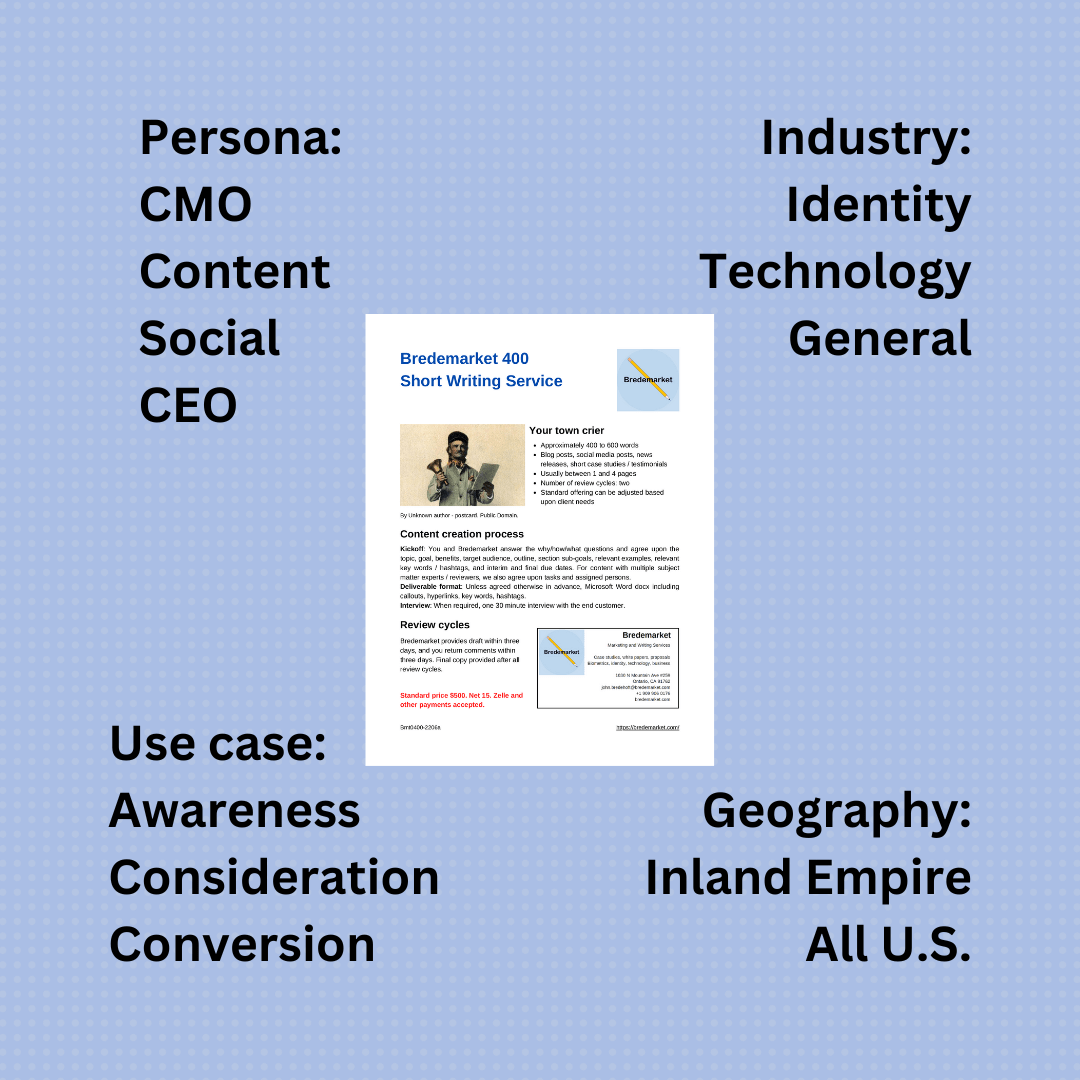
If you’re not already following Bredemarket on LinkedIn (why not?), be sure to read “A Deeper Dive Into Positioning,” and the complexities that occur when you have to position and message for multiple products, personas, industries, use cases, and geographies.
Even for a single product such as the Bredemarket 400 Short Writing Service, the matrix can get pretty hairy.


Due to the nature of my business, Bredemarket doesn’t usually get involved in strategy. The clients set the strategy, and I fill the tactical holes to execute that strategy.

But I recently welcomed the opportunity to envision a strategy to achieve a strategy, and in the process defined seven essential strategy documents to kick off a product marketing or general marketing program.
Depending upon how you define product marketing, one of these seven goes above and beyond the product marketing function. I included it anyway, because if you ask 20 people what “product marketing” is, you will get 21 answers.
There’s a reason I dated this. I may want to refine it in the future. For example, some of you may recall how my “six questions your content creator should ask you” eventually became seven questions.
As I said, I recently had the opportunity to envision these strategies for a prospect, and have scheduled a meeting with the prospect to discuss these. (Note to “prospect”: these are iterative, and I fully expect that up to 90% of this may change by the time of implementation. But I think it’s a good starting point for discussion.)
The prospect may secure my services, or they may not.
And if they don’t, I can develop these same documents for others.
Do YOU need help defining strategies for your business? If so, let’s talk.
If your company needs a full-time product marketer, contact me on LinkedIn.
If your company needs a part-time product marketing consultant, contact me on Bredemarket. (Subject to availability.)

 Bredemarket