BigBear.ai’s Digital Identity Products

One of my more popular posts during the past year (October 2023 to September 2024) was one that I wrote way back in 2021, “Pangiam, CLEAR, and others make a “sporting” effort to deny (or allow) stadium access.”

A lot has happened since then. (The aquisition of Pangiam by BigBear.ai closed in March of this year.)

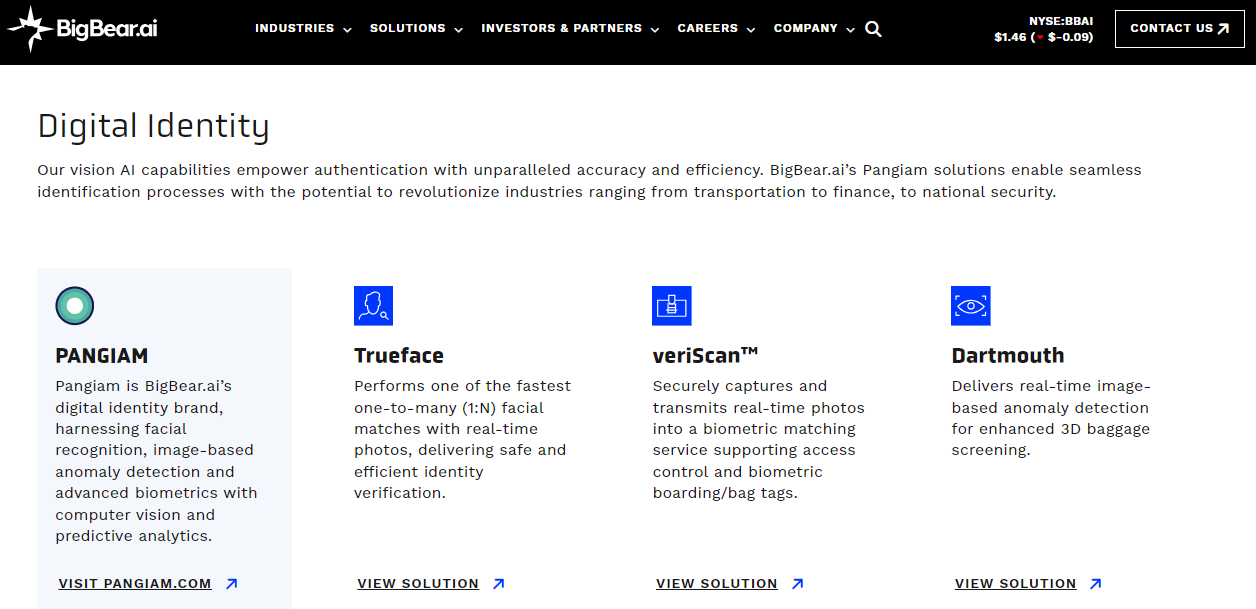
Here is how BigBear.ai describes its digital identity offerings in 2024:

  • Pangiam is BigBear.ai’s digital identity brand, harnessing facial recognition, image-based anomaly detection and advanced biometrics with computer vision and predictive analytics.
  • Trueface Performs one of the fastest one-to-many (1:N) facial matches with real-time photos, delivering safe and efficient identity verification.
  • veriScan™ Securely captures and transmits real-time photos into a biometric matching service supporting access control and biometric boarding/bag tags.
  • Dartmouth Delivers real-time image-based anomaly detection for enhanced 3D baggage screening.

All these products, including Dartmouth, were developed before the BigBear.ai acquisition. (Where is Pangiam Bridge?)

We’ll have to wait and see what happens next.

Pangiam May Be Acquired Next Year

Things change. Pangiam, a company that didn’t even exist a few years ago, and that started off by acquiring a one-off project from a local government agency, is now itself a friendly acquisition target (pending stockholder and regulatory approvals).

From MWAA to Pangiam

Back when I worked for IDEMIA and helped to market its border control solutions, one of our competitors for airport business was an airport itself—specifically, the Metropolitan Washington Airports Authority. Rather than buying a biometric exit solution from someone else, the MWAA developed its own, called veriScan.

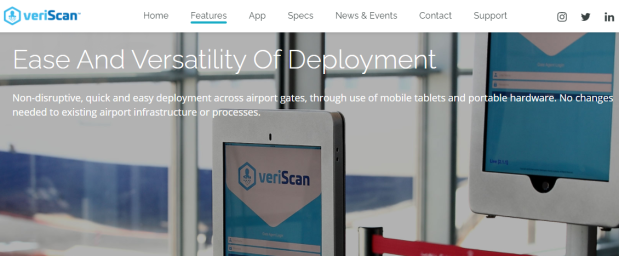
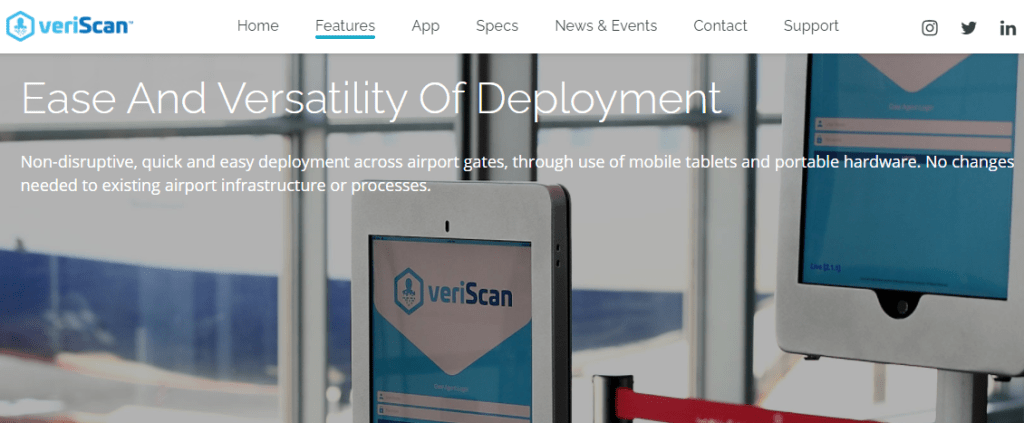
2021 image from the former airportveriscan website.

After I left IDEMIA, the MWAA decided that it didn’t want to be in the software business any more, and sold veriScan to a new company, Pangiam. I posted about this decision and the new company in this blog.

ALEXANDRIA, Va., March 19, 2021 /PRNewswire/ — Pangiam, a technology-based security and travel services provider, announced today that it has acquired veriScan, an integrated biometric facial recognition system for airports and airlines, from the Metropolitan Washington Airports Authority (“Airports Authority”). Terms of the transaction were not disclosed.

From PR Newswire.

But Pangiam was just getting started.

Trueface, FRTE, stadiums, and artificial intelligence

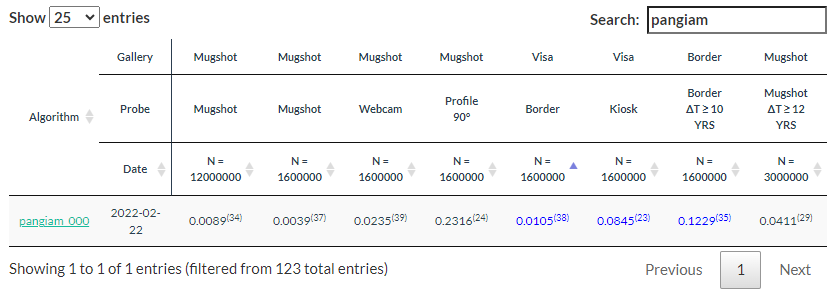
Results for the NIST FRTE 1:N pangiam-000 algorithm, captured November 6, 2023 from NIST.

A few months later Pangiam acquired Trueface and therefore earned a spot on the NIST FRTE 1:N (formerly FRVT 1:N) rankings and an interest in the stadium/venue identity verification/authentication market.

By Chris6d – Own work, CC BY-SA 4.0, https://commons.wikimedia.org/w/index.php?curid=101751795

Meanwhile Pangiam continued to build up its airport business and also improved its core facial recognition technology.

After that I personally concentrated on other markets, and therefore missed the announcements of Pangiam Bridge (introducing artificial intelligence into Pangiam’s border crossing offering) and Project DARTMOUTH (devoted to using artificial intelligence and pattern analysis to airline baggage, cargo, and shipments).

So what will Pangiam work on next? Where will it expand? What will it acquire?

Nothing.

Enter BigBear.ai

Pangiam itself is now an acquisition target.

COLUMBIA, MD.— November 6, 2023 — BigBear.ai (NYSE: BBAI), a leading provider of AI-enabled business intelligence solutions, today announced a definitive merger agreement to acquire Pangiam Intermediate Holdings, LLC (Pangiam), a leader in Vision AI for the global trade, travel, and digital identity industries, for approximately $70 million in an all-stock transaction. The combined company will create one of the industry’s most comprehensive Vision AI portfolios, combining Pangiam’s facial recognition and advanced biometrics with BigBear.ai’s computer vision capabilities, positioning the company as a foundational leader in one of the fastest growing categories for the application of AI. The proposed acquisition is expected to close in the first quarter of 2024, subject to customary closing conditions, including approval by the holders of a majority of BigBear.ai’s outstanding common shares and receipt of regulatory approval.

From bigbear.ai.

Yet another example of how biometrics is now just a minor part of general artificial intelligence efforts. Identify a face or a grenade, it’s all the same.

Anyway, let’s check back in a few months. Because of the technology involved, this proposed acquisition will DEFINITELY merit government review.

Customs Becoming Artificial, Thanks to Pangiam

I missed this story when it came out in May.

MCLEAN, Va., May 2, 2023 /PRNewswire/ — The West Virginia University Research Corporation (WVURC) and Pangiam, a leading trade a travel technology company, announced a new partnership to conduct research and develop new, cutting-edge artificial intelligence, machine learning and computer vision technologies for commercial and government applications.

Pangiam and WVURC will work together to launch Pangiam Bridge, a cutting-edge artificial intelligence driven solution for customs authorities worldwide. Pangiam Bridge will allow customs officials to automate portions of the customs inspection process for baggage and cargo. Jim McLaughlin, Pangiam Chief Technology Officer, said, “we are excited to grow Pangiam’s artificial intelligence work in partnership with West Virginia University and continued development of Pangiam Bridge for customs authorities.”

From https://www.prnewswire.com/news-releases/pangiam-and-west-virginia-university-research-corporation-partner-to-develop-artificial-intelligence-and-computer-vision-technology-301813334.html

Pangiam Bridge is obviously not ready for prime time yet; it’s not even mentioned on Pangiam’s Products and Services page, nor is it mentioned anywhere else on Pangiam’s website. The only mention of Pangiam Bridge is in this press release, which isn’t surprising considering that this is a research effort. But if the research holds out, then many of the manual processes used by customs agents may be significantly reduced or eliminated entirely.

U.S. CBP Office of Field Operations agent checking the authenticity of a travel document at an international airport using a stereo microscope. By James R. Tourtellotte, CBP, U.S. Dept. of Homeland Security – Original link: http://www.cbp.gov/xp/cgov/newsroom/photo_gallery/afc/inspectors_airports/air_05.xml (file Air_5fphoto_5f05.jpg) Now available at: link, Public Domain, https://commons.wikimedia.org/w/index.php?curid=2867071

And this isn’t Pangiam’s only artificial intelligence research effort.

Project DARTMOUTH is the collaboration between Pangiam and Google Cloud, named after the 1956 Dartmouth Summer Research Project on Artificial Intelligence. Project DARTMOUTH utilizes AI and pattern analysis technologies to digest and analyze vast amounts of data in real-time and identify potential prohibited items in carry-on baggage, checked baggage, airline cargo and shipments.

From https://pangiam.com/projectdartmouth/

(Bredemarket email, meeting, contact, subscribe)

Pangiam/Trueface: when version 1.0 of the SDK is the REVISED version

After a lack of appearances in the Bredemarket blog (none since November), Pangiam is making an appearance again, based on announcements by Biometric Update and Trueface itself about a new revision of the Trueface facial recognition SDK.

The new revision includes a number of features, including a new model for masked faces and some technical improvements.

So what is this revision called?

Version 1.0.

“Wait,” you’re asking yourself. “Version 1.0 is the NEW version? It sounds like the ORIGINAL version. Shouldn’t the new version be 2.0?”

Well, no. The original version was V0. Trueface is now ready to release V1.

Well, almost ready.

If you go to the Trueface SDK reference page, you’ll see that Trueface releases are categorized as “alpha,” “beta,” and “stable.”

  • When I viewed the page on the afternoon of March 28, the latest stable release was 0.33.14634.
  • If you want to use the version 1.0 that is being “introduced” (Pangiam’s word), you have to go to the latest beta release, which was 1.0.16286.
  • And if you want to go bleeding edge alpha, you can get release 1.1.16419.

(Again, this was on the afternoon of March 28, and may change by the time you read this.)

Now most biometric vendors don’t expose this much detail about their software. Some don’t even provide any release information, especially for products with long delivery times where the version that a customer will eventually get doesn’t even have locked-down requirements yet. But Pangiam has chosen to provide this level of detail.

Oh, and Pangiam/Trueface also actively participates in the ongoing NIST FRVT testing. Information on the 1:1 performance of the trueface-003 algorithm can be found here. Information on the 1:N performance of the trueface-000 algorithm can be found here.

Pangiam is flying high on its acquisitions

Pangiam, the company that acquired both the Metropolitan Washington Airports Authority product veriScan and the Trueface company and product, is continuing to establish itself in the airport market (while pursuing other markets).

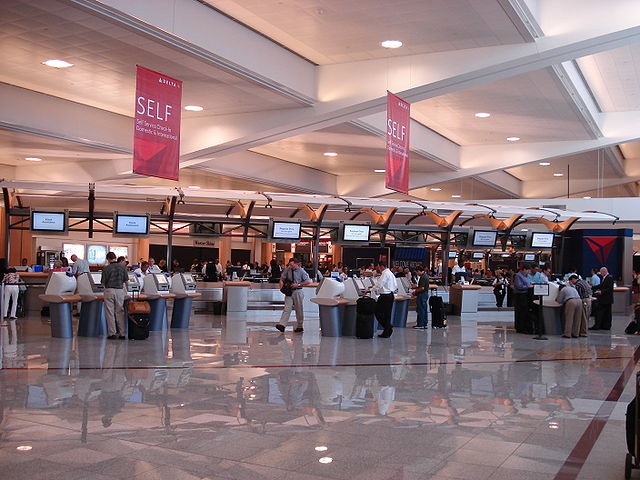
By Atlantacitizen – w:Image:Album 13 006.jpg, Public Domain, https://commons.wikimedia.org/w/index.php?curid=2608406

Forbes recently published this article:

Delta Airlines, the Transportation Security Administration (TSA), and a travel tech company called Pangiam have partnered up to bring facial recognition technology to the Hartsfield–Jackson Atlanta International Airport (ATL). 

As of next month, Delta SkyMiles members who use the Fly Delta app and have a TSA PreCheck membership will be able to simply look at a camera to present their “digital ID” and navigate the airport with greater ease. In this program, a customer’s identity is made up of a SkyMiles member number, passport number and Known Traveler Number.

Of course, TSA PreCheck enrollment is provided by three other companies…but I digress. (I’ll digress again in a minute.)

Forbes goes on to say that this navigation will be available at pre-airport check in (on the Fly Delta app), bag drop (via TSA PreCheck), security (again via TSA PreCheck), and the gate.

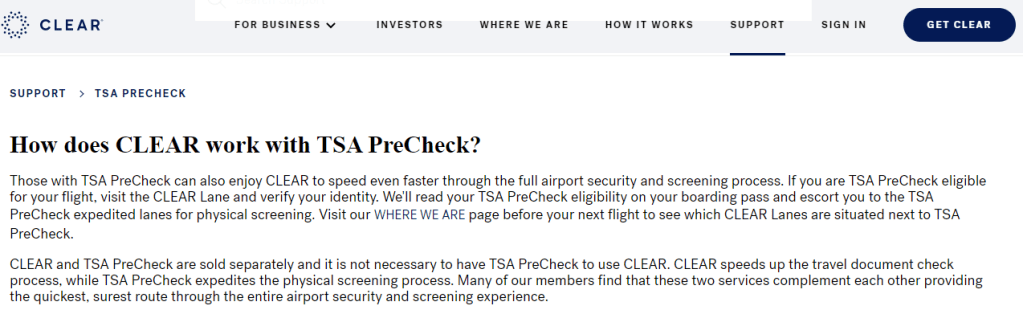
Incidentally, this illustrates how security systems from different providers build upon each other. Since I was an IDEMIA employee at the time that IDEMIA was the only company that performed TSA PreCheck enrollment, I was well aware (in my super-secret competitive intelligence role) how CLEAR touted the complementary features of TSA PreCheck in its own marketing.

Now I have no visibility into Pangiam’s internal discussions, but the company obviously has a long-term growth plan that it is executing.

So what will its next step be?

Monitoring the #connectid hashtag

I have a long history with hashtags.

A LONG history.

Fires and parades

How long?

Back on October 23, 2007, I used my then-active Twitter account to tweet about the #sandiegofire. The San Diego fire was arguably the first mass adoption of hashtags, building upon pioneering work by Stowe Boyd and Chris Messina and acted upon by Nate Ritter and others.

From https://twitter.com/oemperor/status/358071562. Frozen peas? Long story.

The tinyurl link directed followers to my post detailing how the aforementioned San Diego Fire was displacing sports teams, including the San Diego Chargers. (Yes, kids, the Chargers used to play in San Diego.)

So while I was there at the beginning of hashtags, I’m proudest of the post that I wrote a couple of months later, entitled “Hashtagging Challenges When Events Occur at Different Times in Different Locations.” It describes the challenges of talking about the Rose Parade when someone is viewing the beginning of the parade while someone else is viewing the end of the parade at the same time. (This post was cited on PBWorks long ago, referenced deep in a Stowe Boyd post, and cited elsewhere.)

Hashtag use in business

Of course, hashtags have changed a lot since 2007-2008. After some resistance, Twitter formally supported the use of hashtags, and Facebook and other services followed, leading to mass adoption beyond the Factory Joes of the world.

Ignoring personal applications for the moment, hashtags have proven helpful for business purposes, especially when a particular event is taking place. No, not a fire in a major American city, but a conference of some sort. Conferences of all types have rushed to adopt hashtags so that conference attendees will promote their conference attendance. The general rule is that the more techie the conference, the more likely the attendees will use the conference-promoted hashtag.

I held various social media responsibilities during my years at MorphoTrak and IDEMIA, some of which were directly connected to the company’s annual user conference, and some of which were connected to the company’s attendance at other events. Obviously we pulled out the stops for our own conferences, including adopting hashtags that coincided with the conference theme.

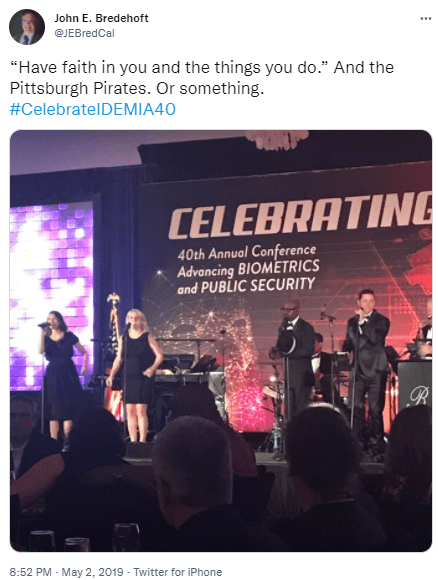
A tweet https://twitter.com/JEBredCal/status/1124159756157849600 from the last (obviously celebratory) night of IDEMIA’s (Printrak’s) 40th conference in 2019. Coincidentally, this conference was held in San Diego.

And then when the conference organizers adopt a hashtag, they fervently hope that people will actually USE the adopted hashtag. As I said before, this isn’t an issue for the technical conferences, but it can be an issue at the semi-technical conferences. (“Hey, everybody! Gather around the screen! Someone used the conference hashtag…oh wait a minute, that’s my burner account.”)

A pleasant surprise with exhibitor/speaker adoption of the #connectID hashtag

Well, I think that we’ve finally crossed a threshold in the biometric world, and hashtags are becoming more and more acceptable.

As I previously mentioned, I’m not attending next week’s connect:ID conference in Washington DC, but I’m obviously interested in the proceedings.

So I turned to Twitter to check if anyone was using a #connectID hashtag in advance of the event. (Helpful hint: hashtags cannot include special characters such as “:” so don’t try to tweet #connect:ID; it won’t work and will appear as #connect.) Using the date-sorted search https://twitter.com/search?q=%23connectid&src=typed_query&f=live, I was expecting to see a couple of companies using the hashtag…if I was lucky.

I was pleasantly surprised to see that nearly two dozen exhibitors and speakers were using the #connectID hashtag (or referenced via the hashtag) as of the Friday before the event, including Acuity Market Intelligence, Aware, BIO-key, Blink Identity, Clearview AI, HID Global, IDEMIA, Integrated Biometrics, iProov, Iris ID, Kantara, NEC and NEC NSS, Pangiam, Paravision, The Paypers, WCC, WorldReach Software/Entrust, and probably some others by the time you read this, as well as some others that I may have missed.

And the event hasn’t even started yet.

At least some of the companies will have the presence of mind to tweet DURING the event on Tuesday and Wednesday.

Will yours be one of them?

But company adoption is only half the battle

While encouraging to me, adoption of a hashtag by a conference’s organizers, exhibitors, and speakers is only the beginning.

The true test will take place when (if) the ATTENDEES at the conference also choose to adopt the conference hashtag.

According to Terrapin (handling the logistics of conference organization), more than 2,500 people are registered for the conference. While the majority of these people are attending the free exhibition, over 750 of them are designated as “conference delegates” who will attend the speaking sessions.

How many of these people will tweet or post about #connectID?

We’ll all find out on Tuesday.

Pangiam, CLEAR, and others make a “sporting” effort to deny (or allow) stadium access

Back when I initially entered the automated fingerprint identification systems industry in the last millennium, I primarily dealt with two markets: the law enforcement market that seeks to solve crimes and identify criminals, and the welfare benefits market that seeks to make sure that the right people receive benefits (and the wrong people don’t).

Other markets simply didn’t exist. If I pulled out my 1994-era mobile telephone and looked at it, nothing would happen. Today, I need to look at my 2020-era mobile telephone to obtain access to its features.

And there are other biometric markets also.

Pangiam and stadium bans

Back in 1994 I couldn’t envision a biometrics story in Sports Illustrated magazine. But SI just ran a story on how facial recognition can be used to keep fans out of stadiums who shouldn’t be there.

Some fans (“fanatics”) perform acts in stadiums that cause the sports teams and/or stadium authorities to officially ban them from the stadium, sometimes for life.

John Green is the man in the blue shirt and white baseball cap to Artest’s left. By Copyright 2004 National Basketball Association. – Television broadcast of the Pacers-Pistons brawl on ESPN., Fair use, https://en.wikipedia.org/w/index.php?curid=6824157

But in the past, these measures were ineffective.

For a long time, those “measures” were limited at best. Fans do not have to show ID upon entering arenas. Teams could run checks on all the credit cards to purchase tickets to see whether any belonged to banned fans, but those fans could easily have a friend buy the tickets. 

But there are other ways to enforce stadium bans, and Sports Illustrated quoted an expert on the matter.

“They’ve kicked the fan out; they’ve taken a picture—that fan they know,” says Shaun Moore, CEO of a facial-recognition company called Trueface. “The old way of doing things was, you give that picture to the security staff and say, ‘Don’t let this person back in.’ It’s not really realistic. So the new way of doing it is, if we do have entry-level cameras, we can run that person against everyone that’s coming in. And if there’s a hit, you know then; then there’s a notification to engage with that person.”

This, incidentally, is an example of a “deny list,” or the use of a security system to deny a person access. We’ll get to that later.

But did you notice the company that was mentioned in the last quote? I’ve mentioned that company before, because Trueface was the most recent acquisition by the company Pangiam, a company that has also acquired airport security technology.

But Pangiam/Trueface isn’t the only company serving stadium (and entertainment) venues.

CLEAR and stadium entry

Most of the time, sports stadiums aren’t concentrating on the practice of DENYING people entry to a stadium. They make a lot more money by ALLOWING people entry to a stadium…and allowing them to enter as quickly as possible so they can spend money on concessions.

One such company that supports this is CLEAR, which was recently in the news because of its Initial Public Offering. Coincidentally, CLEAR also provides airport security technology, but it has branched out from that core market and is also active in other areas.

For example, let’s say you’re a die-hard New York Mets fan, and you head to Citi Field to watch a game.

By Chris6d – Own work, CC BY-SA 4.0, https://commons.wikimedia.org/w/index.php?curid=101751795

The Mets don’t just let anyone into the stadium; you have to purchase a ticket. So you need to take your ticket out of your pocket and show it to the gate staff, or you need to take your smartphone out of your pocket and show your digital ticket to the gate staff.

What if you could get into the stadium without taking ANYTHING out of your pocket? Well, you can.

In the CLEAR Lane, your fingerprint is all you need to use tickets in your MLB Ballpark app – no need to pull out your phone or printed ticket as you enter the game.

Now that is really easy.

Pangiam and CLEAR aren’t the only companies in this space, as I well know. But there’s the possibility that biometrics will be used more often for access to sports games, concerts, and similar events.

Pangiam acquires something else (in this case TrueFace)

People have been coming here to find this news (thanks Google Search Console) so I figured I’d better share it here.

Remember Pangiam, the company that I talked about back in March when it acquired the veriScan product from the Metropolitan Washington Airports Authority? Well, last week Pangiam acquired another company.

TYSONS CORNER, Va., June 2, 2021 /PRNewswire/ — Pangiam, a technology-based security and travel services provider, announced today that it has acquired Trueface, a U.S.-based leader in computer vision focused on facial recognition, weapon detection and age verification technologies. Terms of the transaction were not disclosed….

Trueface, founded in 2013 by Shaun Moore and Nezare Chafni, provides industry leading computer vision solutions to customers in a wide range of industries. The company’s facial recognition technology recently achieved a top three ranking among western vendors in the National Institute of Standards and Technology (NIST) 1:N Face Recognition Vendor Test. 

(Just an aside here: companies can use NIST tests to extract all sorts of superlatives that can be applied to their products, once a bunch of qualifications are applied. Pay attention to the use of the phrase “among western vendors.” While there may be legitimate reasons to exclude non-western vendors from comparisons, make a mental note when such an exclusion is made.)

But what does this mean in terms of Pangiam’s existing product? The press release covers this also.

Trueface will add an additional capability to Pangiam’s existing technologies, creating a comprehensive and seamless solution to satisfy the needs of both federal and commercial enterprises.

And because Pangiam is not a publicly-traded company, it is not obliged to add a disclaimer to investors saying this integration might not happen bla bla bla. Publicly traded companies are obligated to do this so that investors are aware of the risks when a company speculates about its future plans. Pangiam is not publicly traded, and the owners are (presumably) well aware of the risks.

For example, a US government agency may prefer to do business with an eastern vendor. In fact, the US government does a lot of business with one eastern vendor (not Chinese or Russian).

But we’ll see what happens with any future veriTruefaceScan product.

Pangiam, a new/old player in biometric boarding

Make vs. buy.

Businesses are often faced with the question of whether to buy a product or service from a third party, or make the product or service itself.

And airports are no exception to this.

The Metropolitan Washington Airports Authority (MWAA), the entity that manages two of the airports in the Washington, DC area, needed a biometric boarding (biometric exit) solution. Such solutions allow passengers to skip the entire “pull out the paper ticket” process, or even the “pull out the smartphone airline app” process, and simply stand and let a camera capture a picture of the passenger’s face. While there are several companies that sell such solutions, MWAA decided to create its own solution, veriScan.

https://www.airportveriscan.com/

And once MWAA had implemented veriScan at its own airports, it started marketing the solution to other airports, and competing against other providers who were trying to sell their own solutions to airports.

Well, MWAA got out of the border product/service business last week when it participated in this announcement:

ALEXANDRIA, Va., March 19, 2021 /PRNewswire/ — Pangiam, a technology-based security and travel services provider, announced today that it has acquired veriScan, an integrated biometric facial recognition system for airports and airlines, from the Metropolitan Washington Airports Authority (“Airports Authority”). Terms of the transaction were not disclosed.

Pangiam is clearly the new kid on the block, since the company didn’t even exist in its current form a year ago. Late last year, AE Industrial Partners acquired and merged the decade-old Linkware and the newly-formed Pangian (PRE LLC) “to form a highly integrated travel solutions technology platform providing a more seamless and secure travel experience.”

But in a sense, Pangiam ISN’T new to the travel industry, once you read the biographies of many of the principals at the company.

  • “Most recently (Kevin McAleenan) served as Acting Secretary of the U.S. Department of Homeland Security (DHS)….”
  • “Prior to Pangiam, Patrick (Flanagan) held roles at U.S. Customs & Border Protection (CBP), the U.S. Navy, the National Security Staff, the Transportation Security Administration (TSA), and the Department of Homeland Security (DHS).”
  • “Dan (Tanciar) previously served as the Executive Director of Planning, Program Analysis, and Evaluation in the Office of Field Operations (OFO) at U.S. Customs and Border Protection (CBP).”
  • “Prior to Pangiam, Andrew (Meehan) served as the principal adviser to the Acting Secretary for external affairs at the Department of Homeland Security (DHS).”
  • “(Tom Plofchan) served as a National Security Advisor to the Department of Energy’s Pacific Northwest National Laboratory before entering government to serve as the Counterterrorism Advisor to the Commissioner, U.S. Customs and Border Protection, and as Counterterrorism Counselor to the Secretary, U.S. Department of Homeland Security.”

So if you thought that veriScan was well-connected because it was offered by an airport authority, consider how well-connected it appears now because it is offered by a company filled with ex-DHS people.

Which in and of itself doesn’t necessarily indicate that the products work, but it does indicate some level of domain knowledge.

But will airports choose to buy the Pangiam veriScan solution…or make their own?