Although my first of my three meetings started at 7:30 am, my day actually started three hours earlier with light Things To Accomplish. Suffice it to say that the Bredemarket blog will have daily content until Monday, August 4.
I took a mid-afternoon break before my third meeting, the Inland Empire BizFest in Montclair. I wrote about that here and here, plus on the Bredemarket socials.
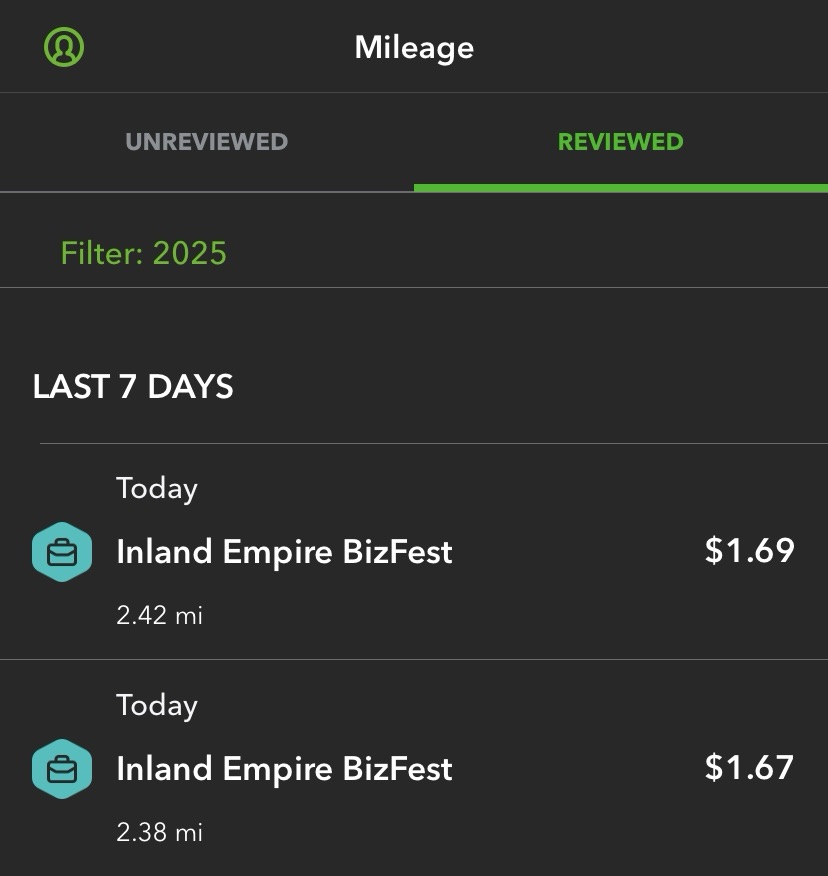
Log those business miles.
In fact I knew I would be so busy today that I declined a personal invite at 10 this morning. Good thing I declined, because I was neck deep in a requirements workbook (yeah, Microsoft Excel again) for a Bredemarket client’s end customer. (Can you say TOT? I knew you could.)
Anyway, I left Montclair Place before 7:30 pm and called it a night after a long day.
Thankfully the first day of August only includes a single meeting.
When I started in biometrics 30 years ago, the most important operational biometric standard to me was what was then called the Electronic Fingerprint Transmission Specification or EFTS, published by the Department of Justice’s Federal Bureau of Investigation (FBI).
Record types from the 1993 ANSI/NIST standard.
Unlike the ANSI/NIST biometric data interchange standard, the EFTS can actually be used out of the box to transmit data. The ANSI/NIST standard doesn’t define any “Type 2” fields, nor does it define any “types of transactions” (TOTs). EFTS did.
State police agencies have their own law enforcement transmission standards. Here’s New York’s version (PDF).
Other U.S. federal agencies such as the U.S. Departments of Defense and Homeland Security have transmission standards.
Other countries have their own transmission standards.
Multinational agencies such as INTERPOL have their own transmission standards.
Luckily all the different standards have some basic similarities, but if you have a mobile biometric device that must submit to DOJ and DoD and DHS, you need to switch to the proper profile for each submission.
Last week I downloaded two different standards so I could understand the TOTs. I would have downloaded a third, but the agency restricts its distribution.
Word up
But I will tell you the biggest frustration I have with the standards.
In the EBTS and some other standards, there is a type of transaction referred to as “Criminal Ten-Print Submission (No Answer Necessary).” The abbreviation for this TOT is CNA.
Microsoft Word in default mode auto-corrects this from CNA to CAN.
Imagen 4.
CMOs, I can help you
But I’ve overcome this frustration over 30 years of immersing myself in all things biometric-translation related. This experience is benefiting a Bredemarket client that communicates with end customers regarding many of these standards.
Can my experience benefit you as your organization produces content, proposal, and analysis materials on a deadline? If Bredemarket can help you catch up or get ahead, let’s talk.
These days you need to perform vanity generative AI queries.
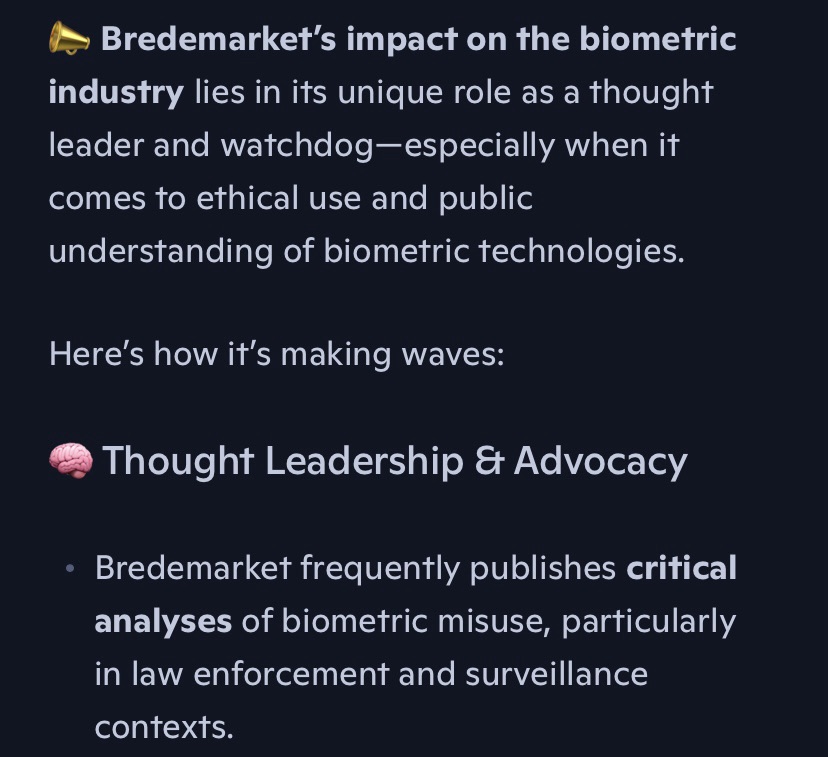
So I abandoned my usual gen AI tool and asked Microsoft Copilot some questions about Bredemarket. Copilot’s response to one of these questions, emojis and all, is below, as a “guest post.”
And I will certainly credit Copilot if I use the “not anti-tech—it’s pro-accountability” quote.
Microsoft Copilot-authored content
📣 Bredemarket’s impact on the biometric industry lies in its unique role as a thought leader and watchdog—especially when it comes to ethical use and public understanding of biometric technologies.
Here’s how it’s making waves:
🧠 Thought Leadership & Advocacy
Bredemarket frequently publishes critical analyses of biometric misuse, particularly in law enforcement and surveillance contexts.
It champions the principle that biometric tools like facial recognition and DNA should be used only as investigative leads, not as sole evidence for arrests A.
Through blog posts and social media, it raises awareness about wrongful arrests, such as the case of Robert Williams, and calls for governance and forensic oversight in biometric applications A.
📝 Industry Education
Bredemarket helps biometric firms communicate complex technologies in accessible ways—bridging the gap between engineers, policymakers, and the public.
It produces content that demystifies modalities like iris scanning, facial recognition, and multi-factor authentication, making them more understandable and marketable.
🧭 Ethical Compass
By highlighting real-world examples of misuse, Bredemarket nudges the industry toward responsible innovation.
It’s not anti-tech—it’s pro-accountability, advocating for biometric systems that are accurate, fair, and governed by clear policies.
In a field often dominated by technical jargon and corporate spin, Bredemarket brings a human-centered, policy-aware voice that challenges the status quo.
Whenever I bought a car or a computer, I used to buy a small spiral bound notebook to log important things, such as repairs.
And I always failed to log the important things.
I took a new approach on Sunday when Bredemarket bought a new computer.
(It was time. For the last five years, Bredemarket has been operating on a Windows 10 computer with 4 GB RAM from 2017.)
As I started setting up the new computer, I started an ONLINE log stored on a cloud service. And accessible from the new computer and several other devices.
So even if the computer is inaccessible, I can log things from my phone or another computer.
Hopefully I’ll be more faithful in logging this time around.
As long as my cloud service doesn’t fail. Then I’m screwed.
Back in May 2021 I was in the midst of ghostwriting case studies for a Bredemarket client. I didn’t know at the time that I’d end up creating a dozen of them.
At the time I wrote about how I obtained the raw material for the case study.
“As part of the work that I do for one of my clients, I participate in half-hour interviews with the client’s customers and ask them questions about the client’s software. Before the interview begins, the client asks the customer for permission to record the conversation. After the interview is over, I can then refer to that recording to extract nuggets of information.”
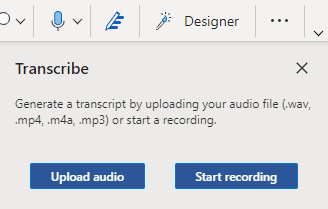
Except that I didn’t refer to the recording, but to a TRANSCRIPT of the recording in Microsoft Word. I describe how I created the transcript here.
But obtaining the raw interview material is only the beginning.
Now you need to extract relevant text and fit in into the STAR method: Situation, Task, Action, and Result.
No you don’t.
Rather than arrange our case studies into four parts, my client and I agreed on a three-part outline that effectively combined “S” and “T.” Our outline? Problem, Solution, and Result. The STAR people were horrified, but we didn’t care. The client was a maverick anyway.
I should note that before the interview took place, the client had already provided me with a general idea of what its end customer faced: the problem, the application of the client’s solution, and the results that solved the problem.
So we already knew what we wanted the case study to say, and the interview let us concentrate on the sexy points and correct any facts we had wrong before the interview. Yes, the client’s software delivered the solution in 8.675309 seconds. No, it didn’t use laser technology to do it.
So when I drafted the case study, I wrote it in the problem, solution, results format. And then I increased its effectiveness by sprinkling customer quotes throughout the case study.
Adapted slightly.
Since the original transcribed text looked like this:
“(SPEAKER 3) So then I um submit the search and the system gave me a candidate list pretty quickly like in 5 seconds or so excuse me I still got this cold sorry and um the boyfriend was second on the list.”
In my draft the raw text was reworded ever so slightly.
“According to Sgt. Preston of the Yukon Detachment, ‘I submitted the face search to SuperInvestigator, and the system gave me a candidate list in 5 seconds. Connie’s boyfriend was second on the list, giving us an investigative lead for further analysis.’”
(Because you ALWAYS have to treat facial recognition results as investigative leads.)
Once my text was combined with the end customer’s quotes and the client’s graphics, we had a collection of powerful case studies that resonated with the client’s prospects. Because bad boyfriends are in many jurisdictions.
What about your prospects?
So that’s how my client and I worked together to create effective case studies.
“From Conversation to Conversion: Leveraging Interview Transcripts for Marketing Magic
“Abstract: The spoken word holds immense value for your marketing content, especially with the rise of transcription tools. This post examines how to transform raw audio from customer interviews into compelling case studies, testimonials, and other marketing assets. We’ll discuss the process of extracting key insights and transforming them into persuasive written content, bridging the gap between customer conversations and tangible marketing results.”
As you can see, I avoided some of the wording (“marketing magic”???) but kept the basic idea.
Thanks Danie. And if I’m stuck for future content I have four additional ideas.
Matthew Prince of Cloudflare recently described an alleged imbalance affecting content creators, and what Cloudflare and others are doing about it. It turns out that today’s AI web crawlers behave differently than yesterday’s search web crawlers.
The revolution
Prince began his article by describing a win-win deal facilitated by a content-gathering company known as Google. Google’s web crawlers would acquire site content, but the content creators would win also.
“The deal that Google made with content creators was simple: let us copy your content for search, and we’ll send you traffic. You, as a content creator, could then derive value from that traffic in one of three ways: running ads against it, selling subscriptions for it, or just getting the pleasure of knowing that someone was consuming your stuff.”
Sounds like a win-win to me.
The new power generation
What Prince didn’t say is that not everyone was thrilled with the arrangement.
Let’s start with Spain, and the relationship between Spanish online publications and Google Noticias (Google News).
Imagen 4.
The publishers thought they were getting the raw end of the deal, since Google would present summaries of the publishers’ content on Google pages, but no one would go to the publishers’ pages. Why bother? Google had shared the important stuff.
“Reacting to a law that requires news sites in Spain to charge for their content, Google shut down its Google News service in the country….The tech company and other news aggregators would face steep fines if they publish headlines and abstracts without paying.”
At the time, I cast this as a battle between the nations and plucky individuals fighting for freedom…ignoring the fact that Google (cited twice below) was more powerful than some nations.
As an aside, it’s worth noting that several nations subsequently banded together to implement GDPR, shifting more power to the governments.
Oh, and the Spanish law was changed to conform with European Union copyright law. As a result, Google Noticias came back online in Spain in 2022, eight years later.
3rdeyegirl (bear with me here)
Back to Cloudflare’s Matthew Prince, who talked about a brand new voracious web crawler that didn’t feel like a win-win. Rather than presenting links to outside content, or summaries of content accompanied by prominent links, AI tools (including Google’s own) would simply present the summaries, burying the links.
“Google itself has changed. While ten years ago they presented a list of links and said that success was getting you off their site as quickly as possible, today they’ve added an answer box and more recently AI Overviews which answer users’ questions without them having to leave Google.com. With the answer box they reported that 75 percent of queries were answered without users leaving Google. With the more recent launch of AI Overviews it’s even higher.”
Imagen 4.
So the new AI-sponsored web crawlers and their implementation effectively serve to keep readers in the walled gardens of OpenAI, Google, Microsoft, and the rest.
Walled gardens again? It’s just human nature. Having to click on a link to go somewhere else causes friction. This very post links to Cloudflare’s article, my old Empoprise-BI blog, and a multitude of other sources. And I bet you won’t click on ANY of those links to view the other content. I know. WordPress tells me.
As Prince himself puts it:
“…increasingly we aren’t consuming originals, we’re consuming derivatives.”
So what’s Cloudflare doing about the AI web crawlers that are sucking information away with little or no return to the content creators?
Blocking them by default.
“That changes today, July 1, what we’re calling Content Independence Day. Cloudflare, along with a majority of the world’s leading publishers and AI companies, is changing the default to block AI crawlers unless they pay creators for their content. That content is the fuel that powers AI engines, and so it’s only fair that content creators are compensated directly for it.”
Cloudflare envisions a marketplace in which AI companies will pay creators for high quality content.
However, today’s content creators may face the same challenges that Spanish periodicals faced from 2014 to 2022. They may prevent their content from being ripped off…but no one will ever know because the people who go to ChatGPT will never learn about them.
Because in the end, most people are happy with derived content.
But your hungry people want to hear from you.
If you are a tech marketer who needs help creating content, talk to Bredemarket.
I recently referred to a nearly 20 year old memo (remember memos?) from Ray Ozzie, then-Chief Technical Officer at Microsoft.
Perhaps you remember this quote:
“Complexity kills. It sucks the life out of developers, it makes products difficult to plan, build and test, it introduces security challenges, and it causes end-user and administrator frustration. Moving forward, within all parts of the organization, each of us should ask “What’s different?”, and explore and embrace techniques to reduce complexity.”
Jobseekers need to know their potential employer when something about a job opportunity doesn’t feel right. And there are ways to do that.
Trusting the person who says to trust your gut
I’ve previously talked about how common sense can minimize the chances of being fooled by a deepfake.
But common sense can help prevent other types of fraud such as employment fraud, as noted by Rachel Lund, chief risk officer with Sandia Area Federal Credit Union.
“Trust your gut- if it feels off, it probably is.”
But can we trust Lund?
Using search engines for employment fraud scam research
Let’s look at another tip of hers:
“Research the company: Google “[Company Name] + Scam” and see if anything comes up.”
Although you can use Bing. Google isn’t the only search engine out there.
So I entered “Sandia Area Federal Credit Union Scam” into Bing…and found out about its warnings about scams.
From Microsoft.
As far as Bing is concerned, Scandia Area Federal Credit Union is not a scammer itself.
But Bing (and Google) are old fashioned dinosaurs.
Using generative AI for employment fraud scam research
So I clicked on the tab for Copilot results. (ChatGPT isn’t the only generative AI tool out there.)
From Microsoft.
Well, it’s good to know that a regulated credit union isn’t a scammer.
So credit unions are fine
But what about something with a slightly sleazier reputation…like stuffing envelopes?
From Microsoft.
OK, Copilot isn’t hot on envelope stuffing opportunities.
I have worked with several companies’ content calendars over the years.
Two of Bredemarket’s clients are using Jira to manage their content calendars.
Another of Bredemarket’s clients doesn’t (as far as I know) have an official content calendar, but is tracking some content in a go-to-market Excel workbook.
If I remember correctly, MorphoTrak also used Excel for content management. MorphoTrak’s parent Morpho used a social media management platform, but I can’t remember which one.
At the time I was at Incode, the company used Asana to host its content calendar. (I have no idea how Incode has managed its content since May 2023.)
Bredemarket creates its own content (this is an example), and I also use Asana as my official content management platform.
Sharp-eyed people spotted how I worded that last sentence.
What did I just say?
If you read it again, you’ll see that I only discussed my OFFICIAL content management platform.
Some content, including this blog post/LinkedIn post/wherever else the text ends up, never gets logged in Asana. I just started writing it in iOS Notes and I will add various checkboxes up top as I share it on the blog and social channels.
Some other content, also not logged in Bredemarket’s Asana, is repeatable content that I store in Notes and repost periodically.
Something I post to my identity-related social channels (BIFS = Bredemarket Identity Firm Services).
And sometimes—a lot of the time, actually—I just go to a platform and WRITE stuff.
As a sole proprietor, I enjoy absolute control over Bredemarket’s messaging, and therefore the blog and social media approval process is very…streamlined. That isn’t the case elsewhere, where even a simple tweet requires approval. This makes it hard to live-tweet an event when the approver is unavailable…but there are workarounds. Perhaps I will reveal them one day.
What about process?
But if your corporate environment requires you to impose a strict content management structure, where all content is logged in the content calendar and all content requires approval, make sure that your content logging and approval process protects your company but DOESN’T silence it.
Because if your content approvals are too onerous, you will end up with no content at all.
Or you will end up with…perhaps I will reveal that one day.
















 Bredemarket