Contactless fingerprint scanning (almost) software at #connectID

Let me kick off this post by quoting from another post that I wrote:

I’ve always been of the opinion that technology is moving away from specialized hardware to COTS hardware. For example, the fingerprint processing and matching that used to require high-end UNIX computers with custom processor boards in the 1990s can now be accomplished on consumer-grade smartphones.

Further evidence of this was promoted in advance of #connectID by Integrated Biometrics.

And yes, for those following Integrated Biometrics’ naming conventions, there IS a 1970s movie called “Slap Shot,” but I don’t think it has anything to do with crime solving. Unless you count hockey “enforcers” as law enforcement. And the product apparently wasn’t named by Integrated Biometrics anyway.

But back to the product:

SlapShot supports the collection of Fingerprint and facial images suitable for use with state of the art matching algorithms. Fingerprints can now be captured by advanced software that enables the camera in your existing smart phones to generate images with a quality capable of precise identification. Facial recognition and metadata supplement the identification process for any potential suspect or person of interest.

This groundbreaking approach turns almost any smart phone into a biometric capture device, and with minimal integration, your entire force can leverage their existing smart phones to capture fingerprints for identification and verification, receiving matching results in seconds from a centralized repository.

Great, you say! But there’s one more thing. Two more things, actually:

SlapShot functions on Android devices that support Lollipop or later operating systems and relies on the device’s rear high-resolution camera. Images captured from the camera are automatically processed on the device in the background and converted into EBTS files. Once the fingerprint image is taken, the fingerprint matcher in the cloud returns results instantly.

The SlapShot SDK allows developers to capture contactless fingerprints and other biometrics within their own apps via calls to the SlapShot APIs.

Note that SlapShot is NOT intended for end users, but for developers to incorporate into existing applications. Also note that it is (currently) ONLY supported on Android, not iOS.

But this does illustrate the continuing move away from dedicated devices, including Integrated Biometrics’ own line of dedicated devices, to multi-use devices that can also perform forensic capture and perform or receive forensic matching results.

And no, Integrated Biometrics is not cannibalizing its own market. I say this for two reasons.

  1. First, there are still going to be customers who will want dedicated devices, for a variety of reasons.
  2. Second, if Integrated Biometrics doesn’t compete in the smartphone contactless fingerprint capture market, it will lose sales to the companies that DO compete in this market.

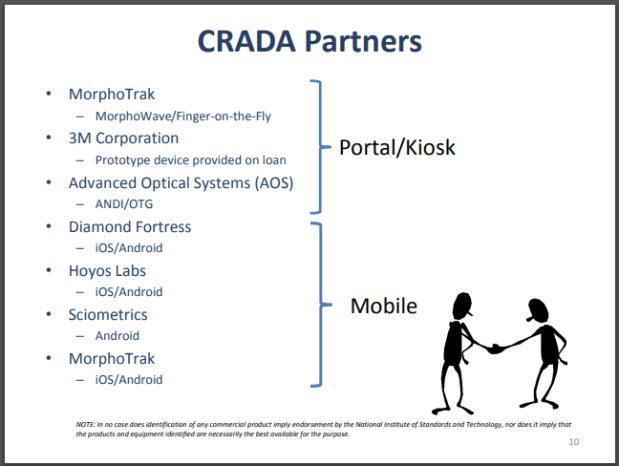
Contactless fingerprint capture has been pursued by multiple companies for years, ever since the NIST CRADA was issued a few years ago. (Integrated Biometrics’ partner Sciometrics was one of those early CRADA participants, along with others.) Actually this effort launched before that, as there were efforts in 2004 and following years to capture a complete set of fingerprints within 15 seconds; those efforts led, among other things, to the smartphone software we are seeing today. Not only from Integrated Biometrics/Sciometrics, but also from other CRADA participants. (Don’t forget this one.)

Of the CRADA partners, MorphoTrak is now IDEMIA, Diamond Fortress is now Telos ID, Hoyos Labs is now Veridium, AOS is no longer in operation, and 3M’s biometric holdings are now part of Thales. Slide 10 from the NIST presentation posted at https://www.nist.gov/system/files/documents/2016/12/14/iai_2016-nist_contactless_fingerprints-distro-20160811.pdf

Of course these smartphone capture software packages aren’t Electronic Biometric Transmission Specification (EBTS) Appendix F certified, but that’s another story entirely.

Monitoring the #connectid hashtag

I have a long history with hashtags.

A LONG history.

Fires and parades

How long?

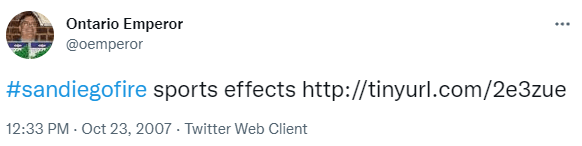
Back on October 23, 2007, I used my then-active Twitter account to tweet about the #sandiegofire. The San Diego fire was arguably the first mass adoption of hashtags, building upon pioneering work by Stowe Boyd and Chris Messina and acted upon by Nate Ritter and others.

From https://twitter.com/oemperor/status/358071562. Frozen peas? Long story.

The tinyurl link directed followers to my post detailing how the aforementioned San Diego Fire was displacing sports teams, including the San Diego Chargers. (Yes, kids, the Chargers used to play in San Diego.)

So while I was there at the beginning of hashtags, I’m proudest of the post that I wrote a couple of months later, entitled “Hashtagging Challenges When Events Occur at Different Times in Different Locations.” It describes the challenges of talking about the Rose Parade when someone is viewing the beginning of the parade while someone else is viewing the end of the parade at the same time. (This post was cited on PBWorks long ago, referenced deep in a Stowe Boyd post, and cited elsewhere.)

Hashtag use in business

Of course, hashtags have changed a lot since 2007-2008. After some resistance, Twitter formally supported the use of hashtags, and Facebook and other services followed, leading to mass adoption beyond the Factory Joes of the world.

Ignoring personal applications for the moment, hashtags have proven helpful for business purposes, especially when a particular event is taking place. No, not a fire in a major American city, but a conference of some sort. Conferences of all types have rushed to adopt hashtags so that conference attendees will promote their conference attendance. The general rule is that the more techie the conference, the more likely the attendees will use the conference-promoted hashtag.

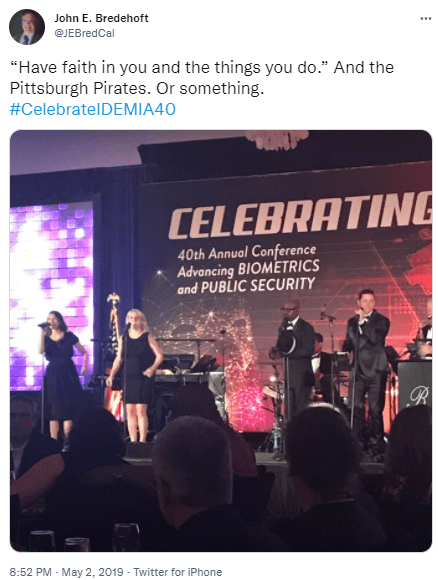
I held various social media responsibilities during my years at MorphoTrak and IDEMIA, some of which were directly connected to the company’s annual user conference, and some of which were connected to the company’s attendance at other events. Obviously we pulled out the stops for our own conferences, including adopting hashtags that coincided with the conference theme.

A tweet https://twitter.com/JEBredCal/status/1124159756157849600 from the last (obviously celebratory) night of IDEMIA’s (Printrak’s) 40th conference in 2019. Coincidentally, this conference was held in San Diego.

And then when the conference organizers adopt a hashtag, they fervently hope that people will actually USE the adopted hashtag. As I said before, this isn’t an issue for the technical conferences, but it can be an issue at the semi-technical conferences. (“Hey, everybody! Gather around the screen! Someone used the conference hashtag…oh wait a minute, that’s my burner account.”)

A pleasant surprise with exhibitor/speaker adoption of the #connectID hashtag

Well, I think that we’ve finally crossed a threshold in the biometric world, and hashtags are becoming more and more acceptable.

As I previously mentioned, I’m not attending next week’s connect:ID conference in Washington DC, but I’m obviously interested in the proceedings.

So I turned to Twitter to check if anyone was using a #connectID hashtag in advance of the event. (Helpful hint: hashtags cannot include special characters such as “:” so don’t try to tweet #connect:ID; it won’t work and will appear as #connect.) Using the date-sorted search https://twitter.com/search?q=%23connectid&src=typed_query&f=live, I was expecting to see a couple of companies using the hashtag…if I was lucky.

I was pleasantly surprised to see that nearly two dozen exhibitors and speakers were using the #connectID hashtag (or referenced via the hashtag) as of the Friday before the event, including Acuity Market Intelligence, Aware, BIO-key, Blink Identity, Clearview AI, HID Global, IDEMIA, Integrated Biometrics, iProov, Iris ID, Kantara, NEC and NEC NSS, Pangiam, Paravision, The Paypers, WCC, WorldReach Software/Entrust, and probably some others by the time you read this, as well as some others that I may have missed.

And the event hasn’t even started yet.

At least some of the companies will have the presence of mind to tweet DURING the event on Tuesday and Wednesday.

Will yours be one of them?

But company adoption is only half the battle

While encouraging to me, adoption of a hashtag by a conference’s organizers, exhibitors, and speakers is only the beginning.

The true test will take place when (if) the ATTENDEES at the conference also choose to adopt the conference hashtag.

According to Terrapin (handling the logistics of conference organization), more than 2,500 people are registered for the conference. While the majority of these people are attending the free exhibition, over 750 of them are designated as “conference delegates” who will attend the speaking sessions.

How many of these people will tweet or post about #connectID?

We’ll all find out on Tuesday.

connect:ID 2021 is coming

I have not been to an identity trade show in years, and sadly I won’t be in Washington DC next week for connect:ID…although I’ll be thinking about it.

I’ve only been to connect:ID once, in 2015. Back in those days I was a strategic marketer with MorphoTrak, and we were demonstrating the MorphoWay. No, not the Morpho Way; the MorphoWay.

At connect:ID 2015.

Perhaps you’ve seen the video.

Video by Biometric Update. https://www.youtube.com/watch?v=mqfHAc227As

As an aside, you’ll notice how big MorphoWay is…which renders it impractical for use in U.S. airports, since space is valuable and therefore security features need a minimum footprint. MorphoWay has a maximum footprint…just ask the tradespeople who were responsible for getting it on and off the trade show floor.

I still remember several other things from this conference. For example, in those days one of Safran’s biometric competitors was 3M. Of course both Safran and 3M have exited the biometric industry, but at the time they were competing against each other. Companies always make a point of checking out the other companies at these conferences, but when I went to 3M’s booth, the one person I knew best (Teresa Wu) was not at the booth. Later that year, Teresa would leave 3M and (re)join Safran, where she remains to this day.

Yes, there is a lot of movement of people between firms. Looking over the companies in the connect:ID 2021 Exhibitor Directory, I know people at a number of these firms. Obviously people from IDEMIA, of course (IDEMIA was the company that bought Safran’s identity business), but I also know people at other companies, all of whom who were former coworkers at IDEMIA or one of its predecessor companies:

  • Aware.
  • Clearview AI.
  • GET Group North America.
  • HID Global.
  • Integrated Biometrics.
  • iProov.
  • NEC.
  • Paravision.
  • Rank One Computing.
  • SAFR/RealNetworks.
  • Thales.
  • Probably some others that I missed.

And I know people at some of the other companies, organizations, and governmental entities that are at connect:ID this year.

Some of these entities didn’t even exist when I was at connect:ID six years ago, and some of these entities (such as Thales) have entered the identity market due to acquisitions (in Thales’ case, the acquisition of Gemalto, which had acquired 3M’s biometric business).

So while I’m not crossing the country next week, I’m obviously thinking of everything that will be going on there.

Incidentally, this is one of the last events of the trade show season, which is starting to wind down for the year. But it will ramp up again next spring (for you Northern Hemisphere folks).

Bredemarket remembers the Southern Hemisphere, even though Bredemarket only does business in the United States. https://www.youtube.com/watch?v=HtZCQiN3n50

Regardless of where you are, hopefully the upcoming trade show season will not be adversely impacted by the pandemic.

When people confuse the two companies Integrated Biometric Technology and Integrated Biometrics

This is the “oops” of the month (actually for the month of July).

By U.S. Government – ATSDR (part of the CDC) series of state-specific fact sheets. Bitmap versions have been seen on US Embassy websites. Direct PDF URL [1], Public Domain, https://commons.wikimedia.org/w/index.php?curid=14801198

On Monday, July 26 the Tennessee Department of Economic and Community Development made an important announcement:

Tennessee Gov. Bill Lee, Department of Economic and Community Development Commissioner Bob Rolfe and Integrated Biometric Technology, LLC (IBT) officials announced today that the company will establish new operations and locate its corporate headquarters in Franklin.

For those who aren’t familiar with the Nashville area, Franklin is a suburb of Nashville. Coincidentally, IDEMIA (IBT President & CEO Charles Carroll’s former employer) used to have an office in Franklin (I visited it in June 2019), but it has since moved to another Nashville suburb.

This job-related news obviously pleased a number of other Tennessee government officials, including one whom (in this post at least) will remain nameless. The government official tweeted the following, along with a link to the announcement:

Congratulations to @IntegratedBiome on their decision to locate their facility in Franklin and to all our state and local officials who helped bring these jobs home!

A nice sentiment to be sure…except for one teeny problem.

The government official didn’t tag Integrated Biometric Technology (who appears to have a Twitter account, but it isn’t live yet), but instead tagged a SOUTH CAROLINA company with a similar name, Integrated Biometrics. (I’ve discussed this company before. They’re the ones who really like 1970s TV crime fighters.)

Book ’em, Danno! By CBS Television – eBay item photo front photo back, Public Domain, https://commons.wikimedia.org/w/index.php?curid=19674714

Integrated Biometrics’ social media person set the record straight.

Hi there! That article is actually about Integrated Biometric Technology – not us (Integrated Biometrics)

It turns out that the two companies with similar names have existed in one form or another for nearly two decades. The first iteration of Integrated Biometric Technology was established in 2005, while Integrated Biometrics dates back to 2002. I was in Motorola at the time and can’t remember any name confusion in those days, since I was busy concentrating on other things…such as AFIX Tracker.

Cue the “It’s a Small World” music. Trust me, the biometrics world can be very small at times…

What is an “antimicrobial” contact fingerprint reader? And what is it NOT?

(Part of the biometric product marketing expert series)

In the COVID and (soon) post-COVID area, people don’t want to touch things. That impacts how identity products are marketed, including biometric readers.

Why contactless biometrics are “better” than contact biometrics

In the biometric world, this reluctance to touch things has served to promote CONTACTLESS biometric technologies, such as facial recognition, other other technologies. The loser in this has been fingerprint-based technologies, as several facial and iris vendors have made the claim that face/iris biometrics are contactless, while fingerprint biometrics are NOT contactless.

Well, my friends at my former employer IDEMIA might take issue with that claim, since you literally do NOT touch the fingerprint reader in IDEMIA’s MorphoWave product. IDEMIA does not (to my knowledge) make any medical claims about MorphoWave, but the company does emphasize that its contactless fingerprint reader allows for fast capture of four-finger slaps.

To protect their premises, organizations need access control solutions that are efficient, fast, and convenient. A contactless fingerprint scanner provides an optimum answer high throughput workplaces. IDEMIA’s MorphoWave contactless fingerprint solution scans and verifies 4 fingerprints in less than 1 second, through a fully touchless hand wave gesture. Thanks to the simplicity of this gesture, the throughput can reach up to 50 people per minute.

An antimicrobial contact fingerprint reader?

But what if there were a CONTACT solution that allowed you to capture prints with a reduced fear of “bad things”?

That’s what Integrated Biometrics appears to be claiming.

Integrated Biometrics (IB), the world leader in mobile, FBI-certified biometric fingerprint scanners, and NBD Nanotechnologies (NBD Nano), the surface coating experts, today announced the inclusion of NBD’s RepelFlex MBED transparent coating on IB’s entire line of fingerprint scanners.

An ultra-thin, transparent coating, RepelFlex MBED is designed to provide outstanding antimicrobial, anti-scratch, and anti-stain protection to devices. Long-lasting and multi-functional, RepelFlex MBED is ideal for surfaces that must stand up to high throughput and harsh conditions without compromising accuracy.

So what exactly does “antimicrobial” mean?

cluster of Escherichia coli bacteria magnified 10,000 times. By Photo by Eric Erbe, digital colorization by Christopher Pooley, both of USDA, ARS, EMU. – This image was released by the Agricultural Research Service, the research agency of the United States Department of Agriculture, with the ID K11077-1 (next)., Public Domain, https://commons.wikimedia.org/w/index.php?curid=958857

Let’s see how NBD Nano describes it.

Preventing the presence and growth of microbials on surfaces is becoming increasingly important. Antimicrobial performance is especially critical on surfaces that are accessible to the public in order to prevent the spread of stain and odor causing bacteria and microbes.

And if you drill further down in NBD Nano’s website, you find this information in a technical data sheet (PDF).

Antimicrobial Performance: Japanese Industrial Standard (JIS) Z 2801 – PASS*
*as tested by Microchem Laboratory, Round Rock, TX

Now since I’m not up to date on my Japanese Industrial Standards, I had to rely on the good folks at the aforementioned Microchem Laboratory to explain what the standard actually means.

The JIS Z 2801 method tests the ability of plastics, metals, ceramics and other antimicrobial surfaces to inhibit the growth of microorganisms or kill them. The procedure is very sensitive to antimicrobial activity and has a number of real world applications anywhere from the hospital/clinical environment to a household consumer company concerned with the ability of a material they have to allow bacterial growth.

The JIS Z 2801 method is the most commonly chosen test and has become the industry standard for antimicrobial hard surface performance in the United States.

It may be antimicrobial, but what about preventing the “C” word?

Now you may have noticed that Microchem Laboratory, NBD Nano, and Integrated Biometrics did not make any medical claims regarding their products. None of them, for example, used the “C” word in any of their materials.

There’s a very, very good reason for that.

If any of these product providers were to make specific MEDICAL claims, then any sales in the United States would come under the purview of the U.S. Food and Drug Administration.

This is something that temperature scanner manufacturers learned the hard way.

Digression: if fever scanners are fever scanners, does that mean they are fever scanners?

Remember “fever scanners”? Those devices that were (and in some cases still are) pointed at your forehead as you enter a building or another secure area? I won’t get into the issues with these devices (what happens when the scanner is placed next to a building’s front entrance on a hot day?), but I will look at some of the claims about those scanners.

About a year ago, John Honovich of IPVM began asking some uncomfortable questions about the marketing of those devices, especially after the FDA clarified what thermal imaging systems could and could not do.

When used correctly, thermal imaging systems generally have been shown to accurately measure someone’s surface skin temperature without being physically close to the person being evaluated….

Thermal imaging systems have not been shown to be accurate when used to take the temperature of multiple people at the same time. The accuracy of these systems depends on careful set-up and operation, as well as proper preparation of the person being evaluated….

Room temperature should be 68-76 °F (20-24 °C) and relative humidity 10-50 percent….

The person handling the system should make sure the person being evaluated…(h)as waited at least 15 minutes in the measurement room or 30 minutes after exercising, strenuous physical activity, bathing, or using hot or cold compresses on the face.

Let’s stop right there. For any of you who have undergone a temperature scan in the last year: how many of you have waited in a measurement room for at least 15 minutes BEFORE your temperature was taken?

Last summer I had a dentist appointment. My dentist is in Ontario, California, where the summers can get kind of hot. The protocol at this dentist’s office was to have you call the office from your car when you arrived in the parking lot, then wait for someone from the office to come outside and take your temperature before you could enter the building.

I was no dummy. I left my car and its air conditioner running while waiting for my temperature to be taken. Otherwise, who knows what my temperature reading would have been? (I also chose NOT to walk to the dentist’s office that day for the same reason.)

Back to John Honovich. He had read the FDA advice on the medical nature of thermal imaging systems, and then noted that some of the manufacturers of said systems were sort of getting around this by stating that their devices were not medical devices.

Even though the manufacturers still referred to them as “fever cameras.”

For example, one vendor (who has since changed its advertising) declared at the time that “thermal temperature-monitoring technology assists in reducing the spread of viral diseases,” even though that vendor’s device “is not a medical device and is not designed or intended for diagnosis, prevention, or treatment of any disease or condition.”

Fever scanners, testosterone supplements…and fingerprint readers

Yes, that language is similar to the language used by providers of natural supplements that, according to anecdotal evidence, work wonders. The FDA really polices this stuff.

So you really don’t want to make medical claims about ANY product unless you can back them up with the FDA. You can say that a particular product passed a particular antimicrobial standard…but you’d better not say anything else.

In fact, Integrated Biometrics only mentions the “antimicrobial” claim in passing, but spends some time discussing other benefits of the NBD Nano technology:

The inclusion of RepelFlex MBED coatings enable IB’s scanners to deliver an even higher level of performance. Surfaces are tougher and more difficult to scratch or stain, increasing their longevity while maintaining print quality even when regular cleaning is not possible due to conditions or times of heavy use.

So the treated Integrated Biometrics products are tough…like those famous 1970s crime fighters Kojak, Columbo, and Danno and the other people from Five-O. (Not that Sherlock and Watson were slouches.)

Book ’em, Danno! By CBS Television – eBay item photo front photo back, Public Domain, https://commons.wikimedia.org/w/index.php?curid=19674714